How to Write a Cover Letter (UK Examples for 5 Common Roles)
A good cover letter does one job: it makes the person reading your CV want to read it properly. It is short, specific and written for one employer. This guide shows you how to write a UK cover letter step by step, gives you a template you can reuse, and walks through five example letters for common roles. Use the examples as a guide to structure and tone, not as text to copy.
Do you really need a cover letter?
If the job advert asks for one, yes. If it says optional, a short, tailored letter is still worth sending, because many applicants skip it and it is your only chance to explain things your CV cannot, such as why you are changing sector or why you want this particular employer.
If the application form has a “supporting statement” box instead, treat it as a cover letter. Public sector and NHS applications often work this way, with the statement matched to a person specification. Our UK CV writing guide covers the CV that goes alongside it.
What a UK cover letter should look like
- Length: one page, usually 250 to 400 words across three or four short paragraphs.
- Format: a clean, simple layout in a standard font such as Arial or Calibri at size 10 to 12, saved as a PDF unless the employer asks for Word.
- Spelling: British English (organisation, enthusiastic, programme).
- No photo or personal details such as your age, marital status or date of birth. Your name, phone number, email address and town or city are enough.
- Tone: polite, confident and plain. Avoid slang and avoid sounding like a template.
How to address it
Use the name of the hiring manager if the advert gives one, and address them as “Dear Ms Patel” or “Dear Mr Jones”. If you cannot find a name after a quick look at the advert and the company website, “Dear Hiring Manager” is acceptable.
The sign-off follows a traditional rule. If you used a name, end with “Yours sincerely”. If you used “Dear Hiring Manager” or another general greeting, end with “Yours faithfully”. In an email, “Kind regards” is also fine.
The structure that works
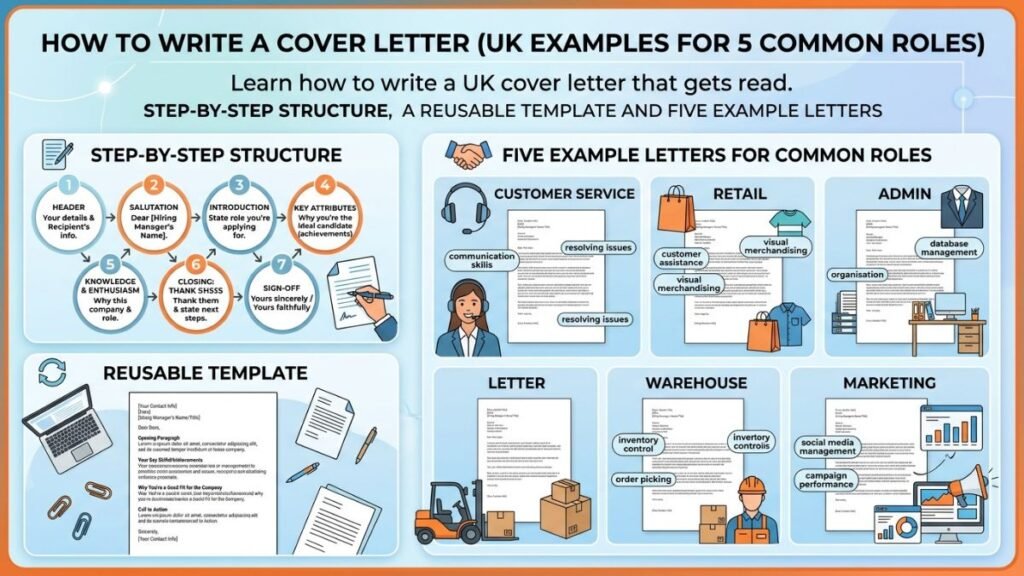
- Opening paragraph. Name the job, say where you saw it, and give one sentence on why you are a strong fit.
- Evidence paragraph. Pick two or three requirements from the job advert and show how you have met them, with a specific example and, where you can, a result.
- Why this employer. Show you understand the organisation. Mention something real, such as its customers, values, growth or a project, rather than praise that could apply anywhere.
- Closing paragraph. Say you would welcome an interview, mention any practical details such as availability, and thank them for their time.
A reusable template
[Your name] [Town or city] · [Phone number] · [Email address]
[Date]
Dear [Name],
Application for [job title] (ref: [reference, if given])
I am applying for the [job title] role at [company], which I saw advertised on [where]. [One sentence on your strongest relevant strength or experience.]
[Paragraph with two or three examples that match the requirements in the advert, ideally with a result or number.]
[Paragraph on why you want this employer and what you can contribute.]
I would welcome the chance to discuss my application. [Availability or notice period, if useful.] Thank you for your time and consideration.
Yours sincerely, [Your name]
Five UK cover letter examples
The examples below use placeholders in square brackets. Replace them with your own details and real examples. Keep your own wording, because recruiters can spot a copied letter quickly.
Example 1: Customer service advisor
This letter works for contact centre, helpdesk and customer-facing roles. The strongest evidence is a specific example of solving a problem calmly. Our guide to customer service careers explains the skills employers screen for.
Dear Ms Patel,
Application for Customer Service Advisor (ref: CS-214)
I am writing to apply for the Customer Service Advisor role at [Company], advertised on [website]. I have two years of experience resolving customer queries in a busy [setting], and I enjoy turning a frustrated caller into a satisfied one.
In my current role at [Employer], I handle around [number] calls and emails a day and consistently meet our target for first-contact resolution. Last month a customer contacted us about a delayed order for the third time. I listened, checked the delivery record, arranged a replacement the same day and followed up by email to confirm it had arrived. The customer later left positive feedback for the team. I am comfortable with [system or software] and with working to targets without losing sight of the person on the other end.
I would like to join [Company] because of its reputation for [specific, real detail, such as service quality or recent growth]. I want to work somewhere that treats good service as a priority and I would bring a patient, practical approach to your team.
I would welcome the chance to talk further. I am available for interview at short notice. Thank you for your time and consideration.
Yours sincerely, [Your name]
Example 2: Retail sales assistant
Retail employers value reliability, teamwork and a friendly manner. If you have little experience, use school, volunteering or part-time work. Our guide to retail career progression shows where the role can lead.
Dear Hiring Manager,
Application for Sales Assistant, [Store location]
I would like to apply for the Sales Assistant position at your [location] store. I am a reliable, friendly team member who enjoys helping customers find what they need, and I am available for the weekend and evening shifts you mention in the advert.
I have worked part-time at [Employer] for [length of time], where I serve customers, operate the till, replenish stock and keep the shop floor tidy. During our busy Christmas period I volunteered to cover extra shifts, and I was asked to train two new colleagues on the till system. I am used to staying calm in a queue and I take pride in accurate cash handling.
I shop at [Company] regularly and I admire how helpful your staff are, so I would be proud to be part of the team. I am keen to learn about the range and to develop in the role.
Thank you for considering my application. I would be glad to attend an interview at any time that suits you.
Yours faithfully, [Your name]
Example 3: Administrator or office assistant
Admin letters should show organisation and accuracy, with concrete examples of tools and processes. Our guide to admin and office support careers explains how the work can progress.
Dear Mr Jones,
Application for Administrator (ref: ADM-087)
I am applying for the Administrator role at [Company]. With three years of experience supporting a small team, I bring strong organisation, accurate data entry and a calm approach to a busy inbox.
At [Employer] I manage diaries for four colleagues, book travel, prepare meeting papers and maintain our records system. I introduced a simple shared filing structure that cut the time spent searching for documents, and I now train new starters on it. I am confident with Microsoft Outlook, Excel and Word, and I check my work carefully because I know small errors can cause bigger problems later.
[Company] stands out to me because of [specific detail, such as its clients, services or recent project]. I would like to bring my organisational skills to a team where reliable administration keeps everything else running smoothly.
I would be pleased to discuss my application and can start with [notice period]. Thank you for your time.
Yours sincerely, [Your name]
Example 4: Warehouse operative
Warehouse employers look for safety awareness, reliability, stamina and willingness to work shifts. Practical detail matters more than long paragraphs. Our guide to logistics and warehouse jobs covers pay structures and progression.
Dear Hiring Manager,
Application for Warehouse Operative, [Site location]
I am writing to apply for the Warehouse Operative position at your [site] distribution centre. I am a reliable, safety-conscious worker with experience in picking and packing, and I am comfortable with early starts and rotating shifts.
In my current role at [Employer], I pick and pack around [number] orders per shift and have kept my accuracy rate above [figure]. I hold a [forklift or MHE licence, if you have one] and I follow safe lifting and manual handling procedures every day. I have not missed a shift in the past year, and my supervisor has asked me to help with training new starters.
I am interested in [Company] because of its growth and the opportunity to develop in a larger operation. I want to build a long-term career in logistics and I am keen to work towards a team leader role.
I am available to start at short notice and would welcome an interview. Thank you for considering my application.
Yours faithfully, [Your name]
Example 5: Entry-level marketing assistant
If you do not have paid experience, build your case from projects, university work, volunteering or your own social media or blog. Our guide to starting a marketing career with no experience has more on building a portfolio.
Dear Ms Taylor,
Application for Marketing Assistant (ref: MKT-102)
I am applying for the Marketing Assistant role at [Company]. I recently completed [degree, course or apprenticeship] and have spent the last year building practical experience in social media and content, and I am keen to start my career in a team like yours.
While studying, I managed the Instagram account for [society or volunteering organisation], growing its following by [figure] over six months by planning a weekly content calendar and testing different post formats. I also completed [certification, such as Google Analytics or HubSpot], and I wrote [number] articles for [blog or publication]. These projects taught me how to plan content, work to deadlines and use data to decide what to do next.
I admire [Company]’s recent campaign for [specific real example], and I would love to contribute to work like that. I am a quick learner, comfortable with [tools such as Canva, Mailchimp or Excel] and eager for feedback.
Thank you for your time. I would welcome the chance to discuss how I could support your marketing team.
Yours sincerely, [Your name]
How to tailor any cover letter in 15 minutes
- Highlight the key requirements in the job advert, usually the first four or five bullet points.
- Match one example to each from your own experience, using a short story and a result.
- Research the employer. Read the About page and recent news so you can say something specific.
- Mirror the language of the advert where it is honest, because automated screening tools and recruiters both look for relevant keywords.
- Cut anything that does not help. If a sentence works for any job, delete it or make it specific.
Common cover letter mistakes
- Repeating your CV line by line instead of adding context.
- Starting with “I am writing to apply for a job” and nothing more.
- Using the wrong company name or job title from a previous application.
- Making it longer than one page.
- Listing qualities such as “hard-working” without any proof.
- Sending it without checking spelling and grammar. Read it aloud before you send it.
- Leaving gaps unexplained. If you have a career break or sector change, address it briefly and positively. Our guide to returning to work after a career break can help.
Sending it: email, attachment or upload
If you apply by email, you can put a shorter version of your letter in the body and attach your CV, or attach both as PDFs and use the email as a brief introduction. Name your files clearly, for example “Jane-Smith-CV.pdf” and “Jane-Smith-Cover-Letter.pdf”. If you apply through an online portal, follow its instructions and upload the letter where it asks.
If you are writing to a company that has not advertised a vacancy, the same principles apply, but make the first paragraph explain why you are getting in touch. Our guide to cold emailing employers covers when speculative applications work.
Next steps
Once your letter and CV are ready, you can browse current UK jobs and tailor each application. Keep track of where you have applied with a simple job application tracker, and start preparing for the common UK interview questions so you are ready if you are invited in.
Frequently asked questions
How long should a UK cover letter be?
One page, usually 250 to 400 words in three or four short paragraphs.
Should I write “Yours sincerely” or “Yours faithfully”?
Use “Yours sincerely” when you have addressed the letter to a named person and “Yours faithfully” when you used a general greeting such as “Dear Hiring Manager”. In an email, “Kind regards” is also acceptable.
Should I include my address on a cover letter?
You do not need a full address. Your name, phone number, email and town or city are enough, and many employers now prefer less personal information.
Do I need a different cover letter for every job?
Yes. You can keep a base template, but you should change the job title, the employer details and your examples each time, so the letter matches the advert.
What if I have no experience?
Use transferable experience such as education, volunteering, part-time work, projects and caring responsibilities. Focus on skills such as reliability, communication and learning quickly, and give one real example of each.
Should I explain a career gap in my cover letter?
If it is relevant, a short, positive line is enough. State what you did or learned and move on to why you are ready for the role.
Is a cover letter still needed if I apply through LinkedIn or an online form?
It depends on the employer. If there is a place to add a letter or statement, a short, tailored one can help you stand out. If not, put your key points in your CV and any message you send.
Can I use AI to write my cover letter?
You can use tools to draft or edit, but every detail must be true and written in your own voice. Employers can spot generic letters, so add your own examples and check every line.