How to Bring an Employment Tribunal Claim: ET1, Acas and the Process
If your employer has dismissed you unfairly, discriminated against you or failed to pay you what you are owed, an employment tribunal can order it to put things right. But the process has strict deadlines, a compulsory first step through Acas and forms that must be completed correctly. Many people lose their rights simply by missing a deadline. This guide explains, step by step, how to bring an employment tribunal claim in 2026, what happens after you submit it, what the tribunal can award and how to prepare, including the extension of most time limits to six months for events from 1 October 2026.
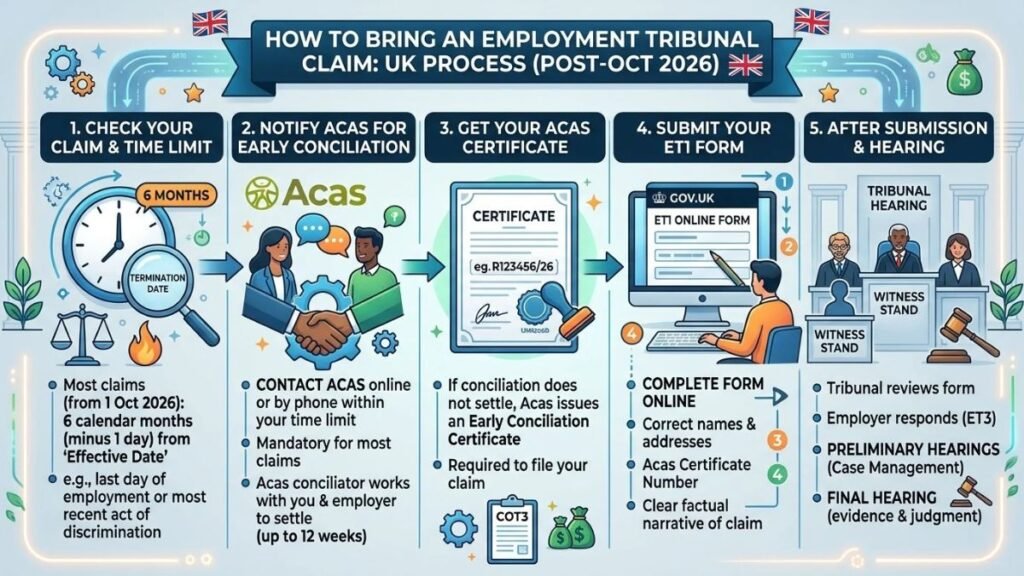
Quick answer: First check your deadline, which for most claims about events on or after 1 October 2026 is six months less one day. You must then notify Acas for early conciliation and get a certificate, before submitting your claim online on form ET1. There is no fee to make a claim. Your employer then has 28 days to respond on form ET3, and the case moves towards a hearing, though many claims settle before that.
This guide covers England, Wales and Scotland. Northern Ireland has its own system, so check the Labour Relations Agency and the Industrial Tribunals. It is general information, not legal advice.
What does an employment tribunal do?
Employment tribunals are independent legal bodies that decide disputes between employers and workers. They deal with claims such as:
- Unfair dismissal. See our guide to unfair dismissal in the UK.
- Discrimination and harassment because of a protected characteristic, including disability, age, sex and race. See our guides to disability and work in the UK and jobs for over 50s and returners.
- Unlawful deductions from wages, unpaid wages, unpaid overtime and holiday pay. See our guides to overtime pay in the UK and holiday entitlement and holiday pay.
- Redundancy pay and notice pay. See our guides to redundancy rights in the UK and notice periods in the UK.
- Whistleblowing, pregnancy, family leave and flexible working complaints. See our guides to maternity, paternity and shared parental leave and pay and flexible working in the UK.
- Breach of contract claims and other statutory rights.
Tribunals are less formal than courts, and you can bring a claim yourself without a lawyer, though advice is valuable.
Before you make a claim
Try to resolve it internally first
If you can, use your employer’s grievance or appeal process. The Acas Code of Practice on disciplinary and grievance procedures applies, and a tribunal can adjust compensation by up to 25% if either side unreasonably fails to follow it. See our guide to disciplinary and grievance procedures in the UK. But an internal process does not stop the clock on your tribunal deadline, so watch the dates.
Get advice early
Talk to Acas, a trade union, Citizens Advice, a law centre or a solicitor. Early advice helps you decide whether you have a claim, which claims to bring and whether a settlement might be better. See our guide to settlement agreements in the UK.
Collect your evidence
Gather and keep:
- Your contract, staff handbook and policies
- Payslips, P45 and P60. See our guide to payslips, tax codes and National Insurance
- Emails, messages, letters and notes of meetings, including warnings and outcome letters
- Performance reviews and references
- A timeline of what happened, with dates, places, names and witnesses
- Evidence of your financial loss, such as lost pay, benefits and job applications
Save documents to your own device or email in a lawful way. Do not take confidential company documents you are not entitled to, and ask your adviser if you are unsure what you can use.
Step 1: Check your time limit
Deadlines are strict, and tribunals rarely accept late claims.
| When the event happened | Time limit for most claims |
|---|---|
| On or after 1 October 2026 | Six months less one day |
| Before 1 October 2026 | Three months less one day |
The change was made under the Employment Rights Act 2025 and a 2026 regulation extending time limits. Key points:
- The date that counts. For unfair dismissal, it is normally the date your employment ended (the effective date of termination). For discrimination, it is the date of the act you complain about, or the end of a continuing series of acts.
- “Less one day.” The deadline is the day before the same date in the later month. For example, if you were dismissed on 15 November 2026, your six months ends on 14 May 2027.
- Some claims have different time limits, for example some claims in Scotland, redundancy payment claims and some pay claims, and some claims have specific starting dates. Check your claim type with Acas or an adviser.
- Early conciliation affects the clock. See below.
Work out your deadline straight away, write it in your diary and start early. Do not wait until the last week.
Step 2: Acas early conciliation
Before you can submit an ET1 for almost any claim, you must contact Acas and go through early conciliation. This is a legal requirement.
How it works
- Notify Acas. Use the online early conciliation form on the Acas website, or call Acas on 0300 123 1100. You will need your details and your employer’s details.
- Acas contacts you. A conciliator talks to you about your case and asks whether you are willing to try to settle with your employer.
- Acas contacts your employer, if you agree, and tries to help both sides reach an agreement. It does not decide who is right.
- Conciliation period. The initial period is normally up to six weeks, and sometimes it can be extended. Sources differ on the maximum length, so ask Acas.
- The outcome. If you reach a settlement, it may be recorded on a COT3 form. If not, or if your employer declines to take part, Acas issues an early conciliation certificate with a reference number.
- Keep the certificate. You need its number to submit your ET1. If your claim is against more than one person or company, you need a certificate number for each of them.
How it stops the clock
Early conciliation pauses the time limit while it is going on, and gives you extra time after the certificate is issued in many cases. The rules on counting the days are complicated, so contact Acas well inside your normal deadline and take advice on how it applies. Do not assume you will get extra time.
Is early conciliation worth taking seriously?
Yes. It is free, it can lead to a settlement quickly, and it is a chance to understand your employer’s position. You do not have to settle if the offer is not right for you. Take advice before agreeing to anything, and be aware that settling through Acas can end your right to bring the claim.
Step 3: Complete the ET1 claim form
The ET1 is the form that starts your tribunal claim. You submit it online through GOV.UK (you can also use a paper form, but online is faster and easier to track).
What you will need
- Your Acas early conciliation certificate number for each respondent
- The exact name and address of your employer (the respondent), as shown on the certificate
- Your job title, start and end dates, pay and hours, and notice period
- The type of claim you are making
- A clear summary of what happened
- What you want the tribunal to award (the remedy)
What happens if the form is wrong?
The tribunal checks every claim. If a form is not accepted, for example because the early conciliation number is missing or the names do not match, it can be rejected, and you may then be out of time. Check the names and numbers carefully.
How to write your claim
- Be clear and factual. Set out events in date order.
- Be specific. Give dates, names, what was said or done and why you say it was unfair or unlawful.
- Tick the right boxes for the types of claim, such as unfair dismissal, disability discrimination or unpaid wages. You can add claims later, but only with the tribunal’s permission, so include everything you reasonably can.
- Say what you want. For example, compensation, reinstatement or a recommendation.
- Keep it concise, but include the essential facts. You will have a chance to give more detail later.
- Do not exaggerate. The tribunal will test your account against the evidence.
There is no fee
There is no fee to make a claim to an employment tribunal. Be careful of any website, email or call that asks you to pay a fee to submit an ET1, because it is probably a scam. Use the official GOV.UK service.
Step 4: What happens after you submit
- The tribunal checks your claim. If it is accepted, you are given a case number.
- Your employer receives the claim and has 28 days to respond on form ET3. It may ask for more time.
- If your employer does not respond, the tribunal can issue a judgment without a hearing, though employers often apply to have it set aside.
- You receive a copy of the ET3. It will say whether the employer defends the claim and what its version of events is.
- Acas may stay in touch during the process, and your employer or you may propose settlement at any time.
Step 5: Case management and preparation
After the ET3, the tribunal sets directions to get the case ready for a hearing. Steps often include:
- A case management preliminary hearing, which can be by phone or video, to clarify the claims and issues, and set a timetable
- A list of issues, setting out the questions the tribunal must decide
- Disclosure of documents, where each side lists and exchanges relevant documents
- A schedule of loss, setting out the money you are claiming
- Witness statements, in which you and your witnesses set out your evidence in writing
- A hearing bundle, which is an agreed set of documents for the hearing
- Possible preliminary hearings on questions such as whether you were an employee, whether you qualify or whether the claim was made in time
Deadlines for these steps are set by the tribunal, so keep an eye on them and keep to them.
Step 6: The final hearing
The final hearing is where the tribunal decides your case. It can be in person or by video. Typically:
- A judge, or sometimes a panel, hears the case. Hearings are usually open to the public.
- Each side gives evidence under oath or affirmation and can be asked questions by the other side.
- Witnesses give evidence in turn.
- Each side makes a closing statement.
- The tribunal may announce its decision on the day, or reserve it and send a written judgment later. Judgments are often published online.
You normally get at least 14 days’ notice of a hearing. How long the process takes depends on the tribunal’s workload and the complexity of the case, so expect it to take months, and sometimes longer.
Tips for the hearing
- Know your documents. Read your bundle and statement carefully.
- Be honest and calm, and answer the question you are asked.
- Stick to the facts, and do not argue with the judge or the other side.
- Dress and behave professionally, even by video.
- Ask for adjustments if you need them, for example because of a disability. The tribunal can make reasonable adjustments.
- Bring support. You can bring a friend or relative for moral support, and your witnesses.
What can a tribunal award?
If you win, the tribunal can award:
| Remedy | What it means |
|---|---|
| Compensation | Money for your financial loss, plus in some cases a basic award, injury to feelings, and interest |
| Reinstatement or re-engagement | Getting your job back, or a similar job, which is rare |
| Recommendations | Suggestions for your employer to reduce the effect of discrimination, in discrimination claims |
| A declaration | A formal finding that your rights were breached |
| Uplift or reduction of up to 25% | For an unreasonable failure to follow the Acas Code |
For unfair dismissal, the basic award is capped at £22,530 (from April 2026), and the compensatory award is capped at the lower of £123,543 or 52 weeks’ pay for dismissals ending before 1 January 2027, with the cap removed after that date. Discrimination awards are not subject to that cap. See our guide to unfair dismissal in the UK for the details.
You must try to limit your loss
If you claim for lost pay, you have to show that you tried to find new work. Keep a record of the jobs you apply for and any income you earn. See our UK jobs board and our guides to writing a UK CV with no experience and common interview questions and answers in the UK.
Getting paid
If your employer does not pay an award, you may need to take enforcement action. There are official routes to enforce tribunal awards, so check GOV.UK. Many employers pay once a judgment is made.
What does it cost?
- Fees. There is no fee to start a claim or to attend a hearing.
- Legal costs. You may need to pay for advice or representation, though many people represent themselves. Some pay through legal expenses insurance, a union or a no-win-no-fee arrangement.
- Costs orders. Each side normally pays its own costs, but a tribunal can order one side to pay the other’s costs in some cases, for example if a party acted unreasonably or pursued a hopeless claim. This is not common, but it is a risk to understand.
- Time and stress. Claims can take a long time and be emotionally demanding.
- Settlement. Many claims settle for a payment, sometimes through Acas, a settlement agreement or judicial mediation. See our guide to settlement agreements in the UK.
Representing yourself or getting help
| Source of help | What they can do |
|---|---|
| Acas | Free, impartial advice and early conciliation. It cannot represent you |
| Trade union | Advice and often representation for members |
| Citizens Advice and law centres | Free advice, and sometimes help with forms and representation |
| Solicitors | Advice and representation, often paid, sometimes under a no-win-no-fee agreement |
| Pro bono schemes and university law clinics | Free help in some areas, subject to capacity |
| Legal expenses insurance | May cover legal costs under home, motor or union policies |
| Equality Advisory and Support Service | Advice on discrimination |
Check that any solicitor or adviser is properly regulated and agree fees in writing.
Does a tribunal claim affect your next job?
Bringing a claim is your legal right, and employers cannot lawfully treat you worse in the process, such as victimising you for making a claim while you still work there. But think about practical issues:
- References. Your previous employer must give accurate references, but disputes can complicate this. Agreeing a reference as part of a settlement can help.
- Talking about it. You do not have to tell new employers about a past claim, but you should answer honestly if asked directly. Prepare a short, factual explanation of why you left.
- Public judgments. Tribunal decisions are often published online, so your name could appear.
Special situations
- Disabled claimants. The tribunal can make adjustments to the process, and you can ask for support. See our guide to disability and work in the UK.
- Pregnant workers and those on family leave. There are special protections and time limits. See our guide to maternity, paternity and shared parental leave and pay.
- Zero-hours, agency and casual workers. Whether you can claim depends on whether you are an employee or a worker. See our guide to zero-hours contracts.
- Multiple claimants or respondents. You may need separate certificates and forms, so take advice.
- Scotland. Employment tribunals in Scotland follow a similar procedure, though some terms differ, such as the national origin of some claims.
- Northern Ireland. Claims go to the Industrial Tribunals, with different rules and agencies.
If you lose, or want to challenge a decision
You can ask the tribunal to reconsider a judgment in limited circumstances, and you can appeal to the Employment Appeal Tribunal on a point of law, normally within 42 days of the written decision. You cannot appeal just because you disagree with the facts, and appeals need careful advice, so speak to Acas, a union or a solicitor quickly. Time limits for appeals are strict.
Checklist: how to bring a claim
- Work out your deadline and put it in your diary.
- Take advice from Acas, a union, Citizens Advice or a solicitor.
- Gather your evidence and write a timeline.
- Use your employer’s internal process if it makes sense, but do not let it delay your deadline.
- Notify Acas for early conciliation, well inside the time limit.
- Consider settlement, but only after advice.
- Get your certificate and keep it safe, with one for each respondent.
- Complete the ET1 online, with accurate names and numbers.
- Keep copies of everything you send and receive.
- Meet each tribunal deadline and prepare your evidence and witnesses.
- Attend the hearing and present your case clearly.
- Keep looking for work and record your efforts.
Scams and risks around tribunal claims
- Fake fees. There is no fee to bring a claim, so beware of emails, texts or websites that demand one.
- Claims firms that cold-call or advertise heavily and charge high fees or take large percentages. Check the Solicitors Regulation Authority register or the Financial Conduct Authority register for claims management firms, and read any agreement carefully.
- Fake tribunal notices. Real notices come from the tribunal service, and you can check by phoning the tribunal office using details from GOV.UK.
- People asking you to pay to “speed up” a case, which is not how tribunals work.
- Fake job offers that target people who have recently lost work. See our guide to how to spot a fake job advert in the UK.
Frequently asked questions
How long do I have to make an employment tribunal claim? For most claims about events on or after 1 October 2026, six months less one day. For earlier events, three months less one day. Acas early conciliation can extend the deadline.
Is Acas early conciliation compulsory? In almost all cases, yes. You need an early conciliation certificate number to submit your ET1.
How much does it cost to bring a tribunal claim? There is no fee to make a claim. You may have legal costs if you hire a lawyer.
What is an ET1? The claim form that starts an employment tribunal claim. You normally complete it online through GOV.UK.
What is an ET3? The response form your employer must file, normally within 28 days of receiving your claim.
Do I need a solicitor? No. Many people represent themselves, but advice can help you decide whether to claim and how to present your case.
How long does a tribunal case take? It varies, but cases often take months, and sometimes longer, depending on the type of claim and the tribunal’s workload. Many settle before a hearing.
What if I miss the deadline? Tribunals only extend time in limited circumstances, and for some claims only if it was not reasonably practicable to claim in time. Do not rely on an extension.
Can I claim if I have not been there for long? Some claims, such as discrimination, need no qualifying service. For ordinary unfair dismissal, you need two years’ service now, and six months for dismissals ending on or after 1 January 2027.
What happens if I win? The tribunal can award compensation and, rarely, reinstatement or recommendations. You may need to take steps to enforce payment.
What if I lose? You will not normally have to pay the other side’s costs, though a costs order is possible in some circumstances. You may be able to appeal on a point of law.
Final thoughts
Bringing a tribunal claim is a serious step, but the process is free to start and designed to be accessible. The key is to watch your deadline, go through Acas first, complete the ET1 accurately and get advice early. When you are ready to look for your next role, browse the latest vacancies on our jobs board.
This article is general information, not legal advice. Tribunal procedure and time limits are changing, and your own deadline depends on your circumstances. Contact Acas, Citizens Advice, a trade union or a qualified employment solicitor, and check GOV.UK for the latest rules and forms.