Workplace Pensions Explained: Auto-Enrolment, Contributions and Opting Out
If you have started a new job in the UK, you have probably been put into a workplace pension without doing anything. That is automatic enrolment, and it is one of the most valuable parts of your pay package, because your employer pays in as well. But many people do not understand how much comes out of their pay, what their employer adds, whether they can opt out or what happens to the money. This guide explains how workplace pensions work in 2026/27, who is enrolled, how contributions are worked out, how tax relief works, when you can opt out and why it is usually worth staying in.
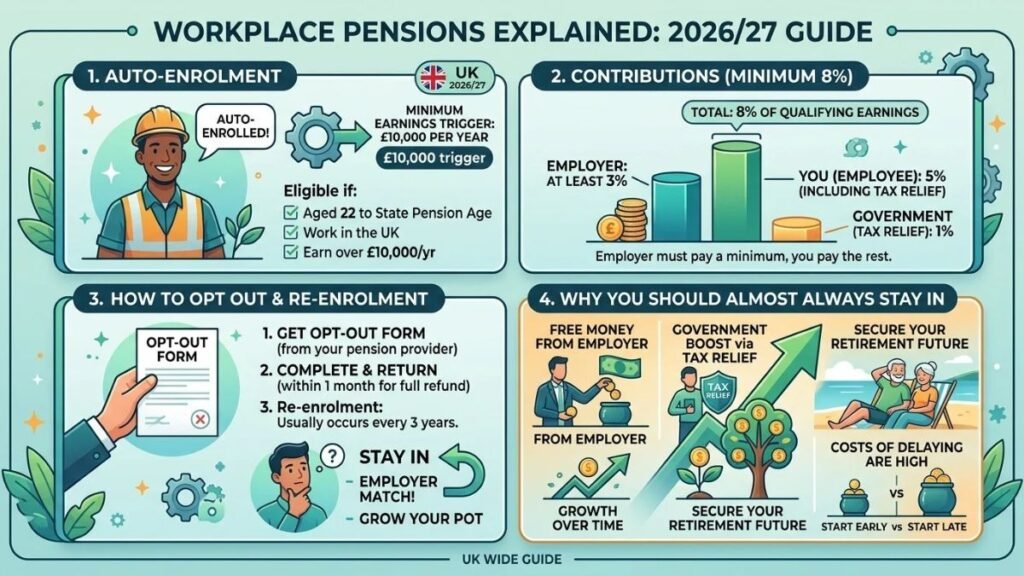
Quick answer: If you are aged 22 or over, under State Pension age and earn more than £10,000 a year from one job, your employer must enrol you in a workplace pension. The legal minimum is 8% of your qualifying earnings, with at least 5% from you (including tax relief) and 3% from your employer. You can opt out within one month for a refund, but you would lose your employer’s contributions and tax relief.
What is a workplace pension?
A workplace pension is a way of saving for retirement through your job. Money is paid in from your pay, and usually from your employer, and invested to grow over the years. You can normally take it from age 55 (rising to 57 from April 2028), subject to the scheme’s rules.
There are two main types:
| Type | How it works | Where you find it |
|---|---|---|
| Defined contribution (DC) | Money builds up in your own pension pot, invested in funds. What you get depends on how much is paid in, investment growth and charges | Most private sector workplace pensions, including auto-enrolment schemes such as NEST and many provided by insurers |
| Defined benefit (DB) | The scheme promises a retirement income based on your salary and years of service, such as a final salary or career average scheme | Mainly the public sector, such as the NHS, teachers, the civil service, local government and some older private schemes |
If you work for the NHS, you may be in the NHS Pension Scheme. See our guide to NHS jobs. School support staff are often in the Local Government Pension Scheme. See our guide to teaching assistant jobs.
Automatic enrolment: who gets put in?
Under automatic enrolment, employers must put eligible workers into a workplace pension scheme and pay contributions. The 2026/27 thresholds are unchanged from 2025/26, as confirmed by the government in December 2025.
| Item | 2026/27 |
|---|---|
| Earnings trigger (the level above which you are automatically enrolled) | £10,000 a year (£833 a month or £192 a week) |
| Lower limit of qualifying earnings | £6,240 a year |
| Upper limit of qualifying earnings | £50,270 a year |
| Age range for automatic enrolment | 22 to State Pension age |
| Minimum total contribution | 8% of qualifying earnings (at least 3% from your employer) |
Are you eligible? A quick guide
| Your situation | What happens |
|---|---|
| Aged 22 to State Pension age and earning over £10,000 a year from a job | Your employer must automatically enrol you and contribute |
| Aged 16 to 21, or over State Pension age and under 75, and earning over £10,000 | You can opt in, and your employer must contribute |
| Any age, earning between £6,240 and £10,000 | You can ask to join, and your employer must contribute |
| Earning under £6,240 | You can ask to join, but your employer does not have to contribute |
A few more points:
- It applies to workers, not just employees. Many agency and casual workers are covered. If your hours vary, your earnings are assessed each pay period against the trigger, so you may be enrolled at some point even if you were not at the start. See our guide to zero-hours contracts.
- Each job is separate. If you have two jobs, each employer looks at your earnings from that job.
- Your employer must tell you in writing that you have been enrolled, and explain what it means and how to opt out. This normally happens within about six weeks of your enrolment date.
- Self-employed people are not automatically enrolled. You need to set up your own pension. See our guide to how to become self-employed in the UK.
What might change?
The government has been reviewing auto-enrolment, including proposals to lower the starting age from 22 to 18 and to remove the lower earnings limit, so that contributions would be calculated from the first pound of earnings. Some sources suggest these changes could take effect around April 2027, but as of mid-2026 other sources say they had not yet been put into law, and regulations are still needed. The Pensions Commission is also looking at longer-term pension adequacy. Check GOV.UK for the latest.
How much goes in? Contributions explained
The minimum
The legal minimum total contribution is 8% of qualifying earnings, made up of:
- At least 3% from your employer
- The remainder (normally 5%) from you, including tax relief
Qualifying earnings are the slice of your pay between £6,240 and £50,270 a year. Pay below £6,240 and above £50,270 does not count for the minimum calculation. Qualifying earnings include salary, wages, overtime, bonuses, commission and statutory pay such as Statutory Sick Pay and maternity pay.
Many employers calculate contributions differently, for example on basic pay or on total pay from the first pound, and some pay more than the minimum. Always check your scheme.
Worked examples
These examples use the minimum contributions on qualifying earnings in 2026/27. They are my own calculations.
| Annual salary | Qualifying earnings | You (5%) | Employer (3%) | Total (8%) |
|---|---|---|---|---|
| £20,000 | £13,760 | £688 | £412.80 | £1,100.80 |
| £25,000 | £18,760 | £938 | £562.80 | £1,500.80 |
| £30,000 | £23,760 | £1,188 | £712.80 | £1,900.80 |
| £40,000 | £33,760 | £1,688 | £1,012.80 | £2,700.80 |
| £50,000 | £43,760 | £2,188 | £1,312.80 | £3,500.80 |
| £60,000 | £44,030 (capped) | £2,202 | £1,321 | £3,523 |
The figures for you include tax relief, so the real cost to your take-home pay is lower. See our guide to take-home pay in the UK 2026/27 for exactly how a 5% pension changes your net pay at each salary. For example, at £30,000 your pension contribution is about £1,188 a year, but your take-home pay falls by only about £951 because you pay less tax.
The contributions above also show why it matters: your employer’s £712.80 is effectively extra pay that you would lose if you opted out.
Employer contributions can be higher
Many employers offer more than 3%, sometimes matching your contribution up to a set level. Public sector schemes often have much higher employer contributions. Ask your HR team what your employer pays, and whether paying more yourself earns a higher employer contribution.
Tax relief: how the government tops up your pension
The government gives you tax relief on pension contributions, which is why pensions are so efficient. How it works depends on how your scheme collects contributions.
| Method | How it works |
|---|---|
| Net pay arrangement | Your contribution is taken from your pay before Income Tax is calculated, so you get relief at your own rate automatically. National Insurance is still charged on your full pay |
| Relief at source | You pay your contribution from pay after tax, and the pension provider claims basic-rate (20%) relief from the government and adds it to your pot. Higher-rate taxpayers can claim extra relief through their tax return or by contacting HMRC |
| Salary sacrifice | You agree to a lower salary and your employer pays the difference into your pension. This can save both Income Tax and National Insurance, but it can also affect things such as your mortgage application, Statutory Sick Pay and statutory maternity pay, so check the details |
Your payslip and pension letter should say which applies. Very low earners need to be careful, because under a net pay arrangement people who do not pay Income Tax may not get relief unless the scheme or government provides a top-up, so check with your scheme and HMRC. See our guide to payslips, tax codes and National Insurance.
Opting out: what you need to know
You are free to leave a workplace pension, but think carefully.
How opting out works
- Opt out within one month. You have a one-month window after your enrolment date, or after you receive your enrolment letter if later, to opt out. If you do, you are treated as never having joined and you get a full refund of any contributions deducted.
- Opt out later. You can stop contributing at any time, but you cannot get back the contributions already paid. They stay in your pot until you retire. Your employer also stops paying.
- How to do it. You must contact your pension provider, not your employer. Your enrolment letter explains the process. Your employer cannot opt you out or pressure you to leave.
Re-enrolment
If you opt out or leave the scheme, your employer must automatically re-enrol you about every three years, if you still meet the age and earnings tests. You can opt out again each time, but you have to repeat the process. You can also ask to rejoin at any time.
Should you opt out?
For most people, staying in is better value. Reasons to stay in include:
- Your employer’s contribution is extra money you would otherwise lose.
- Tax relief boosts what you pay in.
- Long-term growth. Money invested for decades can grow substantially, and starting young makes a big difference.
- The State Pension alone is modest. The full new State Pension is around £241 a week in 2026/27, which many people find hard to live on without extra savings. Check GOV.UK for the current rate.
- Employers cannot lawfully encourage you to opt out or treat you worse for staying in.
People who sometimes consider opting out include those with expensive short-term debts, those in severe financial difficulty, those who have significant pension savings elsewhere and those near a limit on tax-free pension saving. Even then, get free guidance first from MoneyHelper, Citizens Advice or StepChange before deciding.
If you are on a low income, remember that pension contributions come out of your take-home pay. If you claim Universal Credit, your employee pension contributions reduce the earnings counted. See our guide to Universal Credit and work for how this works. Your own household situation matters, so check the figures.
Where does the money go?
In a defined contribution scheme your money is invested, usually through a default fund chosen by the scheme, unless you choose another.
- Default funds often start by investing mostly in shares when you are young, then gradually move into lower-risk investments as you approach retirement (sometimes called lifestyling).
- Charges are taken from your pot. For auto-enrolment default funds the annual charge is capped at 0.75% of your pot. Check your scheme’s charges, because small differences add up over decades.
- You may be able to choose different funds, increase or reduce your contributions, or add extra payments.
- Your pot belongs to you. If you leave your job, it stays invested in that scheme (a “deferred” pot), and you can leave it, transfer it or combine it with another pension.
The value of investments can go down as well as up, and your pension might be worth less than you expect, but over long periods pensions have historically grown.
Changing jobs and tracking your pensions
Most people will have several pension pots over a lifetime.
- Keep a list of every scheme you have joined, with the provider’s name and your policy number.
- Tell providers when you move so they can contact you.
- Consider combining pots, but check fees, guarantees and benefits first, because some old schemes have valuable features such as guaranteed benefits or protected retirement ages. Take advice if a pot is large or you are unsure.
- Use the free Pension Tracing Service on GOV.UK if you have lost track of an old pension.
- Check your State Pension forecast on GOV.UK. You usually need 35 qualifying years of National Insurance for the full new State Pension.
- Pensions dashboards, which let you see all your pensions in one place, are being introduced in stages.
Pensions during leave, sickness and career breaks
- Maternity and family leave. Your employer must keep paying its pension contributions during paid statutory family leave, based on your normal pay, and your pension rights continue. See our guide to maternity, paternity and shared parental leave and pay.
- Sick pay. Statutory sick pay counts as qualifying earnings. See our guide to Statutory Sick Pay 2026.
- Unpaid leave and career breaks. Contributions usually stop, but your pot remains. You may be able to pay in yourself, and National Insurance credits can protect your State Pension record in some cases.
- Redundancy. Your pension pot is yours, but check what happens to your scheme and your employer’s contributions. See our guide to redundancy rights in the UK.
Pensions for different groups
- School leavers and young workers. If you are 18 to 21, you can ask to join and your employer must contribute if you earn over the earnings trigger. Starting early gives your money more time to grow. See our guides to jobs for 16 and 17 year olds and apprenticeships in the UK.
- Graduates and students. Many graduates are enrolled in their first job. See our guide to graduate jobs and schemes in the UK for pay and benefits.
- Part-time and low earners. If you earn between £6,240 and £10,000, you can ask to join and your employer must contribute.
- Over 50s and older workers. You can usually access pensions from 55 (57 from April 2028), but taking money early affects your tax and future income. Get free Pension Wise guidance if you are 50 or over. See our guide to jobs for over 50s and returners in the UK.
- Self-employed and gig workers. You are not automatically enrolled, so consider a personal pension or a self-invested pension, and check what tax relief you get. See our guides to delivery driver jobs and taxi and private hire driver jobs.
- Disabled workers. Pension rules apply equally. If you need help understanding your options, see our guide to disability and work in the UK.
When can you take your pension?
- Minimum pension age. Currently 55, rising to 57 from 6 April 2028 for most people, though some schemes have protected earlier ages.
- Tax-free lump sum. You can usually take up to 25% of your pot tax free, up to a limit, and the rest is taxed as income.
- How you can take it. Options include buying an annuity, drawing down income from your pot, taking lump sums or a mix. Each has pros and cons, and decisions are hard to reverse.
- State Pension age. It is rising from 66 to 67 between April 2026 and March 2028 for those affected, and you can claim your State Pension from then.
- Free guidance. Pension Wise, from MoneyHelper, offers free, impartial guidance to people aged 50 or over with a defined contribution pension.
Before you make any big decisions, get free advice from MoneyHelper, and consider speaking to a regulated financial adviser.
Pension scams: how to protect yourself
Pension scams can wipe out a lifetime of savings. Be on your guard if:
- Someone cold calls, texts or emails you about your pension. Cold calling about pensions is banned in the UK.
- You are offered a “free pension review” or pressured to decide quickly.
- You are promised unrealistic returns, or guaranteed high growth.
- You are offered early access to your pension before the minimum age, which is usually a scam and can lead to a large tax bill.
- You are told to move your money overseas or into unusual investments.
- The company is not on the Financial Conduct Authority register, or you cannot verify who they are.
Check any adviser or firm on the FCA register, use the FCA ScamSmart tool and take your time. If you think you have been scammed, contact your pension provider and your bank, and report it to Report Fraud and the FCA. Job seekers should also watch for fake job adverts that ask for payment or personal details. See our guide to how to spot a fake job advert in the UK.
What to check when you start a job
- Look for your pension letter and keep it. It tells you the scheme, your enrolment date and how to opt out.
- Check your payslip to see your contribution and your employer’s contribution, if shown.
- Ask HR what your employer pays, whether it matches extra contributions and whether the scheme uses net pay, relief at source or salary sacrifice.
- Check your contract for pension details. See our guide to understanding your employment contract.
- Consider whether to pay more. If you can afford it, raising your contribution, especially if your employer matches it, is one of the best ways to boost your future income.
- Think about extra benefits. When you ask for a pay rise or negotiate an offer, ask about the pension too. See our guide to how to ask for a pay rise or negotiate salary in the UK.
- Review your pension each year, including your fund choice, fees and projected income.
Frequently asked questions
Do I have to join my employer’s pension? If you are 22 or over, under State Pension age and earn over £10,000 a year, your employer must enrol you. You can opt out, but you will lose your employer’s contributions and tax relief.
How much do I pay into a workplace pension? The minimum is 5% of qualifying earnings from you (including tax relief) and 3% from your employer, which is 8% in total.
What are qualifying earnings? The part of your pay between £6,240 and £50,270 a year for 2026/27.
Can I opt out of auto-enrolment? Yes. If you opt out within one month of being enrolled, you get your contributions back. Later, you can stop paying but you keep what is already in your pot.
Will my employer enrol me again if I opt out? Yes, normally about every three years, if you still meet the age and earnings tests. You can opt out again.
Is a workplace pension worth it? For most people, yes, because of your employer’s contribution, tax relief and long-term investment growth.
What happens to my pension if I leave my job? Your pot stays invested, and you can leave it, transfer it or combine it with another pension. Keep a record of your provider.
When can I take my workplace pension? From age 55, rising to 57 from April 2028, subject to the scheme’s rules. Taking money early can affect your tax and your future income.
Do part-time workers get a pension? Yes, if they meet the earnings and age tests. If you earn between £6,240 and £10,000 you can ask to join and your employer must contribute.
Do self-employed people get automatic enrolment? No. You need to arrange a personal pension yourself.
Final thoughts
A workplace pension is one of the best deals in your pay package, so understand it, check your payslip and think twice before opting out. Even small increases in contributions early in your career can make a big difference to your retirement. When you are ready to compare jobs, browse the latest vacancies on our jobs board and ask about pensions before you accept.
This article is general information, not financial or pension advice. Pension and tax rules change, and your own circumstances matter. Check GOV.UK, MoneyHelper and Pension Wise for the latest guidance, and speak to a regulated financial adviser about important decisions.