Settlement Agreements in the UK: What to Know Before You Sign
If your employer offers you a settlement agreement, it can feel like a high-pressure moment: a document arrives, a deadline is attached and you are asked to give up legal rights in return for money. Settlement agreements are common in redundancies, disputes and restructures, and they can be a good deal, but only if you understand what you are signing. This guide explains what a settlement agreement is, when employers offer one, what it must contain to be valid, how the money is taxed, what you can negotiate, how confidentiality clauses work and what to do if you decide not to sign.
Quick answer: A settlement agreement is a legally binding contract in which you agree to give up specified employment claims, usually in return for a payment. To be valid, you must receive independent advice from a qualified, insured adviser. The first £30,000 of a genuine termination payment is normally tax-free, but notice pay and holiday pay are taxed as earnings. Employers usually contribute to your legal fees, and you should never sign without advice.
What is a settlement agreement?
A settlement agreement (sometimes called a compromise agreement) is a written contract between you and your employer. In it, you agree not to bring certain claims against your employer, for example for unfair dismissal or discrimination, and your employer agrees to give you something in return, normally a sum of money and agreed terms for your departure.
Settlement agreements are:
- Voluntary. You do not have to sign one, and your employer cannot force you.
- Legally binding once signed, if the legal conditions are met.
- Usually offered when employment is ending, though they can also settle disputes between you and an employer while you stay in the job.
- Negotiable. The first offer is rarely the final one.
Settlement agreements are not the same as a COT3, which is a settlement reached through Acas, and not the same as a normal redundancy payment. See below.
When might you be offered one?
Common situations include:
- Redundancy or restructure, where an employer wants to avoid a dispute over fairness or selection. See our guide to redundancy rights in the UK.
- Poor performance, conduct or capability, where an employer would rather agree a departure than run a lengthy process. See our guide to disciplinary and grievance procedures in the UK.
- Long-term sickness or disability issues, where a departure is being discussed. See our guide to disability and work in the UK.
- A breakdown in the working relationship, a grievance or a complaint of bullying or discrimination.
- Following a dispute that could end in a tribunal claim.
- Senior and specialist roles, where packages and restrictions are more complex.
In some cases, your employer may raise the idea in a “protected conversation”. Under the law, an offer to end your employment on agreed terms, made in a pre-termination discussion, is generally not admissible as evidence in an ordinary unfair dismissal claim. That protection does not apply to everything, such as discrimination claims or where the employer behaves improperly, for example by harassing or threatening you. Acas gives guidance on how these conversations should be handled.
When is a settlement agreement valid?
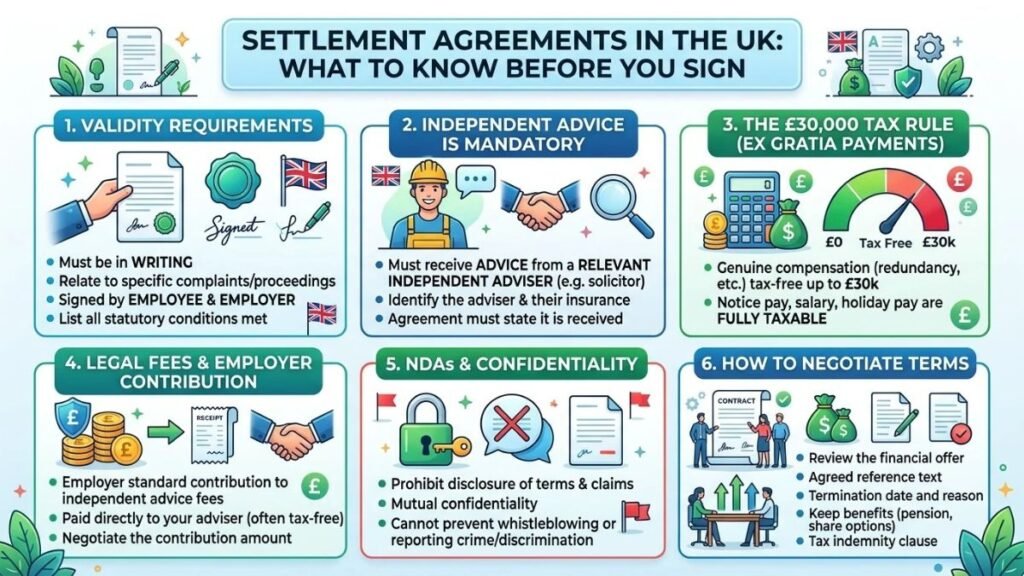
The law (section 203 of the Employment Rights Act 1996) sets conditions. A settlement agreement only stops you bringing statutory employment claims if all of these are satisfied:
- It is in writing.
- It relates to a particular complaint or proceedings (it should list the claims you are giving up).
- You have received advice from a relevant independent adviser on the terms and effect of the agreement, and in particular on its effect on your ability to bring those claims.
- There is insurance or an indemnity covering the adviser against a claim from you if the advice is wrong.
- The adviser is identified in the agreement.
- The agreement states that the conditions above are satisfied.
Who is a “relevant independent adviser”?
- A qualified solicitor or other qualified lawyer
- A certified trade union official (a union representative who has been certified by their union as competent)
- A certified advice centre worker (for example, at an authorised law centre or citizens advice service)
They must be genuinely independent of your employer. An adviser chosen and paid for solely by your employer to act for both sides is not independent. If you have no independent advice, the agreement will not stop you bringing a tribunal claim, even though you signed it, so make sure the process is done properly.
What is in a typical settlement agreement?
| Term | What it usually covers |
|---|---|
| Termination date | The date your employment ends |
| Payment | A lump sum, often made up of notice pay, holiday pay, any redundancy pay and a further “compensation” payment |
| Waiver of claims | The list of claims you give up, such as unfair dismissal, discrimination, breach of contract and unpaid wages |
| Reference | An agreed reference your employer will give |
| Confidentiality | A promise not to disclose the terms or negotiations, and sometimes not to disclose confidential business information |
| Non-disparagement | An agreement not to make negative comments about each other |
| Restrictive covenants | Reminders or changes to non-compete, non-solicitation or similar restrictions |
| Return of property | Giving back laptops, phones, passes and documents |
| Announcement | How your departure will be communicated to colleagues |
| Legal fee contribution | A sum from the employer towards the cost of your advice |
| Tax warranties and indemnities | A statement that you will pay any further tax due on the payment |
| Outplacement or other benefits | Careers support, private medical cover for a time or a pension contribution |
Read every term carefully, and make sure your adviser explains the effect of each.
What you cannot waive
A settlement agreement cannot take away certain rights. For example:
- Whistleblowing. You cannot be prevented from making a protected disclosure about wrongdoing to a regulator or other proper person. Rules on this are strengthening, including protection for disclosures about sexual harassment from April 2026.
- Accrued pension rights, which generally remain yours, though you should check how the agreement affects your pension.
- Claims you do not know about, in some circumstances, depending on how the agreement is drafted. Your adviser can explain.
- Legal duties to report certain matters, and your right to speak to the police, regulators, your adviser, your doctor, your partner and Acas.
How much money can you get?
There is no standard figure. The amount depends on your length of service, pay, notice entitlement, the strength of any claim you could bring, how much your employer wants to avoid a dispute and your negotiating position.
Elements that often make up the payment include:
- Notice pay, or payment in lieu of notice
- Accrued but untaken holiday pay
- Statutory or enhanced redundancy pay, if applicable. See our guide to redundancy rights in the UK, which explains the 2026/27 limits.
- Any bonus or benefits you were due
- An additional compensation sum for loss of employment and in return for giving up your claims
If you could have brought an unfair dismissal claim, bear in mind that, for dismissals ending on or after 1 January 2027, the qualifying service falls to six months and the compensation cap on the compensatory award is removed. That can strengthen your negotiating position, so see our guide to unfair dismissal in the UK. If you were treated unfairly because of a protected characteristic, discrimination compensation is uncapped.
Tax on a settlement payment
Tax is where people most often go wrong. In general:
| Part of the payment | Tax treatment |
|---|---|
| Genuine termination compensation (an ex-gratia payment for loss of employment), including statutory and enhanced redundancy pay | The first £30,000 is free of Income Tax and employee National Insurance. Anything above £30,000 is taxed as income, and employers pay 15% Class 1A National Insurance on the excess |
| Payment in lieu of notice or post-employment notice pay (PENP) | Taxed as earnings, with Income Tax and National Insurance |
| Accrued holiday pay | Taxed as earnings |
| Unpaid wages, bonus and commission | Taxed as earnings |
| Legal fees paid by the employer directly to your adviser | Normally tax-free, if paid directly and the conditions are met |
| Employer contribution to your pension | Can be tax-free within your annual allowance |
The £30,000 exemption is a combined limit that includes redundancy pay. Whether a payment counts as genuine termination compensation, as opposed to notice pay or other earnings, depends on the facts and on HMRC’s rules, so your agreement should be worded carefully and your adviser should check it.
A simple illustration
Suppose an employee on £40,000 a year is offered:
- £5,000 in lieu of notice
- £2,000 of accrued holiday pay
- £35,000 as termination compensation
The first £30,000 of the termination compensation is tax-free. The remaining £5,000 of compensation, the £5,000 notice payment and the £2,000 holiday pay are all taxable, so £12,000 is taxed. If the employee is a basic-rate taxpayer for the year, the Income Tax on that would be roughly £2,400, and National Insurance of about £560 would be due on the £7,000 of notice and holiday pay. Higher rates can apply if the payment and other income push the employee into a higher band in that tax year.
This is my own simplified example for illustration, and the real position depends on your tax code, other income, the time of year and how the payment is structured. See our guides to take-home pay in the UK 2026/27 and payslips, tax codes and National Insurance, and ask your adviser or an accountant to check the tax effect.
Who pays for your legal advice?
There is no legal obligation on the employer to pay, but it is standard practice, because valid advice is a condition of the agreement.
- Typical contributions reported in 2026 range from about £200 to £1,500, with many guides suggesting £500 to £1,000 plus VAT for a straightforward case. More complex cases may need more.
- Direct payment. The fee is often paid directly to your adviser, which can keep it tax-free.
- If the advice costs more than the contribution, you may need to cover the difference, so ask your adviser for a fee estimate before you start. You can ask your employer to increase the contribution.
- Union members can often get advice from their union at no extra cost.
- Legal expenses insurance, for example under your home insurance, may cover some costs.
How long do you have to decide?
Acas guidance says employees should be given a reasonable time to consider an offer, and a period of at least 10 calendar days is generally regarded as reasonable, though it can vary. Do not feel pressured into signing within hours. If you need more time to take advice or negotiate, ask in writing.
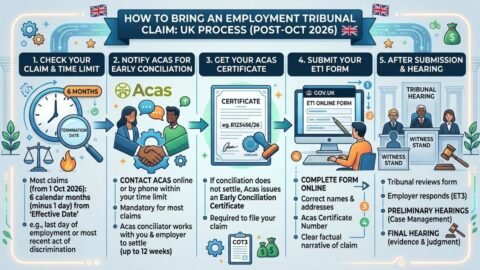
Time limits for claims keep running. Talking to your employer about a settlement does not stop the clock on any tribunal claim. The time limit for most claims is six months less one day for events on or after 1 October 2026, and you must go through Acas early conciliation first, which can pause the clock. Take advice early so you do not lose your rights if talks fail.
How to negotiate: step by step
- Do not sign straight away. Read the whole document, and ask for time.
- Get independent advice from a solicitor, a union or an advice centre.
- Work out your position. Consider your notice, redundancy entitlement, holiday pay, bonus, length of service, how your employer has treated you and whether you have a possible claim.
- Think about what matters to you. Money, a good reference, how your departure is announced, a longer notice period, garden leave, outplacement, a pension contribution or keeping a laptop.
- Ask your adviser to negotiate, or help you negotiate. They know what is realistic.
- Make a counter-offer with a clear reason and a specific figure.
- Check the detail. Look at the confidentiality terms, the list of claims waived, restrictive covenants and the wording of the reference.
- Get the tax wording checked, and understand how the payment will be split.
- Review the final agreement before you sign, and make sure your adviser signs the certificate.
- Keep a copy of the signed agreement and any related documents.
Things to ask for
- A higher payment, or a longer notice period paid in full
- A clear agreed reference (ideally attached to the agreement) and a non-disparagement clause that also binds your employer
- Reasonable confidentiality, with the standard carve-outs for your family, advisers, regulators and the police
- Reasonable restrictive covenants, or release from some of them
- Continued benefits such as private medical cover or life assurance for a period, or a payment instead
- A pension contribution in place of some of the payment, which can be tax-efficient
- Outplacement support or help finding your next job
- Early release from duties on full pay (garden leave), if you want time to look for work
- Agreement on how your departure is announced
Confidentiality clauses and non-disclosure agreements
Most settlement agreements include confidentiality, and some include non-disparagement. These can restrict what you say about the agreement, your employer and your employment.
- What is normal. An agreement to keep the amount and terms confidential, and not to criticise each other, is common.
- What should be allowed. You should be able to tell your spouse or partner, close family, professional advisers, the tax authorities, the police, regulators and Acas, and to make protected disclosures.
- Changes coming. The Employment Rights Act 2025 is due to make confidentiality terms void to the extent that they stop a worker speaking about harassment or discrimination, or how an employer responded. Sources expect the main provisions to take effect in 2027, once regulations set the detail, so check the latest on GOV.UK. A separate law protects disclosures about crimes.
- If you are worried. If you want to speak about wrongdoing, tell your adviser, because the wording of the clause and the law both matter.
See our guide to the Employment Rights Act 2025 for the wider changes.
Restrictive covenants and references
- Restrictive covenants, such as non-competes, non-solicitation clauses and confidentiality duties, may continue after you leave. Check the terms in your contract and in the agreement. Courts only enforce restrictions that are reasonable, but they can still cause problems, so take advice before you sign if you plan to work in the same field.
- References. Ask for an agreed reference, ideally attached to the agreement. Employers must give accurate references, but they do not have to give one at all unless contractually required, so securing it in writing protects you.
- Your next job. Be ready to explain why you left. See our guide to common interview questions and answers in the UK and our guides to writing a UK CV with no experience (the layout tips apply to any CV) and writing a cover letter in the UK.
Money, benefits and pensions
- Universal Credit and other benefits. A lump sum can count as savings or capital, which can affect your benefits if it takes you over certain limits. See our guide to Universal Credit and work, and check GOV.UK or Citizens Advice before you sign if you claim benefits.
- Pension. Ask how the agreement affects your pension, including any employer contributions and any benefits you might lose. See our guide to workplace pensions explained.
- Holiday pay. Make sure your accrued holiday is included and calculated properly. See our guide to holiday entitlement and holiday pay.
- Notice. Check that your notice entitlement is covered. See our guide to notice periods in the UK.
- Tax planning. If the payment is large, consider speaking to an accountant about the best way to receive it.
Settlement agreements and Acas COT3
A COT3 is a settlement reached with the help of Acas, often during early conciliation, to resolve a potential or existing tribunal claim. Compared with a settlement agreement:
| Settlement agreement | COT3 | |
|---|---|---|
| Independent advice | Required for the agreement to be valid | Not required |
| Who arranges it | You and your employer, with advisers | An Acas conciliator |
| Cost | Employer usually contributes to legal fees | Free |
| Covers | Specified claims, as drafted | Only the claims in the dispute you are conciliating |
| Typical use | Ending employment on agreed terms | Settling a particular claim or dispute |
If you are offered a COT3, you are still wise to take advice before you agree.
What if you do not want to sign?
You are free to say no. Here are your options.
- Reject the offer and stay in your job, if your employer does not otherwise end it.
- Negotiate for better terms, or ask for more time.
- Continue with the employer’s process. If the offer was made during a redundancy or disciplinary process, your employer may carry on with it. Take part fully, and keep records. See our guide to disciplinary and grievance procedures in the UK.
- Contact Acas for free advice and early conciliation if you want to pursue a claim.
- Think about a tribunal claim, bearing in mind the time limit, the strength of your case and the cost and stress involved.
- Do not resign without advice, because that could affect your rights and your benefits.
An employer should not punish you for refusing to sign. If you think you are being treated badly for refusing, tell your adviser.
Settlement agreements for specific groups
- Disabled employees and those on long-term sick leave. An agreement should not be rushed, and you may have strong discrimination or reasonable adjustments claims. See our guide to disability and work in the UK.
- Pregnant employees and those on family leave. You have extra protections, and a settlement offer in this situation needs careful advice. See our guide to maternity, paternity and shared parental leave and pay.
- Older workers. Age discrimination and pension issues may matter. See our guide to jobs for over 50s and returners in the UK.
- Employees with short service. If you have less than the qualifying service for an ordinary unfair dismissal claim, you may have less to trade, but other claims may still apply. Check your position, particularly if your employment ends after 1 January 2027, when six months’ service will be enough.
- Agency and zero-hours workers. Your status affects your rights. See our guide to zero-hours contracts.
Scams and bad advice to avoid
- “Claim your compensation” calls, texts and adverts from claims firms that promise large payouts for employment claims, or charge upfront fees. Check any firm on the Solicitors Regulation Authority register, and be wary of high-pressure sales.
- Advisers who are not independent. An adviser chosen for you by your employer who does not act for you alone may not satisfy the legal test.
- Unqualified advice. Make sure your adviser is a solicitor, certified union official or certified advice centre worker and has insurance.
- Fake job offers from people who know you have just lost your job. See our guide to how to spot a fake job advert in the UK.
When you are ready to look for your next role, browse the latest vacancies on our UK jobs board.
Frequently asked questions
What is a settlement agreement? A legally binding contract in which you give up specified employment claims in return for a payment and agreed terms, usually when employment ends.
Do I have to sign a settlement agreement? No. It is voluntary, and you can negotiate or refuse.
Do I need a solicitor? You need advice from a relevant independent adviser, such as a solicitor, a certified trade union official or a certified advice centre worker, for the agreement to be valid.
Who pays for my legal advice? Employers usually contribute, commonly about £200 to £1,500, with £500 to £1,000 plus VAT often quoted for simple cases. There is no legal obligation to pay.
Is a settlement payment tax-free? The first £30,000 of a genuine termination payment is normally tax-free. Notice pay, holiday pay and wages are taxed as earnings, and amounts above £30,000 are taxable.
How long do I have to consider an offer? Acas suggests a reasonable period, at least 10 calendar days. Ask for more time if you need it.
Can I negotiate a settlement agreement? Yes. You can ask for more money, a better reference, different confidentiality terms or other benefits.
What is a protected conversation? A discussion about ending employment on agreed terms that generally cannot be used as evidence in an ordinary unfair dismissal claim, unless the employer behaves improperly.
Can a settlement agreement stop me whistleblowing? No. You cannot be prevented from making a protected disclosure.
What if I refuse to sign? Your employment may continue, or your employer may carry on with its process. Take advice and keep records, and do not resign without advice.
Is a COT3 the same as a settlement agreement? No. A COT3 is an Acas-brokered settlement that does not require independent legal advice and covers only the claims in the dispute.
Final thoughts
A settlement agreement can be a fair way to end a difficult situation, but you only get one chance to negotiate it. Take independent advice, understand the tax, check every clause and use your time. When you are ready to move on, browse the latest vacancies on our jobs board.
This article is general information, not legal or tax advice. Settlement agreements are legal contracts, and your rights depend on your circumstances. Contact Acas, Citizens Advice, a trade union or a qualified employment solicitor before you sign, and check GOV.UK and HMRC for the latest rules.