Customer Service Careers: Skills That Actually Get You Hired
Customer service is often treated as a job you do temporarily, not a career you build deliberately — which is a genuine shame, because the skills it develops (de-escalation, clear communication under pressure, systematic problem-solving, and increasingly, comfort across multiple digital channels) are among the most transferable in the entire job market. This is a practical look at what actually makes a strong customer service candidate, and how the role connects to a wider range of career paths than it’s often given credit for.
What employers are genuinely screening for
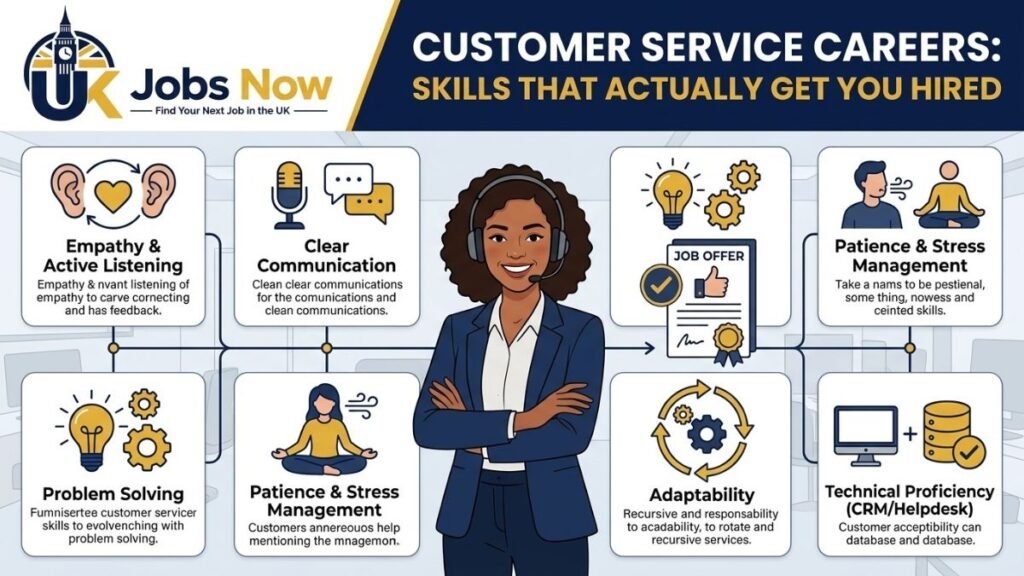
Beyond a generically friendly manner, employers hiring for customer service roles are typically assessing a more specific set of skills, and understanding these helps you demonstrate them convincingly rather than relying on a vague claim of being “good with people.”
De-escalation and composure under pressure
The ability to remain calm and professional with a frustrated or upset customer, without becoming defensive or matching their emotional intensity, is one of the most consistently valued and genuinely difficult skills in the role. This is worth demonstrating through a specific example in an interview — a real situation where you defused tension and reached a resolution — rather than simply asserting you’re “good under pressure.”
Clear, structured communication
Explaining a resolution, a policy, or next steps clearly and without jargon, adjusting your language and tone to the specific person you’re talking to, is a genuinely valuable and transferable skill that extends well beyond customer-facing roles into almost any professional context involving explaining something to someone else.
Systematic problem-solving within constraints
Customer service work often involves solving a specific problem within defined policy or system constraints — not simply doing whatever the customer asks, but finding the best available resolution within what’s actually possible. This kind of structured, constrained problem-solving is a genuinely valuable, demonstrable skill, distinct from simple compliance or simple refusal.
Comfort across multiple communication channels
Modern customer service increasingly spans phone, email, live chat, and social media, each requiring a somewhat different communication style — written channels demand clarity and tone without the benefit of vocal inflection; phone work demands active listening and verbal clarity in real time. Demonstrating genuine comfort and competence across more than one of these channels is increasingly valued as the role has diversified beyond purely phone-based support.
How to demonstrate these skills in an application
| Skill claimed | Weak demonstration | Stronger demonstration |
|---|---|---|
| De-escalation | “Good at handling difficult customers” | “Resolved an escalated complaint about a delayed order by acknowledging the customer’s frustration directly, offering a clear resolution timeline, and following up personally — turning a formal complaint into a repeat customer” |
| Problem-solving | “Strong problem-solving skills” | “Identified a recurring issue behind a spike in similar customer queries and flagged it to the team lead, contributing to a process fix that reduced that specific complaint type” |
| Multi-channel competence | “Experience with customer service” | “Handled an average of 40+ queries per shift across phone and live chat simultaneously, maintaining consistently high resolution rates on both channels” |
Where customer service experience leads
It’s worth understanding customer service not just as an entry-level role but as a genuine foundation for several different career directions, depending on what aspect of the work you find most engaging:
- Team leadership and management — supervising and eventually managing a customer service team, drawing directly on your own front-line experience to support and develop others.
- Training and quality roles — designing training materials or auditing service quality, for people who particularly enjoy the process and communication side of the work.
- Customer success or account management — a more relationship-focused, often B2B-oriented progression, particularly in software and services companies, building longer-term relationships with specific accounts rather than handling high-volume, varied queries.
- Operations and process improvement — for people drawn to the systematic problem-solving side of the role, moving into a role focused on identifying and fixing the root causes behind recurring customer issues.
- Sales — customer service and sales draw on genuinely overlapping skills (communication, handling objections, understanding customer needs), and a move from service into a sales role is a well-established, common transition.
Building a case for progression within customer service
Similar to the progression patterns in retail and hospitality, visible initiative beyond your immediate role — volunteering to help train new starters, identifying and flagging a process improvement, taking on more complex or escalated queries — tends to be noticed and rewarded more directly than simply performing your existing role well without additional visible contribution. Actively expressing interest in progression to your manager, rather than waiting passively to be noticed, remains one of the most effective and underused steps most people skip.
Remote and flexible customer service roles
Customer service is one of the more common role types offered as fully remote or hybrid work, particularly for phone, email, and live chat-based roles that don’t require a physical location. If flexible working arrangement matters to your search, it’s worth specifically filtering for this, since it’s genuinely more available in customer service than in many other entry-level role types.
What makes a customer service CV stand out
Beyond the specific, results-focused language covered above, quantifying your experience where genuinely possible — call or query volume handled, resolution rates, any specific process or training contribution — gives a hiring manager concrete evidence rather than a generic claim. Our guide to writing a UK CV covers this kind of results-focused bullet-point structure in more general depth.
Getting started
Customer service roles are widely available across almost every sector, from retail and hospitality-adjacent support through to specialised technical or financial services support. You can browse current active UK job listings filtered by the customer service category to see current openings, including remote and flexible options.
Technical and specialist customer service roles
It’s worth knowing that “customer service” spans a genuine range of specialism levels — general retail or hospitality-adjacent support at one end, and technical support, financial services support, or specialist B2B account support at the other, each requiring somewhat different additional knowledge alongside the core customer service skills covered above. Technical and specialist customer service roles often pay meaningfully more than general roles and can serve as a genuinely strong entry point into a specific industry (technology, financial services, healthcare) if you’re also interested in eventually moving into a more specialised role within that sector.
How AI and automation are changing the role, and what that means for your career
Customer service has seen genuine change from chatbots and automated systems handling more routine, simple queries, which has shifted the nature of many human-staffed roles toward handling more complex, escalated, or emotionally sensitive interactions that automation genuinely struggles with. This is worth understanding as a career consideration rather than a threat — it means the human skills covered above (de-escalation, structured problem-solving, genuine judgement) are becoming relatively more valuable within the role, not less, even as the total volume of simple, routine queries handled by humans has decreased at many employers.
Working hours and shift patterns in customer service roles
Customer service shift patterns vary considerably by employer and channel — some roles operate standard daytime business hours, while others, particularly those supporting customers across extended hours or different time zones, involve evening, weekend, or rotating shift patterns. It’s worth clarifying the specific shift expectations for a role during the application process rather than assuming, since this varies more within the sector than many other office-based roles, and can meaningfully affect whether a specific role fits your circumstances.
Frequently Asked Questions
Is customer service a good starting point for a wider career?
Yes, genuinely — it builds transferable skills in communication, problem-solving under pressure, and de-escalation that open up progression into team leadership, sales, operations, and several other directions, not just further customer service roles.
What skills matter most for a customer service role?
De-escalation and composure under pressure, clear structured communication, systematic problem-solving within policy constraints, and increasingly, comfort working across multiple channels (phone, email, live chat).
Can customer service experience help me move into sales?
Yes — the two roles draw on genuinely overlapping skills, and moving from customer service into sales is a well-established, common career transition.
Are remote customer service jobs common in the UK?
Yes, relatively more so than in many other entry-level role types, particularly for phone, email, and live chat-based positions that don’t require a specific physical location.
How do I demonstrate customer service skills on a CV if I don’t have formal customer service job titles?
Look for relevant experience from any role involving direct interaction with people under some pressure — retail, hospitality, informal volunteer roles — and describe it using the same specific, results-focused language you’d use for a formal customer service position.