How to Write a UK CV in 2026: Format, Length and What Recruiters Actually Want
If you’ve ever taken a CV template built for the US market and just swapped “resume” for “CV” at the top, it’s worth stopping to fix that properly before you send anything else out. UK recruiters read CVs differently to US hiring managers, and a handful of formatting habits that are completely normal in one market read as slightly off in the other. None of it is complicated once you know what to look for — this is a practical, UK-specific walkthrough of format, length, and content, based on what actually gets a CV read properly rather than skimmed and binned.
How long should a UK CV actually be?
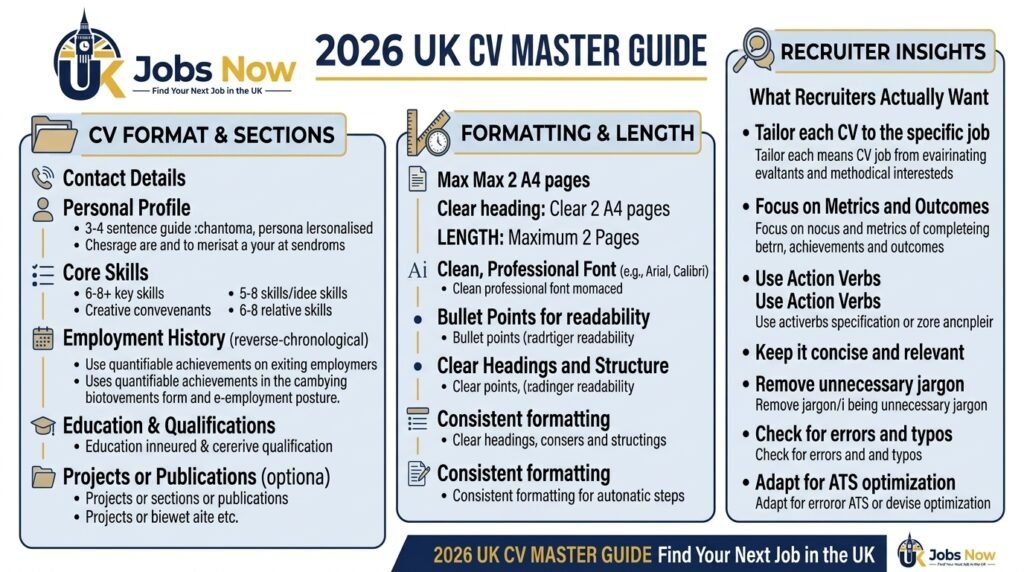
Two pages. That’s the standard answer, and for the vast majority of applicants — including most graduate, early-career, and mid-career roles — it’s the right one. A UK recruiter or hiring manager typically spends a short amount of time on a first pass through a CV, and a tightly written two pages signals that you can prioritise and communicate concisely, which is itself a useful signal about how you’ll write emails and reports on the job.
There are two legitimate exceptions. If you’re very early in your career — a recent graduate or someone with limited work history — one page is often genuinely enough, and padding it to two pages with filler doesn’t help you. At the other end, if you’re applying for a senior or highly technical role with a long, relevant track record (a consultant with a string of major projects, a senior academic, a clinician), three pages can be justified, but only if every section is earning its place. What you should avoid at any career stage is a CV that runs to three or four pages simply because you’ve never gone back and cut anything.
The structure that works
UK CVs tend to follow a consistent structure, and deviating from it without a good reason usually just makes your CV harder to skim, which works against you:
1. Contact details
Name, phone number, email address, and general location (town or city — you don’t need a full postal address). LinkedIn profile if it’s genuinely kept up to date. You don’t need to state your date of birth, marital status, or a photo — including these isn’t wrong exactly, but it’s not expected in the UK the way it might be in some other countries, and a photo in particular can occasionally introduce unconscious bias risk that both candidates and employers are generally better off avoiding.
2. Personal profile or summary
A short paragraph, three or four sentences, summarising who you are professionally and what you’re looking for. This is the section most CVs get wrong by making it generic (“A hardworking, motivated professional seeking a new challenge…”). A stronger version is specific: your area of expertise, your years of relevant experience, and one or two concrete things you’re known for. Tailor this paragraph to each role you apply for — it’s the first thing read and the easiest place to signal relevance immediately.
3. Work experience
Reverse chronological order — most recent role first. For each role: job title, company name, dates (month and year is standard; you don’t need exact days), and then bullet points describing what you actually did and achieved, not just a job description copied from the original listing. This is the section worth spending the most editing time on, and the next section covers exactly how to write it well.
4. Education
Degree, institution, and grade, most recent first. Once you have more than a couple of years of work experience, this section moves down the CV and shrinks — nobody hiring a mid-career professional needs your A-level results in detail. Early in your career, it can sit higher up and include more detail, including relevant modules or a dissertation topic if genuinely relevant to the role.
5. Skills
Keep this focused and relevant to the specific role — software, technical skills, languages, certifications. Avoid vague entries like “good communication skills” with nothing to back them up; if communication is genuinely a strength, it should be demonstrated through your experience bullet points, not just asserted in a list.
6. Additional sections, if relevant
Volunteering, publications, professional memberships, or relevant interests can round out a CV, but only include them if they add something. “Interests: reading, socialising with friends” tells a recruiter nothing useful and takes up space that could go toward something that actually differentiates you.
How to write experience bullet points that actually land
This is where most CVs lose their impact. The common mistake is describing responsibilities rather than outcomes — “Responsible for managing client accounts” tells a reader what your job was, not what you actually did well within it.
A more effective structure leads with an action and, where possible, a result: what you did, and what happened because of it. “Managed a portfolio of 40 client accounts, restructuring the renewal process to reduce late payments by identifying and fixing a recurring administrative bottleneck” tells a much richer story than the generic version, even without a specific headline percentage attached, because it shows judgement and initiative, not just task completion.
You don’t need to fabricate numbers to make this work. If you don’t have a precise metric, describe the scale or the specific problem you solved instead — “coordinated onboarding for a team of 12 new starters across two office locations” is concrete without needing a percentage figure attached to it. What matters is specificity, not decoration.
Tailoring your CV without rewriting it from scratch every time
You don’t need a completely different CV for every application, but you do need to adjust it meaningfully for each one, or an experienced recruiter will spot a generic CV within seconds. A practical approach: keep a master CV containing every role, bullet point, and skill you might ever want to include, then build each application’s version by selecting and lightly rewording the most relevant bullet points from that master document, and rewriting the personal profile paragraph specifically for the role. This is faster than starting from scratch and more effective than sending an identical CV to every job.
Read the job listing closely and mirror the language it uses for key skills and responsibilities, where genuinely accurate to your experience — many employers, particularly larger ones, use applicant tracking systems that scan for keyword matches before a human ever sees the CV, so using the same terminology the listing uses (rather than a close synonym) can be the difference between getting through that first filter or not.
Formatting choices that matter more than people expect
A few practical points that are easy to overlook:
- Use a clean, standard font — something like Calibri, Arial, or a similar sans-serif at 10–12pt body size. This isn’t the place to demonstrate design flair unless you’re applying for a design role specifically, and even then, restraint usually reads better than decoration.
- Save and send as a PDF, not a Word document, unless the employer specifically asks for a different format. A PDF preserves your formatting exactly regardless of what device or software opens it.
- Name the file sensibly — “FirstName-LastName-CV.pdf” rather than “CV_final_v3_ACTUAL_final.pdf”. It sounds trivial, but it’s the first small signal of attention to detail a recruiter sees before opening the file.
- Be consistent — the same date format throughout, the same style of bullet point, consistent spacing between sections. Small inconsistencies are exactly the kind of thing that’s invisible to you after your fifteenth read-through but obvious to someone seeing it fresh.
What to leave out
A few things are worth actively cutting if you find them in your current CV: a photo (not expected, occasionally a bias risk), your full date of birth (age discrimination is illegal in UK hiring, and there’s no upside to including it), references or “references available on request” (this is assumed by default and doesn’t need a line stating it), and a generic objective statement that could apply to literally any job at any company.
Once your CV is ready
A strong CV gets you to the interview stage — it doesn’t do the interview for you. If you want to prepare for what typically happens next, our guide to common UK job interview questions, including competency-based formats, is a natural next read. And if you’re ready to start applying, you can browse current active UK job listings filtered by category, location, and salary to find roles worth tailoring your new CV for.
Frequently Asked Questions
Should I include a personal photo on my UK CV?
No, this isn’t standard practice in the UK and isn’t expected by employers. Including one isn’t a hard rule violation, but it’s unnecessary and can occasionally introduce unconscious bias into the screening process, which is generally best avoided for both sides.
How far back should my work experience go?
Generally, focus on the last ten to fifteen years in detail, particularly your most recent and most relevant roles. Older or less relevant experience can be summarised briefly or omitted if space is tight and it isn’t adding value to the specific application.
Do I need a cover letter as well as a CV?
It depends on the employer and the application process — some explicitly request one, others don’t. When it’s optional but the application clearly matters to you, a well-written, specific cover letter (not a generic template) is usually worth the extra time, since it lets you explain motivation and fit in a way a CV’s bullet points can’t.
Is it okay to use a CV template I found online?
Yes, templates are a fine starting point for structure, but make sure whichever one you use follows UK conventions (two-page length, no photo or date of birth, reverse chronological experience) rather than a format built for a different market’s expectations.
Should my CV be different for every single job I apply for?
It should be tailored for every job, though not necessarily completely rewritten. Keep a comprehensive master CV, then adjust the personal profile and select the most relevant experience bullet points for each specific role you apply to.