How to Organise Your Job Search With a Simple Tracker
Three weeks into an active job search, it’s genuinely common to lose track of what you’ve actually applied for — which version of your CV went where, whether you already heard back from a company, whether that second interview is next Tuesday or the Tuesday after. This isn’t a sign of disorganisation so much as a predictable consequence of running fifteen or twenty parallel processes in your head at once. A simple tracker fixes this, and it takes less time to set up than the confusion it prevents costs you later.
Why this matters more than it seems to at first
Beyond the obvious practical benefit of not double-applying to the same role or missing a follow-up deadline, a tracker gives you something genuinely useful that memory alone can’t: an accurate, honest picture of how your search is actually going. Without one, it’s easy to feel like “nothing is working” after a string of recent rejections, when a tracker might show you’re actually getting a reasonable interview rate from applications a few weeks old that simply haven’t concluded yet. Perception during an active search is often skewed toward whatever happened most recently; a tracker corrects for that.
What to actually track
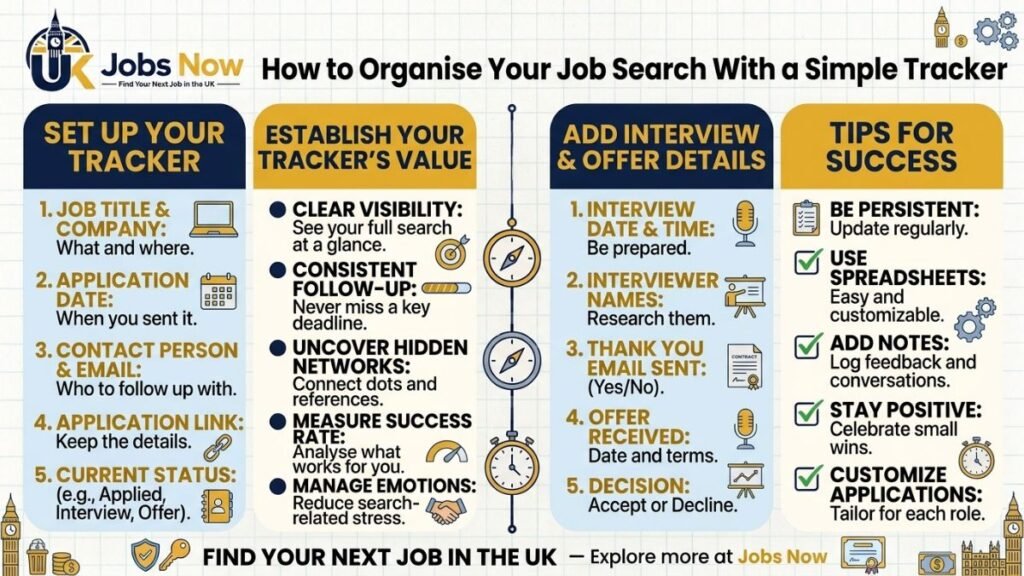
A tracker doesn’t need to be complicated — a simple spreadsheet with a handful of columns covers what genuinely matters for most job seekers:
| Column | Why it matters |
|---|---|
| Company and role title | The basics, obviously — but worth being specific if you’re applying to similar-sounding roles at multiple companies |
| Date applied | Lets you judge realistic response timeframes and know when a polite follow-up is reasonable |
| Application source | Job board, direct company site, recruiter, referral — useful for noticing which channels are actually producing results for you |
| CV/cover letter version used | Particularly useful if you’re tailoring materials differently across applications, so you know exactly what was sent |
| Current status | Applied, interview scheduled, awaiting response, rejected, offer received — a simple status column you update as things move |
| Next action and date | Follow up by [date], prepare for interview on [date] — turns the tracker into a working tool, not just a passive log |
| Salary/key details | Useful for comparing offers later, and for remembering what was actually advertised versus what came up in conversation |
| Notes | Anything specific worth remembering — an interviewer’s name, a detail from the role that stood out, feedback received |
Keeping it simple enough that you’ll actually maintain it
The single biggest risk with any tracking system is building one too elaborate to keep up with — an overly detailed spreadsheet with a dozen columns and complex formulas is more likely to be abandoned within a week than a simple one with the essentials above. Start minimal, and only add complexity if you genuinely find yourself wanting to track something more. A tracker that’s 80% complete and consistently updated is considerably more useful than a perfect one you stopped filling in after the third entry.
Using it to spot patterns, not just record history
The real value of a tracker emerges once you have enough entries to look for patterns rather than just individual records. A few things worth periodically reviewing:
- Response rate by source. If direct applications through company websites are converting to interviews at a noticeably higher rate than a specific job board or recruiter channel, that’s useful information about where to focus more of your effort going forward.
- Response rate by how tailored the application was. If you can honestly categorise applications as “heavily tailored” versus “sent with minimal adjustment,” comparing their outcomes often makes a compelling case for one approach over the other in a way that’s easy to underestimate without the data in front of you.
- Where the process tends to stall. If you’re consistently getting interviews but rarely progressing past a first round, that points to something different needing attention than if you’re rarely getting interview invitations at all. Our guide on realistic UK job search timelines covers how to diagnose exactly this kind of stalling pattern.
A simple weekly review habit
Rather than updating your tracker only when something happens, it’s worth building a short, regular weekly review into your search — ten minutes to update statuses, note any follow-ups due, and glance at the overall picture. This turns the tracker from a passive record into an active tool that actually shapes what you do next, rather than something you only look back on retrospectively.
Following up based on your tracker
One of the most practical uses of a tracker is knowing precisely when a polite follow-up is reasonable, rather than guessing. As a general guide, if you haven’t heard anything within one to two weeks of applying (longer for larger organisations with more formal processes), a brief, polite check-in is appropriate — something like: “I wanted to follow up on my application for [Role] submitted on [date] — I remain very interested in the opportunity and would welcome any update on timeline when convenient.” Having the exact date and role details already logged in your tracker means you’re not scrambling to find this information when you sit down to write the message.
Digital tools versus a simple spreadsheet
Dedicated job search tracking apps and tools exist, and some people find the additional structure genuinely useful, particularly features like automatic reminders or integration with email. For most job seekers, though, a simple spreadsheet (Google Sheets or Excel) is entirely sufficient, more flexible to adapt to your specific search, and doesn’t require learning a new tool’s interface during an already demanding period. Unless you have a specific reason to prefer a dedicated app, starting with a spreadsheet is usually the more practical choice.
What to do once an offer comes in
Having a tracker becomes particularly valuable if you’re fortunate enough to be weighing multiple opportunities at once — comparing salary, working arrangement, and other details side by side is considerably easier when they’re already logged consistently, rather than trying to recall the specifics of a conversation from three weeks earlier. If you reach the point of comparing or negotiating an offer, our guide to negotiating a job offer is worth reading alongside whatever comparison your tracker helps you make.
Staying organised without becoming overwhelmed by the process itself
It’s worth saying plainly: the goal of a tracker is to reduce the mental load of job searching, not add to it. If maintaining a detailed system starts to feel like its own source of stress, it’s entirely reasonable to simplify further — even a basic list of company, date, and status is far better than nothing, and better than trying to hold an increasingly complex search entirely in your head.
Handling multiple CV or cover letter versions without confusion
If you’re tailoring your CV and cover letter meaningfully between applications — which our CV writing guide and cover letter guide both recommend — it’s worth adopting a consistent, simple file naming convention alongside your tracker, such as including the company name and date in each file name. This avoids the genuinely common and embarrassing mistake of accidentally sending the wrong tailored version to the wrong company, which a tracker referencing the exact file used for each application helps prevent.
Using your tracker to prepare for interviews more efficiently
A well-maintained tracker becomes genuinely useful interview preparation material, not just an application log — noting specific details about each role and company as you apply means that when an interview invitation arrives, often weeks after the original application, you’re not starting your research entirely from scratch. A few lines in your notes column about why you were drawn to a specific role, and any particular detail from the listing worth mentioning, can save real time when you sit down to prepare.
Frequently Asked Questions
Do I need special software to track my job applications?
No — a simple spreadsheet is entirely sufficient for most job seekers and is more flexible than most dedicated tracking apps, without requiring you to learn a new tool during an already demanding period.
How often should I update my job application tracker?
A short weekly review is a reasonable habit — updating statuses, noting any follow-ups due, and glancing at your overall search patterns — rather than only updating it reactively when something specific happens.
What’s the most useful thing a tracker can tell me?
Where your search is actually stalling — at the application stage, the interview stage, or the offer stage — since each points to a different, more targeted fix, and this pattern is genuinely hard to see clearly without a record to look back on.
Should I track applications I don’t hear back from?
Yes — even applications with no response are useful data, particularly if you’re tracking response rate by source or by how tailored the application was, since silence is itself a meaningful (if disappointing) outcome to include in your overall picture.
Is a job application tracker really necessary for a short search?
For a very short, small-scale search, it’s less critical, but even a handful of simultaneous applications benefits from a basic record — it takes very little time to set up and prevents the kind of avoidable confusion (missed follow-ups, duplicate applications) that can happen even with a manageable number of active applications.