Overtime Pay in the UK: Your Rights and How It Is Calculated
Overtime is one of the most common sources of confusion at work. Does your employer have to pay you extra for working longer? Can they make you work extra hours? What if you are on a salary? And how is overtime pay worked out? In the UK the law on overtime is less generous than many people expect: there is no automatic right to overtime pay at all. But there are important limits that protect you, including the minimum wage, the 48-hour working week and the way regular overtime affects your holiday pay. This guide explains your rights in 2026, how overtime is calculated, and what to do if you are not being paid properly.
Quick answer: There is no general legal right to be paid extra for overtime in the UK. What you are paid comes from your contract. But your average pay across all the hours you work must never fall below the minimum wage (£12.71 an hour for workers aged 21 and over from April 2026), and you generally cannot be made to work more than an average of 48 hours a week unless you sign an opt-out.
What is overtime?
Overtime generally means work done over and above the basic hours in your contract. For example, if your contract is for 37.5 hours a week and you work 42, the extra 4.5 hours are overtime.
| Type | What it means |
|---|---|
| Compulsory (contractual) overtime | Your contract says you must work extra hours when asked, or a set number of extra hours each week |
| Guaranteed overtime | The employer must offer, and you must work, a set amount of overtime, which is part of your normal pay |
| Voluntary (non-guaranteed) overtime | The employer offers extra hours and you can choose whether to take them |
| Unpaid overtime | Extra hours for no extra pay, common for salaried staff |
| Time off in lieu (TOIL) | You get time off instead of extra pay |
Is there a legal right to overtime pay?
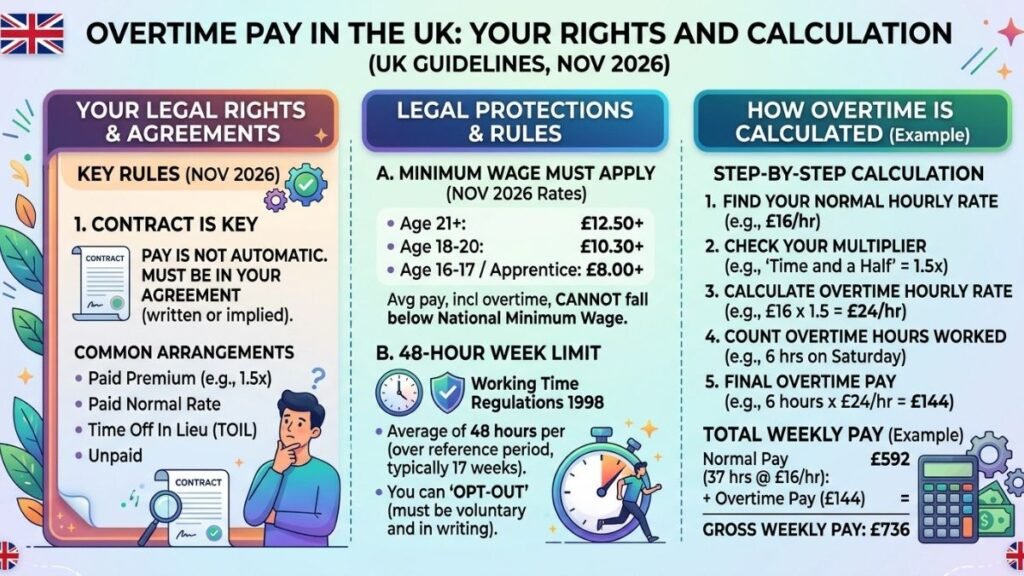
No. According to the government’s guidance, there is no legal right to pay for working extra hours, and no minimum statutory level of overtime pay, although your average pay rate must not fall below the minimum wage. The rate depends on your contract, staff handbook or any agreement with your employer.
Some important consequences:
- Your contract rules. If it says you are paid time and a half after 40 hours, that is legally enforceable. If it says nothing, your employer may be entitled to pay the normal rate, or nothing extra for a salaried worker, as long as the minimum wage and working time rules are met.
- Overtime rates vary. Some employers pay time and a half (1.5 times your normal rate) or double time (2 times). Others pay the normal rate. Extra pay for weekends, bank holidays or nights is a matter for your contract.
- Custom and practice can also matter. If an employer has regularly paid overtime at a certain rate over many years, that may become an implied term. Ask Acas or a union if this is relevant.
- Public sector and large employers often have set enhanced rates in collective agreements or pay scales, such as in the NHS. See our guide to NHS jobs.
Can you be forced to work overtime?
You only have to work overtime if your contract says so, or you have agreed to it. Even if your contract includes an overtime clause:
- Your employer should act reasonably, for example by giving notice where possible.
- You generally cannot be forced to work more than an average of 48 hours a week unless you have signed an opt-out (see below).
- Health and safety and rest rules still apply.
- You may have good reasons to refuse in some cases, such as caring responsibilities, and employers should consider reasonable requests. See our guide to flexible working in the UK.
You should not be dismissed or treated badly for refusing to work hours that would breach the Working Time Regulations, or for refusing to opt out of the 48-hour limit. See our guide to unfair dismissal in the UK.
The minimum wage floor
This is the most important legal protection for overtime. Your average hourly pay across all the hours you actually work in a pay period must not fall below the National Minimum Wage or National Living Wage for your age.
| Age | Minimum hourly pay from April 2026 |
|---|---|
| 21 and over | £12.71 |
| 18 to 20 | £10.85 |
| Under 18 | £8.00 |
| Apprentices (under 19, or first year) | £8.00 |
See our National Minimum Wage 2026 guide for details.
Salaried workers and unpaid overtime
Salaried workers are often expected to work extra hours without extra pay. That is lawful, but only while the salary divided by all hours worked stays at or above the minimum wage.
How to check: divide your weekly pay by the total hours you actually work in a week (including unpaid overtime).
| Salary | Weekly pay | Hours worked | Effective hourly rate | Above £12.71? |
|---|---|---|---|---|
| £25,000 | £480.77 | 37.5 | £12.82 | Yes, just |
| £25,000 | £480.77 | 45 | £10.68 | No. Below the minimum wage |
| £30,000 | £576.92 | 45 | £12.82 | Yes, just |
| £30,000 | £576.92 | 50 | £11.54 | No. Below the minimum wage |
These are my own approximate calculations for a full-time worker aged 21 or over, using £12.71 as the minimum. At a £30,000 salary, the most hours you could be expected to work without extra pay before dropping below the minimum is about 45 hours a week. The rules for salaried staff depend on how the pay reference period and the type of work are defined, so check GOV.UK or ask Acas if you are close to the line.
If your pay falls below the minimum wage once unpaid overtime is counted, you are entitled to back pay. You can complain to your employer, contact Acas or report your employer to HMRC.
How overtime pay is calculated
For hourly-paid workers
Overtime pay = overtime hours × normal hourly rate × overtime multiplier.
Common multipliers are:
| Rate | Multiplier |
|---|---|
| Basic or straight time | 1× |
| Time and a quarter | 1.25× |
| Time and a half | 1.5× |
| Double time | 2× |
Example: you earn £14 an hour, with a contract that says time and a half after 40 hours. You work 46 hours.
- Basic pay: 40 hours × £14 = £560
- Overtime: 6 hours × £14 × 1.5 = £126
- Total gross pay: £686
For salaried workers with paid overtime
If your contract entitles you to paid overtime, you first need an hourly rate.
Hourly rate = annual salary ÷ 52 ÷ weekly contracted hours.
Example: a salary of £30,000 and 37.5 contracted hours a week.
- £30,000 ÷ 52 = £576.92 a week
- £576.92 ÷ 37.5 = £15.38 an hour
- Time and a half = £23.08 an hour
- Double time = £30.77 an hour
Check how your contract defines the formula. Some employers use a different method, such as dividing by a standard number of hours a year.
For shift workers and premium rates
Some sectors pay set premiums, such as a Sunday premium, a night shift allowance or bank holiday rates. These may be expressed as a fixed amount per hour or as a multiplier. Check your contract and payslips. See our guides to hospitality jobs, care worker jobs, warehouse jobs and supermarket jobs for typical pay and premiums.
How much of the extra pay do you keep?
Overtime pay is taxed as normal income. For a typical employee in England, Wales and Northern Ireland in 2026/27, your next pound of pay loses about 28% to Income Tax and National Insurance in the basic-rate band, or 42% above £50,270, plus 9% if you repay a student loan. If you claim Universal Credit, 55p of each extra pound is deducted above any work allowance. See our guides to take-home pay in the UK 2026/27 and Universal Credit and work.
The 48-hour working week
Under the Working Time Regulations 1998, most workers cannot be made to work more than an average of 48 hours a week, normally averaged over 17 weeks.
- Overtime counts towards the 48 hours.
- Averaging means you can work more than 48 hours in some weeks, as long as the average over the reference period is 48 or less.
- Opt-out. You can choose to sign a written agreement to opt out of the 48-hour limit. It must be voluntary: you cannot be forced or penalised for refusing, and an opt-out should not be a condition of getting the job. You can cancel an opt-out by giving notice (normally seven days, or up to three months if the agreement says so).
- Exceptions. Some jobs are outside the 48-hour rules, for example senior managers who control their own working hours, and some emergency and security services, and there are special rules for some sectors such as transport.
- Young workers. Under-18s cannot work more than 8 hours a day or 40 hours a week and cannot opt out. See our guide to jobs for 16 and 17 year olds.
Rest breaks and rest periods
Even when you do overtime, you are generally entitled to:
- A 20-minute break if you work more than six hours
- 11 hours of rest between working days
- A weekly rest period: 24 hours a week (or 48 hours a fortnight)
- Special limits for night workers, who should not average more than eight hours in a 24-hour period, with health assessments
These are minimums. Your contract may give more. If your hours regularly breach these rules, speak to your employer, the Health and Safety Executive or your local authority, or contact Acas.
Overtime and your other pay and benefits
Holiday pay
Holiday pay should reflect your normal pay. The government’s guidance says overtime is taken into account for holiday pay when it is guaranteed as part of your contract. In addition, court decisions have held that regular overtime, even voluntary, must be included in holiday pay for the first four weeks of statutory leave, normally averaged over the previous 52 paid weeks. The position can be complicated, so check with Acas if you think your holiday pay is too low. See our guide to holiday entitlement and holiday pay.
Sick pay
Statutory Sick Pay is based on your average weekly earnings, which include overtime if you are paid it regularly, but the weekly rate is capped at £123.25 in 2026/27. Many contractual sick pay schemes use basic pay only. See our guide to Statutory Sick Pay 2026.
Pensions
Overtime can count as qualifying earnings for workplace pension contributions if your scheme uses total pay, but some schemes use basic pay only. Check your scheme. See our guide to workplace pensions explained.
Redundancy, notice and family leave
Whether overtime counts for redundancy pay, notice pay and statutory family pay depends on whether it is guaranteed or regular and on how the rules define a week’s pay. See our guides to redundancy rights in the UK and maternity, paternity and shared parental leave and pay.
Payslips
Your payslip should show overtime separately or as part of your total hours and pay. Check that hours, rates and totals are right. See our guide to payslips, tax codes and National Insurance.
Time off in lieu (TOIL)
Some employers offer time off in lieu instead of pay for overtime. The law leaves most of the details to you and your employer, so ask:
- How much time off does an hour of overtime earn? Is it 1 hour, or 1.5 for time-and-a-half equivalent?
- When must it be taken, and how much notice is needed?
- What happens to unused TOIL at the end of the year, or when you leave?
- How is it recorded?
TOIL does not remove the minimum wage requirement. If you bank a lot of hours in one pay period and receive no extra pay, your average pay for that period can still fall below the minimum. Get the arrangement in writing. See our guide to understanding your employment contract.
Overtime on different contracts
- Part-time workers. If you work more than your contracted hours, you are entitled to be treated no less favourably than full-time workers, for example in the rate you receive for extra hours once you pass the full-time threshold if full-timers would get a premium. Check your contract and take advice.
- Zero-hours and casual workers. The concept of overtime may not apply, but the minimum wage and the 48-hour limit do. See our guide to zero-hours contracts.
- Agency workers. After 12 weeks in the same role you are entitled to equal treatment on basic pay and working time, which can include overtime rates. Ask the agency how this applies.
- Apprentices. The apprentice minimum wage applies to all hours worked, including overtime. See our guide to apprenticeships in the UK.
- Self-employed people. Overtime does not apply, because you set your own hours and rates. See our guide to how to become self-employed in the UK.
- Drivers. Drivers’ hours rules apply as well as working time rules. See our guides to HGV driver jobs and delivery driver jobs.
What if you are not paid for overtime you were promised?
If your contract or an agreement says you will be paid for overtime and you are not, that can be an unlawful deduction from wages or a breach of contract. Here is what to do.
- Keep records. Note the dates, start and finish times and what you worked on. Save emails and messages that request or approve overtime, rotas, clocking records and payslips.
- Check your contract and handbook for the overtime clause and rates. See our guide to understanding your employment contract.
- Work out what you are owed, including holiday pay effects.
- Raise it informally with your manager or payroll, and ask for a correction in writing.
- Raise a formal grievance if that does not work, following the Acas Code. See our guide to disciplinary and grievance procedures in the UK.
- Contact Acas for free advice and early conciliation. If your pay is below the minimum wage you can also report it to HMRC.
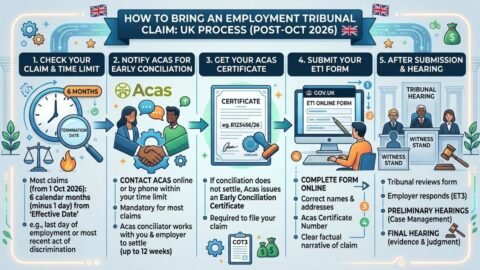
- Consider a tribunal claim for unlawful deductions or breach of contract. Time limits apply and are strict, normally six months for events on or after 1 October 2026, after contacting Acas, though some claims have different limits. Check the position early.
Overtime and job adverts
Be careful when adverts promise a high income through “unlimited overtime”. Check:
- The base rate, which must meet the minimum wage.
- Whether overtime is guaranteed or only sometimes available.
- The overtime rate and when it applies.
- The hours, and whether they comply with working time rules.
Adverts that promise very high earnings for easy work, or that ask you to pay to start, can be scams. See our guide to how to spot a fake job advert in the UK. You can browse real vacancies on our UK jobs board.
Practical tips for workers
- Read your contract before you accept a job, especially the overtime, hours and pay clauses.
- Track your hours, even if you are salaried, so you can check your effective hourly rate.
- Ask before you work extra hours whether they will be paid or recorded as TOIL, and get it in writing.
- Do not sign a 48-hour opt-out without thinking. You can refuse, and you can withdraw later.
- Keep an eye on your health. Long hours affect sleep, safety and wellbeing.
- Raise concerns early. If you are regularly doing unpaid overtime, discuss workload, pay and priorities with your manager. See our guide to how to ask for a pay rise or negotiate salary in the UK.
- Join a union if you can. Unions can negotiate overtime rates and help with disputes.
Frequently asked questions
Do employers have to pay overtime in the UK? No. There is no general legal right to overtime pay. What you are paid depends on your contract, but your average pay across all hours worked must meet the minimum wage.
Is time and a half the law? No. Time and a half and double time are common conventions, not legal requirements, unless your contract says so.
Can my employer make me work overtime? Only if your contract requires it or you agree. You also cannot normally be made to work more than an average of 48 hours a week without an opt-out.
Is unpaid overtime legal? Yes, for salaried staff, as long as your average hourly pay across all hours worked stays at or above the minimum wage and working time limits are respected.
How do I calculate my hourly rate from my salary? Divide your annual salary by 52 to get a weekly figure, then divide by your weekly contracted hours.
Does overtime count towards holiday pay? Guaranteed overtime does, and regular overtime generally must be included for the first four weeks of statutory leave. Check with Acas if you are unsure.
What is the 48-hour opt-out? A voluntary written agreement to work more than an average of 48 hours a week. You can refuse to sign, and you can cancel it with notice.
What is TOIL? Time off in lieu. It means taking time off instead of being paid for overtime, on terms agreed with your employer.
What can I do if my overtime is not paid? Keep records, check your contract, raise it with your employer, contact Acas and, if needed, make a claim. Report minimum wage problems to HMRC.
Final thoughts
Overtime can boost your income, but it is not guaranteed, and you need to protect yourself with a clear contract, good records and an eye on the minimum wage. When you are ready for your next role, browse the latest vacancies on our jobs board and ask about overtime before you accept.
This article is general information, not legal advice. Employment law is complex, and your contract and circumstances matter. Check GOV.UK and Acas for the latest guidance, and seek advice about your own situation.