Returning to Work After a Career Break: A Practical Guide
Coming back to work after an extended break — whether for maternity or parental leave, caring responsibilities, health reasons, or simply a deliberate pause — brings a specific kind of uncertainty that’s genuinely different from a standard job search: not just “will I get hired” but “does my previous experience still count, and how do I even talk about the gap.” This is a practical, honest guide to actually rebuilding momentum, adapted specifically for the return-to-work situation rather than a generic job search.
Why returning to work needs a different approach than a standard job search
Most job search advice assumes a fairly continuous, recent employment history to draw on, which doesn’t quite fit the return-to-work situation — your most relevant experience might be several years old, your confidence in specific skills may have genuinely faded through disuse rather than any real loss of underlying ability, and you’re navigating a genuine, real question about how much detail to share about the reason for your break. Recognising that this situation warrants its own specific strategy, rather than applying generic job search advice unchanged, tends to produce a smoother return.
Rebuilding confidence before you start applying
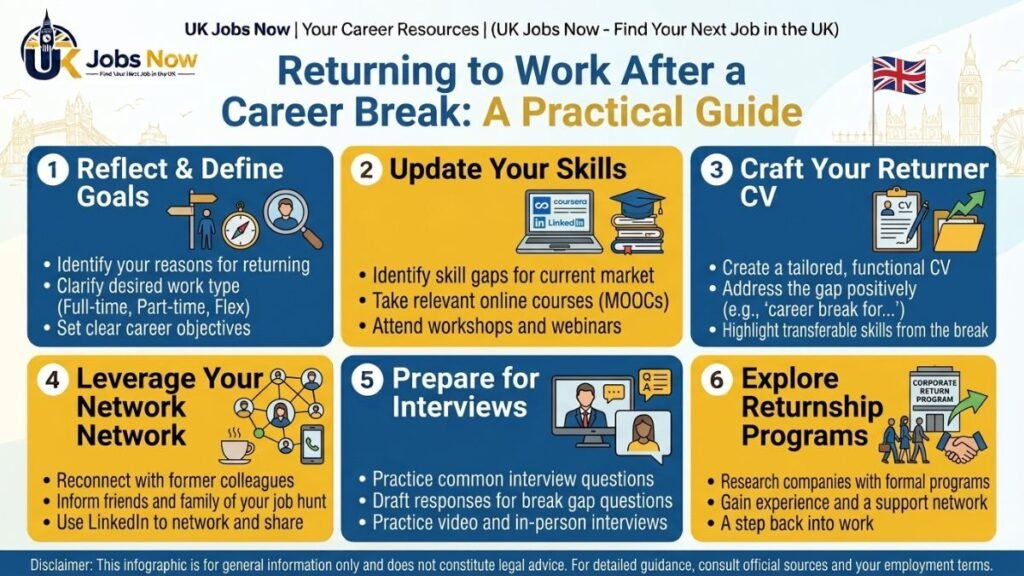
It’s genuinely common, and completely understandable, for confidence to have eroded somewhat during an extended break, even when your underlying skills and capability haven’t meaningfully diminished at all. A few practical, low-stakes steps can help rebuild this before you’re in front of a prospective employer: a short refresher course in a specific relevant skill, informal conversations with former colleagues to reconnect with your professional network and remind yourself of your own expertise, or simply reviewing your own past achievements and writing them down concretely, which is often more reassuring than it sounds once you actually see the full list in front of you.
Addressing the gap on your CV
As covered in more depth in our guide to explaining a career gap on your CV, a brief, confident, factual line — “Career break for family reasons,” “Career break following [specific circumstance]” — is generally sufficient, rather than an extended, apologetic explanation. If you undertook any relevant activity during your break — informal volunteering, freelance work, relevant courses, or even significant caring responsibilities that genuinely built transferable skills like organisation and multitasking — it’s worth including this specifically, since it demonstrates the time wasn’t simply empty from a professional development perspective.
Returnship programmes: a genuinely useful, specific route
Some UK employers, particularly larger organisations, run structured “returnship” programmes specifically designed for people re-entering the workforce after an extended break, often combining a paid placement with additional support and refresher training recognising that a capable, experienced professional returning after a break needs a slightly different onboarding than someone with continuous recent experience. These programmes can be genuinely valuable precisely because they’re designed around your specific situation rather than expecting you to fit a standard recruitment process built for continuously employed candidates.
How to talk about your break in an interview
If asked directly about your break, a short, confident, forward-looking answer generally lands better than either an overly detailed explanation or visible discomfort with the topic — something like “I took time away for [brief reason], and I’m genuinely ready and excited to return to [specific type of role], bringing [specific relevant strength] with me” does the job efficiently and pivots the conversation productively back toward your genuine value as a candidate. You’re not obligated to share more detail than you’re comfortable with, particularly around health or personal circumstances, and a reasonable interviewer won’t push further once you’ve clearly and politely indicated the topic is addressed.
Updating your skills for a changed working landscape
| Area | What’s worth checking |
|---|---|
| Software and technical tools | Tools and systems commonly used in your field may have changed — worth researching current standard tools before interviews |
| Working practices | Remote and hybrid working, covered in our guide to remote and hybrid work, may be considerably more normalised in your field now than when you last worked |
| Industry developments | Worth catching up on genuine, significant developments in your specific field during your time away |
| Application processes | Digital application platforms, video interviews, and online assessments, covered in our guides to video interviews and psychometric tests, may be more prevalent now than during your last job search |
Practical logistics worth considering
If your return is connected to childcare or other caring responsibilities, it’s worth having a genuinely realistic plan for how this will work practically before starting a new role, since being caught off guard by a logistical gap in the first few weeks adds unnecessary pressure to an already significant transition. This isn’t something you’re obligated to discuss with a prospective employer in detail, but having it genuinely sorted for yourself supports a smoother, more confident start.
Returning after maternity or parental leave specifically
If you’re returning to your existing employer after statutory maternity, paternity, shared parental, or adoption leave, you have specific legal protections worth understanding clearly — the right to return to the same job after up to 26 weeks of leave, or a similar job on the same terms after a longer period, along with protection from discrimination connected to your leave, all of which are worth reviewing directly on GOV.UK before any conversation with your employer about your specific return date. If you’re instead job searching fresh after this kind of leave, rather than returning to a previous employer, the general guidance in this article applies, alongside the same broader employment protections against discrimination based on pregnancy or maternity that apply throughout any UK hiring process.
Networking your way back in
Reconnecting with your professional network, covered in more depth in our guide to networking, is particularly valuable during a return to work specifically, since former colleagues and contacts already have direct, genuine knowledge of your actual capability, which can meaningfully shortcut some of the trust-building that a completely cold application to an unfamiliar employer would otherwise require. A simple, genuine message to a handful of former colleagues — letting them know you’re returning to the workforce and open to opportunities — is a low-effort, often surprisingly effective starting point that many people returning to work skip entirely out of hesitation or a sense of awkwardness that usually turns out to be unfounded.
Managing the emotional side of returning
It’s worth acknowledging directly that returning to work after a significant break can bring up genuine, complicated feelings beyond simple job-search logistics — a mix of excitement, anxiety, and sometimes grief for the version of your career that might have progressed differently without the break. These feelings are normal and don’t indicate anything is wrong with your decision to return; giving yourself permission to feel genuinely mixed about the transition, rather than expecting unambiguous enthusiasm throughout, tends to make the whole process feel considerably less internally conflicting than pretending otherwise.
Getting started
Once you’ve rebuilt some confidence and updated your CV to reflect your break clearly and confidently, you can browse current active UK job listings and begin applying with a genuine, considered strategy rather than either rushing back in or delaying indefinitely out of uncertainty about how to approach the return.
Frequently Asked Questions
How do I explain a long career break in a job interview?
A short, confident, forward-looking answer — briefly stating the reason and pivoting to your readiness and relevant strengths — generally works better than an extended, apologetic explanation. You’re not obligated to share more detail than you’re comfortable with.
What is a returnship programme?
A structured programme, run by some larger UK employers, specifically designed for people re-entering the workforce after an extended break, often combining a paid placement with additional support and refresher training tailored to this specific situation.
Will my skills still be valued after a long break from work?
Generally yes — underlying skills and capability don’t typically diminish significantly during a break, even if confidence has eroded somewhat, and reviewing your genuine past achievements can help remind you of this before you start applying.
Should I mention volunteering or informal activity done during my career break?
Yes, if it’s genuinely relevant — informal volunteering, freelance work, relevant courses, or transferable skills built through caring responsibilities are all worth including, since they demonstrate the time wasn’t professionally empty.
How do I catch up on changes in my industry after being away?
Research current standard tools, working practices, and significant developments in your specific field before interviews — a returnship programme, where available, can also provide structured support for this kind of catch-up.