Bank Holiday Pay and Working on Bank Holidays in the UK
Bank holidays cause more confusion at work than almost any other topic. Are you entitled to the day off? Should you be paid more for working one? Do bank holidays count as part of your annual leave? And what happens if you work part time or on a zero-hours contract? The answers surprise many people, because the law gives much less than most assume: there is no automatic right to time off or extra pay on bank holidays. What you get depends on your contract. This guide explains the rules for 2026 and 2027, shows how to work out your entitlement, lists the dates for each part of the UK and covers what to do if you think you are being treated unfairly.
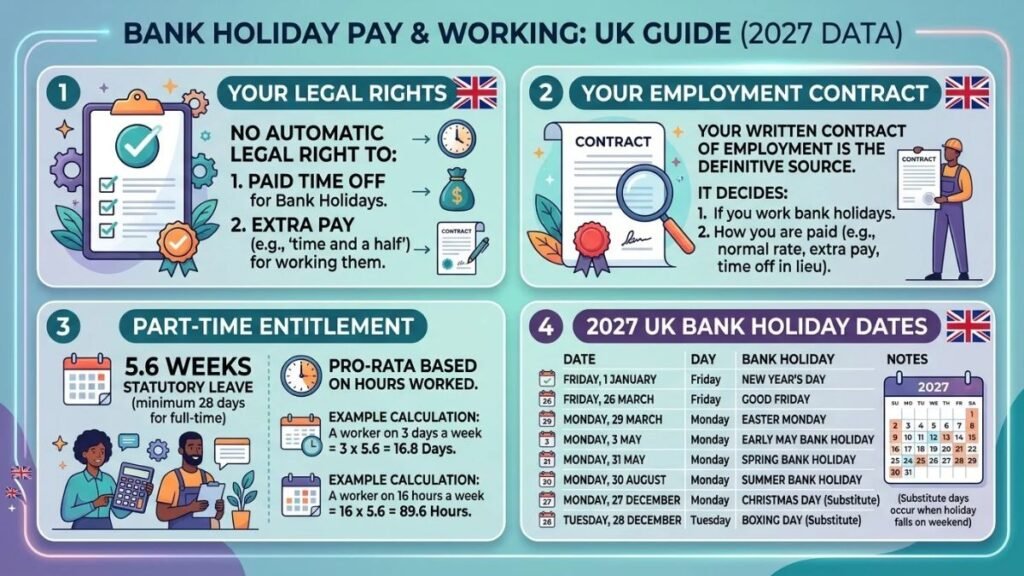
Quick answer: There is no legal right to take a bank holiday off, and no legal right to extra pay for working one. What you get depends on your employment contract. Employers can count bank holidays as part of your minimum 5.6 weeks (28 days) of paid annual leave, or give them on top. Part-time workers must not be treated less favourably than full-time colleagues, so they should get a fair, pro rata share.
What the law says
There are 8 bank holidays a year in England and Wales, 9 in Scotland and 10 in Northern Ireland. But the rules are often misunderstood:
- No automatic day off. Bank holidays are not statutory days of leave for workers. Your employer can ask you to work them if your contract allows.
- No automatic extra pay. There is no legal rate of enhanced pay for bank holiday work. If you receive time and a half or double time, it is because your contract, staff handbook or an agreement says so.
- They can count towards your leave. Your legal minimum is 5.6 weeks of paid holiday a year (28 days for a five-day week). Your employer may include bank holidays within that 28 days, or give them in addition.
- Your contract decides. Check whether it says “28 days including bank holidays” or “28 days plus bank holidays”, and what it says about working on them.
Our guide to holiday entitlement and holiday pay explains the basic 5.6-week entitlement and how holiday pay is calculated.
Inclusive or additional?
| Contract wording | What it means in England and Wales |
|---|---|
| 28 days including bank holidays | You have 28 days in total. The 8 bank holidays use up 8 of them, leaving 20 days to choose |
| 28 days plus bank holidays | You have 28 days to take as you wish, plus the 8 bank holidays, so 36 days in total |
| Contract is silent | The safest reading is that bank holidays count towards the statutory 5.6-week minimum and are taken as paid leave |
Many employers go beyond the minimum, for example 25 days plus bank holidays, but that is a contract choice. Always check your written terms. See our guide to understanding your employment contract.
Bank holiday dates: remaining 2026 and 2027
Bank holidays differ across the UK. When a bank holiday falls on a weekend, a substitute day is usually given on the next working day.
Rest of 2026
| Date | Day | Holiday | Where |
|---|---|---|---|
| 30 November | Monday | St Andrew’s Day | Scotland |
| 25 December | Friday | Christmas Day | UK-wide |
| 28 December | Monday | Boxing Day (substitute) | UK-wide |
Boxing Day falls on Saturday 26 December 2026, so the substitute day is Monday 28 December.
2027: England and Wales (8 days)
| Date | Day | Holiday |
|---|---|---|
| 1 January | Friday | New Year’s Day |
| 26 March | Friday | Good Friday |
| 29 March | Monday | Easter Monday |
| 3 May | Monday | Early May bank holiday |
| 31 May | Monday | Spring bank holiday |
| 30 August | Monday | Summer bank holiday |
| 27 December | Monday | Christmas Day (substitute) |
| 28 December | Tuesday | Boxing Day (substitute) |
2027: Scotland (9 days)
| Date | Day | Holiday |
|---|---|---|
| 1 January | Friday | New Year’s Day |
| 4 January | Monday | 2 January (substitute) |
| 26 March | Friday | Good Friday |
| 3 May | Monday | Early May bank holiday |
| 31 May | Monday | Spring bank holiday |
| 2 August | Monday | Summer bank holiday |
| 30 November | Tuesday | St Andrew’s Day |
| 27 December | Monday | Christmas Day (substitute) |
| 28 December | Tuesday | Boxing Day (substitute) |
Scotland does not have Easter Monday as a bank holiday, and its summer bank holiday is earlier than elsewhere in the UK. Local holidays may also apply in some Scottish areas.
2027: Northern Ireland (10 days)
| Date | Day | Holiday |
|---|---|---|
| 1 January | Friday | New Year’s Day |
| 17 March | Wednesday | St Patrick’s Day |
| 26 March | Friday | Good Friday |
| 29 March | Monday | Easter Monday |
| 3 May | Monday | Early May bank holiday |
| 31 May | Monday | Spring bank holiday |
| 12 July | Monday | Battle of the Boyne (Orangemen’s Day) |
| 30 August | Monday | Summer bank holiday |
| 27 December | Monday | Christmas Day (substitute) |
| 28 December | Tuesday | Boxing Day (substitute) |
These dates come from the GOV.UK list as reproduced by several calendars. Check GOV.UK for the official dates and any changes, because the government can proclaim additional bank holidays.
Do you get paid more for working a bank holiday?
Only if your contract says so. Common arrangements include:
| Arrangement | Example |
|---|---|
| Normal pay | You are paid your usual rate, with no extra |
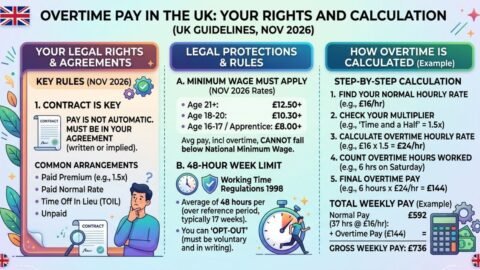
| Time and a half (1.5×) | A £14 an hour worker earns £21 an hour |
| Double time (2×) | A £14 an hour worker earns £28 an hour |
| A fixed premium | An extra £2 or £3 an hour, or a flat bonus for the day |
| Time off in lieu (TOIL) | A day off at another time instead of extra pay |
| Both | Enhanced pay and a day off in lieu, common in some public services |
The minimum wage still applies. Your average pay across all hours worked in the pay period must be at least the legal minimum, which is £12.71 an hour for workers aged 21 and over from April 2026. See our National Minimum Wage 2026 guide and our guide to overtime pay in the UK, because a bank holiday shift beyond your normal hours may also count as overtime.
Enhanced rates are common in certain sectors, such as hospitality, retail, care and health, but they are not universal. Check your contract, your offer letter and your payslips. See our guides to hospitality jobs, care worker jobs, supermarket jobs and NHS jobs.
Can your employer make you work on a bank holiday?
If your contract says you may be required to work bank holidays, or your normal pattern includes them, then yes. Points to know:
- Your employer should act reasonably and give as much notice of rotas as possible.
- You cannot normally refuse if the contract requires it, but you may ask for flexibility, such as swapping a shift. See our guide to flexible working in the UK.
- Working time limits still apply. You must still get your rest breaks and rest periods, and your hours must stay within the 48-hour average unless you have opted out.
- Religious or caring needs. There is no right to a day off for a religious festival, but employers must not discriminate, and should consider reasonable requests. A refusal that disadvantages people with a particular belief or with caring responsibilities may be unlawful in some circumstances. Contact Acas if you have a concern.
- Shops and Sunday rules. In England and Wales, larger shops have special rules on Sunday and Christmas Day opening, and shop workers generally have a right to opt out of Sunday working, with notice. Check GOV.UK and Acas if you work in retail. See our guide to Christmas jobs in the UK 2026 for the festive period.
If your employer asks you to work a bank holiday and your contract does not say you must, you can agree to it voluntarily, and it is reasonable to ask what you will receive in return.
Part-time workers: a fair share
Bank holidays often fall on Mondays. Someone who works Tuesday to Friday never has a Monday bank holiday on a working day, so they could lose out. The Part-Time Workers Regulations say part-time workers must not be treated less favourably than comparable full-time colleagues. In practice:
- If full-time staff get bank holidays on top of their annual leave, part-time staff should get a pro rata share, even if the day is not one they would normally work.
- If bank holidays are included in the 28 days, part-time staff get the same proportion of 5.6 weeks, as normal, and bank holidays that fall on working days are deducted from it.
- Employers often use a pro rata method in hours or days, so everyone gets a fair amount.
How to work out your share
Pro rata bank holiday entitlement = (your weekly hours ÷ full-time weekly hours) × full-time bank holiday entitlement.
| Example | Calculation | Your bank holiday allowance |
|---|---|---|
| Works 3 days a week (60% of a five-day week), 8 bank holidays | 8 × 3 ÷ 5 | 4.8 days |
| Works 20 hours a week when full time is 37.5 hours, with 8 bank holidays of 7.5 hours each (60 hours) | 60 × 20 ÷ 37.5 | 32 hours |
| Works 2 days a week, 8 bank holidays | 8 × 2 ÷ 5 | 3.2 days |
These are my own examples. Check how your employer calculates it, and ask for an explanation in writing. If you think you are being treated less favourably than full-time staff, raise it with your employer and contact Acas.
Zero-hours, agency and irregular-hours workers
- Holiday builds up as you work. If you work irregular hours, you accrue 12.07% of the hours you work as paid holiday, either paid when you take leave or rolled up into your pay. Bank holidays are not extra, because they are part of that entitlement. Check your payslip shows holiday pay clearly. See our guide to zero-hours contracts.
- If you are not offered shifts on a bank holiday, you generally will not be paid for that day, unless your contract guarantees hours.
- If you work on a bank holiday, you are paid your usual rate or an enhanced one if the contract provides for it.
- Agency workers. After 12 weeks in the same role, you are entitled to equal treatment on basic pay and working time with comparable permanent staff, which can include enhanced rates. Ask the agency how this applies to you. See our guide to warehouse jobs for typical agency arrangements.
Bank holidays and your annual leave
- Bank holidays that fall on days you normally work are usually deducted from your leave if your contract treats them as part of your entitlement.
- Shutdowns. If your employer closes for Christmas, it can require you to use annual leave, provided it gives you notice at least twice the length of the leave. Check your contract. See our guide to holiday entitlement and holiday pay.
- Starters and leavers. Your entitlement is usually pro rated for the part of the leave year you work, so bank holidays outside your employment do not count for you.
- Sickness and family leave. You keep building up leave while off sick or on family leave, and bank holidays during maternity or other family leave are normally treated as leave you have taken, so check your contract and policy. See our guides to Statutory Sick Pay 2026 and maternity, paternity and shared parental leave and pay.
- Term-time workers. Bank holidays that fall in school holidays do not affect you, but pay is calculated pro rata. See our guide to teaching assistant jobs.
Does bank holiday pay affect holiday pay and other pay?
- Holiday pay. If you regularly receive an enhanced rate or regular overtime for bank holiday work, it may need to be included in your holiday pay, calculated over the previous 52 paid weeks. Guaranteed overtime counts, and case law means regular overtime generally does too, so check with Acas if your holiday pay looks low.
- Statutory Sick Pay and statutory pay. These are based on your average earnings, which may include regular bank holiday premiums.
- Pensions. Some schemes include enhanced pay as qualifying earnings. See our guide to workplace pensions explained.
- Universal Credit. Extra pay from bank holiday work is counted as earnings. See our guide to Universal Credit and work.
- Tax. Extra pay is taxed in the normal way. See our guide to take-home pay in the UK 2026/27.
Bank holidays in different jobs
| Sector | What to expect |
|---|---|
| Retail and supermarkets | Often open on bank holidays, with some employers paying a premium or giving time off in lieu. Easter Sunday and Christmas Day closures apply to large shops in England and Wales |
| Hospitality | Busy on bank holidays. Many employers pay premiums, and tips and tronc are separate. See our hospitality jobs guide |
| Care and health | Services run all year, so staff often work bank holidays, with enhanced pay or time off in lieu. NHS staff are covered by national terms, so check NHS Employers |
| Warehousing and logistics | Often a mix of working and closed days, depending on the site |
| Office, school and public sector jobs | Usually closed, with bank holidays counted in or on top of leave |
| Self-employed people | Set your own hours and rates. Many charge more on bank holidays |
What to do if you think you are being treated unfairly
- Check your contract, offer letter and handbook for bank holiday terms.
- Keep records of your shifts, pay and any promises about bank holiday pay or time off.
- Compare with colleagues where you can, particularly full-time versus part-time treatment.
- Raise it informally with your manager or HR, and ask for a written explanation.
- Raise a grievance if needed. See our guide to disciplinary and grievance procedures in the UK.
- Contact Acas for free advice and early conciliation. Time limits for tribunal claims are strict, normally six months for most claims for events on or after 1 October 2026, after contacting Acas.
- Report minimum wage problems to HMRC. If your bank holiday pay is unlawfully low or unpaid, you may have a claim for unlawful deductions.
Tips for job seekers
- Ask before you accept a job how bank holidays work: whether they are included in annual leave, whether you will be asked to work them and whether enhanced pay or time off in lieu applies.
- Check the whole package, not just the hourly rate. A job with 20 days plus bank holidays and premium pay may be worth more than a higher rate with fewer benefits.
- Look at the advert, the contract and the staff handbook. Browse current vacancies on our UK jobs board.
- If you are a parent or carer, ask about shift swaps and flexibility. See our guide to jobs that fit around school hours and childcare in the UK.
- Beware of scams that promise very high bank holiday pay to start work, or ask for fees. See our guide to how to spot a fake job advert in the UK.
Frequently asked questions
Do I have a legal right to bank holidays off? No. There is no statutory right to take a bank holiday off. It depends on your contract.
Do I get paid extra for working a bank holiday? Only if your contract or an agreement says so. There is no legal rate of extra pay.
Do bank holidays count as part of my 28 days’ holiday? They can. Your employer may include bank holidays within your 28 days, or give them in addition. Check your contract.
How many bank holidays are there in the UK? Eight in England and Wales, nine in Scotland and ten in Northern Ireland.
Do part-time workers get bank holidays? Part-time workers must not be treated less favourably than full-time colleagues, so they should get a pro rata share, even if bank holidays fall on days they do not work.
Can my employer make me work on a bank holiday? If your contract allows it or you agree, yes. They should give reasonable notice, and working time limits still apply.
What is the substitute day for Christmas in 2026? Christmas Day is Friday 25 December 2026, and Boxing Day’s substitute is Monday 28 December.
When is the summer bank holiday in 2027? Monday 30 August in England, Wales and Northern Ireland, and Monday 2 August in Scotland.
Do zero-hours workers get bank holiday pay? They build up holiday at 12.07% of hours worked. Bank holidays are not extra, and if you are not given shifts you are generally not paid for that day.
Final thoughts
Bank holiday entitlement is a contract question, not a legal right, so read your terms carefully, ask before you accept a job and keep records. When you are ready for your next role, browse the latest vacancies on our jobs board and ask about bank holidays and premium pay.
This article is general information, not legal advice. Bank holiday dates and employment rights can change. Check GOV.UK and Acas for the latest guidance, and seek advice about your own situation.