Common UK Job Interview Questions and How to Answer Them (Including Competency-Based Questions)
There’s a specific moment in a lot of UK job interviews where the question shifts from “tell me about yourself” into something like “tell me about a time you had to deal with a difficult colleague” — and if you haven’t prepared for that shift specifically, it can throw you even if you know the role and the company inside out. This is a practical walkthrough of the interview formats you’re most likely to encounter in the UK, the specific competency-based structure that trips people up, and how to prepare for both without sounding rehearsed.
The two broad interview styles you’ll meet
Most UK interviews fall into one of two categories, and many combine both within the same conversation.
Conversational or general interviews tend to be more free-flowing, covering your background, motivation for applying, understanding of the role, and general fit. These are common for smaller employers, less structured hiring processes, and more senior or specialist roles where the interviewer wants a genuine two-way conversation rather than a scripted assessment.
Competency-based (or behavioural) interviews are more structured and are especially common at larger employers, in the public sector, and in graduate schemes. Here, questions are built around specific competencies the employer has identified as important for the role — things like teamwork, problem-solving, communication, or resilience — and you’re asked to describe a real, specific past example that demonstrates each one, rather than answering hypothetically.
It’s worth checking the job listing and any information the employer sends ahead of the interview for clues about which style to expect. Larger organisations, and particularly graduate and apprenticeship schemes, often tell you directly that the interview will be competency-based, sometimes even listing the specific competencies they’ll assess.
Understanding the STAR method
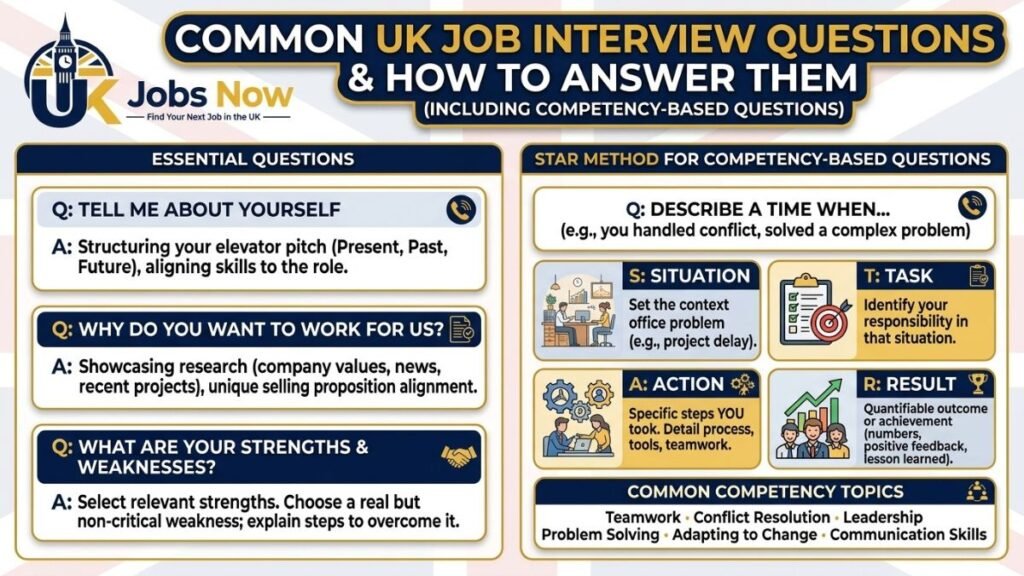
If you take away one framework from this article, make it this one. STAR stands for Situation, Task, Action, Result, and it’s the structure that makes a competency-based answer work:
- Situation — briefly set the scene. What was the context? Keep this short; it’s context, not the main event.
- Task — what were you specifically responsible for or trying to achieve in that situation?
- Action — this is the part to spend the most time on. What did you personally do? Be specific about your own actions, not what “the team” did generally — the interviewer wants to understand your individual contribution and thinking.
- Result — what happened as a result of your action? What did you learn, or what would you do differently next time? A result doesn’t need to be a dramatic success story — a genuine, honestly described outcome, including what you learned from something that didn’t go perfectly, is often more convincing than a suspiciously flawless anecdote.
The most common mistake with STAR isn’t forgetting the structure — it’s spending eighty percent of the answer on Situation and Task (context-setting) and rushing through Action and Result, which is where the actual evidence of your competency lives. Practise catching yourself doing this and consciously rebalancing toward Action.
Preparing examples before you know the exact questions
You won’t always know exactly which competencies will be assessed, but you can prepare efficiently by building a small bank of five or six strong, detailed examples from your own experience that each demonstrate different strengths — a time you solved a difficult problem, a time you led or influenced something without formal authority, a time you handled conflict or disagreement, a time you made a mistake and recovered from it, a time you managed competing priorities under pressure. Most competency-based questions, however they’re worded, map onto one of a fairly small set of underlying themes, so a well-prepared bank of real examples will cover the vast majority of what comes up, even if the specific wording surprises you on the day.
Common questions and how to think about them
“Tell me about yourself”
Not an invitation for your full life story — a concise, professional summary of your background, relevant experience, and why you’re interested in this specific role, in roughly ninety seconds to two minutes. Practise this one specifically, because an unprepared, meandering answer here sets an uncertain tone for the rest of the interview.
“Why do you want to work here?”
This question is testing whether you’ve actually researched the company beyond the job listing itself. A generic answer (“great company, great opportunity”) is instantly forgettable. A stronger answer references something specific — a recent project, a particular approach the company takes, a genuine alignment between your experience and what they seem to be trying to build — that shows you’ve thought about this employer specifically, not just applied to twenty companies with the same cover letter.
“Tell me about a time you disagreed with a manager or colleague”
This is a competency question about handling conflict constructively. The strongest answers describe a genuine, specific disagreement, how you raised it professionally, and a resolution — ideally showing that you can disagree without being difficult, and that you’re capable of either changing your mind with new information or holding a position respectfully when you’re confident you’re right.
“Describe a time you failed or made a mistake”
Employers ask this to see how you handle setbacks and whether you can be honest about imperfection. Avoid the two common failure modes: choosing a “fake” failure that’s actually a humblebrag (“I just work too hard and sometimes burn myself out”), or genuinely undermining yourself with an example that raises real doubts about your competence. The strongest answers pick a real, moderate mistake, take clear ownership of it, and focus most of the answer on what you learned and changed afterward.
“Where do you see yourself in five years?”
Less about a rigid five-year plan and more about whether your general direction is compatible with what this role and this employer can realistically offer. A reasonable answer signals ambition and genuine interest in growing within a similar field or organisation, without sounding either aimless or like you’ll have outgrown the role in six months.
Questions to ask the interviewer
Almost every UK interview ends with “do you have any questions for us?” — and having none, or only asking about salary and holiday allowance at this stage, is a missed opportunity. Good questions to have ready include things like what success in this role looks like in the first six months, what the team’s current priorities are, or what the interviewer personally enjoys about working there. These questions do double duty — they give you genuinely useful information for deciding whether to accept an offer, and they demonstrate real engagement with the role rather than a passive attitude toward the process.
Practical preparation for the day
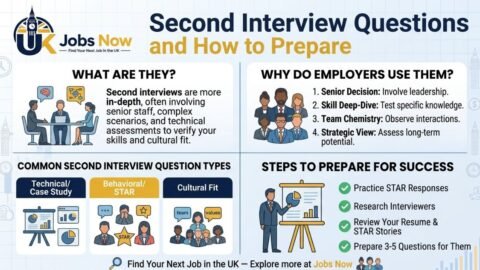
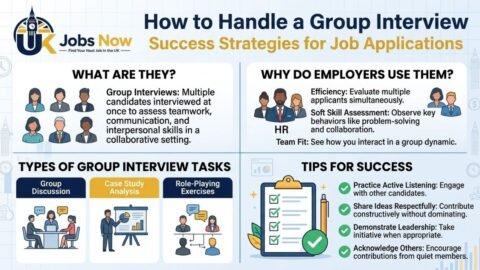
A few things worth sorting out well ahead of time rather than the morning of: confirm the interview format (in person, video call, phone) and the platform if it’s a video call, test your setup in advance if it is one, plan your route or login process with enough buffer that a delay doesn’t become a crisis, and re-read the job listing and your own CV the night before so both are fresh. If it’s a panel interview, it’s worth asking in advance how many people will be there and their roles, so you’re not caught off guard.
What to do after the interview
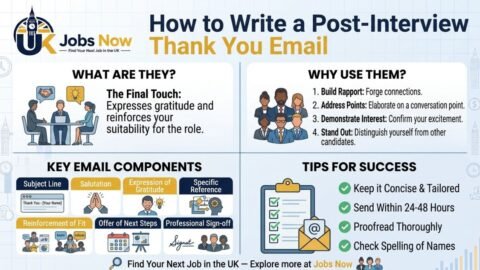
A brief thank-you email within a day of the interview is a good habit — not essential everywhere, but it’s a low-effort, professional touch that some employers do notice, and it gives you a natural opening to briefly reinforce a point you felt you didn’t land as well as you’d have liked during the conversation itself.
Bringing it together
Interview preparation isn’t about memorising scripted answers — a rehearsed-sounding response is often easy for an experienced interviewer to spot, and it tends to fall apart under a genuine follow-up question. It’s about having real examples ready, understanding the STAR structure well enough to use it naturally rather than mechanically, and doing enough research on the employer that your interest in the specific role comes across as genuine rather than generic. If you haven’t already put together the CV that got you to this stage, our guide to writing a UK CV covers the structure and content that tends to work. And if you’re preparing for interviews across several applications at once, you can browse current active listings to keep your pipeline moving while you prepare.
Frequently Asked Questions
What is a competency-based interview?
A structured interview format where questions are built around specific skills or behaviours the employer has identified as important for the role, and you’re expected to answer with real, specific examples from your past experience rather than hypothetical responses — typically structured using the STAR method (Situation, Task, Action, Result).
How many examples should I prepare before an interview?
A bank of five or six detailed, varied examples covering different strengths (problem-solving, leadership, conflict handling, resilience, prioritisation) is usually enough to adapt to most competency questions you’ll actually be asked, even if the exact wording differs from what you prepared for.
Is it okay to admit I don’t have a perfect example for a question?
Yes — it’s better to briefly acknowledge that a specific example isn’t your strongest and offer the closest genuine one you have, than to fabricate or exaggerate a story that falls apart under a follow-up question.
Should I ask about salary during the interview?
It depends on the stage and how the process has been run — many UK employers state salary information in the job listing itself, in which case there’s less need to raise it directly. If it hasn’t been discussed and you’re at a later stage of the process, it’s generally reasonable to ask, though it’s often better handled with HR or in a separate conversation than as your only question at the end of a first interview.
What should I do if I go blank during a competency question?
It’s fine to pause and think — a brief silence while you recall a specific example is far better than rushing into a vague or fabricated answer. You can also ask the interviewer to repeat or clarify the question if that helps you think of the right example.