Cold Emailing Employers: Does It Actually Work?
Sending a speculative application to a company with no advertised vacancy feels like shouting into a void, and for a badly executed version of it, that’s essentially what happens. But a well-targeted, well-written cold email genuinely does work often enough to be worth doing properly — particularly for smaller companies, specialist fields, or employers you have a genuine, specific reason to be interested in. This is a practical guide to when it’s worth trying, how to actually write one, and what a realistic response rate looks like so you’re not setting yourself up for unnecessary disappointment.
Does cold emailing actually work?
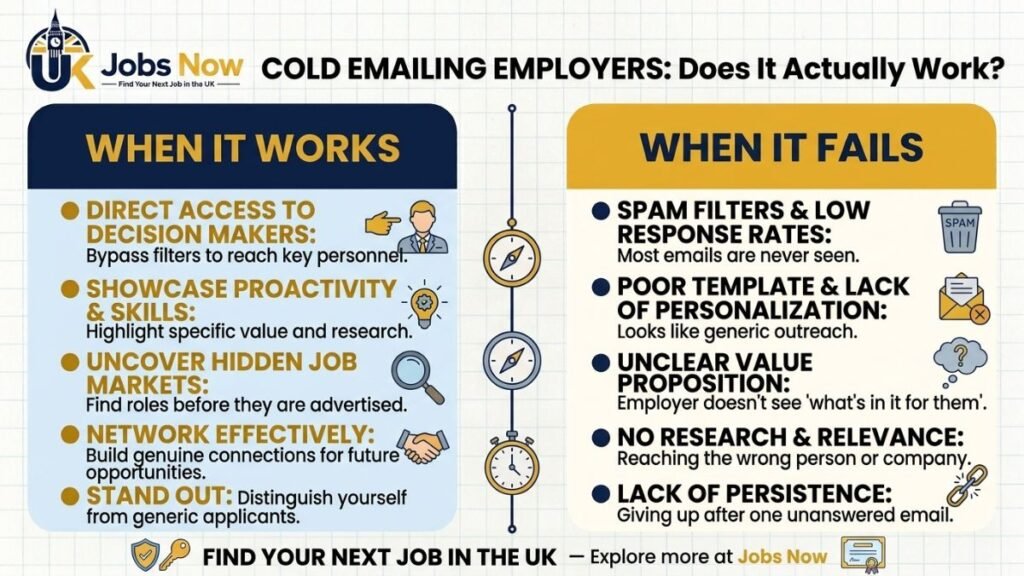
It’s worth being realistic from the start: a cold email to a company with no open vacancy will, in most cases, get a lower response rate than applying to an actual advertised role, simply because there’s no immediate, specific need on the employer’s side driving them to respond. That said, “lower response rate” doesn’t mean “not worth doing” — many roles, particularly at smaller companies, are filled without ever being formally advertised, either because a genuinely strong speculative approach arrived at the right moment, or because it’s simply cheaper and easier for a smaller employer to hire someone who’s already shown direct interest than to run a full recruitment process. It’s a genuine, worthwhile channel — just one with different expectations than a normal application.
When cold emailing is most likely to be worth your time
- Smaller companies and startups, which are more likely to hire opportunistically when a strong candidate reaches out, rather than only through formal, planned recruitment cycles.
- Specialist or niche fields, where the pool of genuinely qualified candidates is small enough that a direct, well-targeted approach stands out more than it would in a high-volume, generic field.
- Companies you have a specific, genuine reason to be interested in — not just any company in your general field, but one where you can articulate a real, specific reason for reaching out, which makes the email itself considerably stronger and easier to write convincingly.
- When you have any kind of genuine connection or reason for context — a mutual contact, a specific piece of the company’s work you engaged with directly, a genuine and demonstrable reason your background aligns with something they’re doing.
How to actually write one
Address it to a specific person, not a generic inbox
A cold email sent to “info@company.com” or a generic careers inbox is easy to overlook. Finding the name of a relevant hiring manager, team lead, or department head — often findable through LinkedIn or the company’s own team page — and addressing your email to them directly meaningfully increases the likelihood it’s actually read and taken seriously.
Keep it short — genuinely short
A speculative email should be noticeably shorter than a standard cover letter — three to five sentences at most, not a full page. The person receiving it has no specific vacancy to match you against and no obligation to read a long message; brevity respects that and makes it far more likely to actually be read in full.
Lead with something specific about the company, not about yourself
Opening with “I am writing to express my interest in potential opportunities at your company” is generic enough to be instantly forgettable. A stronger opening references something specific — a recent project, a particular approach the company takes, a genuine reason you’re reaching out to them specifically rather than any similar company. This immediately signals the email wasn’t sent identically to fifty other companies.
Briefly state what you’d bring, not just what you’re looking for
Include one or two specific, relevant strengths or achievements — briefly, not a full CV summary — that connect logically to what you understand the company does or might need. This gives the recipient an actual, concrete reason to consider replying, rather than just noting your general interest.
Make it easy to respond with minimal effort
End with a low-pressure, specific ask — “I’d welcome the chance to have a brief conversation if you’re open to it” rather than a vague, open-ended close. Attach your CV, but keep the email body itself as the primary content, since not everyone will open an attachment from an unsolicited message immediately.
A worked example
“Hi [Name], I’ve been following [Company]’s work on [specific project or development] with genuine interest — the approach to [specific detail] stood out to me particularly. I’m a [role/field] professional with [brief, specific relevant experience], and I wanted to reach out directly in case there’s ever a fit for someone with my background, even without a current vacancy posted. I’ve attached my CV, and I’d welcome the chance to have a brief conversation if that’s of interest. Either way, I’ll continue to follow [Company]’s progress with interest.”
Notice this is short, specific to the company, states a concrete (if brief) relevant strength, and closes with a low-pressure ask that doesn’t demand an immediate commitment from the recipient.
Following up without becoming a nuisance
If you don’t hear back within one to two weeks, a single, brief, polite follow-up is reasonable — “Just wanted to briefly follow up on my note below, in case it was missed among other messages — no pressure at all, and I hope things are going well at [Company].” One follow-up is generally the right amount; repeated follow-ups without any response start to work against you rather than demonstrating persistence.
Setting realistic expectations for response rate
| Approach | Realistic expectation |
|---|---|
| Generic cold email to a large company’s general careers inbox | Very low response rate — often none at all, since these are rarely monitored closely without a specific vacancy |
| Targeted cold email to a specific individual at a smaller company, with genuine relevance | Meaningfully better response rate, though still lower than applying to an actual advertised vacancy |
| Cold email following some existing connection or context (mutual contact, prior interaction) | The strongest response rate among speculative approaches, since there’s already a reason for the recipient to engage |
Cold emailing as one part of a broader strategy, not the whole plan
Given the realistically lower response rate compared to applying to advertised vacancies, cold emailing works best as a supplementary strategy alongside — not a replacement for — actively applying to open roles. It’s a genuinely good use of time specifically for a small, well-researched shortlist of companies you’re particularly interested in, rather than as a primary, high-volume search strategy on its own. You can combine it with browsing current active UK job listings for advertised roles, and our guide to using LinkedIn effectively covers another complementary channel, particularly for finding the right specific contact to address a cold email to in the first place.
Finding the right person to email
The research step is often the part people skip, and it’s genuinely the most important one. LinkedIn is usually the most reliable starting point — searching the company name alongside a relevant job function often surfaces the right team lead or hiring manager directly. A company’s own “About” or “Team” page can also list relevant contacts for smaller organisations. Where you genuinely can’t identify a specific individual, addressing the email to a named department (“Hiring Manager, Marketing Team”) is a reasonable fallback that’s still considerably more targeted than a completely generic greeting.
What to do if you receive a positive response
If a cold email does get a genuine, interested reply, treat what follows with the same seriousness as a formal application process, even though it started informally — be prompt and professional in your responses, be ready to send a properly tailored CV if you haven’t already, and be prepared for the conversation to develop into something closer to a standard interview process from that point. A strong initial cold email can lose momentum if the follow-through afterward feels rushed or less considered by comparison.
Frequently Asked Questions
Is cold emailing an effective job search strategy?
It can be, particularly for smaller companies, specialist fields, or a specific shortlist of employers you’re genuinely interested in — but it typically produces a lower response rate than applying to advertised vacancies, so it works best as a supplementary strategy rather than a primary one.
Who should I address a cold email to?
A specific, relevant individual — a hiring manager, team lead, or department head — rather than a generic careers inbox, which is significantly less likely to result in a response.
How long should a cold email be?
Genuinely short — three to five sentences. The recipient has no specific vacancy to weigh you against, so brevity respects their time and increases the likelihood the message is actually read.
Should I follow up if I don’t hear back?
A single, brief, polite follow-up after one to two weeks is reasonable. Repeated follow-ups without any response tend to work against you rather than demonstrate useful persistence.
Is it worth cold emailing large, well-known companies?
Generally less effective than for smaller companies, since large organisations typically hire through formal, planned recruitment processes and general careers inboxes are often not closely monitored — your time is often better spent on smaller or specialist employers, or applying directly to advertised vacancies at larger companies.