
Careers in Retail: Progression Routes Beyond the Shop Floor
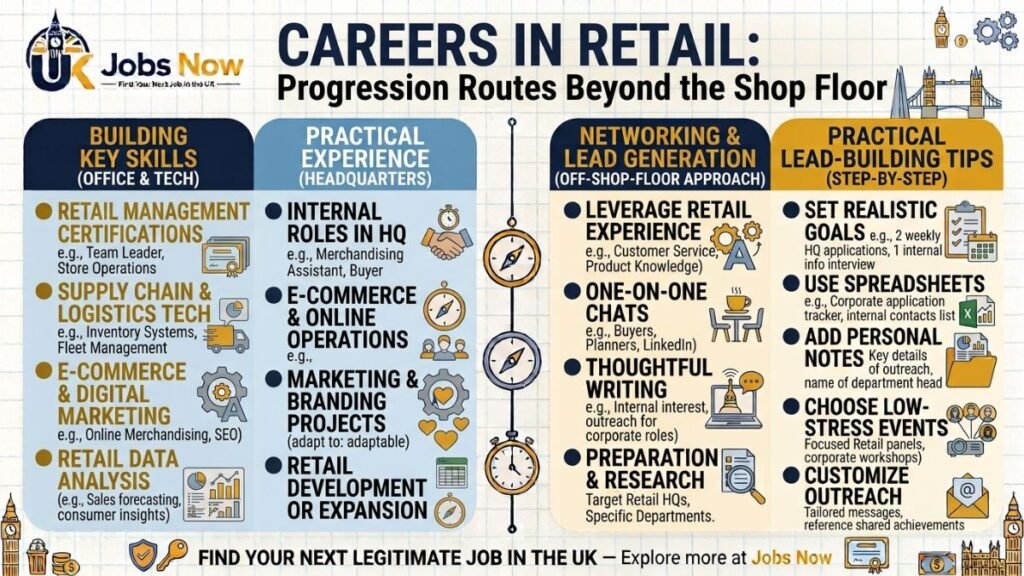
Retail is often treated as a starting job rather than a career — something people do while figuring out what they actually want to do next. For a lot of people that’s genuinely true, but it undersells a real, structured progression path that exists within retail itself, one that takes people from a shop floor role into store management, regional operations, buying, merchandising, and head office functions, often without needing to leave the sector or start from scratch somewhere else.
Why retail progression gets underestimated
Part of the reason retail career paths are underappreciated is that entry-level retail roles are genuinely accessible with minimal formal requirements, which creates an impression that the whole sector operates the same way at every level. In reality, retail is a substantial, structurally complex industry — supply chain, buying and merchandising, digital and e-commerce operations, regional and national management, and significant head office functions all sit above the shop floor, and a meaningful proportion of people in these more senior roles started in a customer-facing position and progressed internally.
The typical progression path
Sales assistant to supervisor or team leader
The first step usually involves taking on informal or formal responsibility beyond direct customer service — supervising a shift, training new starters, handling more complex customer issues. This is often the most accessible internal step, since it’s commonly filled from within the existing team rather than externally recruited.
Supervisor to assistant manager or department manager
This step typically involves genuine management responsibility — staff scheduling, performance management, stock and loss prevention, and contributing to store-level commercial targets. Many retailers offer structured internal training programmes at this stage, recognising it as a meaningful step up rather than assuming existing staff will simply pick up management skills unsupported.
Store manager
Full responsibility for a store’s overall performance — commercial results, staff management, operational standards. This role carries genuine general management experience that’s transferable well beyond retail itself, which is worth recognising if you’re ever considering a move into a different sector later.
Area, regional, or multi-site management
Responsibility for multiple stores rather than a single site, requiring a different skill set focused more on strategic oversight, performance analysis across locations, and managing multiple store managers rather than a single direct team.
Head office and specialist functions
Buying, merchandising, retail operations, visual merchandising, and e-commerce roles at head office level often specifically value candidates with genuine store-level experience, since it provides real, practical understanding of how head office decisions actually play out on the shop floor — a perspective someone entering these functions without retail floor experience genuinely lacks.
A visual summary of the path
| Stage | Typical focus |
|---|---|
| Sales assistant | Customer service, product knowledge, basic operational tasks |
| Supervisor/team leader | Shift supervision, training new starters, handling escalations |
| Assistant/department manager | Staff management, stock control, contributing to commercial targets |
| Store manager | Full store P&L responsibility, staff management, operational standards |
| Area/regional manager | Multi-site oversight, performance analysis, managing store managers |
| Head office (buying, merchandising, operations) | Strategic, company-wide functions, often valuing direct store experience |
What actually helps you progress within retail
- Visible initiative beyond your immediate role. Volunteering for additional responsibility — training new starters, taking on a specific project, covering for a supervisor — is often the most direct, low-risk way to demonstrate readiness for the next step, and it’s genuinely noticed by store and area managers making promotion decisions.
- Understanding the commercial side of the business, not just the operational side. Progression into management increasingly rewards understanding of sales performance, shrinkage, and broader commercial metrics, not just strong customer service and operational competence — actively engaging with this data, even informally, at an earlier stage helps build this understanding ahead of when it’s formally required.
- Taking up internal training and development programmes. Most larger retailers run structured management development programmes; actively expressing interest in and engaging with these, rather than waiting to be selected passively, tends to accelerate genuine progression.
- Being open to relocation or moving between store formats. Progression opportunities aren’t always available at your current store specifically — willingness to move to a different location, or to a different store format or size within the same company, often opens up progression opportunities considerably faster than waiting for a vacancy at your exact current site.
Moving into head office or specialist functions
If your interest lies specifically in buying, merchandising, or another head office function rather than store management, it’s worth being explicit about this with your manager or HR relatively early, since the path into these roles often differs meaningfully from the store-management progression track — some retailers run specific graduate or internal transfer schemes into these functions, and expressing interest early can position you for these opportunities as they arise, rather than only being considered for further store-level promotion by default.
Should you move between retailers to progress, or stay within one company?
Both are genuinely viable strategies, and the right choice depends on your specific situation. Staying within one company allows you to build a track record and internal relationships that can accelerate promotion, particularly at larger retailers with well-developed internal progression paths. Moving between companies can sometimes secure a step up in title or responsibility faster than waiting for an internal vacancy to open, particularly if your current employer’s structure genuinely has limited immediate progression opportunities at your specific store or region. Neither approach is inherently better — it’s worth honestly assessing your current employer’s actual progression track record before deciding which route makes more sense for you.
Retail experience as a transferable foundation for other sectors
It’s also worth recognising that retail experience, particularly at supervisor level and above, builds genuinely transferable skills — staff management, customer service under pressure, commercial awareness, operational problem-solving — that are valued well beyond retail itself. If you’re weighing retail progression against a move into a different sector entirely, our guide to changing careers in the UK covers how to reframe this kind of experience for a broader range of roles.
Finding progression opportunities
Beyond internal promotion at your current employer, it’s worth periodically checking what’s being advertised more broadly across the sector, both to benchmark your own progression against the wider market and to identify opportunities at other retailers if your current path has genuinely stalled. You can browse current active UK job listings filtered by the retail category to see current openings across store management, area management, and head office functions.
How seasonal retail work fits into a longer-term career
Seasonal roles, particularly around the Christmas period, are often assumed to be entirely separate from genuine career progression, but this isn’t always accurate — some retailers specifically use seasonal periods to identify strong performers for permanent conversion, and even where a role is genuinely temporary, performing well during a high-pressure seasonal period is a real, demonstrable achievement worth including on a CV and mentioning in future retail applications, since it shows you can perform reliably under the kind of pressure permanent roles also involve.
Making the case for promotion when you feel ready before it’s offered
It’s common to wait passively for a manager to notice readiness for promotion, but proactively raising the conversation yourself — with specific examples of the additional responsibility you’ve already taken on, and a clear, direct request for a conversation about progression — tends to be more effective than waiting indefinitely. Most retail managers are genuinely responsive to a well-prepared, confident conversation initiated by a team member who’s already demonstrated real initiative, and it signals exactly the kind of proactive attitude that management roles require.
Frequently Asked Questions
How long does it typically take to move from sales assistant to store manager?
This varies enormously by individual, retailer, and available opportunities, but demonstrating genuine initiative and engaging actively with internal training programmes tends to accelerate progression meaningfully compared to a purely passive approach of waiting to be noticed.
Do I need a degree to progress into retail management?
Generally, no — most retail management progression is built on demonstrated performance and internal development rather than formal academic qualifications, though some larger retailers do also run degree-entry graduate schemes as an alternative, faster route into management for those who prefer it.
Is it better to stay at one retailer or move between companies to progress faster?
Both are viable — staying builds internal track record and relationships that can accelerate promotion; moving can sometimes secure a faster step up in responsibility if your current employer’s structure has limited immediate opportunities. The right choice depends on your specific situation and your current employer’s actual progression track record.
Can retail experience help me move into a completely different sector later?
Yes — particularly supervisory and management-level retail experience builds genuinely transferable skills (staff management, commercial awareness, operational problem-solving) that are valued across many other sectors, not just within retail itself.
How do I move from store-level retail into a head office role like buying or merchandising?
Express interest early and directly with your manager or HR, since the path into these functions often differs from standard store-management progression — some retailers run specific transfer or graduate schemes into these roles, and store-level experience is often genuinely valued for the practical perspective it brings.
