Call Centre and Customer Service Jobs in the UK: Pay, Hours and How to Apply
Call centres and contact centres are among the biggest employers in the UK. Banks, energy firms, insurers, retailers, councils, the NHS and thousands of other organisations rely on customer service teams to answer questions, solve problems and make sales. Many jobs need no experience, training is provided and some roles can be done from home. But the work can also be fast-paced and target-driven. This guide explains what call centre and customer service jobs involve, what they pay in 2026, what employers look for, and how to apply.
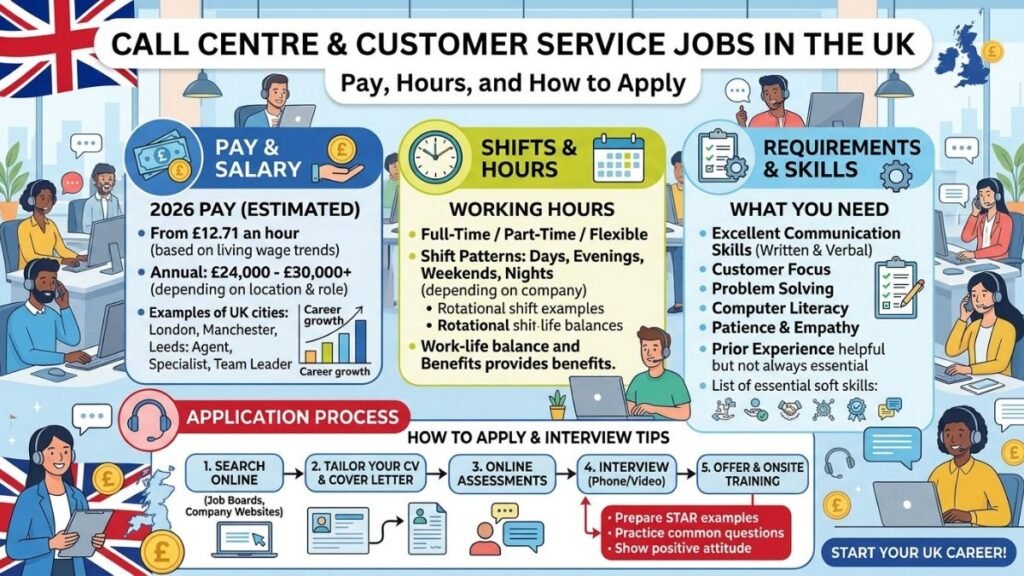
Quick answer: Entry-level call centre jobs in 2026 are commonly advertised from the legal minimum (£12.71 an hour for those aged 21 and over) up to about £15 an hour, or roughly £19,000 to £27,000 a year, with shift allowances and bonuses on top in some roles. You usually do not need qualifications, but you do need good communication skills, basic IT skills and the right to work in the UK.
What is a call centre or contact centre job?
Call centres, now often called contact centres, handle customer enquiries by phone, email, live chat, text and social media. Advisors take or make contact with customers, find answers using computer systems and record what happened.
Types of role
| Role | What it involves |
|---|---|
| Inbound customer service advisor | Answering customers’ questions, fixing problems, handling complaints, taking payments and updating accounts |
| Outbound sales or retention advisor | Calling people to sell products, renew contracts or keep customers from leaving |
| Technical support advisor | Helping customers with technical problems, such as broadband, devices or software |
| Collections and credit control advisor | Contacting customers about overdue payments and agreeing payment plans, subject to strict rules |
| Complaints handler | Dealing with complaints and escalations |
| Live chat and email advisor | Providing support in writing, rather than by phone |
| Appointment setter or booking agent | Arranging bookings, repairs and appointments |
| Emergency or public service call handler | Taking calls for services such as NHS 111 or councils, which has specific training and checks |
| Team leader, trainer and quality analyst | Supervising advisors, training new staff and checking call quality |
Browse current customer service vacancies on our UK jobs board.
Where call centre jobs are found
- Banks, building societies and insurers
- Energy, water and telecoms companies
- Retailers and online shops
- Travel, utilities and transport providers
- Councils, the NHS and public services
- Outsourcing companies that run customer service for other businesses, such as large business process outsourcers
How much do call centre jobs pay in 2026?
Pay depends on the employer, the type of role, the shift and the location. Figures below come from 2026 job adverts and salary sites, which differ, so treat them as a guide.
| Source or example | Pay |
|---|---|
| Entry-level adverts (October 2026) | £12.71 to £12.91 an hour |
| Advert with a shift allowance | £12.88 an hour plus £1.50 an hour shift allowance |
| Part-time bank advert with night rate | £13.00 an hour for 7am to 9pm and £15.50 an hour for 10pm to 6am |
| Job site average for call centre roles | About £23,000 a year, in a range of roughly £19,000 to £27,000 |
| A salary survey average for call centre agents | About £27,600 a year or £13 an hour |
| Payslip guide median for customer service advisors | About £24,400 a year |
| Average advertised salary for customer service advisors on one job feed | About £27,000 a year |
| Public sector example (Scottish council, part time) | About £19,200 to £20,800 a year, which looks like a pro rata figure |
A few points to remember:
- The legal minimum applies. The National Living Wage is £12.71 an hour for workers aged 21 and over from April 2026, £10.85 for ages 18 to 20 and £8.00 for under-18s and apprentices. Some adverts show lower figures for younger staff. See our National Minimum Wage 2026 guide.
- Basic pay is often only part of the package. Many employers add shift allowances, evening and weekend premiums, bonuses linked to quality or sales, commission for sales roles, and a pension.
- Pay varies by sector and region. Financial services, specialist technical support and sales-led roles often pay more than basic service roles, and London and big cities usually pay more than smaller towns.
- Part-time and annualised salaries. Check whether an advertised salary is full time or pro rata.
- Progression raises pay. Team leaders, trainers and quality analysts typically earn more than advisors.
What a week looks like
At £12.71 an hour, a 37.5-hour week is about £477 before tax, and a 30-hour week is about £381. Your take-home pay will be lower after tax, National Insurance, pension and any other deductions. See our guide to payslips, tax codes and National Insurance.
Hours and working patterns
Call centres often run long hours, so shifts matter as much as pay.
- Day shifts (for example 9am to 5pm) are common in business-to-business and public sector roles.
- Early and late shifts cover opening hours, often between 7am and 10pm.
- Evenings and weekends are common, since many customers call after work. Weekend work may pay a premium.
- Nights and 24-hour operations exist in emergency, utilities, travel and banking services, and often come with a shift allowance.
- Rotas may change weekly or monthly, and some are set using shift bidding or workforce planning systems.
- Part-time and flexible hours are widely available, which suits students, parents and carers.
- Home-based and hybrid roles have grown, though many employers still expect staff to be in an office for training. See our guide to work from home jobs in the UK.
Check whether your contract gives guaranteed hours. Some roles use zero-hours or variable-hours contracts, especially in agency and bank work. See our guide to zero-hours contracts.
What is the work like?
The good parts
- Training is provided and no experience is usually needed
- Plenty of vacancies in most areas, with part-time and flexible options
- Skills that transfer to many other jobs, including communication, problem solving and IT
- Clear promotion routes to team leader, trainer or quality roles
- A social, team-based environment in many centres
The challenges
- Targets and monitoring. Calls are often recorded and measured for things such as average handling time, quality scores, customer satisfaction and sales conversion. Some people find this stressful.
- Difficult callers. You may deal with upset, frustrated or abusive customers.
- Repetition and sitting for long periods. Look after your posture, eyes and voice.
- Shift patterns that can affect your social life or sleep.
- Pressure in sales and collections roles, where targets and regulations are tighter.
Ask about targets, call monitoring, breaks and support for staff at interview.
Requirements and skills
Most employers look for:
- The right to work in the UK. See our guide to right to work checks in the UK.
- A clear, friendly telephone manner and good spoken and written English
- Basic IT and typing skills, and the ability to learn computer systems quickly
- Patience and empathy, especially with upset customers
- Reliability and good attendance
- Listening and problem-solving skills
- Flexibility with shifts, including evenings and weekends
- Numeracy for handling payments, refunds and figures, in some roles
You do not usually need formal qualifications for entry-level roles, though some employers ask for GCSE English and maths, and many ask for previous customer service experience, which can come from retail, hospitality or volunteering. Some jobs, for example in banking, insurance and collections, require extra training or accreditation.
Pre-employment checks
Depending on the employer, you may be asked for:
- References covering the last few years of work or study
- A basic criminal record check, and in financial services sometimes a credit check
- Identity and right-to-work checks
- Security screening, particularly for public sector, banking and government contracts
- A typing, numeracy or call simulation test as part of the application
If you have a conviction, read our guide to how to get a job with a criminal record in the UK.
How to apply: step by step
- Decide what suits you. Think about inbound versus outbound, sales versus service, shift patterns and travel or home working.
- Prepare a short CV. Highlight communication, teamwork, reliability, IT skills and any customer-facing experience from jobs, volunteering or school. See our guides to writing a UK CV with no experience and writing a cover letter in the UK.
- Search for vacancies. Check employer careers pages, recruitment agencies that specialise in customer service, council and NHS sites, and our jobs board.
- Apply for several roles, and read the advert carefully for hours, pay, targets and whether the job is office-based, hybrid or home-based.
- Complete online tests. Many employers use online assessments, such as typing, situational judgement and call simulations.
- Prepare for an interview by phone, video or in person, or an assessment day, which may include role plays.
- Complete checks. References, right to work and any security checks.
- Start with training. Most new advisors have a classroom or online induction, product training and a period of mentoring or nesting before taking calls alone.
- Check your contract. Read the pay, hours, breaks, notice and targets. Our guide to understanding your employment contract lists what to look for.
Interview tips for call centre jobs
Employers want to know that you are friendly, patient, reliable and able to stay calm. Expect scenario and competency questions, and sometimes a role play.
Common questions
- Why do you want to work in a call centre or customer service?
- What does good customer service mean to you?
- Tell me about a time you helped a customer or dealt with a difficult person.
- How would you deal with an angry customer on the phone?
- How do you stay calm and positive when you have back-to-back calls?
- What would you do if you did not know the answer to a customer’s question?
- How do you cope with targets and being monitored?
- Are you happy to work shifts, evenings and weekends?
How to answer
- Use the STAR method (Situation, Task, Action, Result) for examples, with real situations from work, school or home. Our guides to common interview questions and answers in the UK and customer assistant interview questions and answers explain it with examples.
- Show empathy. Say you would listen, apologise where appropriate, and focus on solving the problem.
- Be honest about your availability and about any limits.
- Show you can learn systems. Mention any experience with software, databases or typing.
- Prepare for a role play. The interviewer may play an upset customer. Stay calm, listen, repeat the problem back, apologise sincerely and offer clear next steps.
- Speak clearly on phone interviews, smile as you talk, and be somewhere quiet.
Your rights in a call centre job
- Minimum wage and payslips. You must be paid at least the minimum for your age. Time you are required to be logged in and available, such as waiting between calls or logging on before your shift, can count as working time.
- Breaks. Adult workers are generally entitled to a 20-minute break if they work more than six hours, and rest between shifts. Employers should also arrange breaks from screen work, and offer eye tests to people who regularly use display screens.
- Holiday pay. You build up paid holiday, including on part-time and shift contracts. See our guide to holiday entitlement and holiday pay.
- Sick pay. Since April 2026, Statutory Sick Pay is payable from the first day for those who qualify. Call centres often have absence policies and trigger points, so check yours, and read our guide to Statutory Sick Pay 2026.
- Protection from abuse and harassment. If customers are abusive on calls, your employer has a duty to protect you. The rules on employers’ responsibilities for harassment, including by third parties such as customers, are strengthening from 30 October 2026. See our guide to the Employment Rights Act 2025.
- Health and safety. This includes safe equipment, a suitable workstation and, where relevant, noise protection. Raise concerns with your manager or health and safety rep.
- Call recording and data. Employers can record calls for training and quality, but they must follow data protection rules.
- Fair treatment and reasonable adjustments. If you have a disability, you can ask for adjustments such as a different headset, break schedule or workstation.
If you have a problem, keep records and contact Acas for free advice. The time limit for most employment tribunal claims is six months for events on or after 1 October 2026, and you must go through Acas early conciliation first. See our guide to notice periods in the UK if you decide to move on.
Career progression
Call centre experience can lead to many careers:
- Senior advisor, specialist advisor or mentor
- Team leader and supervisor, managing a team of advisors
- Trainer or coach, training new starters
- Quality analyst, assessing and improving call quality
- Workforce planner or scheduler, managing staffing levels
- Customer success, account management or complaints specialist
- Operations manager or contact centre manager
- Moving into sales, marketing, HR, IT support or other departments
- Apprenticeships. Customer service apprenticeships are available at several levels. See our guide to apprenticeships in the UK.
Ask about training and promotion routes at interview, and look for employers that promote from within.
Part-time, student and school-leaver options
Many call centres offer part-time, evening and weekend work that suits students. If you are a student, remember the hours limits that apply on a Student visa. See our guide to part-time jobs for students in the UK. Many call centres only hire people aged 18 and over because of the nature of the work, though some offer apprenticeships for younger people.
Scams and warning signs
Call centre and customer service roles are often used as bait in fake job adverts, particularly work from home ones. Watch for:
- Fees for training, equipment or software before you start
- Jobs offered by WhatsApp, Telegram or text with no proper interview
- Very high pay for simple phone work with no experience
- Employers who cannot be found on Companies House or have no real website
- Requests for your passport or bank details before you have a contract
- Offers to receive and move money, or to make calls on behalf of an unknown company, which could involve fraud
Apply through the employer’s own website or a reputable agency. Read our guides to how to spot a fake job advert in the UK and work from home jobs in the UK.
Frequently asked questions
How much do call centre workers earn in the UK? Entry-level jobs in 2026 are commonly advertised from £12.71 an hour to about £15 an hour, or roughly £19,000 to £27,000 a year. Averages from different sites vary, and shift allowances and bonuses can add to this.
Do I need experience to work in a call centre? Not always. Many employers train new advisors, though customer service experience from retail, hospitality or volunteering helps.
Do I need qualifications? Usually not, though some employers ask for GCSE English and maths, and some regulated roles need extra training.
What hours do call centre staff work? It varies. Many centres run early and late shifts, evenings and weekends, and some operate 24 hours. Part-time and flexible hours are common.
Can I work in a call centre from home? Sometimes. Home-based and hybrid roles exist, but check the advert and be cautious of scams.
Are call centre jobs stressful? They can be, because of targets, monitoring and difficult callers. Ask about training, support and wellbeing when you apply.
Can I get a call centre job at 16 or 17? Many employers require staff to be 18, but some roles and apprenticeships are open to younger people. Check each advert.
What should I wear to a call centre interview? Smart casual or business casual is usually fine. Check the invitation, and dress neatly even for a phone or video interview.
Final thoughts
Call centre and customer service jobs offer an accessible start, with training, flexible hours and clear routes to progress. Check the pay and shift pattern, ask about targets and support, and protect yourself from scams. When you are ready, browse the latest vacancies on our jobs board and apply directly with the employer.
This article is general information. Pay figures come from 2026 job adverts and salary sites and change often. Check the job advert, your contract and GOV.UK or Acas for the latest guidance.