Statutory Sick Pay 2026: Who Gets It, How Much and From When
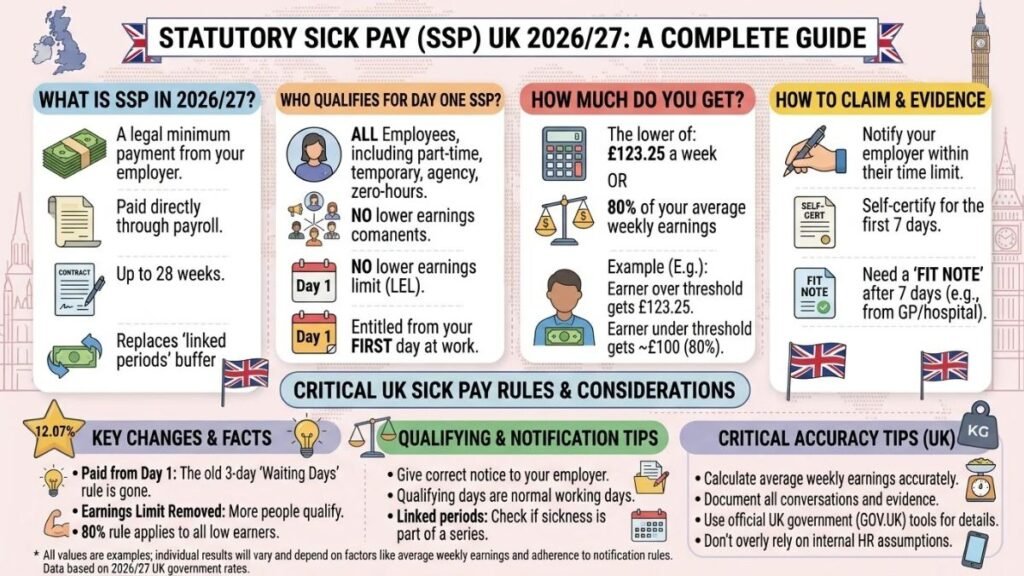
If you are too ill to work, you may be entitled to Statutory Sick Pay (SSP), the minimum your employer must pay you. Until April 2026 you had to wait three days before it started and earn above a minimum amount to qualify. Both rules have now gone. This guide explains how SSP works in 2026/27, who qualifies, how much you get, how long it lasts, how to claim it and what to do if you are not eligible.
Quick answer: From 6 April 2026, SSP is paid from the first day you are off sick, there is no minimum earnings limit, and the rate is £123.25 a week or 80% of your average weekly earnings, whichever is lower, for up to 28 weeks. It is paid by your employer, through payroll, to eligible employees. The self-employed do not get it.
What changed in April 2026?
The Employment Rights Act 2025 made two big changes to SSP, which came into force on 6 April 2026:
| Before 6 April 2026 | From 6 April 2026 | |
|---|---|---|
| Waiting days | The first three qualifying days were unpaid | None. SSP is paid from the first qualifying day |
| Minimum earnings | You had to earn at least the Lower Earnings Limit (£125 a week in 2025/26) | No minimum earnings. Everyone who is an eligible employee qualifies |
| Weekly rate | A flat rate (£118.75 in 2025/26) | The lower of £123.25 or 80% of your average weekly earnings |
| Shortest absence that counted | Four days in a row | A single day |
| Maximum length | 28 weeks | 28 weeks (unchanged) |
This is a major change for low-paid, part-time and shift workers, many of whom previously received nothing for short absences or did not qualify at all. For more on the wider reforms, see our guide to the Employment Rights Act 2025.
How much is SSP in 2026/27?
For the 2026/27 tax year (6 April 2026 to 5 April 2027), SSP is:
- £123.25 a week (up from £118.75 in 2025/26), or
- 80% of your average weekly earnings, if that figure is lower
SSP is the lower of the two. You reach the full £123.25 once 80% of your average weekly earnings is above it, which happens at around £154 a week of average earnings. If you earn less than about £154 a week on average, you receive 80% of your earnings instead.
Examples
| Your average weekly earnings | 80% of earnings | SSP you receive per week |
|---|---|---|
| £400 | £320 | £123.25 |
| £200 | £160 | £123.25 |
| £154 | £123.20 | About £123.20 |
| £120 | £96 | £96 |
| £80 | £64 | £64 |
Your average weekly earnings are usually worked out from your pay over the eight weeks before your sickness began. If your pay varies, because of shifts, overtime or irregular hours, your employer will use that average.
Daily rates
SSP is paid only for qualifying days, which are normally the days you are expected to work. The weekly rate is divided by the number of qualifying days in your week to give a daily rate. At the full £123.25 rate:
| Qualifying days a week | SSP per qualifying day |
|---|---|
| 3 | About £41.08 |
| 4 | About £30.81 |
| 5 | About £24.65 |
| 6 | About £20.54 |
So if you work five days a week and are off sick for three working days, you would receive around £73.95 in SSP for that absence (3 x £24.65), if you are on the full rate.
Tax and National Insurance
SSP is treated as pay. Your employer deducts Income Tax and National Insurance, if they apply to you, before paying it. It appears on your payslip. See our guide to payslips, tax codes and National Insurance.
Who is eligible for SSP?
To get SSP you normally need to:
- Be an employee (this includes many agency workers and people on zero-hours contracts who count as employees for SSP, but not the genuinely self-employed)
- Be too ill to work, including physical and mental health conditions
- Be off sick on a qualifying day, a day you would normally have worked
- Follow your employer’s notification rules and provide the right evidence
- Not have used up your 28 weeks of SSP
Since April 2026 there is no minimum earnings test and no minimum length of service. You can get SSP even if you have only just started your job. If you are unsure whether you count as an employee, ask Acas. Our guide to zero-hours contracts explains the difference between workers and employees.
Who does not get SSP?
- Self-employed people, who are not covered by SSP
- People who are not employees, such as some genuine freelancers and contractors
- People who have already received 28 weeks of SSP for the same or linked periods of sickness
- People already receiving statutory maternity, adoption or paternity pay in some circumstances, because those payments replace SSP
- Some other limited exceptions, such as certain people in prison or abroad
If you are not eligible, you may be able to claim other support, described below.
How long does SSP last?
- Up to 28 weeks in total for one period of sickness or linked periods.
- Periods of sickness that are eight weeks or less apart are usually treated as linked, so they count towards the same 28 weeks.
- After 28 weeks, SSP stops, but you may qualify for other benefits (see below).
How to claim SSP: step by step
- Tell your employer as soon as you can. Follow the rules in your contract or staff handbook, usually phoning or messaging your manager before your shift. If there is no rule, you should normally tell your employer within seven days.
- Check your contract and policy. Some employers set stricter reporting rules, such as ringing in at a set time, which you must follow.
- Self-certify for the first seven days. For absences of up to seven calendar days (including weekends), you do not need a doctor’s note. Your employer may ask you to complete a self-certification form.
- Get a fit note after seven days. If you are off for more than seven calendar days, you generally need a fit note from your GP, another doctor or other registered healthcare professional.
- Check your payslip. SSP should appear as a separate line and be paid on your normal payday.
- Keep records. Keep copies of messages, forms, fit notes and payslips.
You do not have to apply to the government for SSP. Your employer pays it, through payroll. If your employer refuses to pay SSP, or you think it is wrong, see below.
What if your employer says you are not eligible, or stops paying?
- Ask for the reason in writing. Employers can only refuse in limited circumstances.
- Ask for form SSP1. If your employer says you do not qualify, or your SSP ends, they should give you a form SSP1 explaining why, which you can use to claim other benefits.
- Check your pay. If the amount looks wrong, ask for a breakdown of how they calculated your average weekly earnings and daily rate.
- Contact Acas for free advice, and keep all your records.
- Report it to HMRC. HMRC enforces SSP and you can ask it to investigate if your employer refuses to pay what you are owed.
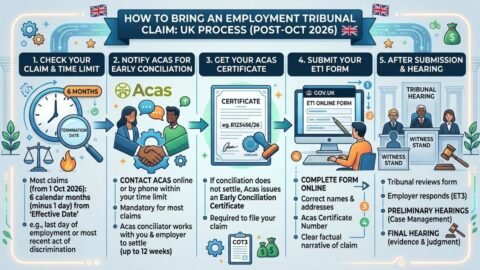
- Think about a claim. The time limit for most employment tribunal claims is six months for events on or after 1 October 2026, and you must go through Acas early conciliation first.
The new Fair Work Agency, launched in April 2026, is also meant to help enforce workers’ rights, including sick pay. Check GOV.UK for how it works.
What if SSP is not enough, or you do not qualify?
SSP is low, and it replaces only part of your pay for most people. Options include:
- Contractual or occupational sick pay. Many employers pay more than SSP, for example full pay for a set period. Check your contract and staff handbook, and our guide to understanding your employment contract. Employers can also set rules for when their own scheme applies.
- Universal Credit. If you are on a low income or not eligible for SSP, you may be able to claim Universal Credit, including the health element if you have limited capability for work. Check GOV.UK and tell the DWP about changes to your income.
- New Style Employment and Support Allowance (ESA). If you are not eligible for SSP, you may be able to claim ESA, depending on your National Insurance record. Check the current rules on GOV.UK.
- If you are self-employed, SSP does not apply. You may be able to claim Universal Credit or ESA, and you could consider income protection insurance.
- Charity and local support. Citizens Advice can help with benefits, debt and other support.
SSP and your job
Can you be dismissed for being off sick?
An employer can sometimes dismiss someone for long-term sickness or poor attendance, but it must follow a fair process, consider medical evidence and make reasonable adjustments if you are disabled. It is unlawful to dismiss you for claiming SSP or to treat you unfairly because of a disability. Get advice from Acas straight away if you are worried.
Sick pay and holiday
You continue to build up paid holiday while you are on sick leave, and if you fall ill before or during your holiday, you may be able to take the time as sick leave instead, depending on your employer’s policy and the law. See our guide to holiday entitlement and holiday pay.
Sickness during notice
If you are ill while working your notice, you may still be entitled to SSP, and you generally keep your contractual notice rights. See our guide to notice periods in the UK.
Sickness in a new job
Since April 2026, you can get SSP from the first day of your first qualifying absence, even in your first week. You should receive the same rights as other employees, though your employer’s own sick pay may have a service requirement.
SSP for zero-hours, part-time and shift workers
The changes help these workers the most:
- No earnings floor. Part-time and low-paid workers who earned below the old limit now qualify.
- Day-one pay. A single missed shift can now generate a payment, though at 80% of earnings for those on low pay.
- Qualifying days. If your hours vary, your employer should agree which days count as your qualifying days. Check your contract and ask HR if you are unsure.
- Average earnings. If your pay varies, SSP is based on your average weekly earnings in the eight weeks before your absence, so keep your payslips.
See our guides to hospitality jobs, care worker jobs, warehouse jobs and cleaning jobs for sectors where hours often vary.
A note for seasonal and student workers
Seasonal staff, including Christmas workers, and students working part time are entitled to SSP if they are employees and qualify. Check your employer’s reporting rules and keep records of your hours. See our guides to Christmas jobs in the UK 2026 and part-time jobs for students in the UK.
Checklist for when you are ill
- Tell your employer promptly, using the correct method.
- Note the dates you are off, and the days you would have worked.
- Self-certify for the first seven days, and get a fit note if you are off for longer.
- Check your contract for contractual sick pay.
- Check your payslip shows SSP.
- Ask for an SSP1 form if SSP is refused or ends.
- Check whether you can claim Universal Credit or ESA.
- Contact Acas or Citizens Advice for help.
Frequently asked questions
How much is Statutory Sick Pay in 2026? £123.25 a week, or 80% of your average weekly earnings if that is lower, from 6 April 2026 to 5 April 2027.
Do I get SSP from the first day I am off sick? Yes. Since 6 April 2026 the three waiting days have been abolished, and SSP is payable from the first qualifying day.
Do I need to earn a minimum amount to get SSP? No. The Lower Earnings Limit was removed on 6 April 2026. Lower earners receive 80% of their average weekly earnings.
How long can I get SSP for? Up to 28 weeks for a period of sickness, or linked periods that are eight weeks or less apart.
Do I need a doctor’s note? Not for the first seven calendar days, when you can self-certify. After that, you generally need a fit note.
Can I get SSP if I am on a zero-hours contract? Possibly. If you are an employee and meet the other rules, yes. Ask your employer and check with Acas if you are unsure.
Can the self-employed get SSP? No. You may be able to claim Universal Credit or Employment and Support Allowance instead.
Is SSP taxed? Yes. It is treated as pay, and Income Tax and National Insurance are deducted where they apply.
What happens when SSP runs out? If you are still unwell after 28 weeks, you may be able to claim Universal Credit or Employment and Support Allowance. Your employer should give you form SSP1.
Final thoughts
The 2026 changes make sick pay available to many more people, from the first day. Know your rights, tell your employer promptly, keep records and ask for help if something is not right. When you are ready for your next job, browse the latest vacancies on our jobs board and ask about sick pay before you accept.
This article is general information, not legal or financial advice. Sick pay rules are detailed and can change. Check GOV.UK and Acas for the latest guidance, and seek advice about your own situation.