Take-Home Pay in the UK 2026/27: What £20,000 to £60,000 Looks Like After Tax
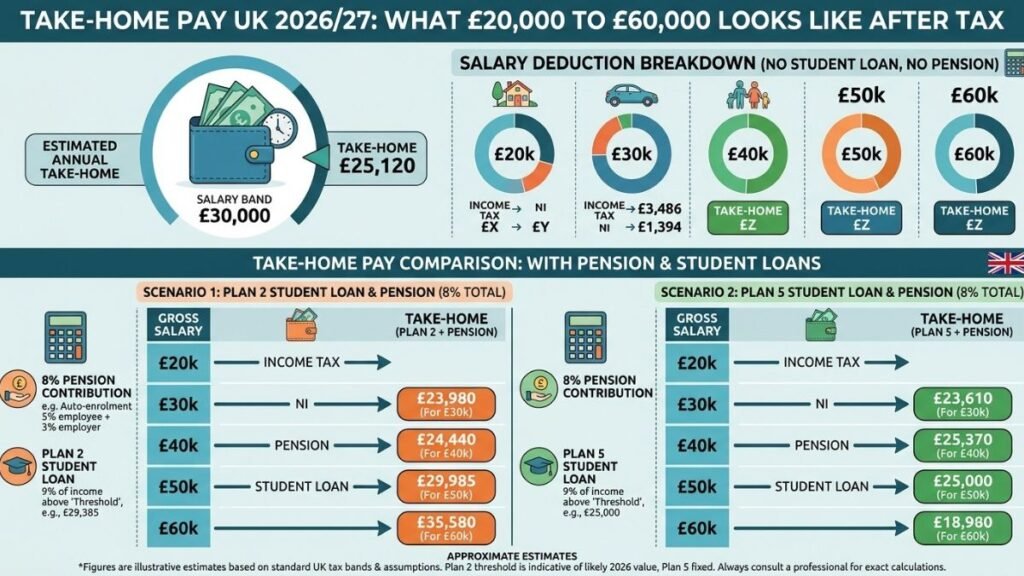
A salary of £30,000 does not mean £30,000 in your bank account. Income Tax, National Insurance, workplace pension contributions and student loan repayments all come out first. This guide shows what you actually take home at salaries from £20,000 to £60,000 in the 2026/27 tax year, explains how each deduction works, and shows how a pension or student loan changes the picture. All figures are calculated for a standard employee in England, Wales or Northern Ireland.
Quick answer: In 2026/27, a £30,000 salary leaves about £25,120 a year (about £2,093 a month) after Income Tax and National Insurance, before any pension or student loan. A £40,000 salary leaves about £32,320 (£2,693 a month), and £50,000 leaves about £39,520 (£3,293 a month).
How these figures were worked out
The tables below use the following assumptions. Your own situation may differ.
- Tax year: 6 April 2026 to 5 April 2027.
- Where you live: England, Wales or Northern Ireland. Scotland has different Income Tax bands, so Scottish take-home pay is different. Check the Scottish Government and GOV.UK.
- Tax code: the standard 1257L, giving a personal allowance of £12,570 and no other income, benefits or deductions.
- Income Tax: 0% on the first £12,570, 20% on income from £12,571 to £50,270, and 40% on income above £50,270.
- National Insurance (employee, category A): 0% on earnings up to about £12,570 a year (£242 a week), 8% on earnings between about £12,570 and £50,270, and 2% above that.
- A full year of pay at a steady salary, with no bonuses, overtime or unpaid leave.
- Employer costs such as employer National Insurance and employer pension contributions are not included, because they do not come out of your pay.
The tax and National Insurance figures are my own calculations using these published rates, rounded to the nearest pound. Your payslip may differ slightly because of tax code adjustments, pay periods and rounding. For a deeper look at how the pieces work, see our guide to payslips, tax codes and National Insurance.
Take-home pay at a glance: tax and National Insurance only
This is what you take home with no pension and no student loan.
| Gross salary | Income Tax | National Insurance | Take-home per year | Per month | Per week |
|---|---|---|---|---|---|
| £20,000 | £1,486 | £594 | £17,920 | £1,493 | £345 |
| £25,000 | £2,486 | £994 | £21,520 | £1,793 | £414 |
| £30,000 | £3,486 | £1,394 | £25,120 | £2,093 | £483 |
| £35,000 | £4,486 | £1,794 | £28,720 | £2,393 | £552 |
| £40,000 | £5,486 | £2,194 | £32,320 | £2,693 | £622 |
| £45,000 | £6,486 | £2,594 | £35,920 | £2,993 | £691 |
| £50,000 | £7,486 | £2,994 | £39,520 | £3,293 | £760 |
| £55,000 | £9,432 | £3,111 | £42,457 | £3,538 | £816 |
| £60,000 | £11,432 | £3,211 | £45,357 | £3,780 | £872 |
What share of your pay goes in tax and National Insurance?
| Gross salary | Tax and NI as a share of salary |
|---|---|
| £20,000 | About 10.4% |
| £30,000 | About 16.3% |
| £40,000 | About 19.2% |
| £50,000 | About 21.0% |
| £60,000 | About 24.4% |
The share rises with your salary because the first £12,570 is tax-free and higher earners pay the higher rate of tax on the top slice.
What about the minimum wage?
A full-time worker aged 21 or over on the National Living Wage of £12.71 an hour earns about £24,785 a year for 37.5 hours a week, and about £26,437 for 40 hours a week (before tax). After tax and National Insurance, that is roughly:
| Hours per week | Gross per year | Take-home per year | Per month |
|---|---|---|---|
| 37.5 hours | About £24,785 | About £21,365 | About £1,780 |
| 40 hours | About £26,437 | About £22,554 | About £1,880 |
See our National Minimum Wage 2026 guide for the rates for other ages.
How a workplace pension changes your take-home pay
If you are auto-enrolled into a workplace pension, your contribution comes out of your pay. The standard minimum is 5% of your qualifying earnings from you and 3% from your employer, where qualifying earnings are the slice of your pay between £6,240 and £50,270 a year. Many employers pay more.
The table below assumes you pay 5% on qualifying earnings through a net pay arrangement, where the contribution is taken before Income Tax is calculated, so you get tax relief automatically. National Insurance is still worked out on your full salary, unless your employer uses salary sacrifice.
| Gross salary | Your pension (5%) | Income Tax | National Insurance | Take-home per year | Per month |
|---|---|---|---|---|---|
| £20,000 | £688 | £1,348 | £594 | £17,369 | £1,447 |
| £25,000 | £938 | £2,298 | £994 | £20,769 | £1,731 |
| £30,000 | £1,188 | £3,248 | £1,394 | £24,169 | £2,014 |
| £35,000 | £1,438 | £4,198 | £1,794 | £27,569 | £2,297 |
| £40,000 | £1,688 | £5,148 | £2,194 | £30,969 | £2,581 |
| £45,000 | £1,938 | £6,098 | £2,594 | £34,369 | £2,864 |
| £50,000 | £2,188 | £7,048 | £2,994 | £37,769 | £3,147 |
| £55,000 | £2,202 | £8,551 | £3,111 | £41,136 | £3,428 |
| £60,000 | £2,202 | £10,551 | £3,211 | £44,036 | £3,670 |
Notice that a 5% pension at £30,000 costs you about £1,188 a year, but your take-home pay falls by only about £951 compared with the no-pension table, because you pay less tax. And your employer pays in on top, and your pension grows over time, so it is worth much more than it costs.
Pension rules vary between employers and between pension schemes. Some use “relief at source”, where you pay from taxed pay and the government adds basic-rate tax relief, and others use salary sacrifice, which can also reduce National Insurance. Your payslip will show which applies to you.
How a student loan changes your take-home pay
If you have a UK student loan, you repay 9% of your earnings above the threshold for your repayment plan (6% for a postgraduate loan above its threshold). For 2026/27 the annual thresholds are about:
| Plan | Annual threshold |
|---|---|
| Plan 1 | £26,900 |
| Plan 2 | £29,385 |
| Plan 4 (Scotland) | £33,795 |
| Plan 5 (England, courses starting from August 2023) | £25,000 |
| Postgraduate Loan | £21,000 |
Plan 2 example
Take-home pay with tax, National Insurance and a Plan 2 student loan repayment (no pension):
| Gross salary | Student loan repayment | Take-home per year | Per month |
|---|---|---|---|
| £30,000 | £55 | £25,064 | £2,089 |
| £35,000 | £505 | £28,214 | £2,351 |
| £40,000 | £955 | £31,364 | £2,614 |
| £45,000 | £1,405 | £34,514 | £2,876 |
| £50,000 | £1,855 | £37,664 | £3,139 |
| £55,000 | £2,305 | £40,152 | £3,346 |
| £60,000 | £2,755 | £42,602 | £3,550 |
Plan 5 example
The same, but with a Plan 5 loan (no pension):
| Gross salary | Student loan repayment | Take-home per year | Per month |
|---|---|---|---|
| £25,000 | £0 | £21,520 | £1,793 |
| £30,000 | £450 | £24,670 | £2,056 |
| £35,000 | £900 | £27,820 | £2,318 |
| £40,000 | £1,350 | £30,970 | £2,581 |
| £45,000 | £1,800 | £34,120 | £2,843 |
| £50,000 | £2,250 | £37,270 | £3,106 |
| £55,000 | £2,700 | £39,757 | £3,313 |
| £60,000 | £3,150 | £42,207 | £3,517 |
Student loan repayments are not a normal debt. They depend on your income, and any balance left at the end of the loan term is written off, so check GOV.UK for the details of your plan.
Pension and student loan together
Here is what some salaries look like with both a 5% pension and a Plan 2 loan:
| Gross salary | Pension | Income Tax | National Insurance | Student loan | Take-home per year | Per month |
|---|---|---|---|---|---|---|
| £30,000 | £1,188 | £3,248 | £1,394 | £55 | £24,114 | £2,009 |
| £40,000 | £1,688 | £5,148 | £2,194 | £955 | £30,014 | £2,501 |
| £50,000 | £2,188 | £7,048 | £2,994 | £1,855 | £35,914 | £2,993 |
| £60,000 | £2,202 | £10,551 | £3,211 | £2,755 | £41,281 | £3,440 |
So someone on £40,000 with a pension and a Plan 2 loan takes home roughly £2,500 a month, not the £3,333 you get from dividing £40,000 by 12.
Your marginal rate: what happens to each extra pound
The “marginal rate” is the share of your next pound of pay that goes in deductions. For a standard employee in 2026/27:
| Slice of income | Income Tax | National Insurance | Combined |
|---|---|---|---|
| Up to £12,570 | 0% | 0% | 0% |
| £12,571 to £50,270 | 20% | 8% | 28% |
| Above £50,270 | 40% | 2% | 42% |
If you also repay a student loan, add 9% (6% for a postgraduate loan), so your marginal rate could be 37% in the basic-rate band or 51% above £50,270. This is why a pay rise can feel smaller than you expect. See our guide to how to ask for a pay rise or negotiate salary in the UK for how to make the most of a raise.
If you earn around £60,000, you may also be affected by the High Income Child Benefit Charge, which can claw back some or all of Child Benefit once your income passes a threshold, commonly cited as £60,000. Check GOV.UK for current rules.
Why your payslip might not match these figures
- Tax code. If your code is not 1257L, your tax will differ. Emergency codes, a second job or taxable benefits such as a company car can all change it.
- Pay frequency. Weekly, four-weekly and monthly pay use slightly different thresholds, so your payslip can vary a little from the annual calculation.
- Starting mid-year. If you started partway through the tax year, your first payslips may look different.
- Overtime, bonuses and commission can push income into higher bands in some months.
- Pension method. Net pay, relief at source and salary sacrifice produce different take-home amounts.
- Student loan plan. The wrong plan on your record means the wrong repayment.
- Scotland. Different Income Tax bands apply.
- Other deductions. Union fees, charitable giving, cycle to work schemes and benefits can all reduce your pay.
- Rounding and part-year effects. The tables show annual totals divided into months and weeks, so actual monthly amounts can vary.
If your tax code looks wrong or you think you have overpaid tax, check your personal tax account on GOV.UK and contact HMRC.
Ways to increase your take-home pay (legally)
- Check your tax code. Make sure it is correct and that you are getting your full personal allowance.
- Increase pension contributions, which can reduce your tax bill, especially if you are a higher-rate taxpayer. Ask your employer about salary sacrifice, which can also save National Insurance.
- Use tax-efficient schemes that your employer offers, such as cycle to work, if they suit you.
- Claim what you are owed. If you pay for uniforms, professional fees or work from home at your employer’s request, you may be able to claim tax relief on some costs. Check GOV.UK.
- Use your allowances. ISAs, the personal savings allowance and the marriage allowance (for some couples) can reduce tax elsewhere in your finances.
- Negotiate your pay. A pay rise has a bigger effect than a small tax saving. See our guide to how to ask for a pay rise or negotiate salary in the UK.
- Check benefits and childcare support if you have children. See our guide to jobs that fit around school hours and childcare in the UK.
Examples from real jobs
Use the tables to see what typical salaries mean. These are salary ranges from our other guides, so check current adverts.
| Role (typical full-time salary) | Gross | Approx. take-home (tax and NI only) |
|---|---|---|
| Entry-level admin or customer service | About £22,000 to £25,000 | About £19,000 to £21,500. See our guides to admin and office jobs and call centre jobs |
| Warehouse operative on about £15.10 an hour | About £31,400 for 40 hours | About £26,000. See our guide to Amazon jobs |
| Newly qualified nurse (NHS Band 5) | £32,073 to £39,043 | About £26,700 to £31,600. See our guide to how to become a nurse |
| Graduate scheme at a top employer | About £35,000 median | About £28,700. See our guide to graduate jobs and schemes |
| Experienced HGV driver (Class 1) | About £32,000 to £55,000 | About £26,500 to £42,500. See our guide to HGV driver jobs |
The take-home figures in this table are rough, because I rounded and interpolated between the main table’s figures. Use the salary tables above, or HMRC’s calculators, for precision.
What about self-employed people?
Self-employed people pay Income Tax and Class 4 National Insurance on their profits through Self Assessment, not through payroll, and the rates differ from employees. See our guide to how to become self-employed in the UK for the rules and worked examples.
Part-time workers and students
If you work part time, use your annual earnings, not the full-time equivalent, to estimate your tax. Many part-time workers and students earn less than the £12,570 personal allowance, so they pay no Income Tax. See our guide to part-time jobs for students in the UK.
Checking your own figures: step by step
- Find your gross annual pay in your contract or offer. See our guide to understanding your employment contract.
- Check your tax code on a payslip or in your personal tax account on GOV.UK.
- Find your pension details and your student loan plan.
- Use the tables above to estimate, or use a reputable online take-home pay calculator.
- Compare with your payslip. If the difference is more than a few pounds a month, ask your payroll team or contact HMRC.
- Keep your payslips and P60.
Frequently asked questions
How much is £30,000 after tax in the UK? In 2026/27, about £25,120 a year (£2,093 a month) after Income Tax and National Insurance, with no pension or student loan.
How much is £40,000 after tax? About £32,320 a year (£2,693 a month) after tax and National Insurance, or about £30,969 (£2,581 a month) with a 5% workplace pension.
How much is £50,000 after tax? About £39,520 a year (£3,293 a month), before pension and student loan.
What is the tax-free personal allowance in 2026/27? £12,570, for most people.
At what salary do you start paying higher-rate tax? On income above £50,270, which includes your personal allowance, in England, Wales and Northern Ireland.
How much National Insurance do employees pay? 8% on earnings between about £12,570 and £50,270 a year, and 2% above that.
Do student loan repayments come out of take-home pay? Yes, if your earnings are above your plan’s threshold. The repayment is 9% of the amount above it for most plans.
Does a pension reduce take-home pay? Yes, but by less than the contribution, because of tax relief, and your employer adds money too.
Are Scottish taxpayers different? Yes. Scotland has its own Income Tax bands, so take-home pay differs. National Insurance is the same across the UK.
Why is my payslip different from an online calculator? Because of tax code differences, pension method, pay frequency and rounding.
Final thoughts
Knowing your take-home pay helps you budget, compare job offers and judge whether a pay rise is worth it. Use the tables as a guide, check your payslip and tax code, and look at the whole package, not just the salary. When you are ready to compare roles, browse the latest vacancies on our jobs board.
This article is general information, not tax or financial advice. The calculations are approximate, based on published 2026/27 rates for a standard employee in England, Wales and Northern Ireland, and tax rules can change. Check GOV.UK and HMRC for the latest figures, and use an official calculator or an adviser for your own situation.