Taxi and Private Hire Driver Jobs in the UK: Licence, Costs and Pay
Driving a taxi or private hire vehicle is one of the most flexible ways to earn money in the UK. You can work for ride-hailing apps such as Uber, Bolt and FreeNow, for local minicab firms or, in some towns, from a taxi rank. But unlike delivery driving, you cannot just start. You need a licence, and the licence comes from your local council or, in London, from Transport for London (TfL). The rules, costs and tests vary a lot depending on where you work. This guide explains the types of licence, the requirements, what it costs, what drivers earn and how to get started.
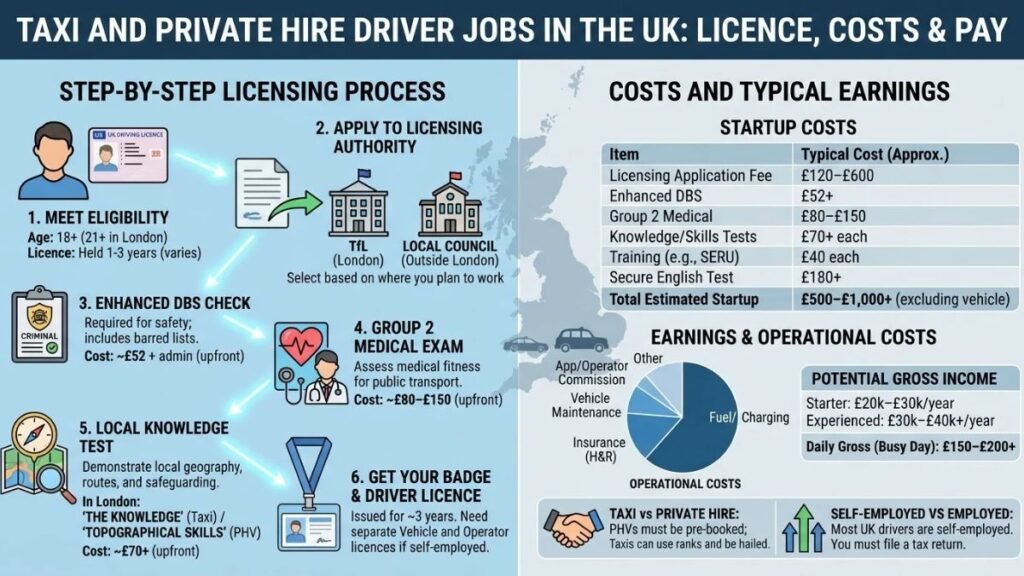
Quick answer: To drive a private hire vehicle you need a private hire driver licence from your local council or TfL, and a separately licensed vehicle. Typical requirements are an enhanced DBS check, a medical, a driving licence held for a set period, a knowledge or English test and safeguarding training. Gross earnings of about £15 to £22 an hour are commonly quoted for app drivers, but after costs most keep roughly £11 to £15.
Taxi or private hire: what is the difference?
The two are licensed separately.
| Hackney carriage (taxi) | Private hire vehicle (PHV or minicab) | |
|---|---|---|
| How passengers get it | Can be hailed in the street or picked up at a rank, and can also be pre-booked | Must be pre-booked through a licensed operator. It is illegal to pick up a passenger off the street |
| Fares | Often set by the local council through a meter and tariff | Set by the operator or app, often agreed in advance |
| Vehicle | Often a purpose-built or accessible vehicle, with a roof sign | A standard car, often unmarked, with a licence plate and a licence disc |
| Driver licence | A hackney carriage driver licence or badge | A private hire driver licence or badge |
| Examples | London black cabs and local council taxis | Uber, Bolt, FreeNow and local minicab firms |
Some councils offer a dual licence, which lets you work as either. In London, taxi drivers must pass the Knowledge of London, a demanding test that normally takes several years, while private hire drivers take a different, shorter test.
For taxi or private hire work, you generally need three licences to be in place:
- A driver licence for you
- A vehicle licence for the car
- An operator licence for the firm or platform that takes the booking (this is the company’s responsibility, not yours, but check that your operator is licensed)
Who issues the licence?
There is no single UK licence.
- In London, licences are issued by Transport for London (TfL). A London private hire driver licence is often called a PCO licence.
- In the rest of England and Wales, your local council issues licences. Requirements, fees and tests vary from council to council.
- In Scotland and Northern Ireland, licensing is run through local authorities and separate legislation, so check your local council or Department for Infrastructure.
A licence from one council normally lets you work only in that area for pre-booked journeys that start there, so choose the council where you plan to work. The rules on picking up and dropping off in other areas are complicated, so check before you work across borders.
Requirements to become a private hire driver
Councils decide the details, but most applicants must show that they are a “fit and proper person”. Typical requirements are:
| Requirement | What it usually means |
|---|---|
| Age | Often 21 in London and 18 or 21 elsewhere. Check your council |
| Driving licence | A full UK or equivalent driving licence, normally held for at least 12 months. TfL’s rules can be stricter, and sources differ, so check |
| Right to work | You must have the right to work in the UK. See our guide to right to work checks in the UK |
| Enhanced DBS check | Includes the children’s and adults’ barred lists. TfL also requires you to register with the DBS Update Service |
| Medical | A Group 2 medical, the same standard used for lorry and bus drivers, usually done by a doctor on a form such as the D4. It often has to be repeated every few years |
| Knowledge or topographical test | A test of local geography and routes. London uses a topographical skills test for private hire drivers |
| English language test | Many councils require one. London requires a speaking and listening test plus the SERU assessment, which covers written English and regulations |
| Safeguarding and disability awareness training | Common requirements, designed to protect passengers |
| Tax check | Many councils ask you to confirm that you are registered for tax, if you are self-employed |
If you have a criminal record or points on your licence, councils look at each case individually. Serious or recent offences can lead to refusal. Read our guide to how to get a job with a criminal record in the UK for how disclosure and DBS checks work.
How much does it cost?
Costs vary a lot between councils, so use these figures as a guide, and always check the current fees with your licensing authority.
In London (TfL)
Sources differ on TfL’s exact fees, which have changed over time. One 2026 guide says that from June 2026 TfL’s private hire driver application fee is £138 and the grant fee is £205, with the DBS and medical costing extra. Another puts the total for a licence at around £477 excluding the medical. The licence is valid for three years. On top of that, you may pay for:
- A medical, about £50 to £150
- An English test, from about £50 to £150 if you need one
- Safeguarding training and the DBS Update Service subscription, at small extra cost
- A private hire vehicle licence for your car, charged separately and renewed each year, plus inspections and compliance checks
Elsewhere in England and Wales
Council driver licence fees are often between about £120 and £310, depending on the council and the length of the licence, with enhanced DBS checks costing around £50 to £70 and a medical around £80 to £150. One council’s published example shows:
| Item | Example fee |
|---|---|
| Three-year private hire or hackney carriage licence | £299.50, including a £49.50 DBS enhanced application |
| Dual three-year licence | £329.50 |
| Knowledge test | £65 |
| Safeguarding course | £35 |
| Disability awareness course | £40 |
| Medical | Extra, taken with the council’s medical centre or your own doctor |
Putting it together
Budget for several hundred pounds before you take your first fare, and more if you also need to licence a car. One 2026 estimate for London puts the first-year total at about £650 to £870 excluding insurance, although that figure is based on older fee levels, so check with TfL. Others quote total start-up costs for councils elsewhere of about £200 to £600.
Vehicle and insurance costs
- Vehicle licence. Your car needs its own licence, inspections and in some councils age and emissions limits. In London it must meet emissions standards such as ULEZ and pass a TfL inspection.
- Hire and reward insurance. Normal car insurance does not cover carrying paying passengers. You need private hire insurance, which can be expensive, particularly for new drivers.
- Vehicle rental. If you do not own a suitable car, many firms rent licensed vehicles weekly. Costs vary and can eat into your earnings, so compare carefully and read the agreement, as some rental firms add charges for mileage, damage and penalty notices.
- Other costs. Fuel or charging, servicing, tyres, breakdown cover, congestion charges, Clean Air Zone charges, car washes, parking fines and your phone.
How to get a private hire licence: step by step
- Choose where you want to work. Pick the council or TfL area, and check what kind of licence is needed there.
- Check you are eligible. Age, driving licence, right to work, criminal record and health.
- Read the licensing authority’s requirements. Councils publish guides and fees on their websites. Watch for local rules about vehicle age and type.
- Book your medical with a doctor who can complete the correct form.
- Apply for your enhanced DBS check, usually as part of the council application. In London, subscribe to the DBS Update Service.
- Complete the tests and training. This can include a knowledge or topographical test, an English test, safeguarding training and disability awareness.
- Submit your application and pay the fees. Include your documents, photos and proof of identity.
- Arrange a licensed vehicle, get hire and reward insurance and pass any vehicle inspection.
- Collect your licence, badge and vehicle plate, and register with an operator or app.
- Start work. Apps and operators will check your documents before you can accept bookings.
One guide suggests the whole process typically takes 12 to 16 weeks from first application to first fare, with the DBS check and medical booking the main causes of delay. Your own timing will depend on your council and how quickly you complete each step.
How do taxi and private hire drivers work?
| Model | How it works | Notes |
|---|---|---|
| Ride-hailing apps | You drive for Uber, Bolt, FreeNow or similar, accepting trips through an app | Flexible hours, fast start, but a platform takes a commission |
| Local minicab firms | You take bookings from a local operator, often paying a weekly fee for the radio or app circuit | A steady local base, but fees apply |
| Executive and account work | Pre-booked corporate or airport transfers, often with higher-spec vehicles | Can pay better, with stricter standards |
| Hackney carriage (taxi) | Working ranks and hails in a council area, or in a London black cab after passing the Knowledge | Often higher earnings potential, but longer to qualify |
| School and contract work | Transporting children or patients for councils and the NHS, with extra checks | Regular hours, with enhanced vetting and often different insurance |
What do taxi and private hire drivers earn?
Earnings vary widely, because they depend on your area, hours, demand, vehicle and how you work. The figures below come from 2026 guides and studies that differ, so treat them as a guide.
| Measure | Figure |
|---|---|
| Gross earnings per hour for app drivers | About £15 to £22, with many sources around £18 to £19 in cities |
| Median gross earnings (University of Oxford study of Uber trips) | Around £19 an hour before costs |
| Net earnings per hour after fuel, insurance and fees | Commonly quoted at about £11 to £15, with some guides saying £8 to £17 |
| Typical full-time gross weekly earnings | Roughly £600 to £1,200, depending on hours and city |
| Typical rider fare | About £10 to £15, with the driver taking around £7 to £12 after the platform’s share |
| Trips per hour | Often 1.5 to 2.5 |
Things that affect your income:
- Location and time. London and other big cities pay more, and evenings, weekends, airports and events are busier.
- Waiting time. You are often not paid while waiting for a booking, and fuel and car costs run all the time.
- Platform fees and commission. Apps typically take a share of each fare. The commission rate varies.
- Vehicle costs. Older cars cost more to maintain, and electric vehicles have lower running costs but a higher purchase price.
- Hours worked. Full-time drivers often work long days to reach a decent income, so think about rest and safety.
Worker status, minimum pay and holiday pay
In 2021 the UK Supreme Court ruled that Uber drivers are workers, not self-employed contractors, which means they are entitled to the minimum wage and holiday pay. Uber now says it guarantees drivers at least the National Living Wage after expenses for the time from accepting a trip to drop-off, and pays holiday pay at 12.07% of earnings. The legal minimum for workers aged 21 and over is £12.71 an hour from April 2026. See our National Minimum Wage 2026 guide and our guide to holiday entitlement and holiday pay.
Other operators may treat drivers differently, and unlicensed or smaller firms may offer far fewer protections. Ask any operator whether you would be treated as employed, a worker or self-employed, and what it guarantees. Our guide to delivery driver jobs explains the difference between these statuses.
Tax
Many private hire drivers are treated as self-employed for tax, so you must usually register for Self Assessment, keep records of income and expenses and set money aside for tax and National Insurance. If your income from self-employment goes over the £1,000 trading allowance, you generally need to register. Check HMRC for the current rules on allowable expenses, mileage rates and VAT. Seek advice from an accountant if you are unsure.
Pros and cons
Advantages
- Flexible hours that you can fit around other commitments
- A relatively quick way to start earning, once licensed
- A choice of working for apps, local firms or on your own account
- Potentially good earnings in busy cities and at peak times
Disadvantages
- Licensing costs and delays before you can start
- High running costs and insurance
- Unpaid waiting time and income that is uneven
- Long hours and fatigue, plus sitting for long periods
- Safety risks, including difficult or abusive passengers
- Rules that differ between councils
Scams and risks to avoid
Taxi and private hire driving attracts several scams and risky offers:
- Anyone selling licences, badges or plates or offering to “fast-track” or fix your application for a fee. Licences can only be issued by the licensing authority, and fake licences are illegal.
- Fake test centres, “guaranteed pass” courses or exam cheating. This can lead to your licence being refused or revoked.
- Vehicle rental or finance deals with hidden charges. Read the contract, check what is included and avoid paying large deposits to unknown firms.
- “Account rental” schemes, where someone offers to let you use their licensed account. This is illegal working and can put your immigration status and licence at risk.
- Fake job adverts asking for fees to join as a driver. Read our guide to how to spot a fake job advert in the UK.
- Unlicensed operators, who may not insure or protect you. Check that any operator you work for is licensed.
If you are applying from overseas, check carefully, because taxi and private hire driving is not a visa route. See our guide to jobs with visa sponsorship in the UK.
Safety and rules on the road
- Pre-booked only. Private hire drivers must not pick up passengers who have not booked, and doing so can lead to prosecution and an invalid insurance policy.
- Display your licence, badge and plates as your council requires.
- Keep your vehicle roadworthy, and follow the council’s inspection and testing rules.
- Avoid fatigue. Plan breaks and rest, and do not drive when tired.
- Know your rights and your passengers’ rights, including your duties to assist disabled passengers and assistance dog owners.
- Keep records of income, expenses and any incidents.
Since 1 October 2026, the Home Office has extended right to work checks to more working arrangements, so check how this affects platform and agency drivers. See our guide to right to work checks in the UK.
Other driving jobs to consider
If taxi or private hire is not right for you, see our guides to delivery driver jobs and HGV driver jobs, and browse driver vacancies on our UK jobs board.
Frequently asked questions
How do I become a private hire driver in the UK? Apply to your local council or TfL for a private hire driver licence. You will need an enhanced DBS check, a medical, a driving licence held for a set period, and often a knowledge, English or topographical test and safeguarding training. You also need a licensed vehicle and insurance.
How much does a private hire licence cost? Council driver licence fees are often about £120 to £310, plus DBS and medical costs. In London, one 2026 guide says TfL charges a £138 application fee and a £205 grant fee. Check the current fees with your licensing authority.
How long does it take to get a private hire licence? Often around 12 to 16 weeks from application to first fare, though it varies by council and how quickly you complete each step.
What is a PCO licence? A private hire driver licence issued by Transport for London for work in London.
Can I drive for Uber without a licence? No. You need a private hire driver licence, a licensed vehicle and the right insurance.
How much do Uber drivers earn in the UK? Gross earnings of about £15 to £22 an hour are commonly quoted, with net earnings after costs often around £11 to £15 an hour. Results vary a lot.
Do Uber drivers get holiday pay? Uber says it pays holiday pay at 12.07% of earnings and guarantees at least the National Living Wage after expenses for the time between trip acceptance and drop-off. Other operators may differ.
Do I need my own car to drive a taxi or private hire vehicle? You need access to a licensed vehicle. You can use your own car if it meets the council’s rules, or rent one from a firm.
Can I be a taxi driver with a criminal record? It depends on the offence, how long ago it was and the council’s policy. Serious and recent offences can lead to refusal.
Final thoughts
Taxi and private hire driving can offer flexible work and decent earnings, but only if you plan the costs, choose the right licensing area and understand how you will be paid. Compare operators, check the real running costs and never pay anyone for a licence or a guaranteed job. When you are ready, browse the latest driver vacancies on our jobs board and apply directly with licensed operators.
This article is general information, not legal, tax or licensing advice. Licensing rules, fees and tests differ by council and change often. Check your local council or TfL, HMRC and GOV.UK for the latest requirements before you apply or pay for anything.