
Admin and Office Jobs in the UK With No Experience: Pay and How to Apply
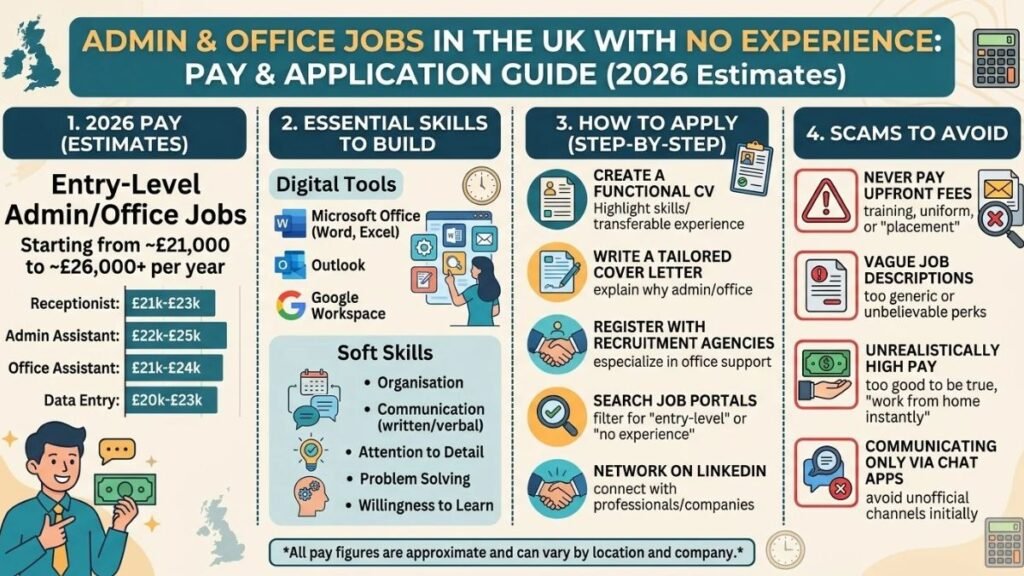
Admin and office jobs are a popular first step into a career. Almost every organisation, from councils and schools to law firms, charities and manufacturers, needs people to keep information organised, answer queries and help teams run smoothly. Many entry-level roles do not ask for experience, but they do expect basic computer skills and a good attitude. This guide explains the types of admin job, what they pay in 2026, how to get one with no experience, how to build the right skills and how to avoid the scams that target office job seekers.
Quick answer: Entry-level admin and office jobs in the UK commonly pay about £21,000 to £25,000 a year, with the typical administrator median nearer £28,000. You do not usually need a degree, but you will need basic computer skills, clear written English, good organisation and reliability. Many people start through temping, volunteering, a business admin apprenticeship or customer service experience.
What do admin and office workers do?
Admin work means supporting the day-to-day running of an organisation. Typical tasks include:
- Answering phones, emails and enquiries, and passing them to the right person
- Data entry and record keeping, updating spreadsheets, databases and filing systems
- Diary and meeting support, booking rooms, arranging appointments and taking minutes
- Typing and preparing documents, letters, reports and presentations
- Handling post, orders and invoices, and basic bookkeeping or purchase tasks
- Welcoming visitors and handling reception duties
- Supporting colleagues on projects and special tasks
The work is mostly office-based, though many roles are now hybrid or fully remote. See our guide to work from home jobs in the UK.
Types of admin and office jobs
| Role | What it involves | Experience |
|---|---|---|
| Admin assistant or office junior | General clerical support, filing, data entry, phones and email | None to little |
| Receptionist | Greeting visitors, handling calls, bookings and security | None to little, customer service helps |
| Data entry clerk | Entering and checking information accurately | Little, typing speed matters |
| Customer service administrator | Handling customer queries, orders and accounts, often by email and phone | Customer service helps. See our guide to call centre jobs |
| Post room and mailroom assistant | Sorting and distributing mail and parcels | None |
| Records or document controller | Managing files and records, often in regulated sectors | Little to some |
| Finance and accounts clerk | Invoices, payments, expenses and ledgers | Some numeracy or finance skills |
| HR or recruitment assistant | Supporting hiring, contracts and employee records | Little |
| Medical, school and council receptionist or administrator | Admin in GP surgeries, schools, councils and the NHS | None to some. See our guides to NHS jobs and teaching assistant jobs |
| Legal or property administrator | Document preparation and client support in law and estate agency | Little, with training |
| Personal assistant (PA) | Supporting a manager or director, with diary, travel and communications | Usually experience needed |
Browse current admin and office vacancies on our UK jobs board.
How much do admin and office jobs pay in 2026?
Salary sites give different figures because they measure different things, so treat them as a guide.
| Source or role | Typical pay |
|---|---|
| Entry-level or junior admin assistant (Indeed averages) | About £22,600 to £22,800 a year |
| Admin assistant or office junior (one salary guide) | £22,000 to £25,000 |
| Admin assistant average advertised pay (Indeed, UK) | About £25,400 a year |
| Typical admin assistant range (employer cost guide) | £21,000 to £32,000, with regional pay often £21,000 to £26,000 |
| General administrator | £25,000 to £29,000 |
| Median for office administrators and admin assistants (ONS survey as reported by one site) | About £28,300 a year, typically in a wide range of £22,000 to £42,000 |
| Specialist administrator in legal, finance, HR or project support | £28,000 to £35,000 |
| Senior administrator or office manager | £32,000 to £42,000 |
| London admin assistant average | About £27,300 a year |
| Receptionist or admin assistant average (Indeed) | About £24,600 a year, or from about £12.75 an hour in one advert |
Points to remember:
- The legal minimum applies. From April 2026 it is £12.71 an hour for workers aged 21 and over (about £24,800 a year for 37.5 hours a week), £10.85 for ages 18 to 20 and £8.00 for under-18s and apprentices. Some admin adverts are close to the minimum. See our National Minimum Wage 2026 guide.
- Location matters. London and the South East pay more, but living costs are higher.
- Sector matters. Finance, legal, technology and professional services often pay more than small businesses and charities. Public sector roles usually have set pay scales and pensions.
- Part-time and temporary roles are paid pro rata or hourly, so check the effective rate.
- Progression raises pay. Moving from admin assistant to administrator, PA, team coordinator or office manager can add several thousand pounds.
Your take-home pay will be lower after tax, National Insurance and pension. See our guide to payslips, tax codes and National Insurance.
Do you need experience or qualifications?
For many entry-level admin jobs, you do not need either, but employers will usually look for:
- GCSE English and maths at grade 4 or above, or equivalents, in many roles
- Computer skills, particularly Microsoft Office (Word, Excel, Outlook) or Google Workspace
- Accurate typing and attention to detail
- Clear written and spoken English, including a professional phone and email manner
- Organisation and time management
- Reliability and discretion, especially for confidential information
- Willingness to learn new systems
Experience in retail, hospitality, customer service, volunteering or at school or college can be used as evidence of these skills.
How to get an admin job with no experience
1. Build the core skills
- Learn the basics of Microsoft Office or Google Workspace. Free tutorials and short online courses cover Word formatting, Excel formulas, email and calendar management. A short, recognised certificate can help, but employers usually care more about what you can do.
- Practise typing and accuracy. Free online typing tests help you track your speed and errors.
- Improve your Excel. Learn sorting, filtering, formulas such as SUM and VLOOKUP or XLOOKUP, and basic charts.
- Learn email and phone etiquette. Practise writing clear, polite emails and taking messages.
- Get comfortable with common tools, such as video meeting software, shared drives and online calendars.
- Consider a qualification. Options include Level 2 or Level 3 courses in business administration, customer service or IT user skills. Check that a provider is recognised before you pay, and look for funded places through local colleges or the National Careers Service.
2. Gain relevant experience
- Volunteer. Charities, community groups, schools, parent groups and clubs often need help with admin, bookkeeping, social media and events. It gives you something concrete for your CV.
- Temp through agencies. Many agencies place temporary admin staff, which lets you try different workplaces and often leads to permanent jobs. Register with a few reputable agencies, and never pay a fee.
- Start in a related role. Reception, customer service, post room and data entry roles can lead to admin positions.
- Ask for admin tasks in your current job, such as rotas, stock records or reports.
- Consider an apprenticeship. Business administration apprenticeships let you earn while you learn. See our guide to apprenticeships in the UK.
3. Show your transferable skills
Skills from other jobs are often what employers want:
| From | Admin skill |
|---|---|
| Retail and hospitality | Customer service, handling cash and orders, working under pressure, teamwork |
| Call centres | Phone manner, systems use, accuracy, handling complaints |
| School or college | Research, writing, presenting, organising deadlines |
| Volunteering and clubs | Organising events, keeping records, communication |
| Caring and family responsibilities | Reliability, planning, multi-tasking |
How to apply: step by step
- Decide what type of admin job you want, such as general office, reception, finance admin or in a school or the NHS.
- Write a clear one-page CV. Lead with a short profile, your key skills, any work or volunteering and your education. Include the software you can use. See our guides to writing a UK CV with no experience and writing a cover letter in the UK.
- Use keywords from the advert, such as “data entry”, “Microsoft Excel”, “customer service” and “organised”. Many employers use software to scan CVs.
- Search the right places. Check council and NHS websites, school and academy trust pages, university jobs sites, agencies and our jobs board.
- Apply to many roles, and tailor your CV and cover letter to each.
- Prepare for tests. Many employers use typing, Excel, Word or situational tests.
- Prepare for the interview. See below.
- Check the offer. Make sure it states your pay, hours, location, notice and whether hybrid working is allowed. Read our guide to understanding your employment contract.
Tips for your CV
- Put your strongest relevant skills near the top.
- Use clear headings and a simple layout. Avoid fancy graphics that may not scan well.
- Give examples with numbers, such as “handled about 50 customer emails a day”.
- Proofread carefully. Errors matter in an admin role.
- Keep it to one or two pages.
Interview tips for admin jobs
Employers want to see that you are organised, accurate, discreet and friendly. Expect a mix of competency questions and practical tests.
Common questions
- Why do you want to work in admin or in this organisation?
- How do you organise your time when you have lots of tasks?
- Tell me about a time you made a mistake and how you put it right.
- How do you make sure your work is accurate?
- How would you handle a difficult phone call or email?
- What experience do you have with Excel, Word or other software?
- How do you keep information confidential?
- How would you deal with two urgent requests from different managers?
Use the STAR method (Situation, Task, Action, Result) for examples. Our guides to common interview questions and answers in the UK and customer assistant interview questions and answers explain it with examples.
Practical tests
- Typing tests for speed and accuracy
- Excel or Word tests, with tasks such as formatting or basic formulas
- Prioritisation exercises, where you decide the order of tasks
- Written tasks, such as drafting an email or summarising a document
Practise beforehand, and read the instructions carefully.
Hours, hybrid working and rights
- Hours. Most admin jobs are around 9am to 5pm or 37.5 hours a week, with part-time and flexible options.
- Hybrid and remote work. Some employers offer it, but many entry-level roles are in the office, especially during training. You can ask about flexibility, and you have a legal right to request it from day one. See our guide to flexible working in the UK.
- Breaks and workstation. Employers must provide suitable workstations, and workers who use screens regularly are entitled to breaks and, in many cases, eye tests.
- Holiday and sick pay. You build up paid holiday, and since April 2026 Statutory Sick Pay is payable from day one for those who qualify. See our guides to holiday entitlement and holiday pay and Statutory Sick Pay 2026.
- Temporary and agency work. Rights differ for agency workers, including a right to equal treatment on basic pay after 12 weeks in the same role. Ask the agency how it applies to you.
- Probation and notice. Check your contract. See our guide to notice periods in the UK.
Admin careers: where it can lead
Admin experience opens many doors:
- Senior administrator, team coordinator or office manager
- Personal assistant or executive assistant
- Project coordinator or project support officer
- HR, payroll or finance roles, with further qualifications
- Customer success, operations and account management
- Legal, property and compliance support
- Public sector and NHS administration, with pay scales and pensions
A note on technology: routine data entry and simple tasks are increasingly automated or supported by software and AI tools. People who can use these tools, check their output, organise work and communicate well are likely to be more valuable. Keep learning new systems.
Scams and warning signs
Office and admin roles, especially remote ones, are heavily used in job scams. Watch for:
- Data entry and “typing from home” offers that ask for a fee, a deposit or purchase of software
- Payment processing, “finance assistant” or “parcel” roles that ask you to move money or goods, which can involve money laundering
- A “personal assistant” to a company boss who contacts you by email or text and asks you to buy gift cards, pay invoices or send cheques
- Fake agencies that ask for a registration fee, or copy real agencies’ names
- Cheques or payments sent to you for “equipment” before you start
- Offers through WhatsApp or Telegram with no named employer or proper interview
- Requests for your passport or bank details before you have a contract
Check the employer on Companies House, apply through its own website or a reputable agency, and never pay to get a job. Read our guides to how to spot a fake job advert in the UK and work from home jobs in the UK.
Other groups: school leavers, students and people with a record
- School leavers and 16 to 17 year olds can find office junior and apprenticeship roles. See our guides to jobs for 16 and 17 year olds and apprenticeships in the UK.
- Students can find part-time admin and campus roles. See our guide to part-time jobs for students in the UK.
- People with a criminal record may face extra checks for roles handling money or sensitive data. See our guide to how to get a job with a criminal record in the UK.
Frequently asked questions
Can I get an admin job with no experience? Yes. Many entry-level roles accept people with no admin experience, especially if you can show customer service skills, computer skills and reliability.
How much does an admin assistant earn in the UK? Entry-level pay is commonly around £21,000 to £25,000, and the typical average across all admin assistants is about £25,000 to £28,000, depending on the source.
What qualifications do I need for an admin job? None are legally required. Many employers ask for GCSE English and maths, and appreciate Level 2 or 3 business admin or IT qualifications.
What skills do admin jobs need? Computer skills (especially Excel and Word), typing, organisation, communication, attention to detail and confidentiality.
How do I get my first admin job? Build basic skills, volunteer or temp, tailor your CV, apply widely and consider an apprenticeship.
Can I do admin work from home? Sometimes. Remote and hybrid roles exist, but be careful of scams that promise easy money from home.
Are admin jobs well paid? Entry-level pay is modest, often close to the minimum wage in some roles, but you can progress to better-paid positions such as office manager, PA or specialist administrator.
Is admin a good career? It can be, as a stable route into many industries, particularly if you keep developing your skills.
Final thoughts
Admin and office jobs are one of the most accessible routes into a career. Build the basic skills, gather evidence from any experience you have, tailor each application and stay safe from scams. When you are ready, browse the latest vacancies on our jobs board and apply directly with employers or reputable agencies.
This article is general information. Salary figures come from several job and salary sites that differ, and pay changes often. Check the job advert, your contract and GOV.UK or the National Careers Service for the latest guidance.


