Warehouse Jobs in the UK 2026: Pay, Requirements and Shift Patterns
Warehouse and logistics work is one of the biggest sources of entry-level jobs in the UK. Thousands of vacancies are advertised at any time, most need no experience or qualifications, and many offer weekly pay, overtime and start dates within days. This guide explains what warehouse jobs involve, what they pay in 2026, what employers ask for, how shift patterns work, and what to check before you accept a job.
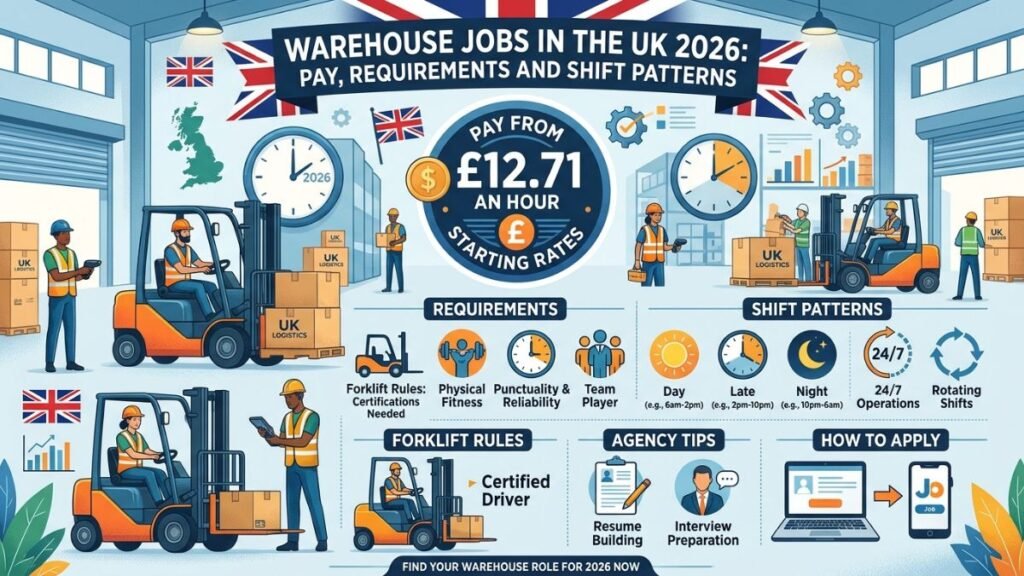
Quick answer: Most warehouse operative jobs in October 2026 are advertised at between £12.71 and about £14.50 an hour, with nights, forklift roles and some agency shifts paying more. You usually do not need experience, but you do need the right to work in the UK, reasonable fitness and flexibility with shifts.
What do warehouse workers do?
Warehouses store, sort and move goods for retailers, manufacturers, food companies, parcel carriers and online sellers. Typical tasks include:
- Picking: collecting items for customer orders, using a handheld scanner or a paper list
- Packing: boxing, labelling and wrapping orders
- Goods in: unloading lorries, checking deliveries and scanning stock
- Loading and despatch: loading outgoing orders onto vehicles
- Stock control: counting stock and keeping records accurate
- Machine operation: using pallet trucks and, with training, forklift trucks
- Housekeeping: keeping aisles clear and following health and safety rules
The work is active, often repetitive, and sometimes carried out in cold or chilled areas, such as food and freezer warehouses.
Types of warehouse jobs
| Role | What it involves | Experience |
|---|---|---|
| Warehouse operative | General picking, packing, loading and stock handling | None usually needed |
| Picker / packer | Preparing orders to a target | None usually needed |
| Forklift driver (FLT operator) | Moving pallets with a counterbalance, reach or other truck | Training or a forklift ticket often needed |
| Goods-in / despatch operative | Receiving and sending stock | Little or none |
| Parcel and mail sorter | Sorting parcels at hubs | None usually needed |
| Chilled or freezer operative | Working in cold stores | None, though suitable clothing is provided |
| Team leader / supervisor | Running a shift or section | Warehouse experience |
| Inventory or stock controller | Counting and checking stock, using IT systems | Some experience helps |
Browse current warehouse and logistics vacancies on our UK jobs board.
How much do warehouse jobs pay in 2026?
Pay depends on the employer, location, shift and whether you are hired directly or through an agency. The examples below come from job adverts live in October 2026, so they show what employers are offering now, not a guaranteed rate.
| Role and shift (example) | Advertised pay |
|---|---|
| Warehouse operative, days (agency, various sites) | £12.71 to £13.05 an hour |
| Warehouse operative, rotating shifts | £13.41 to £14.12 an hour |
| Warehouse operative, nights | About £13.50 an hour plus night allowance |
| Warehouse operative, freezer chamber nights | About £14.05 an hour |
| Warehouse operative, Monday to Friday days (one advert) | £14.83 an hour |
| Night warehouse operative, Swansea (agency) | £12.71 rising to £15.01 after 13 weeks |
| Rotating shift operative with pay step-up | £13.67 for 12 weeks, then £14.12 |
| Forklift driver and warehouse operative (agency) | About £13.50 to £14.50 an hour |
| Forklift driver, nights (Barnsley example) | £17.25 an hour |
A recruitment site’s salary guide puts the typical UK forklift driver at around £14 to £15 an hour, which is roughly £30,000 to £31,000 a year for full-time work, with higher rates in London and for specialist trucks.
Things to know about warehouse pay:
- The legal minimum for workers aged 21 and over is £12.71 an hour from April 2026, and many entry-level warehouse jobs are advertised at exactly that rate. See our guide to the National Minimum Wage 2026.
- Night shifts and weekends often pay a premium or allowance.
- Pay can step up after a number of weeks, especially for agency workers. Some adverts show a lower starting rate that rises after 12 or 13 weeks.
- Overtime is common, but check whether it is paid at a higher rate or at your normal rate.
- Amazon and similar large employers advertise frontline operations pay at higher rates in some locations. For example, Amazon seasonal and frontline roles were advertised at about £15.10 to £16.10 an hour in autumn 2026, depending on site. Check the advert for the exact rate.
- Some adverts show wide ranges, such as £12.71 to over £20. These usually include overtime, shift premiums or weekend rates, so check the base rate.
What it means in a week
For a 40-hour week (before tax):
| Hourly rate | Weekly pay |
|---|---|
| £12.71 | £508 |
| £13.50 | £540 |
| £14.50 | £580 |
| £15.00 | £600 |
Take-home pay will be lower after tax, National Insurance and any pension contributions.
Shift patterns explained
Many warehouses run for long hours, so shift patterns matter as much as pay. Common patterns include:
| Pattern | Typical hours | Notes |
|---|---|---|
| Early (AM) | 6am to 2pm | Good for afternoons free. Often needs reliable early transport |
| Late (PM) | 2pm to 10pm | Evenings and some weekends |
| Night | 10pm to 6am, or similar | Often pays more. Affects sleep and social life |
| Days, Monday to Friday | For example 8am to 5pm | Often lower pay but steadier hours |
| Rotating shifts | Weekly or fortnightly change between earlies, lates and nights | Can pay more, can disrupt routines |
| 4 on, 4 off | Four long shifts, then four days off | Common in 24-hour sites. Check shift lengths |
| 5 out of 7 days | Any five days a week | Flexible but less predictable |
| Weekend only | Saturday and Sunday | Often higher hourly pay |
| 12-hour continental shifts | Long shifts on a repeating pattern | Fewer days at work, but long days |
Before you accept, ask for the exact start and finish times, shift rotation, break lengths and how overtime and last-minute changes are handled.
Requirements for warehouse jobs
Most employers look for:
- The right to work in the UK. You will need to show documents or a share code.
- Reliability and good timekeeping. This is often the most important quality, since missed shifts disrupt the whole operation.
- Reasonable fitness. You may be on your feet all shift, lifting, bending and walking long distances.
- Attention to detail. Picking the wrong item or quantity costs the employer money.
- Willingness to follow safety rules, including wearing protective equipment.
- Basic English and numeracy, for reading labels and using scanners.
- Flexibility with shifts, including nights and weekends.
- Transport. Many warehouses are on industrial estates with limited public transport, so check how you will get there at 5am or midnight.
- A driving licence, for some roles that involve driving vans or vehicles on site.
You do not usually need experience, qualifications or a forklift licence to start as a general warehouse operative. New staff normally get an induction and are trained on the job.
Forklift training
There is no single “forklift licence” required by law, but employers must make sure that anyone who operates a forklift is properly trained and competent. In practice, employers usually ask for a recognised forklift certificate or ticket from an approved training provider, or provide training themselves. Some adverts say full forklift training is provided, while others require an in-date licence.
Forklift certificates are often specific to the truck type, such as counterbalance, reach or narrow-aisle trucks, and employers often want a few years’ experience for higher-paid roles. If you pay for your own course, check that the provider is accredited and that employers in your area accept the certificate. Ask employers whether they will train you, since many do.
Personal protective equipment
Employers must carry out risk assessments and provide any protective equipment the job requires, such as high-visibility clothing, gloves and cold-store clothing. Safety footwear policies differ between employers, so ask whether boots are provided or whether you need to buy your own before you start.
Agency or direct employment?
Many warehouse vacancies are advertised by recruitment agencies, while other employers hire directly.
Agency work
- Pros: quick starts, weekly pay, flexibility, and a way to try different employers
- Cons: hours may not be guaranteed, shifts can be cancelled at short notice, and benefits may be limited
- Agency workers who stay in the same role with the same hirer for 12 weeks become entitled to equal treatment on basic pay and working conditions under UK law, which is why some adverts show a pay step-up after 12 or 13 weeks. Ask the agency how this will apply to you.
Direct employment
- Pros: often more stable hours, pension, sick pay, holiday and progression
- Cons: recruitment can be slower, and some employers prefer to take on agency staff first before offering a permanent contract
Many agency adverts are “temp to perm”, meaning a temporary start with a chance of a permanent job. Ask how the agency or employer decides who is made permanent. Read your contract carefully. Our guide to understanding your employment contract explains the key terms.
How to apply for warehouse jobs
- Decide on your shift preferences and how far you can travel.
- Prepare a simple CV. Include any work, volunteering or physical activity that shows reliability. If you have no experience, read our guide to writing a UK CV with no experience.
- Register with two or three reputable agencies in your area and keep your phone on, since shifts can fill quickly. Apply directly to employers too.
- Have your documents ready: proof of right to work, ID, proof of address, National Insurance number and bank details.
- Attend the interview or induction. Many warehouse recruiters run short interviews or group inductions rather than formal ones.
- Check the details before you accept. Confirm pay, hours, start date, shift pattern, breaks and who the employer is.
- Keep records. Save your contract, payslips and a note of your hours.
Interview tips
Warehouse interviews are usually short and practical. Expect questions about reliability, teamwork and safety, for example:
- Why do you want to work in a warehouse?
- Are you comfortable with physical work and shifts, including nights?
- How would you make sure an order was accurate?
- How do you get to work, and what would you do if you were running late?
- What would you do if you saw a safety hazard?
Give honest, specific answers, and be clear about your availability. Our guide to customer assistant interview questions and answers explains the STAR method for examples.
Your rights in a warehouse job
- Minimum wage. You must be paid at least the minimum for your age. Unpaid time you are required to be at work, such as waiting or briefings, can count as working time.
- Rest breaks. Workers aged 18 and over are generally entitled to a 20-minute break if they work more than six hours, plus rest between shifts.
- Night work. Night workers are generally entitled to free health assessments, and limits apply to average night working hours. Ask your employer for details.
- Holiday pay. You build up paid holiday, including as an agency worker, and unused holiday should be paid at the end of your job.
- Sick pay. Since April 2026, Statutory Sick Pay is payable from the first day for those who qualify. Read our guide to the Employment Rights Act 2025.
- Health and safety. Your employer must provide training, safe equipment and a safe workplace. You can raise concerns without being punished for doing so.
- Agency fees. An agency cannot charge you a fee for finding you work.
If you think you are being underpaid or treated unfairly, keep your payslips and rotas and contact Acas for free advice.
Health and wellbeing
Warehouse work is physical, so look after yourself:
- Learn safe lifting and manual handling techniques during your training
- Wear the right footwear and protective gear
- Stay hydrated, and take your breaks
- Be realistic about nights and rotating shifts, which can affect sleep
- Report injuries and near misses promptly
- Ask about productivity targets, how they are measured and whether breaks are protected
Career progression
Warehouse work can lead to better-paid roles. Typical steps include:
- Forklift or machine operator, which usually pays more than general picking
- Team leader or shift supervisor
- Inventory controller or goods-in coordinator
- Warehouse or logistics manager
- Transport planner or supply chain roles
- HGV driver, with the right licence (see our upcoming guide on HGV driver jobs)
Ask about training, forklift courses and promotion routes at interview.
Scams and problems to avoid
- Agencies that charge you to register, for “training” or for a job. Agencies cannot legally charge you for finding work.
- Jobs advertised only on WhatsApp or social media, with no named employer or agency.
- Unrealistic pay, such as £50 an hour for no experience.
- Unpaid trial shifts. If you are doing real work, you should be paid.
- Cash-in-hand work with no payslip, which leaves you without holiday, sick pay or proof of earnings.
- Pressure to hand over your passport or bank details before you have a confirmed job.
Read our guide to how to spot a fake job advert in the UK for a full checklist.
Peak season: Christmas and Black Friday
Warehouses hire large numbers of temporary staff for the pre-Christmas rush, from October through to December, and some of those roles lead to permanent jobs. See our guide to Christmas jobs in the UK 2026 for who is hiring now.
Frequently asked questions
Do I need experience for a warehouse job? No. Most general warehouse operative jobs are open to beginners and include training.
How much do warehouse workers earn? Most entry-level roles advertised in October 2026 pay between £12.71 and about £14.50 an hour, with nights, forklift driving and some agency roles paying more.
Do I need a forklift licence? Not for general warehouse work. For forklift roles, employers need you to be trained and competent, and many ask for a recognised certificate, though some provide training.
What are the usual warehouse shift times? Early shifts (around 6am to 2pm), late shifts (around 2pm to 10pm), night shifts (around 10pm to 6am), and patterns such as 4 on, 4 off.
Is agency work worth it? It can be, for fast starts and weekly pay, but hours can be less secure. After 12 weeks in the same role you gain extra rights to equal treatment on basic pay.
Can I work in a warehouse at 16 or 17? It depends on the employer and role. Many warehouse jobs have age limits, especially those involving machinery, so check each advert.
Are warehouse jobs hiring now? Yes. There are thousands of vacancies, and recruitment is especially high before Christmas.
Final thoughts
Warehouse work offers quick starts, steady demand and clear routes to higher pay through forklift training and supervisor roles. Before you accept a job, check the pay rate, shift pattern, contract and employer, and avoid anyone who asks you to pay. When you are ready, browse the latest vacancies on our jobs board and apply directly or through a reputable agency.
This article is general information. Pay rates come from job adverts live in October 2026 and change often. Always check the job advert, your contract and the employer’s own details before you accept a job.