Common Interview Questions and Answers in the UK (Any Job)
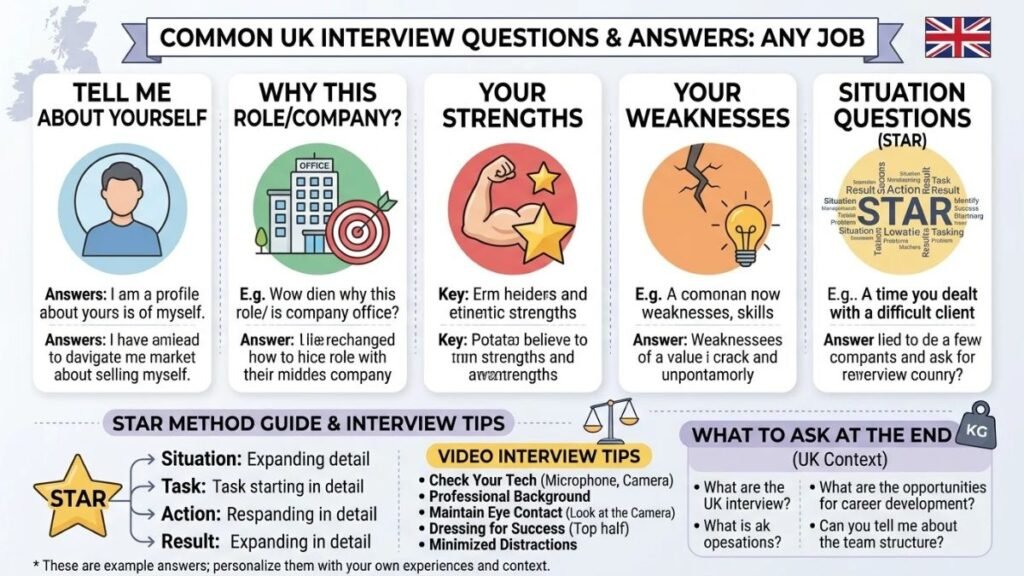
Whether you are going for a shop job, an office role, a warehouse position or a graduate scheme, the same questions come up again and again in UK interviews. Employers want to know who you are, why you want the job, what you can do and how you will fit in. This guide covers the questions you are most likely to be asked, explains what interviewers are really looking for, and gives example answers you can adapt using your own experience.
Quick answer: Prepare short, specific answers to about ten common questions: tell me about yourself, why this job and company, your strengths and weaknesses, a time you worked in a team or solved a problem, and where you see yourself in five years. Use the STAR method (Situation, Task, Action, Result) for examples, and always give real evidence, not just claims.
How UK interviews usually work
The format depends on the employer and the job, but you may meet one or more of these:
- Phone or video screening: a short call, often 15 to 30 minutes, to check the basics before a full interview.
- One-to-one interview: with the hiring manager, usually 30 to 60 minutes.
- Panel interview: two or three people ask you questions, common in the public sector, schools, the NHS and large employers.
- Competency or behavioural interview: questions that ask for past examples (“Tell me about a time when…”).
- Group assessment or assessment centre: group tasks, presentations and tests, common for graduate and retail roles.
- Practical or trial: a short task, test or paid trial shift in some jobs.
Most interviews start with introductions and easy questions, move on to experience and examples, and end with “Do you have any questions for us?”
The STAR method
For any question that begins “Tell me about a time…” or “Give me an example…”, use STAR:
- Situation: set the scene briefly (who, where, when).
- Task: explain what you needed to achieve.
- Action: describe what you did, using “I” rather than “we”.
- Result: say what happened, with numbers if possible, and what you learned.
Aim for about 60 to 90 seconds per example. If you have little work experience, use examples from education, volunteering, sport, caring responsibilities or community work. These count.
Questions about you
1. Tell me about yourself
What they want: a short, relevant summary, not your life story.
Formula: present (what you do now), past (relevant experience), future (why you want this job).
Example answer: “I’m currently a customer service advisor at a telecoms company, where I handle around 60 calls a day and have been top for customer satisfaction for the last two quarters. Before that I worked in retail, which taught me to stay calm under pressure. I’m now looking for a role with more responsibility, and your team leader position looks like the right next step.”
Tip: Keep it to about a minute and link it to the job.
2. Why do you want this job?
What they want: real interest, not just “I need a job”.
Example answer: “The role combines the customer service I enjoy with the chance to work in a team, and the training programme in your advert is exactly the kind of development I’m looking for. I also like that your company is known for promoting people from within.”
3. Why do you want to work for us?
What they want: evidence you have done your research.
Example answer: “I’ve followed your company for a while and I’m impressed by its focus on sustainability. I read in your recent annual report that you’ve cut packaging waste by a third, and I’d like to contribute to work like that.”
Tip: Look at the website, social media, recent news and the job advert. Mention one or two specific things.
4. What are your strengths?
What they want: strengths that match the job, with proof.
Example answer: “I’m organised and reliable. In my last job I managed the rota for a team of eight and made sure every shift was covered, even during holidays. I’m also good at staying calm when things get busy.”
5. What is your biggest weakness?
What they want: honesty, self-awareness and evidence that you work on weaknesses.
Example answer: “I used to find it hard to delegate because I wanted everything done properly. I realised that was slowing the team down, so I started sharing tasks and checking in rather than taking over. It’s made me more efficient.”
Tip: Avoid clichés such as “I’m a perfectionist” or “I work too hard”, and never name a weakness that is essential for the job.
6. Where do you see yourself in five years?
What they want: ambition that fits the role, and a sign that you will stay.
Example answer: “In five years I’d like to have developed my skills and taken on more responsibility, possibly as a team leader. I’m keen to build a long-term career in this industry.”
7. What motivates you?
Example answer: “I’m motivated by helping people and seeing results. I like knowing that I’ve made a customer’s day easier, and I enjoy hitting targets as part of a team.”
8. How would your colleagues describe you?
Example answer: “I think they’d say I’m dependable and approachable. I’m usually the person colleagues come to when they need a hand, and my manager has said I’m good at staying positive under pressure.”
Questions about experience and skills
9. Tell me about a time you worked in a team
Example answer (STAR): “Situation: At my previous job, our team had to prepare for a stock take at short notice. Task: We needed to finish in a weekend. Action: I suggested splitting into pairs by section, set up a checklist and offered to check the counts at the end. Result: We finished a day early with fewer than 1% errors, and my manager asked me to organise the next one.”
10. Tell me about a time you solved a problem
Example answer (STAR): “Situation: A delivery was going to arrive late for a key customer. Task: I needed to avoid losing the order. Action: I phoned the customer, explained the delay and offered a partial delivery the same day with the rest the next morning. Result: They accepted, and they stayed with us. I also suggested a new delay alert to my manager.”
11. Tell me about a time you dealt with a difficult customer or colleague
Example answer: “A customer was angry about a billing error. I listened without interrupting, apologised for the mistake and checked the account while they were on the line. I corrected the error, confirmed it by email and followed up two days later. They thanked me and left a positive review.”
12. Tell me about a time you made a mistake
What they want: honesty, responsibility and learning.
Example answer: “I once sent a customer the wrong price list. As soon as I noticed, I told my manager, sent the correct version with an apology and checked the other emails I had sent that day. I now double-check attachments before sending.”
13. Tell me about a time you worked under pressure or to a tight deadline
Example answer: “We lost two team members during a busy period. I prioritised the urgent tasks, agreed deadlines with my manager and worked with colleagues to share the workload. We met every deadline, and I learned to ask for help early.”
14. Tell me about a time you showed initiative
Example answer: “I noticed we were spending a lot of time answering the same customer question, so I wrote a short guide and shared it with the team. It cut the number of repeat calls and was added to our induction pack.”
15. Tell me about a time you disagreed with your manager or a colleague
Example answer: “My manager wanted to change a process, and I was worried it would slow down orders. I asked for a meeting, showed my concerns with figures and suggested a trial. We tested it for two weeks and adjusted the process. I learned to raise concerns constructively and with evidence.”
16. What skills do you bring to this role?
Tip: Pick two or three skills from the advert, such as communication, organisation and IT skills, and give an example of each.
Practical and situational questions
17. What would you do in your first 30 days?
Example answer: “I’d focus on learning: understanding the systems, meeting the team and getting to know the customers or processes. I’d ask lots of questions, and agree some early goals with my manager.”
18. How do you prioritise your work?
Example answer: “I list tasks by urgency and importance, check deadlines and talk to my manager if priorities clash. I review the list at the start and end of each day.”
19. What would you do if you did not know the answer to a customer’s question?
Example answer: “I’d be honest, say I’d find out, then check the information or ask a colleague. I’d come back to the customer promptly, rather than guess.”
20. Are you happy to work shifts, evenings or weekends?
Tip: Answer honestly. If you have limits, state them clearly, so there are no surprises later.
21. What are your salary expectations?
What they want: a realistic figure that fits the role.
Example answer: “I’ve researched similar roles and see a range of £27,000 to £31,000 for this level. Based on my experience, I’d be looking at the middle of that range, but I’m open to discussing the whole package.”
Tip: Research typical pay on job adverts and salary guides, and remember the legal minimum. For workers aged 21 and over it is £12.71 an hour from April 2026. See our National Minimum Wage 2026 guide. If asked early, you can give a range or ask what the budget is.
22. When can you start? What is your notice period?
Example answer: “My contract requires one month’s notice, so I could start on [date]. I’d be happy to try to negotiate an earlier finish if you need me sooner.”
Tip: Check your contract before you answer. Our guide to notice periods in the UK explains your rights.
Difficult questions
23. Why are you leaving your current job?
What they want: a positive, honest answer without criticising your employer.
Example answer: “I’ve enjoyed my time there and learned a lot, but I’ve reached the point where there isn’t room to progress. I’m looking for a role with more responsibility.”
Tip: Never criticise a previous employer or colleagues.
24. Why was there a gap in your CV?
Example answer: “I took time out to care for a family member, which I’m glad I could do. During that time I kept my skills up by completing an online course, and I’m now ready to return to work full-time.”
Tip: Be brief, honest and positive, and bring the conversation back to the job.
25. Why were you made redundant?
Example answer: “The company closed its second site and my role was one of 15 that were cut. It was difficult, but I took the chance to review what I want next and I’m excited about this role.”
Tip: Redundancy is not a reflection on you. See our guide to redundancy rights in the UK if you are affected.
26. What do you know about our company and its competitors?
Tip: Prepare two or three facts about the employer’s services, customers, values or news, and one thing that sets it apart.
27. Do you have any questions for us?
Always ask at least one or two questions. Good examples:
- What does a typical day or week look like in this role?
- How will success be measured in the first six months?
- What training and development do you offer?
- Who would I be working with most closely?
- What are the next steps in the process?
Save detailed pay and holiday questions for later in the process, unless the interviewer raises them. Before you accept an offer, check the details in writing. Our guide to understanding your employment contract explains what to look for.
What if you have no experience?
If you are applying for your first job or changing career:
- Use examples from school, college or university, such as group projects, presentations and societies.
- Use volunteering, clubs, sport, youth groups and community projects.
- Use caring responsibilities and family duties, which show reliability and maturity.
- Show enthusiasm, willingness to learn and reliability.
- Explain how your transferable skills (communication, teamwork, problem solving) apply to the job.
See our guide to writing a UK CV with no experience and our guide to customer assistant interview questions and answers for more examples.
How to prepare
- Read the job advert and person specification carefully, and list the skills and qualities they want.
- Match your examples to the requirements. Prepare four or five STAR stories that you can adapt.
- Research the employer. Look at its website, values, news and social media.
- Prepare your questions for the end.
- Practise out loud. Rehearse with a friend, family member or in front of a mirror, and time yourself.
- Plan your journey or test your technology for a video call. Arrive 10 to 15 minutes early.
- Dress appropriately. Aim for a slightly smarter level than the workplace’s everyday dress.
- Bring what you need: ID, your CV, notes, a pen and any documents requested. If you have the right to work in the UK, be ready to show the documents. See our guide to right to work checks in the UK.
During the interview
- Greet everyone with a smile and a handshake or friendly nod.
- Listen carefully, and ask for a question to be repeated if needed.
- Answer clearly and concisely, and back claims with examples.
- Be positive and honest. Do not criticise past employers.
- Show enthusiasm and good body language: eye contact, sitting upright and nodding.
- Thank the interviewers at the end.
Video and phone interviews
- Test your camera, microphone and internet beforehand.
- Use a quiet, tidy space with good lighting and a plain background.
- Look at the camera when you speak, and dress as you would for a face-to-face interview.
- Have your notes and CV nearby, but do not read from a script.
- Be careful of fake video interviews. A genuine employer will name the company, the interviewers and the platform, and will not ask for money or ID before a job offer. See our guide to how to spot a fake job advert in the UK.
Your rights in the interview
- Equality. Employers should not discriminate on grounds of age, disability, sex, race, religion or belief, sexual orientation, pregnancy and maternity, gender reassignment or marriage and civil partnership. Employers generally should not ask about these in the interview, or about health, except in very limited circumstances, such as to find out whether you need reasonable adjustments or to check you can do a core part of the job.
- Reasonable adjustments. If you have a disability or health condition, you can ask for adjustments, such as extra time, a different format or step-free access. You do not have to say more than you wish.
- Disability Confident. Some employers are part of the Disability Confident scheme and may offer an interview to disabled applicants who meet the minimum criteria, so check the advert.
- Illegal questions. If you are asked something that feels discriminatory, you can politely say you would prefer to focus on your skills for the job, or refuse to answer. You can complain to the employer or contact Acas.
- Expenses and pay. Employers do not have to pay interview travel costs, but some do. Ask beforehand if it matters.
- Unpaid work. A short assessment or trial is normal, but if you do real work for the business, you should be paid.
After the interview
- Send a short thank-you email the same day, restating your interest.
- Reflect. Note what went well and what you could improve.
- Follow up politely if you have not heard by the date you were given.
- Ask for feedback if you do not get the job. Many employers will give it.
- Check any offer in writing, including pay, hours, start date and contract terms, before you accept.
- Keep applying. Browse the latest vacancies on our UK jobs board.
If you are asked to send a covering letter before the interview, see our guide to writing a cover letter in the UK.
Common mistakes to avoid
- Being unprepared, and knowing nothing about the employer
- Rambling or giving one-word answers
- Criticising a previous employer or colleagues
- Giving vague answers without examples
- Using “we” for everything, so the interviewer cannot tell what you did
- Lying or exaggerating. Employers check, and it can cost you the job
- Being late, or arriving flustered
- Looking at your phone or letting it ring
- Not asking any questions
- Talking only about pay and benefits at the start
Frequently asked questions
What are the most common interview questions in the UK? Tell me about yourself, why do you want this job, what are your strengths and weaknesses, tell me about a time you worked in a team or solved a problem, and where do you see yourself in five years.
How long should my answers be? About one to two minutes for most questions, and 60 to 90 seconds for a STAR example.
What is the STAR method? A way to structure answers: Situation, Task, Action, Result.
What should I wear to an interview? Dress smartly and slightly more formally than the workplace. For many jobs, a clean, neat shirt or blouse and smart trousers, a skirt or dress is suitable.
Can I ask about salary at the interview? Yes, but usually later in the process or when the interviewer raises it. Research typical pay first.
What if I do not know the answer? Take a moment to think. It is fine to say you would need to find out, and explain how you would do it.
What should I do if I am asked an inappropriate question? You can politely decline to answer and steer back to your skills. If you feel you have been discriminated against, contact Acas.
How soon will I hear back? Employers often tell you at the end. If you do not hear by that date, send a polite email.
Final thoughts
Good interview preparation is simple: understand the job, prepare a handful of real examples, practise out loud and show that you are keen. You do not need perfect answers, just clear, honest and specific ones. When you are ready to apply, browse the latest vacancies on our jobs board and use these questions to practise.
This article is general guidance. Every employer runs interviews differently, so always follow the instructions in your invitation. The legal points are summaries only, so contact Acas or Citizens Advice for advice on your own situation.