How to Write a Post-Interview Thank You Email
Whether a thank-you email after an interview actually changes a hiring decision is genuinely debatable — a strong interview rarely gets undone by skipping one, and a weak interview rarely gets rescued by sending one. But it’s a low-effort, professional habit with essentially no downside, and it occasionally gives you a useful second chance to reinforce a point or address something you felt you didn’t land as well as you’d have liked. This is a practical guide to when to send one, what to actually say, and a few worked examples.
Should you send one at all?
In most cases, yes, particularly for more formal or senior roles, though the stakes of getting this exactly right are lower than a lot of advice implies — it’s a nice-to-have professional courtesy, not a make-or-break step in the process. For very informal, fast-moving hiring processes (a quick chat for a casual part-time role, for instance), it matters less and is sometimes skipped entirely without any real consequence. When in doubt, sending a short, genuine one is rarely a mistake, and it costs you very little time to do.
Timing: sooner is better, but don’t panic if a day or two passes
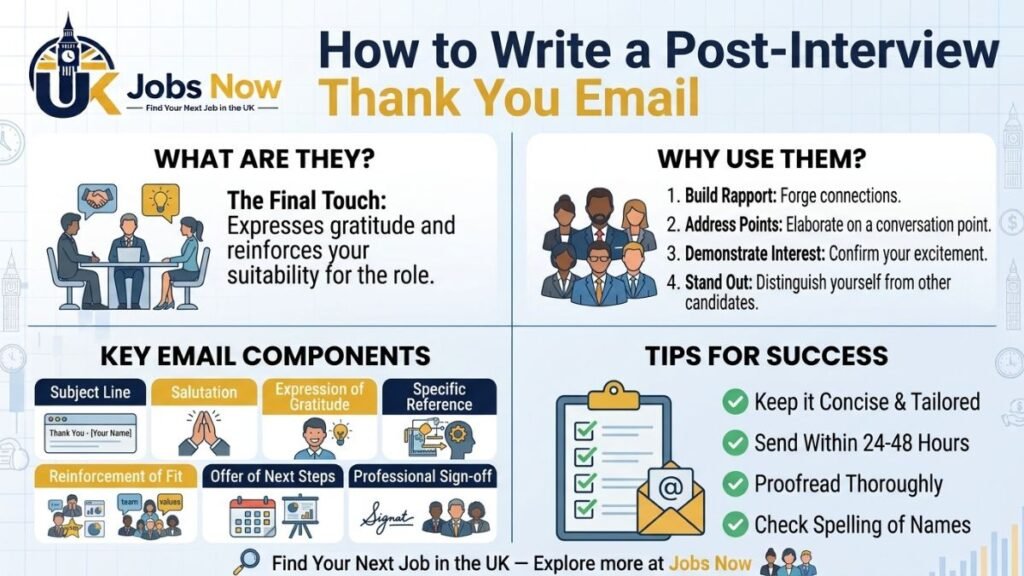
The general guidance is to send it within 24 hours of the interview, while the conversation is still fresh for both you and the interviewer. That said, sending one a couple of days later is still worthwhile and rarely counted against you — a slightly delayed thank-you is considerably better than none at all, so don’t skip it entirely just because the ideal window has passed.
What actually belongs in the email
A strong post-interview thank-you email is short — typically three to five sentences — and covers three things: genuine thanks for their time, a brief, specific reference to something from the conversation (not generic, since this demonstrates you were genuinely engaged rather than sending a templated message), and a short, confident restatement of your interest in the role. It should not restate your entire CV or repeat everything you already covered in the interview — that undermines the purpose, which is a brief, warm follow-up, not a second application.
Worked examples
Standard version, after a general interview
“Hi [Name], thank you for taking the time to speak with me today about the [Role Title] position. I particularly enjoyed our conversation about [specific topic discussed] — it reinforced how well this role aligns with what I’m looking for next. Please let me know if there’s any further information I can provide, and I look forward to hearing from you regarding next steps.”
Version that addresses a point you felt you didn’t answer well
“Hi [Name], thank you for the conversation today — I enjoyed learning more about [specific team or project]. On reflection, I wanted to briefly add to my answer about [specific question] — [one or two sentences with the additional or clarified point]. I remain very enthusiastic about the opportunity and look forward to hearing from you.”
Version after a second or final interview
“Hi [Name], thank you for the thorough conversation today, and for introducing me to [colleague/team member mentioned, if applicable]. Meeting the wider team gave me an even clearer sense of how well this role would suit me, particularly around [specific detail from the conversation]. I’m genuinely excited about the possibility of joining, and I’m happy to provide anything further you might need.”
Should you send it to everyone who interviewed you?
If you were interviewed by a panel or spoke with multiple people separately, a brief, individually addressed thank-you to each person is generally better than a single email cc’ing everyone, since each message can reference something specific to that particular conversation rather than reading as a mass-sent note. If you only have contact details for one person (often the recruiter or HR contact), it’s fine to send one message and ask them to pass on your thanks to the wider panel.
What to do if you don’t have the interviewer’s direct email address
This is common, particularly when a recruiter or agency has managed the process. In that case, sending your thank-you to the recruiter with a request to pass it along, or simply sending it to your main point of contact for the process, works just as well — the goal is demonstrating genuine professionalism and interest, not the specific delivery mechanism.
Common mistakes to avoid
- Making it too long. A thank-you email that restates your whole interview or CV loses the point of being a brief, warm gesture.
- Being overly generic. “Thank you for the interview, I look forward to hearing from you” with no specific reference to the actual conversation reads as a template, which somewhat undermines its purpose.
- Sending it too late. A thank-you sent a week later, well after the hiring decision may already be moving forward, has largely lost its usefulness — sooner is meaningfully better.
- Using it to raise new demands. This isn’t the place to introduce new salary expectations or additional requirements you didn’t mention in the interview itself — keep it focused on thanks and brief reinforcement of interest.
What if you’re now less interested in the role after the interview?
It’s still generally worth sending a brief, polite thank-you even if the interview left you less enthusiastic than before — professional courtesy and a good final impression cost little, and industries can be smaller than they seem, meaning paths cross again more often than people expect. You’re not obligated to overstate your enthusiasm, but a short, professional note is still worthwhile regardless of your evolving interest level.
Does a thank-you email actually influence the decision?
Realistically, its impact is modest in most cases — hiring decisions are generally driven by how well you actually performed in the interview and how you compare against other candidates, not by whether a follow-up email was sent. Where it can genuinely matter is in a close decision between two similarly strong candidates, where small additional signals of genuine interest and professionalism can occasionally be a tie-breaking factor, or in the specific case where it lets you clarify or add to an answer you felt fell short during the conversation itself.
Adapting the tone for different types of employer
A thank-you email to a small, informal company can reasonably be slightly more conversational in tone than one to a large, formal corporate employer, but the core content — genuine thanks, a specific reference, brief restated interest — stays consistent regardless. It’s worth mirroring, loosely, the tone the employer has used with you throughout the process rather than defaulting to either extreme; a stiff, overly formal note to a relaxed startup can feel oddly mismatched, just as an overly casual note to a formal organisation can undercut a professional impression built up over the rest of the process.
What if you don’t hear back after sending your thank-you email?
Silence after a thank-you email isn’t unusual and doesn’t necessarily signal anything negative — many interviewers don’t reply directly to a thank-you note, since it doesn’t typically require a response, and the actual hiring decision timeline is usually separate from it entirely. If you’re waiting to hear about the broader outcome and it’s taking longer than the timeframe you were given, a separate, brief follow-up specifically asking about status — rather than resending the thank-you itself — is the more appropriate next step, and our guide on realistic UK hiring timelines covers what’s reasonable to expect at this stage.
Putting your best preparation in from the start
A strong thank-you email is a small final touch — the bulk of your effort is better spent on genuine interview preparation itself. Our guide to common UK interview questions and the STAR method covers that core preparation, and if you’re heading into a second round after this one, our guide to second interviews covers how that stage typically differs from the first.
Frequently Asked Questions
How soon after an interview should I send a thank-you email?
Ideally within 24 hours, while the conversation is still fresh. A day or two later is still worthwhile if you miss that window — a delayed thank-you is considerably better than none.
Is it necessary to send a thank-you email after every interview?
Not strictly necessary, particularly for very informal or fast-moving processes, but it’s a low-effort professional habit that rarely hurts and occasionally helps, so it’s generally worth doing when you have a genuine contact to send it to.
Can a thank-you email actually get me the job if the interview went badly?
Realistically, no — hiring decisions are driven primarily by interview performance, not a follow-up email. It can occasionally help clarify or add to a specific answer you felt fell short, but it won’t substantially change an interview that genuinely didn’t go well overall.
Should I mention salary or start date in a thank-you email?
Generally no, unless it’s a genuine follow-up to something specifically discussed and left unresolved during the interview itself — keep the email focused on thanks and brief reinforcement of interest rather than introducing new logistical points.
What if I interviewed with a panel of several people?
A brief, individually addressed thank-you to each person, referencing something specific to their part of the conversation, is generally better than one generic email sent to the whole group — though if you only have one contact’s details, sending it to them with a request to pass on your thanks works fine too.