Second Interview Questions and How to Prepare
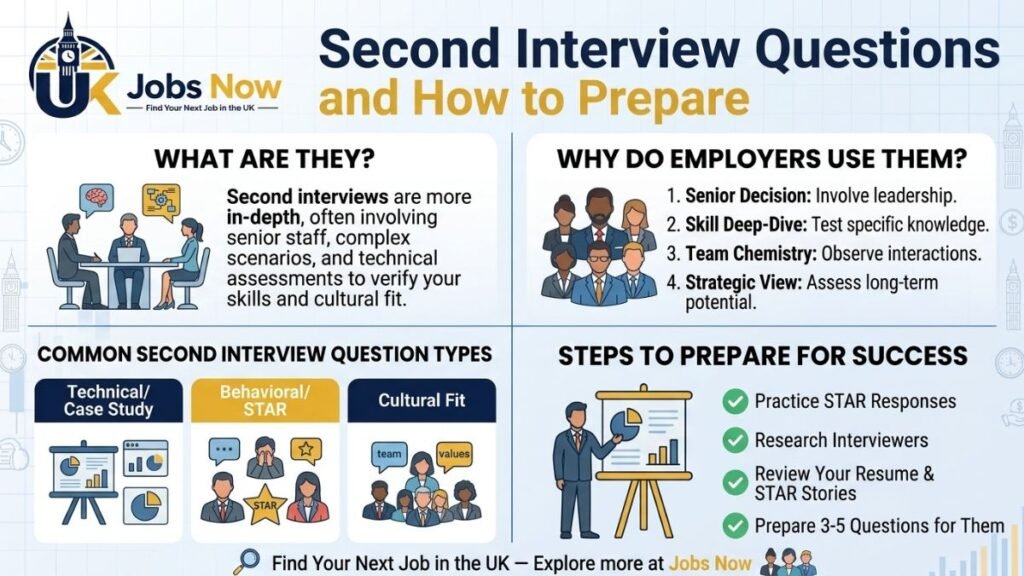
Getting invited back for a second interview is genuinely good news — you’ve already cleared the stage where most candidates get filtered out — but it also raises the stakes in a specific way. A second interview usually isn’t a repeat of the first; it typically goes deeper, involves different or more senior people, and sometimes shifts from “can you do this job” toward “do we want to work with you specifically.” Preparing for it as if it were identical to the first round is a common, avoidable mistake.
How a second interview typically differs from the first
The exact format varies by employer, but a few patterns are common enough to plan around. First interviews are often screening-focused — confirming your core qualifications, experience, and general fit, sometimes conducted by a recruiter or HR representative rather than the actual hiring manager. Second interviews more often involve the people you’d actually work with or report to, dig into more specific, technical, or scenario-based detail, and are more likely to include practical elements — a task, a presentation, or a more detailed discussion of how you’d approach real situations specific to the role.
Who you’re likely to meet
It’s common for a second interview to include the direct line manager for the role (if they weren’t in the first round), sometimes a more senior stakeholder or department head, and occasionally a peer or potential colleague, particularly for roles emphasising team fit. If you don’t already know who you’ll be meeting, it’s entirely reasonable to ask the recruiter or HR contact in advance — knowing whether you’re meeting your prospective manager versus a more senior executive changes how you might frame certain answers, particularly around your working style and expectations.
What tends to get asked at this stage
More specific, scenario-based questions about the actual role
Where a first interview might ask general competency questions, a second interview more often asks about specific situations closely tied to the actual day-to-day of the role — “how would you approach [a specific type of project or problem this team regularly faces]” rather than a more general “tell me about a time you solved a problem.”
Questions about working style and team fit
Expect more direct questions about how you like to work, how you handle feedback, and how you’d fit into the specific team’s existing dynamic. These are less about testing competence (already largely established in the first round) and more about assessing whether you’d genuinely work well within this particular team and management style.
Questions probing for consistency
It’s not uncommon for a second interviewer to ask about something you mentioned in the first round, sometimes from a slightly different angle, partly to check for consistency and partly because they may not have full detail from the first interviewer’s notes. Answering consistently — without needing to remember your first answer word for word — is generally fine, since genuine, real experiences don’t usually shift dramatically in the retelling.
More detailed questions about salary, notice period, and logistics
A second interview is often where practical questions get more concrete — your notice period, salary expectations, and start date availability. Having clear, considered answers ready for these, rather than being caught off guard, helps the conversation move smoothly if things are progressing toward an offer.
What to prepare that’s specific to this stage
Deeper company and role research
By the second interview, having only surface-level knowledge of the company (what you’d find in five minutes on their homepage) starts to look thin. Go deeper — recent news, understanding of their specific market position or challenges, and if possible, some knowledge of the specific team or department you’d be joining, not just the company broadly.
Questions that show you’re thinking about the role practically
Where first-round questions might reasonably be more general, second-round questions are a good opportunity to ask more specific, practical things: what does success look like in the first three to six months, what does the team’s current workload or focus look like, what are the biggest challenges the person in this role would face initially. These questions signal that you’re genuinely picturing yourself doing the job, not just trying to get through the interview.
A considered answer on salary expectations
If salary comes up at this stage and hasn’t already been discussed, having a researched, realistic range ready — rather than a vague answer or a number picked without any real basis — puts you in a stronger position. Our guide to UK regional salaries is useful background research for this.
A comparison: first interview versus second interview focus
| Aspect | Typical first interview | Typical second interview |
|---|---|---|
| Who’s involved | Recruiter or HR, sometimes hiring manager | Hiring manager, sometimes senior stakeholders or future colleagues |
| Question style | General competency-based, broad fit | Specific, scenario-based, deeper team/culture fit |
| Your research depth | General company understanding | Deeper knowledge of the team, role specifics, recent developments |
| Practical logistics | Sometimes touched on briefly | More likely to be discussed concretely (salary, notice, start date) |
Staying consistent without sounding rehearsed
A natural worry at this stage is inadvertently contradicting something you said in the first interview. In practice, if your first-round answers were genuine and specific rather than exaggerated, staying consistent is straightforward, because you’re describing real experiences rather than trying to remember an invented script. If you’re specifically asked to repeat or expand on something from the first interview, it’s fine to add new detail or a slightly different angle — interviewers generally aren’t looking for word-for-word repetition, just genuine consistency in the underlying facts.
What a second interview invitation does and doesn’t mean
Being invited to a second round is a genuinely positive signal, but it doesn’t mean the outcome is decided — most processes involving a second interview are still comparing multiple candidates at this stage, sometimes down to a shortlist of two or three. Treating it with the same level of preparation and seriousness as the first round, rather than assuming it’s a formality, gives you the best chance of converting the invitation into an actual offer.
Handling nerves specific to a second interview
It’s genuinely common to feel more pressure at a second interview than a first, precisely because you now have something concrete to lose — you’ve already invested hope in the outcome, and a second rejection at this stage can feel more disappointing than an earlier one. A useful reframe: you’ve already demonstrated you’re a genuinely strong candidate by reaching this stage, so the goal now is less about proving basic competence again and more about confirming fit and building genuine rapport with the people you’d actually work alongside. Approaching the conversation with that framing tends to come across as more relaxed and natural than treating it as a second exam to pass.
What if you’re asked to complete a task or presentation before the second interview?
Some second-round processes include a practical element — a short presentation, a written task, or a case study to prepare in advance. Treat the instructions for this precisely as given (word or time limits, specific format requested) since deviating from clear instructions is itself sometimes assessed alongside the content. If instructions are genuinely ambiguous, it’s entirely reasonable to ask a clarifying question ahead of time rather than guessing and potentially misjudging what’s expected.
After the interview
A short, genuine thank-you message following a second interview is worth sending, much as after a first. If the process runs longer than you expected from here, our broader guide on realistic UK hiring timelines covers what’s normal at this stage.
Frequently Asked Questions
Is a second interview always a good sign?
Generally yes — it means you’ve cleared an earlier stage of screening, which is genuinely meaningful. It doesn’t guarantee an offer, since many processes still compare multiple candidates at this stage, but it’s a clear positive signal about how your application has been received so far.
Should I prepare completely different answers for a second interview?
Not completely different, but expect the questions to go deeper and more specific — prepare to expand on and add detail to points you may have covered more generally in the first round, and be ready for more scenario-based questions closely tied to the actual role.
Who typically attends a second interview?
It varies, but it often includes the direct line manager, sometimes a more senior stakeholder, and occasionally a future colleague or peer, particularly for roles where team fit matters significantly. It’s reasonable to ask in advance who you’ll be meeting.
Is it appropriate to discuss salary at a second interview?
Often yes, particularly if it hasn’t already been addressed — many UK hiring processes move into more concrete practical discussions (salary, notice period, start date) by the second round, so having a considered, researched answer ready is worthwhile.
What if I’m asked a question I already answered in the first interview?
This is normal and usually not a trick — the second interviewer may not have full detail from the first round, or wants to hear it directly. Answer genuinely and consistently; adding new detail or a slightly different angle is fine and often welcomed.