Customer Assistant Interview Questions and Answers (UK Retail)
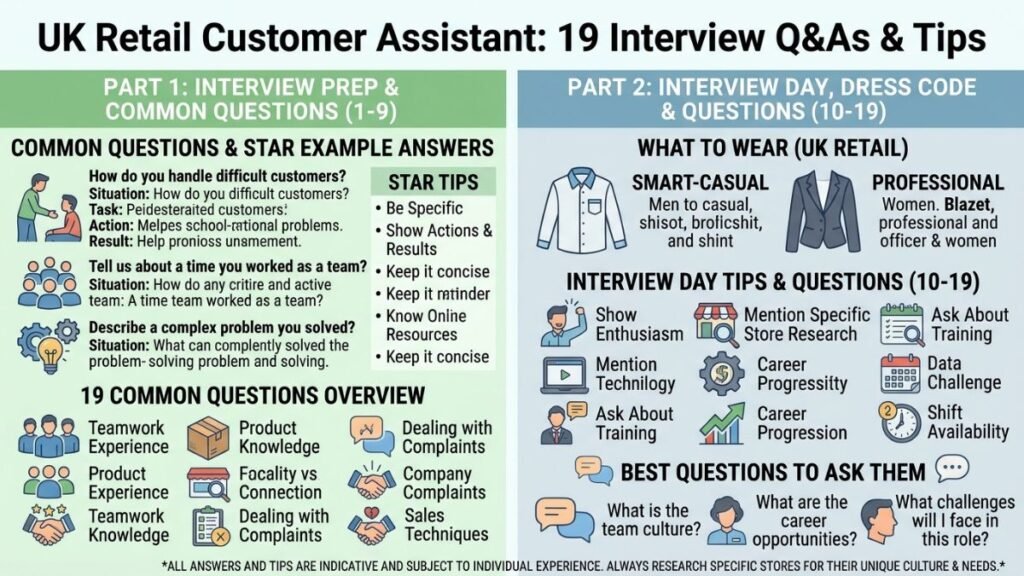
Customer assistant jobs are among the most common entry-level roles in UK retail, and many employers are hiring now for the Christmas period. The interview is usually short and friendly, but you still need to prepare. This guide covers how retail interviews work, the questions you are most likely to be asked, and example answers you can adapt using your own experience.
Quick answer: Retail interviewers want to know that you are reliable, friendly, work well in a team and can stay calm with customers. Use short, real examples (the STAR method), be honest about your availability, and show you know the shop.
How retail interviews work
The process differs by employer, but many large UK retailers follow a similar pattern:
- Online application. You fill in a form and give your availability. Some employers ask you to create an account.
- Online assessment. Many retailers use short online tests with shop-floor scenarios, to see how you would handle customers, queues and mistakes. There are no trick questions, so read each scenario carefully.
- Interview or group assessment. This may be a one-to-one with a manager, a short panel, or a group session where you take part in activities with other applicants. Some roles include a short task, such as helping a mock customer.
- Offer and checks. If successful, you will be asked for right-to-work documents and may need references.
For a detailed example of the process, see our guide to M&S jobs. Interviews typically last 15 to 45 minutes.
What retail employers are looking for
Whatever the shop, managers tend to look for the same qualities:
- Friendliness and customer focus. Can you make people feel welcome and helped?
- Reliability. Will you turn up on time, on the days you agreed?
- Teamwork. Will you help colleagues and pitch in when it is busy?
- Attention to detail. Can you keep shelves, prices and tills accurate?
- Resilience. Can you stay calm with a rushed or unhappy customer?
- Flexibility. Are you willing to work evenings, weekends and bank holidays?
Keep these in mind as you read the questions below.
The STAR method: your best tool
For questions that start with “Tell me about a time when…”, use the STAR method:
- Situation: Briefly set the scene.
- Task: Explain what you needed to do.
- Action: Describe what you did, using “I” rather than “we”.
- Result: Say what happened, and what you learned.
Keep each answer to about 60 to 90 seconds. If you have no work experience, use examples from school, college, volunteering, sport, family or helping in the community. All of these count.
Common questions and example answers
The example answers below are templates. Do not memorise them word for word. Replace the details with your own real experience, because interviewers can tell when an answer is rehearsed or untrue.
Motivation questions
1. Why do you want to work in retail?
What they want: Genuine interest and a realistic view of the job.
Example answer: “I enjoy being around people and helping them find what they need. I like busy, active jobs where no two days are the same, and I want to build my customer service skills. I have also shopped here for years and I like how well the staff look after customers.”
2. Why do you want to work for us?
What they want: Proof that you have done some research.
Example answer: “I like that you are known for good quality and friendly service. I visited the store last week and noticed how staff greeted customers and kept the shelves tidy, and I’d like to be part of that. I also saw you are expanding your food range, which I think is a strength.”
Tip: Visit the store before your interview and note one or two specific things you liked.
3. Why should we hire you?
Example answer: “I’m reliable, I learn quickly and I enjoy helping people. In my previous role (or at college), I was trusted to open on my own and I never missed a shift. I would bring that same dependability and a positive attitude to your team.”
Customer service questions
4. What does good customer service mean to you?
Example answer: “To me it means making every customer feel noticed and valued. That includes a friendly greeting, listening to what they need, giving accurate information and following through. If I can’t help, I find someone who can, so they never leave without an answer.”
5. Tell me about a time you helped someone who was upset or frustrated.
Example answer (STAR): “Situation: At my weekend job in a cafe, a customer was upset because her order had been wrong. Task: I needed to calm her down and fix it. Action: I apologised, listened without interrupting, checked what she had ordered and replaced it straight away, then told my manager. Result: She thanked me, stayed for her drink and said she would come back.”
6. How would you deal with an angry customer?
Example answer: “I would stay calm, let them explain without interrupting and apologise for the problem. Then I’d try to solve it within what I’m allowed to do, or get a team leader if it needs more authority. I wouldn’t take it personally.”
7. What would you do if a customer asked for something you didn’t know the answer to?
Example answer: “I’d tell them honestly that I wasn’t sure, then check the shelf label or system, or ask a colleague, so they get the right answer. I wouldn’t guess, because that could cause problems later.”
Teamwork questions
8. Tell me about a time you worked as part of a team.
Example answer (STAR): “Situation: In a group project at college, we had a tight deadline and one person left. Task: We needed to finish the work. Action: I offered to take on part of the missing work, and I set up a shared list so everyone knew what to do. Result: We finished a day early and got a good mark.”
9. How would you handle a colleague who isn’t pulling their weight?
Example answer: “I’d first ask if they were OK or needed help, because there could be a reason. If it kept happening and affected customers, I would speak to my supervisor rather than complain to other colleagues.”
Situational questions
These ask what you would do in a particular situation. There is usually no single “right” answer, but managers look for calm, customer-first, honest answers.
10. There is a long queue and you are the only person on the till. What do you do?
Example answer: “I’d serve customers as quickly and politely as I can, and let the people waiting know I’d be with them shortly. I’d also ask a colleague or supervisor to open another till. Keeping people informed makes the wait feel shorter.”
11. A customer asks you to hold an item or give a discount you can’t authorise. What do you do?
Example answer: “I’d explain politely what I can and can’t do, offer an alternative, such as checking another store, and ask a supervisor if it might be possible. I wouldn’t promise something I can’t deliver.”
12. You see someone acting suspiciously or you find a lost item or a spill. What do you do?
Example answer: “For a spill, I’d put up a warning sign and tell a colleague straight away so it was cleaned. For lost property, I’d hand it to a supervisor. If I thought something was a security risk, I would not confront anyone and would tell a manager.”
13. You make a mistake at the till. What do you do?
Example answer: “I’d tell my supervisor straight away so it could be corrected, and I’d apologise to the customer if needed. Mistakes happen, and honesty is the most important thing. I’d also check how it happened so I don’t repeat it.”
Practical and personal questions
14. What is your availability?
What they want: An honest answer that fits the shop’s opening hours.
Example answer: “I’m available Monday to Friday from 4pm, and all day Saturday and Sunday, including bank holidays. I can also be flexible around busy periods like Christmas.”
Tip: Be honest. If you say you are free and then cannot work the shifts, it can cost you the job.
15. What are your strengths?
Example answer: “I’m reliable, friendly and good at staying calm. At my last job my manager often asked me to train new starters because I’m patient and explain things clearly.”
16. What is your biggest weakness?
Example answer: “I used to find it hard to ask for help, so I’d try to do everything myself. I’ve learned that asking early saves time and avoids mistakes, so now I check when I’m unsure.”
Tip: Choose a real weakness, say what you have done about it and avoid cliches like “I work too hard”.
17. How do you cope when it’s busy or stressful?
Example answer: “I stay organised by prioritising what’s most urgent, such as customers waiting, and I keep communicating with my team. I find busy shifts go quickly and I enjoy the pace.”
18. Where do you see yourself in a few years?
Example answer: “I’d like to learn the job well and then take on more responsibility, perhaps as a team leader. I’m happy to build a career in retail if the opportunities are there.”
19. Do you have any experience of handling cash or a till?
Example answer: “I’ve used a card reader and handled cash at (a school fair, a part-time job, a family business). I’m careful with counting and I always check change. I’m happy to be trained on your system.”
If you have no experience
Many customer assistant jobs are open to first-time workers. If you haven’t worked before:
- Talk about school, college or sport, such as being part of a team, captaining a squad or organising an event.
- Mention volunteering, helping at a charity shop, community events or religious organisations.
- Use family responsibilities, such as helping in a relative’s shop or caring for siblings.
- Show enthusiasm and willingness to learn, since many employers train new staff.
Questions to ask at the end
Nearly every interviewer asks “Do you have any questions for us?” Asking one or two shows interest. Good examples:
- What does a typical shift look like in this team?
- What training do new colleagues get?
- How are rotas organised, and how much notice do you give?
- Are there opportunities to move up, for example to team leader?
Save questions about pay, holidays and discounts for later in the process unless you are asked, but do check the details before you accept an offer. Our guide to understanding your employment contract lists what to look for, and our National Minimum Wage guide shows what the legal minimum is for your age.
What to wear and how to prepare
- Dress smartly. A clean, ironed shirt or blouse and smart trousers, a skirt or dress is fine. Avoid ripped clothes or strong perfume.
- Arrive early. Aim for 10 to 15 minutes before your time, and plan the journey.
- Bring what you need. Take ID, any documents asked for, and a pen. Have your availability written down.
- Visit the shop. Look at how staff behave, how displays look and what products are on offer.
- Practise out loud. Practise two or three STAR stories with a friend or family member.
- Smile and make eye contact. First impressions count in a customer-facing job.
In a group assessment
- Listen carefully and include quieter people.
- Share ideas but don’t dominate.
- Be friendly and encourage others.
- Stay positive, even if the group disagrees.
Common mistakes to avoid
- Being late or not checking where to go.
- Giving one-word answers. Add a sentence of detail.
- Criticising a previous employer.
- Not knowing anything about the shop.
- Saying you are available when you are not.
- Looking at your phone, or having it ring during the interview.
After the interview
Thank the interviewer when you leave. If you do not hear back by the date they gave you, send a polite email or call to ask. If you are offered the job, read the contract carefully before signing. And be careful of anyone who asks you to pay a fee for a job. Read our guide to how to spot a fake job advert in the UK.
Frequently asked questions
What are the most common retail interview questions? Why you want the job, what good customer service means, how you handle difficult customers, teamwork examples and your availability.
How long does a customer assistant interview last? Usually 15 to 45 minutes, though group assessments can take longer.
Do I need experience to be a customer assistant? Not for most entry-level roles. Employers look for attitude, reliability and willingness to learn.
What should I say if I’m nervous? It is fine to say so. Take a breath, slow down and ask for the question to be repeated. Most interviewers expect some nerves.
Are retail interviews online? Some first stages are online or by phone, and some retailers use video interviews, but many second stages are in store.
Final thoughts
A retail interview is really a conversation about whether you will be friendly, reliable and good in a team. Prepare a few real examples, learn about the shop and show that you enjoy helping people. When you’re ready, browse the latest retail vacancies on our jobs board and apply directly with the employer.
This article is general guidance. Every employer runs its own recruitment process, so always follow the instructions in your invitation and the job advert.