Teaching Assistant Jobs in the UK: Pay, Qualifications and How to Apply
Teaching assistants (TAs) are a vital part of almost every UK school. They support pupils in the classroom, help teachers and often work with children who need extra help. It is a popular job for parents, career changers, graduates and people who want to work with children without a full teaching degree. But TA pay can be confusing, because advertised salaries are usually full-time equivalent figures and most contracts are term time only. This guide explains what TAs do, what they really earn in 2026, which qualifications help, and how to apply.
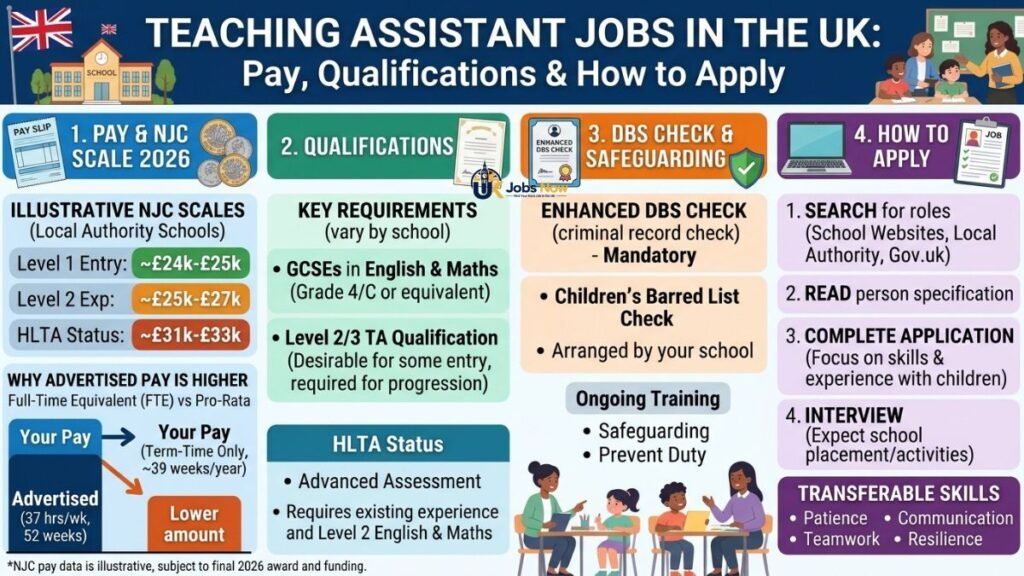
Quick answer: Teaching assistants in England and Wales are typically paid on the local government (NJC) scale. From April 2026, full-time equivalent salaries run from about £25,600 for Level 1 and 2 posts to around £30,000 for Level 3 and up to about £37,500 for Higher Level Teaching Assistants. Because most contracts are term time only and part time, actual pay is usually around 75% to 85% of the advertised figure. You do not need a degree, but schools expect an enhanced DBS check and usually GCSE English and maths.
What does a teaching assistant do?
Teaching assistants work alongside teachers to help pupils learn. Typical duties include:
- Supporting pupils in class, helping them understand tasks and stay on track
- Working with small groups or individuals, for example on reading, phonics or maths
- Helping children with special educational needs or disabilities (SEND), sometimes one to one
- Preparing and tidying resources, setting up the classroom and displays
- Supporting behaviour and encouraging positive habits
- Supervising at break and lunchtime, and on trips
- Helping with personal care or medical needs in some roles
- Marking, record keeping and feedback to the teacher, depending on the role
- Covering classes in some Higher Level Teaching Assistant (HLTA) posts
TAs work in primary, secondary, special schools, nurseries and colleges, in both state and independent schools.
Levels of teaching assistant
| Level | Typical job titles | What it involves |
|---|---|---|
| Level 1 and 2 | Teaching assistant, classroom assistant | Supporting pupils and teachers under direction |
| Level 3 | Senior TA, SEN or specialist TA, cover supervisor | More responsibility, specialist support, sometimes leading groups |
| Level 4 (HLTA) | Higher Level Teaching Assistant | Planning and teaching groups or whole classes under a teacher’s direction, and supervising other staff |
Your pay grade depends on the level, the school and the local authority or academy trust.
How much do teaching assistants earn in 2026?
Full-time equivalent salaries
Most TAs in local authority schools in England and Wales are paid on the National Joint Council (NJC) scale for local government staff. A 2026/27 pay table published by an education training provider gives these typical full-time equivalent (FTE) figures, based on the 2026 award:
| Role | Typical FTE salary |
|---|---|
| Level 1 and 2 teaching assistant | About £25,614 to £26,847 |
| Level 3 teaching assistant | About £27,274 to £30,023 |
| Higher Level Teaching Assistant (HLTA) | About £29,542 to £37,563 |
Those FTE figures equal roughly £13.28 to £14.59 an hour at the lower points, rising for HLTAs. Pay is higher in London, where local weighting applies, and some roles for children with complex needs are graded higher.
Why you will probably earn less than the advertised figure
This is the most important thing to understand about TA pay. Most TA jobs are advertised with the full-time equivalent salary, but:
- Most TAs work term time only, around 38 to 39 weeks a year, plus some training days
- Most work part time, for example 25 to 32.5 hours a week, rather than the full 37
- Your annual pay is pro rata, so it is calculated from your actual hours and weeks, though it is usually paid in 12 equal monthly instalments that include your holiday pay
In practice, actual annual pay is usually around 75% to 85% of the advertised figure. For example, a role advertised at £27,274 FTE might pay around £21,000 to £23,000 a year, depending on hours and weeks. Estimates from different sites vary, with actual annual pay for standard Level 2 roles often quoted between roughly £18,000 and £24,000. Always ask whether the figure in the advert is FTE or actual pay, and ask for the exact calculation.
For comparison, the legal minimum for workers aged 21 and over is £12.71 an hour from April 2026, so TA pay is above it, but not by much at entry level. See our National Minimum Wage 2026 guide.
Academies, independent schools and the rest of the UK
- Academy schools and trusts can set their own pay and conditions, so they may not follow the NJC scale. Some match it, others pay more or less.
- Independent schools also set their own pay.
- Wales follows the NJC scale for local authority schools.
- Scotland uses separate pay arrangements, and the job is often called a pupil support assistant or classroom assistant. Check the local council’s pay scale.
- Northern Ireland has its own pay scales for classroom assistants.
Check the school or local authority’s own pay scale for exact figures, because secondary sources can differ.
Benefits
Many school support staff can join the Local Government Pension Scheme, which is a major benefit, and receive pay for the school holidays through the term-time pro rata arrangement. Other perks can include a predictable school day, holidays that match children’s, training and a route into teaching. Check each employer for sick pay, pension and other benefits.
Hours and working pattern
- A typical school day runs from around 8.30am to 3.30pm, with breaks. Some roles include breakfast club, after-school club or lunchtime supervision.
- Part-time hours are common, for example 25 to 32.5 hours a week.
- Term time only means you work during the school year and do not work during the main school holidays, though you may have to attend training (INSET) days.
- Supply and agency work is available, with day-to-day cover, but hours and pay are less secure. See our guide to zero-hours contracts for your rights if you are on casual terms.
Check your contract for hours, pay weeks and holiday pay. Our guide to understanding your employment contract explains what to look for.
Qualifications and requirements
Do you need qualifications?
No single qualification is required by law for entry-level TA jobs, and each school sets its own requirements. In practice:
- Most schools ask for GCSE English and maths at grade 4 (C) or above, or Level 2 Functional Skills equivalents. This is the standard guidance from the National Careers Service.
- Many schools prefer or ask for a Level 2 or Level 3 certificate in supporting teaching and learning (completed or in progress).
- Experience with children is very helpful. This could be volunteering at a school, working at a nursery or club, scouts or guides, youth work, coaching or looking after your own children.
- Skills such as patience, communication, reliability and teamwork matter a great deal.
Useful qualifications
| Qualification | Why it helps |
|---|---|
| Level 2 Certificate in Supporting Teaching and Learning | A good entry-level qualification for new TAs |
| Level 3 Certificate or Diploma in Supporting Teaching and Learning, or in Specialist Support | Often expected for higher grades, SEN and senior TA roles |
| Teaching Assistant apprenticeship (Level 3) | Lets you earn while you train in a school |
| HLTA qualification (Level 4) and assessment | Needed for HLTA posts. Usually requires some experience first |
| Paediatric first aid, safeguarding, SEND and phonics training | Valued by employers and often provided by schools |
Enhanced DBS check
Every person working in a school must pass an enhanced DBS check (or the Scottish or Northern Irish equivalent). The school arranges it once you receive a conditional offer. You may be asked about any convictions, cautions and gaps in your history, and you must be honest.
Safer recruitment
Schools follow strict safer recruitment procedures, based on the statutory guidance on keeping children safe in education. That usually means:
- A full application form (many schools do not accept CVs alone)
- A full employment history, with gaps explained
- Two references, often including your current or most recent employer
- Identity and right-to-work checks. See our guide to right to work checks in the UK
- Safeguarding questions at interview
- Pre-employment checks, including the DBS
How to become a teaching assistant: step by step
- Check the basics. Make sure you have, or can get, GCSE English and maths (or equivalents), and the right to work in the UK.
- Get experience with children. Volunteer in a local school, nursery or youth group. Many schools welcome volunteers, and it helps you decide if the job is for you.
- Consider a qualification. A Level 2 or 3 certificate in supporting teaching and learning can improve your chances. Compare providers, check they are recognised, and consider funding options.
- Look at apprenticeships. A TA apprenticeship lets you learn while you work, though places vary by area.
- Find vacancies. Search school and academy trust websites, local council job pages, education job sites and our UK jobs board. Local authorities often publish all their school vacancies in one place.
- Write a strong application. Most schools want a detailed supporting statement that matches the person specification. See below.
- Prepare for the interview. Expect a panel, questions about safeguarding and sometimes a short activity or classroom visit.
- Complete pre-employment checks. DBS, references, right to work and sometimes a medical questionnaire.
- Start with induction and training. Schools usually give new TAs safeguarding, behaviour and subject training.
How to write a supporting statement
- Go through the person specification point by point and give a real example for each requirement.
- Show your experience with children, even if it is voluntary or informal.
- Explain why you want to work in that school. Mention something specific about the school’s ethos, approach or pupils, from its website or Ofsted report.
- Show your values: patience, positivity, respect for pupils, teamwork and commitment to safeguarding.
- Be specific about outcomes, such as helping a child improve their reading.
- Check spelling and grammar and keep to any word limit.
If you need help with your CV or letter, see our guides to writing a UK CV with no experience and writing a cover letter in the UK.
Interview tips for teaching assistant jobs
School interviews often include questions about children, behaviour and safeguarding. Prepare examples for questions such as:
- Why do you want to be a teaching assistant, and why this school?
- How would you support a child who is struggling with their work?
- How would you deal with a pupil who is disruptive or upset?
- What would you do if a child told you something that worried you? (This is a safeguarding question. The right answer is to listen, not promise secrecy and report it straight away to the designated safeguarding lead.)
- How do you work as part of a team with teachers and other staff?
- How would you encourage a child to be independent?
- What experience do you have of working with children with special educational needs?
Use real examples and the STAR method (Situation, Task, Action, Result). Our guide to customer assistant interview questions and answers explains the technique.
Career progression
Teaching assistants have several ways to progress:
- Level 3 or senior TA, with more responsibility and pay
- SEN or specialist TA, supporting children with specific needs
- Higher Level Teaching Assistant, working with whole classes
- Cover supervisor, covering lessons when a teacher is absent
- Pastoral and family support roles, such as learning mentor or attendance officer
- Moving into teaching. Many TAs go on to train as teachers through a degree, a PGCE, a school-based route or an apprenticeship. Experience in a classroom is a strong advantage. Check the Get Into Teaching service for current routes and funding.
- Other careers working with children. See also our guides to care worker jobs and NHS jobs for related paths.
The pros and cons
Advantages
- Work that makes a real difference to children
- School hours and holidays that fit family life
- Pension, training and progression routes
- No degree needed to start
- A route into teaching, if you want it
Disadvantages
- Pay is modest, especially after the term-time and part-time adjustments
- Contracts can be short or tied to funding, particularly for one-to-one SEN posts
- The job can be emotionally and physically demanding
- Behaviour challenges and workload, with limited recognition in some schools
- Pay and conditions vary between local authorities and academy trusts
Your rights
- Minimum wage and payslips. You must be paid at least the minimum for your age.
- Holiday pay. If you work term time only, your holiday entitlement is built into your pay, so check how it is calculated.
- Sick pay. Statutory Sick Pay is payable from day one since April 2026 for those who qualify, and many schools have their own sick pay schemes. See our guide to the Employment Rights Act 2025.
- Notice. Check your notice period. See our guide to notice periods in the UK.
- Fixed-term contracts. If your job is funded for a limited period, know when it ends and what happens next.
If you have a pay or contract problem, contact Acas, your union (many TAs join a school staff union) or your local council’s HR team.
Beware of scams
School jobs are advertised through official channels, and you should not pay anyone to get one. Watch for:
- Websites or agents who charge a fee for a school job, a DBS check or “registration”
- Offers of school jobs from abroad with visa sponsorship, which are almost always scams. TA roles are not usually a visa route. See our guide to jobs with visa sponsorship in the UK
- Fake adverts that collect your personal documents
- Offers by WhatsApp or social media with no school name or proper process
Apply through the school’s own website or the local council. Read our guide to how to spot a fake job advert in the UK.
Frequently asked questions
How much does a teaching assistant earn in the UK? Full-time equivalent pay in England and Wales on the NJC scale is roughly £25,600 to £30,000 for Level 1 to 3 posts and up to about £37,500 for HLTAs from April 2026. Actual pay is usually about 75% to 85% of that because most jobs are term time only and part time.
Do I need qualifications to be a teaching assistant? Not by law, but most schools want GCSE English and maths at grade 4 or above (or equivalents) and often prefer a Level 2 or 3 certificate.
Do I need experience to become a teaching assistant? Experience with children helps, and volunteering in a school is a good way to get it, but some schools hire people with little classroom experience.
What is the difference between a teaching assistant and an HLTA? An HLTA has a higher level qualification and can plan and deliver lessons under a teacher’s direction, so the pay and responsibility are higher.
Is a teaching assistant job term time only? Most are, usually around 38 to 39 weeks a year, with pay calculated pro rata.
Do I need a DBS check? Yes. Every school role requires an enhanced DBS check, which the school arranges.
Can I become a teacher after being a TA? Yes. Many TAs train as teachers through a degree, a PGCE, school-based routes or apprenticeships.
Can I be a teaching assistant part time? Yes. Many roles are part time or flexible.
Final thoughts
Teaching assistant jobs offer meaningful work, school-friendly hours and a route into education, but the real pay is lower than the advertised figure, so do the sums before you apply. Gain some experience with children, tailor your application to each school and be ready for safeguarding questions. When you are ready, browse the latest vacancies on our jobs board and the websites of local schools and councils.
This article is general information. Pay scales are set by local authorities and academy trusts, and qualification requirements vary by school. Check the job advert, the school or council pay scale and GOV.UK or the National Careers Service for the latest details.