Work From Home Jobs in the UK: Genuine Options and How to Avoid Scams
Working from home is one of the most searched-for job types in the UK, and one of the most targeted by fraudsters. Genuine remote jobs exist in customer service, administration, finance, writing, tutoring and many other areas. But scammers know how many people are looking, and they copy real jobs closely enough to fool careful people. This guide explains which work from home jobs are genuine, what they really pay, how to find them, and how to spot the scams that cost job seekers money and identity details every year.
Quick answer: Genuine work from home jobs have a named employer, a proper interview and never ask you to pay money. Most general remote roles pay between the minimum wage and about £15 an hour, not the £200 a day that scam adverts promise. If someone asks you to pay for training, equipment, a DBS check or to “unlock” earnings, it is a scam.
Genuine work from home jobs in the UK
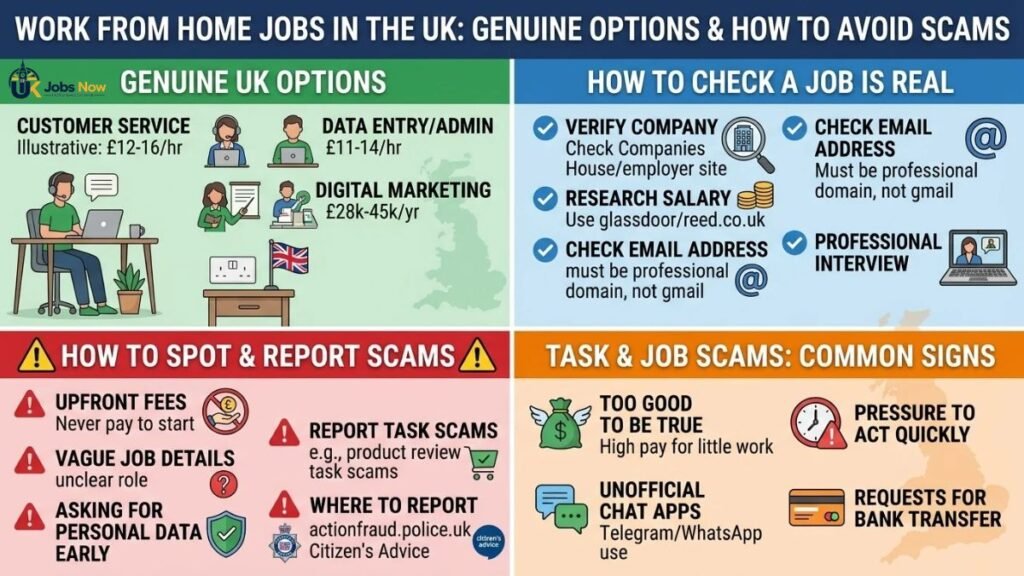
These are the main types of remote work that are real, with typical pay from 2026 guides. Many figures are estimates, so check each advert.
| Type of work | How it works | Typical pay |
|---|---|---|
| Customer service and contact centre | Taking calls, emails or chats for a company, usually employed with training | About £12.71 an hour or more, or roughly £20,000 to £30,000 a year full time |
| Administration and data entry | Typing, scheduling, record keeping and email management for an employer | Roughly £21,000 to £28,000 a year |
| Virtual assistant (VA) | Admin, diary, inbox and social media support for businesses | About £15 to £25 an hour through agencies, and £15 to £35 an hour for freelancers, depending on experience |
| Bookkeeping | Managing accounts using software such as Xero or QuickBooks | Often £25 to £50 an hour once you have qualifications and your own clients |
| Writing, editing and proofreading | Articles, copy and technical content | Varies widely. Specialist B2B writers earn more |
| Translation and transcription | Converting text or audio between languages | Varies by language and skill |
| Online tutoring | Teaching school subjects or languages online | Varies by subject and level |
| Social media and digital marketing | Managing accounts, ads and content | Varies with experience |
| Remote or hybrid professional roles | IT, finance, HR, sales, project management | Salaried, often above £30,000 |
| Call handling and support roles with public bodies | Some councils and organisations hire home-based staff | Check each advert |
A few important truths:
- Most general remote jobs pay modestly. One 2026 guide says most general work from home jobs pay somewhere between minimum wage and £15 an hour, and that figures of £25 to £40 an hour on job boards are usually for specialist skills or freelancers with an established client base.
- The legal minimum applies. If you are an employee, you must be paid at least the National Minimum Wage, which is £12.71 an hour for workers aged 21 and over from April 2026. An employed remote job that works out at less is unlawful. Be wary of “self-employed” task work that pays far less than the minimum. See our National Minimum Wage 2026 guide.
- Some employers pay the same rate wherever you live, while others adjust pay by location, so ask.
- Freelance income is uneven. You may earn a lot some months and nothing in others.
Employed or self-employed?
Before you accept a remote job, find out your status, because it affects your rights, tax and pay.
- Employee: you are paid through payroll and get holiday pay, sick pay and the minimum wage. The employer usually provides equipment and training.
- Worker or agency worker: some rights, but fewer than employees.
- Self-employed or freelance: you invoice clients, pay your own tax and National Insurance, and provide your own equipment. No paid holiday or sick pay.
If you are self-employed and earn more than the £1,000 trading allowance in a tax year, you generally need to register for Self Assessment. Check HMRC for the current rules. Our guide to delivery driver jobs explains the difference between employed and self-employed status in more detail, and our guide to zero-hours contracts covers casual and flexible terms.
The scams to know about
Fraudsters adapt quickly, so know the main types. The most common work from home scams in the UK and elsewhere in 2026 include:
1. Task scams (“click to earn”)
You are contacted by text, WhatsApp, Telegram or social media and offered easy online “tasks”, such as liking videos, boosting product ratings or completing orders, for a daily payment. You may be paid small amounts at first. Then you are told you must deposit your own money to “unlock” tasks or withdraw earnings, and the amounts get bigger. A group chat full of other “workers” posting successful withdrawals is often part of the trick. By the time you realise, you may have lost hundreds or thousands of pounds.
Rule: a genuine job never asks you to deposit your own money before you can be paid.
2. Advance-fee scams
You are offered a job, then asked to pay for “training”, a laptop lease, software, “registration”, a “starter kit”, a portfolio or writer profile, or a “DBS check”. A real employer pays for the checks, equipment and training it requires. As one UK jobs support service puts it, a professional employer or agency will not ask you for money to work for them.
3. Reshipping and package scams
You are hired as a “logistics coordinator”, “package handler” or “warehouse manager” working from home, receiving parcels and forwarding them elsewhere. The goods are often stolen or bought with stolen cards, and you can end up under investigation. No genuine remote job involves parcels arriving at your home to be sent on.
4. Money mule jobs
You are asked to receive money into your bank account and transfer it on, keeping a “commission”. Titles include “payment processor” and “finance assistant”. This is money laundering, and you could be prosecuted even if you did not know.
5. Fake cheque and equipment scams
You receive a cheque or payment to buy equipment from a recommended supplier. The cheque later bounces, and you have paid real money.
6. Fake data entry, envelope stuffing and “home business” offers
Offers of high pay for typing or stuffing envelopes at home, or the chance to run your own online shop, usually involve upfront fees for materials or software, or recruiting other people. Genuine businesses do not pay people to stuff envelopes at home.
7. Fake recruiters and cloned companies
Scammers copy real employers’ names, logos and websites, or pose as agencies on LinkedIn, Indeed and social media, to collect your CV, ID and bank details. Details of known scams are often listed on the real employer’s website.
8. Fake interviews and AI-generated jobs
In 2026, scam adverts and messages are more convincing because AI can write polished job descriptions and even imitate recruiters. Some scammers use text-only “interviews” on messaging apps or fake video interviews. Do not rely on how professional a message looks.
9. Crypto and recruitment fraud
Offers that involve being paid in cryptocurrency, installing software, or connecting a crypto wallet can be used to steal funds or install malware.
10. Multi-level marketing disguised as a job
Phrases such as “be your own boss”, income claims based only on top earners, pressure to recruit friends and family, and an upfront fee for a starter pack suggest an MLM scheme rather than a real job.
15 red flags that a work from home job is a scam
- You did not apply, but someone contacts you with an offer, especially by text, WhatsApp or Telegram.
- You are asked to pay anything for training, equipment, a background check or registration.
- You must deposit money to start or withdraw earnings.
- The pay is too high for the work, such as £150 to £500 a day for simple tasks with no experience.
- Pay is quoted per day, not per hour or per year, for basic tasks.
- The job description is vague, with no clear duties, reporting line or location.
- The employer will not name itself, or cannot be found on Companies House.
- The email address is free (Gmail, Hotmail) or does not match the company’s real domain.
- The interview is by text only, or the offer arrives with no real interview.
- You are hired immediately with no references or right-to-work checks.
- You are asked for your passport, bank details or National Insurance number before you have a signed contract.
- You are told to keep it secret or not to tell your bank or family.
- There is pressure and urgency, such as “offer expires today”.
- You are asked to use your own bank account to move money, or to receive parcels.
- The website is new or copied, with poor spelling, stock photos and no real company details.
Read our full guide to how to spot a fake job advert in the UK for more detail.
How to check a remote job is genuine
Use this quick checklist before you share personal details or accept an offer:
- Find the job on the employer’s own website. Go to the company’s careers page by typing the address yourself, not by clicking a link in a message.
- Check the company on Companies House. Look at its registered address, directors, incorporation date and filing history.
- Check the recruiter. Genuine agencies have a website, a landline and a registered company. Many UK recruitment agencies are members of the Recruitment and Employment Confederation, whose member list you can check.
- Search for reviews and scam reports. Search the company name with words like “scam” and “complaints”.
- Ask for a video interview and check the people are real, with LinkedIn profiles that match the company.
- Check the contract. You should receive a written offer and contract with the company’s name, your duties, hours, pay and notice. Read our guide to understanding your employment contract.
- Check the pay against the job. If an employed job pays below the minimum wage, or a simple job pays far above the market rate, be suspicious.
- Ask who pays for equipment. Genuine employers normally provide or pay for laptops and software, or tell you what you need and reimburse costs.
- Ask a trusted friend or family member to look at the offer before you commit.
- Trust your instincts. If you feel pressured, stop and check.
How to find genuine work from home jobs
- Use trusted job boards and employer websites. Search for “remote”, “home based” or “hybrid” on well-known sites, and browse our UK jobs board.
- Apply directly to companies you know, especially large employers with home-based customer service and admin teams.
- Register with reputable agencies that place remote and temporary staff.
- Look at councils, the NHS and public bodies, which sometimes advertise home-based or hybrid roles.
- Build a freelance profile on established platforms if you offer skills such as writing, design or bookkeeping, but never pay to get work.
- Network. Many remote jobs are found through contacts and professional networks such as LinkedIn.
- Be specific about what you can do. Tailor your CV for each role. See our guides to writing a UK CV with no experience and writing a cover letter in the UK.
- Prepare for remote interviews. Test your camera and microphone, choose a quiet space and practise answers using the STAR method. Our customer assistant interview guide explains it.
What you need to work from home
- A reliable internet connection and a quiet workspace
- A computer or laptop (usually provided by an employer, or you may need your own for freelance work)
- Good communication and self-discipline
- Any software required for the job
- Awareness of data protection and security if you handle customer information
- The right to work in the UK, even if the job is remote. See our guide to right to work checks in the UK. From 1 October 2026 the Home Office extended its checking scheme to more working arrangements, so check the guidance if you work through an agency or platform
If you are a student, remember that a Student visa’s weekly work limit applies to remote work for a UK employer too. See our guide to part-time jobs for students in the UK.
Your rights when you work from home
- Minimum wage and payslips if you are an employee or worker
- Holiday pay and sick pay. Since April 2026, Statutory Sick Pay is payable from the first day for those who qualify. See our guide to the Employment Rights Act 2025
- Flexible working. Employees have a right to request flexible working from their first day in a job, and your employer must consider the request reasonably
- A safe working environment. Employers still have health and safety duties for home workers, such as workstation assessments
- Written terms and notice. See our guide to notice periods in the UK
If you are self-employed, you do not have these rights, so budget for holidays, sickness and tax.
What to do if you think you have been scammed
Act quickly. The sooner you act, the better your chances of limiting the damage.
- Stop all contact with the scammer. Do not send any more money, even to “recover” what you have lost.
- Keep evidence. Take screenshots of messages, adverts, websites, payment details and phone numbers.
- Contact your bank immediately. You can ring 159 to be connected to your bank’s fraud team, or use the number on the back of your card. Ask whether you may be entitled to reimbursement, which depends on the type of payment and the circumstances. Task scams are especially hard because victims authorise the payments themselves, so tell your bank exactly what happened.
- Report it to Report Fraud, the national fraud reporting service that replaced Action Fraud in England, Wales and Northern Ireland in December 2025. Report online at reportfraud.police.uk or call 0300 123 2040. In Scotland, call Police Scotland on 101.
- Report it to JobsAware, a UK service that gives free advice on job scams.
- Report the advert, account or message to the job site, social media platform or messaging service.
- Forward scam texts to 7726 and scam emails to report@phishing.gov.uk.
- Protect your identity. If you shared documents or bank details, change passwords, monitor your accounts and credit file, and consider fraud protection.
- Do not be embarrassed. These scams are professional, and many careful people are caught.
Frequently asked questions
Are work from home jobs real? Yes. Many UK employers hire remote and hybrid staff, in customer service, admin, finance, IT and many other fields. But they are advertised through proper channels and never ask you to pay.
How much do work from home jobs pay in the UK? Most general roles pay from the minimum wage (£12.71 for those aged 21 and over) to about £15 an hour. Specialist and freelance work can pay more.
Do I have to pay for training or equipment for a work from home job? No, not for a genuine employed job. Anyone asking for upfront fees is probably a scammer.
Can I work from home with no experience? Some entry-level customer service and admin jobs accept beginners, but be wary of offers that promise high pay for no skills.
What is a task scam? An offer of easy online tasks for daily pay that later demands deposits from you to unlock earnings. You lose the money you pay in.
Is a WhatsApp job offer legitimate? Unsolicited job offers by WhatsApp, Telegram or text are very often scams. Check the company independently before replying.
Can I get my money back if I am scammed? Sometimes. Contact your bank immediately and report the fraud. The outcome depends on how you paid and the circumstances.
Are survey and “get paid to click” sites real? Some pay very small amounts, but they will not replace a salary. Never pay to join one, and be cautious about sharing personal details.
Final thoughts
Genuine remote jobs are out there, but the safest approach is simple: apply directly to employers, check every company, never pay to get work and walk away from anyone who pressures you. When you are ready, browse the latest vacancies on our jobs board and apply through each employer’s official website.
This article is general information, not legal or financial advice. Pay ranges come from 2026 guides and change often, and scams evolve quickly. Check the official websites for current reporting details, and use the job advert and a signed contract to confirm your pay and status.