How to Get a CSCS Card and Work in Construction in the UK
Construction is one of the biggest sources of manual work in the UK, with jobs for labourers, trades, apprentices and specialists across the country. But on almost every large construction site you need a card before you can start: a CSCS card. This guide explains what a CSCS card is, which colour you need, how much it costs, how to apply step by step, and what construction workers earn in 2026.
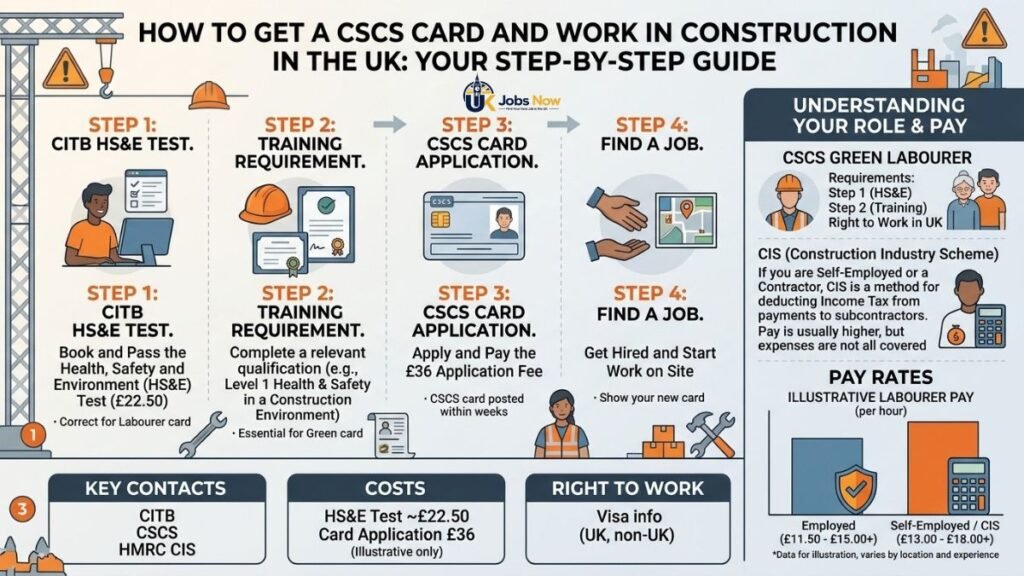
Quick answer: To get the entry-level Green Labourer CSCS card you need a Level 1 Award in Health and Safety in a Construction Environment, a pass in the CITB Health, Safety and Environment (HS&E) Operatives test (50 questions, 90% pass mark), and the £36 card fee. The test costs about £22.50 and the card lasts five years.
What is a CSCS card?
CSCS stands for the Construction Skills Certification Scheme. A CSCS card shows that you have the right training and qualifications for your job on a construction site, including an up-to-date understanding of health and safety. Site managers and principal contractors usually ask to see the card before they let you on site, and many will not employ you without one.
The card is not a licence, and it does not give you the right to work in the UK. You still need to prove your right to work. See our guide to right to work checks in the UK.
CSCS card colours explained
Cards are colour-coded to show your level of skill and your role. The main ones are:
| Card | Who it is for | Typical requirement |
|---|---|---|
| Green (Labourer) | Site labourers and general operatives, the usual entry-level card | Level 1 Award in Health and Safety in a Construction Environment, plus the Operatives HS&E test |
| Blue (Skilled Worker) | Skilled tradespeople, such as bricklayers, carpenters and electricians | NVQ or SVQ Level 2, plus the HS&E test |
| Gold (Advanced Craft or Supervisor) | Advanced craftspeople and supervisors | NVQ or SVQ Level 3, plus the relevant HS&E test |
| Black (Manager) | Site and project managers | Level 4 or above qualification, plus the Managers and Professionals HS&E test |
| White (Academically Qualified Professional) | Professionals with a recognised degree or similar qualification | A relevant academic or professional qualification |
| Red (Trainee and temporary cards) | Apprentices, trainees and some workers still gaining qualifications | Varies by card type. Often time-limited |
The exact requirements and the range of cards change from time to time, so check the CSCS website for the current list and for any new or retired card types.
Which card do you need?
- No trade qualifications and starting out: Green Labourer card.
- Qualified in a trade (NVQ or SVQ Level 2 or similar): Blue Skilled Worker card.
- Working towards a qualification or an apprentice: a Red trainee-type card, or a card linked to your apprenticeship.
- Supervising or managing: Gold or Black card, depending on your qualifications.
If your job needs more than a general card, for example operating plant machinery, scaffolding or working at height, you may need an additional card or ticket specific to that work.
How to get a Green Labourer CSCS card: step by step
Step 1: Complete a Level 1 Award in Health and Safety in a Construction Environment
This is a one-day course, available online or in a classroom through approved training providers. Costs vary a lot, from around £15 for some online courses to £100 to £200 for classroom-based training, so compare providers and check the course is recognised for CSCS. In Scotland, equivalent qualifications are accepted, such as SCQF level awards, so check the CSCS website.
Step 2: Book and pass the CITB Health, Safety and Environment test
The Operatives HS&E test is taken at a Pearson VUE test centre:
- 50 multiple-choice questions, with 45 minutes to answer
- Pass mark of 45 out of 50 (90%)
- Cost of about £22.50. Different sites quote £21 to £23.50, so check the current price when you book on the CITB website
- Your result is recorded electronically, and you must apply for your card within two years of passing
The test covers topics such as accidents and emergencies, health and welfare, working at height, manual handling, plant and equipment and environmental awareness. Practise with the official CITB revision materials, and treat free mock tests with care, since some are unofficial.
Step 3: Apply for your card
Apply on the official CSCS website with your test pass details and evidence of your Level 1 qualification. You will need:
- Your HS&E test pass reference
- Your qualification certificate
- Personal details and ID
- A photograph
- Payment of the £36 card fee
Step 4: Receive your card
The physical card is posted to you, and you may also be able to use a digital card through your CSCS account. The card is normally valid for five years. Check your card details carefully when it arrives.
Step 5: Renew before it expires
You will need to pass a current HS&E test before you renew. The renewal fee is also about £36. Put a reminder in your diary a few months ahead.
How much does a CSCS card cost?
Costs vary by provider, so use these as a guide.
| Item | Typical cost |
|---|---|
| Level 1 Health and Safety Award | About £15 to £200, depending on provider and whether it is online or in a classroom |
| CITB HS&E Operatives test | About £21 to £23.50 (commonly quoted at £22.50) |
| CSCS card application | £36 |
| Total for a Green Labourer card | Roughly £75 to £260 |
Some employers and training providers cover part of the cost, and some employers arrange group bookings, so ask. Be careful of any website that charges far more than these figures, or that offers a card without a test.
Other cards and tickets you may need
The CSCS card is the main passport to site, but some jobs need extra proof of training:
- CPCS cards for plant machinery operators, such as excavator and telehandler operators
- CISRS cards for scaffolders
- IPAF and PASMA training for powered access platforms and mobile towers
- Working at height, asbestos awareness and manual handling training, often arranged by employers
- First aid certificates for site first aiders
- Gas Safe registration for gas work, and electrical qualifications for electricians
Check which ones your employer requires, and ask who pays.
How much do construction workers earn in 2026?
Pay depends on your trade, region, experience and whether you are employed or self-employed.
Industry minimum rates (CIJC, from 20 July 2026)
The Construction Industry Joint Council has confirmed new minimum rates for workers covered by its Working Rule Agreement from 20 July 2026:
| Grade | Minimum hourly rate | Weekly (39 hours) |
|---|---|---|
| General operative | £13.18 | £514.02 |
| Skill Rate 4 | £13.30 | £518.70 |
| Skill Rate 3 | £14.07 | £548.73 |
| Skill Rate 2 | £15.04 | £586.56 |
| Skill Rate 1 | £15.61 | £608.79 |
| Craft rate | £16.40 | £639.60 |
Apprentice minimums from the same date are £8.29 an hour in year 1, £8.80 in year 2 and £10.27 in year 3 without an NVQ Level 2. Apprentices aged 19 to 20 in their second or final year must receive at least the minimum wage for their age, which is £10.85 from April 2026. These are minimums for covered employers, and many pay more.
Advertised pay
Examples from 2026 job adverts and guides:
- General labourer: about £14 to £16.25 an hour, or roughly £120 to £180 a day in many regions
- Bricklayer: about £18 to £26 an hour on temporary contracts, or around £200 to £280 a day
- Skilled trades and groundworkers: often around £190 to £250 a day in advertised rates, depending on location
Day rates are often gross and offered to CIS workers. They are not guaranteed for every working day, and your take-home pay can be much lower after tax, expenses and unpaid gaps between jobs. See our National Minimum Wage 2026 guide for the legal minimum.
Employed, agency or self-employed (CIS)
Construction workers are paid in several ways, and it matters which you are.
- Direct employee (PAYE). Your employer deducts tax and National Insurance, and you get paid holiday and sick pay.
- Agency worker. An agency places you with clients. You may be on PAYE or paid through an umbrella company.
- Self-employed under the Construction Industry Scheme (CIS). The contractor deducts tax at 20% if you are registered with CIS, or 30% if you are not, and pays the money to HMRC. Those deductions count towards your tax bill, but you may still owe more or get a refund when you file your Self Assessment return.
- Umbrella company. You are an employee of the umbrella, which charges fees. Check the fees and what you receive.
CIS is for genuinely self-employed people. If the contractor controls your hours, tools and work like an employer, you might be a worker or employee with more rights, even if the contract says self-employed. Check your status with Acas or HMRC. Our guide to delivery driver jobs explains the differences in employment status.
If you are self-employed, register for Self Assessment, keep records of your income and expenses and set money aside for tax. Check HMRC’s guidance for current rules and rates.
How to find construction jobs
- Get your CSCS card first. Many adverts say “CSCS card essential”.
- Prepare a short CV. List any physical work, trades training, courses and your availability. See our guides to writing a UK CV with no experience and writing a cover letter in the UK.
- Apply to contractors and agencies. Search the careers pages of construction firms and reputable construction recruitment agencies.
- Check our UK jobs board for current labourer, trade and site vacancies.
- Ask about work on local sites. Many jobs come through word of mouth and local contacts.
- Consider an apprenticeship. You earn while you learn and work towards a trade qualification and the right CSCS card. Check the CITB and GOV.UK for current schemes.
- Be ready for site inductions. Bring your card, ID and right-to-work documents, and wear safety boots, a hard hat and hi-vis if the employer does not supply them.
What employers look for
- A valid CSCS card
- Reliability and punctuality, including early starts
- Physical fitness and willingness to do hard outdoor work
- Good safety awareness
- Willingness to learn and follow instructions
- A basic set of tools, for some trades
Your rights on site
- Minimum wage. You must be paid at least the minimum for your age, and the CIJC rates apply if your employer is covered by that agreement.
- Safe working. Your employer must provide training, protective equipment and a safe site. You can raise concerns without being penalised.
- Holiday pay and sick pay. Employees and workers get paid holiday. Since April 2026, Statutory Sick Pay is payable from the first day for those who qualify. See our guide to the Employment Rights Act 2025.
- Written terms. Ask for a written statement of your pay and conditions. Our guide to understanding your employment contract explains what to look for.
- Unpaid time and deductions. Check you are not paying unlawful deductions for tools, PPE or training.
If you think you are being underpaid or treated unfairly, keep records and contact Acas for free advice.
Scams and fake cards
Construction is a common target for card fraud and job scams. Be careful of:
- Fake CSCS cards sold online or in person. Using a fake card is a criminal offence, and sites check cards regularly, including through digital checks.
- Websites that offer a card without a test or training. Real cards require a proper HS&E test and the right qualification.
- Test “cheats” or someone else sitting your test. This can lead to your card being cancelled.
- Overpriced booking sites that charge far more than the official fees. Book through the official CITB and CSCS pages.
- Job adverts that ask for fees up front, or offers of site work abroad or visa sponsorship in return for payment
- WhatsApp or social media recruitment with no named company
Read our guide to how to spot a fake job advert in the UK for more warning signs.
Frequently asked questions
How much is a CSCS card? The card itself costs £36. You also need a CITB HS&E test (about £22.50) and the right qualification, so the total for a Green Labourer card is roughly £75 to £260, depending on the training you choose.
How do I get a CSCS card with no experience? For the Green Labourer card, complete a Level 1 Award in Health and Safety in a Construction Environment, pass the Operatives HS&E test and apply for the card.
What is the pass mark for the CSCS test? The Operatives test has 50 questions, and the pass mark is 45 out of 50 (90%).
How long does a CSCS card last? Typically five years, though some trainee and temporary cards are valid for shorter periods.
Can I work on a construction site without a CSCS card? On many sites, no. Principal contractors usually require a valid card for everyone working on site. Some small domestic jobs do not, but you should not rely on that.
Do I need a CSCS card to be a labourer? In most cases, yes. The Green Labourer card is the standard entry-level card.
What is the CIS tax rate? 20% for registered subcontractors and 30% for those who are not registered.
Can I get a CSCS card if I am not a UK citizen? The card is about training and safety, not immigration status. You still need the right to work in the UK before you can be employed.
Final thoughts
A CSCS card is the key that opens most construction sites, and the entry-level route is short and affordable. Do the training, pass the test, avoid fake cards and shady websites, and check how you will be paid before you start. When you are ready, browse the latest construction vacancies on our jobs board and apply directly with the employer.
This article is general information, not legal, tax or safety advice. Costs, card types and requirements change. Check the CSCS and CITB websites, GOV.UK and HMRC for the latest details before you book or pay.