Care Worker Jobs in the UK: Pay, Requirements and How to Apply
Care work is one of the biggest and most in-demand areas of employment in the UK. Care workers help older people and adults with disabilities, illness or mental health conditions to live safely and with dignity, either in their own homes or in care homes. You do not need qualifications or experience to start, training is provided, and there are jobs in every part of the country. But pay is often close to the legal minimum, and the work is demanding. This guide explains what care workers do, what they earn in 2026, what employers require, and how to apply safely.
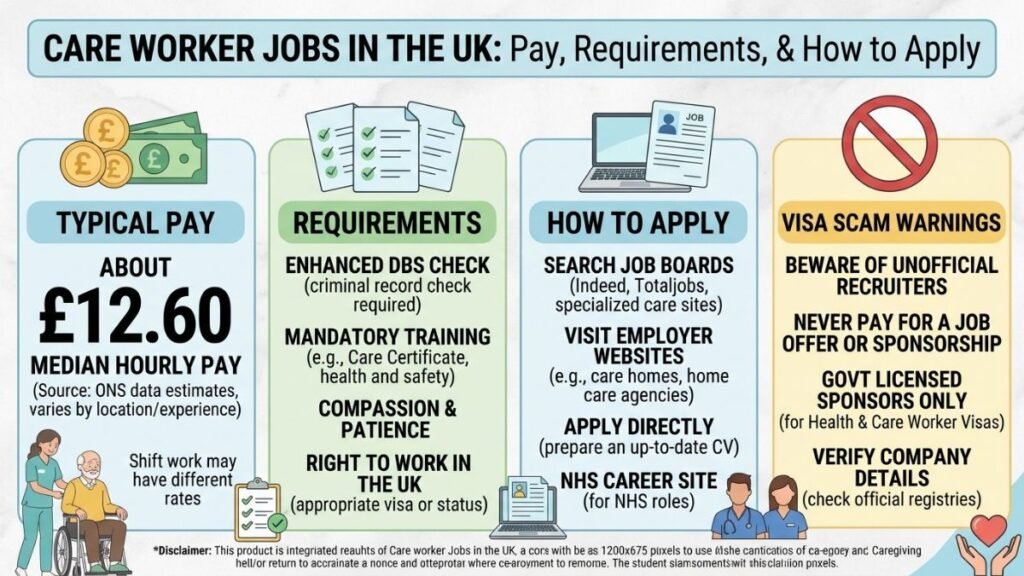
Quick answer: Most care worker jobs need no qualifications, but you do need the right to work in the UK, an enhanced DBS check and a caring attitude. The typical independent-sector care worker in England earns about £12.60 an hour, with advertised jobs commonly between £12.71 and about £16.70. Overseas applicants can no longer get a visa for adult social care roles.
What does a care worker do?
Care workers (also called carers, care assistants, support workers or home carers) support people with everyday life. Typical tasks include:
- Personal care: helping people to wash, dress, use the toilet and move around safely
- Meals and nutrition: preparing food and drink, and helping people to eat
- Medication support: reminding people to take medication or giving it under training and instructions
- Companionship and emotional support: chatting, listening and encouraging activities
- Household tasks: light cleaning, laundry and shopping in a person’s home
- Monitoring wellbeing: noticing changes in health or behaviour and reporting them
- Record keeping: writing notes on care given, using paper or digital systems
The work is physical and emotional, and can be very rewarding.
Types of care worker jobs
| Role | Where you work | What it involves |
|---|---|---|
| Care assistant (residential or nursing home) | Care homes | Supporting residents in a shared setting, usually in shifts including nights and weekends |
| Domiciliary or home care worker | People’s own homes | Visiting several people a day, with travel between visits. A driving licence is often needed |
| Live-in carer | A person’s home | Living with the person for a period, with breaks arranged by the employer |
| Support worker | Supported living, community services | Helping adults with learning disabilities, autism or mental health needs |
| Night care worker | Care homes or homes | Waking night duties, or sleep-in shifts in some roles |
| Reablement worker | Community teams | Helping people to regain independence after illness or hospital |
| Senior care worker or team leader | Care homes, home care teams | Supervising carers, helping with medication and care plans |
| Personal assistant | A person’s home | Employed directly by someone who arranges their own care |
| NHS healthcare assistant | Hospitals and community teams | Similar care tasks in the NHS. See our guide to NHS jobs |
Browse current care vacancies on our UK jobs board.
How much do care workers earn in 2026?
Care pay is often close to the National Living Wage, and sources give different figures because they measure different things.
| Source | Figure |
|---|---|
| Skills for Care, median hourly pay for independent-sector care workers in England (December 2025) | £12.60 |
| Skills for Care, mean pay in domiciliary care services in England (2025/26) | £12.96 |
| Skills for Care median in London | About £13.00 |
| Typical advertised care assistant job (a 2026 analysis of adverts) | About £13.92, in a range of £12.71 to £16.70 |
| Indeed UK salary estimate for care workers (October 2026) | About £14.10, with the lowest 10% near £12.71 and the top 10% near £18.39 |
A few points to remember:
- The legal minimum for workers aged 21 and over is £12.71 an hour from April 2026. The Skills for Care median of £12.60 was recorded before that rise, so many care workers are on or close to the minimum. See our National Minimum Wage 2026 guide.
- Advertised rates are higher than the median because job adverts show what employers offer now, not what everyone currently earns.
- Senior carers, team leaders and specialist support workers usually earn more, as do night shifts and some agency shifts.
- Rates differ by region, with London and the South generally higher.
- NHS roles are paid on national bands. For example, Band 2 healthcare support workers in England start at £25,272 a year.
- A Fair Pay Agreement for adult social care is planned under the Employment Rights Act 2025, with the first agreement reported as due in April 2028. Check GOV.UK for any update.
Pay problems to watch for
Care work has some specific pay issues, so check your contract and payslip.
- Travel time. For home care workers, time spent travelling between visits during your working day should count as working time for minimum wage purposes. If you are only paid for the time at each visit, check your hourly rate after travel time is included.
- Unpaid waiting time and short visits. Ask how the rota works, and whether gaps between calls are paid.
- Sleep-in shifts. If you sleep at a workplace and are available to be woken, the minimum wage rules treat time spent asleep differently from time spent awake and working. Ask how sleep-ins are paid.
- Mileage. If you use your own car, ask whether the employer pays mileage and how much.
- Uniforms and training. Do not accept deductions that bring your pay below the minimum.
If you think you are being underpaid, keep your rotas and payslips and contact Acas for free advice, or report it to HMRC.
Contracts and hours
Many care jobs offer flexibility, but contracts vary:
- Zero-hours contracts are common in home care. Skills for Care data reports that about one in five posts in adult social care are on zero-hours contracts. Read our guide to zero-hours contracts for your rights, including the reforms expected in 2027.
- Guaranteed-hours contracts give more security. Ask for one if you can.
- Shift patterns often include early mornings, evenings, weekends, bank holidays and nights, and split shifts in home care.
- Statutory Sick Pay is payable from day one since April 2026 for those who qualify. See our guide to the Employment Rights Act 2025.
Before you accept, check the pay, hours, travel time, mileage, training and notice. Our guides to understanding your employment contract and notice periods in the UK explain what to look for.
Requirements to become a care worker
Most employers ask for:
- The right to work in the UK. See our guide to right to work checks in the UK.
- An enhanced DBS check, including a check of the adults’ barred list, because you will work with vulnerable adults. In Scotland this is the PVG scheme, and in Northern Ireland an AccessNI enhanced check. Employers normally arrange it, and most do not charge you.
- References, usually covering your recent work or study history, and explanations of any gaps.
- A caring, patient and reliable attitude, which matters more than experience.
- Good English, to understand care plans, medication instructions and to communicate with the people you support.
- A full driving licence and access to a car, for many home care jobs. Some employers in cities offer transport or routes you can cover on foot or by public transport.
- Physical fitness, because the job involves moving and assisting people.
- Health checks and vaccinations, depending on the employer.
Qualifications and training
You do not usually need qualifications to start. Employers provide induction training in areas such as manual handling, safeguarding, infection control, first aid, medication awareness and dementia. New care workers are normally expected to work towards the Care Certificate, a set of national standards for health and social care support staff, within the first weeks of the job.
If you want to progress, many employers support you to complete a Level 2 or Level 3 Diploma in Health and Social Care, or an apprenticeship. In Scotland, Wales and Northern Ireland, some care workers must register with the national social care workforce regulator, so check the requirements for your country.
How to apply: step by step
- Decide what kind of care you want. Residential, home care, support work, nights or live-in, and how far you can travel.
- Prepare your documents. Right-to-work proof, ID, address history and references. Employers will want a full history, with gaps explained.
- Write a short CV. Include any caring experience, such as looking after a relative, volunteering, childcare, hospital or school work. If you are new to work, see our guide to writing a UK CV with no experience and our guide to writing a cover letter in the UK.
- Find vacancies. Search provider websites, council and NHS sites, reputable agencies and our jobs board.
- Check the provider. In England, you can look up a care provider’s inspection rating on the Care Quality Commission (CQC) website. In Scotland, Wales and Northern Ireland, the regulators are the Care Inspectorate, Care Inspectorate Wales and RQIA.
- Apply directly through the employer’s website or a reputable agency.
- Attend the interview. Expect questions about values and real situations (see below).
- Complete pre-employment checks. These include DBS, references, right to work and sometimes health checks.
- Start with induction and shadowing. Many employers pair new staff with an experienced worker for the first shifts.
Interview tips for care jobs
Care interviews focus on values and attitude. Prepare examples for questions such as:
- Why do you want to work in care?
- What does treating someone with dignity and respect mean to you?
- Tell me about a time you helped someone who was upset or vulnerable.
- What would you do if a person you support refused help?
- What would you do if you saw a colleague treating someone badly?
- How would you handle a medication error or an accident?
- How do you cope with emotionally difficult situations?
Use the STAR method (Situation, Task, Action, Result) and honest, specific examples. Our guide to customer assistant interview questions and answers explains it. Also ask your own questions, such as how many visits a day you would have, how travel time is paid and what training and support is offered.
Career progression
Care work offers real routes to progress:
- Senior care worker or team leader
- Care coordinator or field supervisor in home care
- Deputy manager and registered manager, with a Level 5 management qualification
- Specialist roles, such as dementia care, end-of-life care or learning disability support
- Training to become a nursing associate or registered nurse, through apprenticeships or university
- Moving into NHS roles. See our guide to NHS jobs
The pros and cons
Advantages
- You make a real difference to people’s lives
- No experience or qualifications needed to start
- Training and induction provided
- Jobs in every town and city, with flexible hours
- Clear routes to progress
Disadvantages
- Pay is often close to the legal minimum
- Work can be physically and emotionally demanding
- Shifts, split shifts and weekends are common
- Turnover is high, and some employers rely on zero-hours contracts
- Travel between visits can be tiring and may not always be well paid
Can overseas applicants get a care worker visa?
No, not for new applications from outside the UK. Since 22 July 2025, new overseas applicants can no longer apply for Health and Care Worker visas for adult social care roles such as care workers and senior care workers. There are transitional arrangements for people who are already in the UK in these jobs, so check GOV.UK and take advice from a regulated adviser if this applies to you.
This is one of the biggest scam areas in the UK job market. Be very careful of:
- Anyone who offers a care worker job and visa from abroad for a fee
- Agents who promise “guaranteed sponsorship” or a certificate of sponsorship for payment
- Care providers that are not on the licensed sponsor register, or that cannot be verified with the CQC
- Job offers via WhatsApp or social media with no proper interview
Read our guides to jobs with visa sponsorship in the UK and how to spot a fake job advert in the UK. Never pay for a job, a visa or sponsorship.
Frequently asked questions
How much do care workers earn per hour in the UK? The median for independent-sector care workers in England was about £12.60 in the latest Skills for Care data, with advertised jobs commonly between £12.71 and about £16.70.
Do I need qualifications to be a care worker? No. Employers usually provide induction training and support you to complete the Care Certificate.
Do I need a DBS check? Yes. An enhanced DBS check, including the adults’ barred list, is normally required, and the employer usually arranges it.
Do I need a driving licence? For most home care jobs, yes. Care home jobs often do not require one.
Can I get a care worker visa from abroad? No. New overseas applications for adult social care visas closed on 22 July 2025.
Is travel time paid for home care workers? Travel between visits during your working day should count as working time for minimum wage purposes. Check your rota and payslip, and contact Acas if you are unsure.
Are care jobs zero hours? Many home care jobs are, but guaranteed-hours contracts exist. Ask before you accept.
How old do you have to be to be a care worker? It varies. Many employers require staff to be at least 18 for direct personal care, but some offer other roles or apprenticeships to younger people. Check each advert.
Can I work in care part time or around school hours? Yes. Many roles offer part-time or flexible hours, though shift patterns vary.
Final thoughts
Care work is demanding, but it offers steady demand, training and a chance to make a real difference. Check the pay and travel arrangements, ask about guaranteed hours, look up the provider’s inspection rating and never pay anyone for a job or a visa. When you are ready, browse the latest care vacancies on our jobs board and apply directly with the employer.
This article is general information, not legal advice. Pay data comes from Skills for Care and other published sources and changes often. Rules on DBS checks, registration and visas vary by country and change, so check the job advert, GOV.UK and the relevant regulator for the latest details.