Delivery Driver Jobs in the UK: Pay, Van Rules and Self-Employed vs Employed
Delivery driving is one of the easiest jobs to start in the UK. You can often begin within days with a car or van licence, and there are vacancies with supermarkets, parcel companies, couriers and delivery apps in every region. But the headline pay rates can be misleading, because the job comes in two very different forms: employed and self-employed. This guide explains what delivery drivers earn in 2026, the van and licence rules, the difference between being employed and self-employed, and how to avoid common traps.
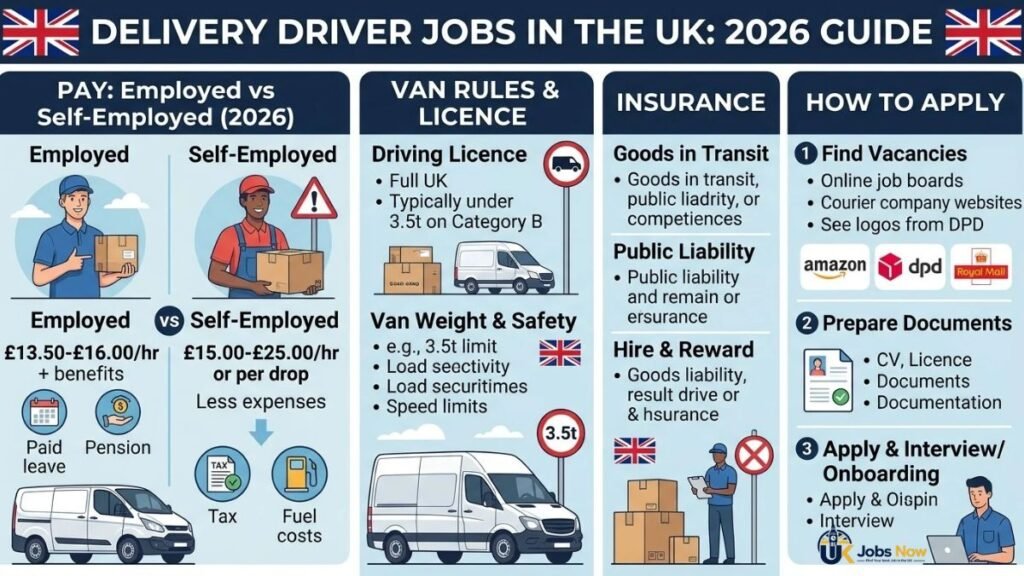
Quick answer: Employed delivery drivers typically earn about £12.71 to £15 an hour, or roughly £25,000 to £31,000 a year full time. Self-employed couriers are often advertised at £14 to £18 an hour, but after fuel, insurance and vehicle costs their real earnings can be much lower, and they do not get holiday pay or sick pay.
Types of delivery driver jobs
| Type of job | Typical employer | Employed or self-employed | Vehicle |
|---|---|---|---|
| Supermarket home delivery | Tesco, Sainsbury’s, Asda and others | Employed | Company van |
| Parcel delivery (employed) | Royal Mail, some DPD and Amazon delivery partner roles | Employed | Company van |
| Parcel delivery (self-employed) | Evri, DPD owner-driver and Connect models, Yodel | Usually self-employed | Your own car or van |
| Amazon delivery | Amazon delivery service partners (DSPs) | Employed | Branded van |
| Amazon Flex | Amazon | Self-employed | Your own car |
| Food delivery | Deliveroo, Uber Eats, Just Eat | Usually self-employed | Bike, moped or car |
| Multi-drop courier | Courier firms | Employed or self-employed | Van |
| Two-person delivery | Furniture and white goods firms | Usually employed | Larger van |
| 7.5-tonne delivery | Wholesale, retail and distribution | Usually employed | 7.5t lorry, needs a C1 licence |
For heavier lorries, see our guide to HGV driver jobs in the UK. Browse current vacancies on our UK jobs board.
How much do delivery drivers earn in 2026?
There is no single figure, because pay depends on employer, vehicle, area and status. The examples below come from 2026 pay guides and job adverts, and many are estimates from adverts and aggregator sites, so treat them as a guide.
Employed drivers
| Role | Typical pay |
|---|---|
| Employed parcel or multi-drop van driver | About £12.71 to £15 an hour |
| Asda home shopping driver | £13.10 an hour, or £14.35 inside the M25 (July 2026) |
| Supermarket and Royal Mail drivers | Often about £13 to £16 an hour, depending on the employer and location |
| Amazon delivery service partner driver | Often advertised at about £14 to £17 an hour |
| DPD employed driver | Around £12.71 to £16 an hour in adverts |
| 7.5-tonne driver | About £16 to £24 an hour |
| Typical full-time employed driver | Roughly £25,000 to £31,000 a year |
The National Careers Service gives a lower indicative range of about £20,000 for starters to £27,000 for experienced van drivers, based on variable hours. Most advertised jobs now sit above that because of the 2026 National Living Wage of £12.71 an hour for workers aged 21 and over. See our National Minimum Wage 2026 guide.
Self-employed drivers
Self-employed couriers are paid per parcel, per drop or per block of time, and usually bring their own vehicle.
| Work | How it pays | Advertised or indicative figure |
|---|---|---|
| Amazon Flex | Per booked block | About £14 to £18 an hour, according to published rates |
| DPD Connect | Per parcel | Advertised at up to about £18 an hour |
| DPD owner-driver | Per parcel, with a van you own or finance | Adverts quote gross route earnings far above employed pay, but costs are high |
| Evri | Per parcel, often 50p to £1.50 a parcel | About £13.72 an hour effective, from indicative courier reports |
| Yodel and others | Per parcel | Often reported at the low end, around £9 to £11 an hour |
Important: these are gross revenue figures. Self-employed drivers pay for fuel, vehicle costs, insurance, maintenance, parking fines, phone and tax. Several 2026 guides estimate that net pay after expenses can fall to roughly £8 to £14 an hour, depending on the work, vehicle and area. A van driver on a published £18 an hour may keep far less once everything is paid.
Employed vs self-employed: what is the difference?
Your status decides your rights. There are three main categories.
| Employee | Worker | Self-employed | |
|---|---|---|---|
| Minimum wage | Yes | Yes | No |
| Paid holiday | Yes | Yes | No |
| Statutory sick pay | Yes, if you qualify | Yes, if you qualify | No |
| Pension auto-enrolment | Yes | Usually | No |
| Redundancy pay and unfair dismissal | Yes, if you qualify | No | No |
| Who pays tax and National Insurance | Your employer, through payroll | Your employer, through payroll | You, through Self Assessment |
| Who pays for the vehicle and fuel | Usually the employer | Varies | You |
| Can you send someone in your place? | No | Limited | Sometimes |
Your real working arrangement matters more than the label in the contract. Courts and tribunals look at factors such as how much control the company has over you, whether you must do the work personally, whether you can turn work down, and whether you are really running your own business. A driver who wears a company uniform, follows set routes and must accept shifts may be a worker or employee even if the contract says “self-employed”.
If you are unsure of your status, you can use HMRC’s employment status check tool and ask Acas for free advice. Our guide to zero-hours contracts also explains the difference between workers and employees.
Pros and cons of being employed
Advantages: guaranteed minimum pay, holiday and sick pay, pension, a company vehicle and insurance, and training.
Disadvantages: lower headline hourly rates, set shifts and routes, and less flexibility.
Pros and cons of being self-employed
Advantages: flexibility, the chance to earn more per hour, and the freedom to choose when you work.
Disadvantages: you pay all vehicle and running costs, income can be unpredictable, there is no holiday or sick pay, and you must manage your own tax. If you have a bad week or your van breaks down, you lose income.
Licence and van rules
Licence requirements
- Vans up to 3.5 tonnes can normally be driven with a standard car licence (Category B). Check the maximum permitted weight on your licence and vehicle, because some alternatively fuelled vehicles have higher limits.
- 7.5-tonne vehicles need a Category C1 licence. Some drivers who passed their car test before 1997 already hold C1 entitlement, but check your licence and whether you need a Driver CPC.
- Heavier lorries need HGV licences and the Driver CPC. See our HGV guide.
- Points and convictions. Employers and insurers check your driving record. Serious offences can stop you getting work or cover.
Minimum age
You can hold a car licence at 17, but many employers and insurers set higher minimum ages for van driving, often 21 or older. Check each advert.
Insurance
- Employed drivers are usually covered by the employer’s fleet insurance.
- Self-employed couriers normally need hire and reward insurance, which covers carrying other people’s goods for payment. Standard car insurance does not cover this. Cover can be expensive, especially for younger or newly qualified drivers.
- Some platforms and courier firms provide insurance, and some do not, so ask before you sign up.
Vehicle checks and costs
- Keep your vehicle roadworthy, with a valid MOT, tax and regular maintenance.
- Check your vehicle before each journey, and report faults.
- Self-employed drivers pay for fuel, servicing, tyres, repairs, breakdown cover and parking or traffic penalties.
Hours and rest
Drivers’ hours rules for vans differ from those for HGVs. Employers and drivers should follow the rules that apply to their vehicle weight and type of work, and avoid driving when tired. Check the DVSA’s guidance on GOV.UK.
Right to work checks
Employers must check your right to work, and from 1 October 2026 the Home Office extended the check scheme to more working arrangements, which may affect some gig and courier engagements. Read our guide to right to work checks in the UK. Never share or rent your driver account to someone else. That can be illegal working and can put your own status at risk.
Tax and money for self-employed drivers
If you are self-employed:
- Register for Self Assessment with HMRC and file a tax return each year. If you earn more than the £1,000 trading allowance in a tax year, you generally need to register.
- Keep records of income and expenses, such as fuel, insurance, repairs, phone costs and mileage. You can often claim allowable expenses, or use HMRC’s simplified mileage rates if they suit you.
- Set money aside for tax and National Insurance. No one takes it from your pay automatically.
- Budget for gaps. Vehicle repairs and slow weeks can hit your income.
- Consider extra cover, such as breakdown cover and income protection.
Check HMRC’s guidance for the current rates and rules, or speak to an accountant.
Requirements for delivery driver jobs
Most employers look for:
- A full UK driving licence, usually held for a minimum period, with few or no points
- The right to work in the UK
- Reliability, good timekeeping and good customer service
- Physical fitness, since you may lift parcels, climb stairs and walk long distances
- A smartphone or handheld scanner, and basic digital skills for delivery apps
- Local knowledge, or good navigation skills
- Flexibility with early starts, evenings or weekends
You do not usually need previous experience. Many employers train new drivers.
How to apply: step by step
- Decide on employed or self-employed work, based on your vehicle, savings and how much flexibility you need.
- Check your licence and insurance position. Self-employed drivers should get a quote for hire and reward insurance before committing.
- Prepare a short CV. Include your licence details, any driving or delivery experience and your availability. See our guide to writing a UK CV with no experience and our cover letter guide.
- Apply directly. Use official employer websites, delivery company driver pages or reputable agencies. See our guides to supermarket jobs and Christmas jobs in the UK for employers hiring now.
- Ask the key questions (see below).
- Complete checks. Employers check your licence, right to work and sometimes references.
- Read the contract or agreement carefully. Our guides to understanding your employment contract and notice periods in the UK explain what to check.
Questions to ask before you accept
- Am I employed, a worker or self-employed? Can I see that in writing?
- How is pay calculated, per hour, per parcel or per block, and what is the minimum I will earn?
- Who pays for the vehicle, fuel, insurance, uniform and scanner?
- What happens if I cannot deliver parcels, or there is a fine or a damaged item?
- How many drops or parcels are expected in a day, and how is performance measured?
- Are breaks protected, and how long are the shifts?
- Are there guaranteed hours, holiday pay and sick pay?
- How and when am I paid, weekly or monthly?
Scams and warning signs
Delivery work is a common target for scammers. Watch for:
- Fees up front, such as a deposit, a registration fee, a fee for a “route” or a charge for a uniform or app access
- Pressure to buy or lease a van from a specific supplier before you have a confirmed contract
- Offers on WhatsApp or Telegram with no named company or proper application process
- Promises of very high earnings, such as £500 a day with no experience
- Requests to rent or share your delivery account or lend your identity documents
- Fake delivery job adverts that collect your documents and bank details
Apply only through official company sites and reputable agencies, and never pay for the chance to work. Read our guide to how to spot a fake job advert in the UK.
Career progression
Delivery driving can lead to:
- Senior driver, driver trainer or team leader
- Transport planner or dispatcher
- Warehouse and logistics supervisor. See our guide to warehouse jobs in the UK
- 7.5-tonne and HGV driving, which usually pays more. See our HGV guide
- Running your own courier business, with the extra responsibility that brings
Frequently asked questions
How much do delivery drivers earn in the UK? Employed drivers typically earn about £12.71 to £15 an hour, or roughly £25,000 to £31,000 a year. Self-employed pay is advertised higher but is reduced by costs.
Do I need a special licence to drive a delivery van? Not usually. A standard car licence covers vans up to 3.5 tonnes. Larger vehicles need C1 or C licences.
Is delivery driving better employed or self-employed? It depends. Employed work offers holiday pay, sick pay and stability. Self-employed work offers flexibility and higher headline rates but you pay your own costs and tax.
Do self-employed delivery drivers get holiday pay or sick pay? No. Self-employed people do not get paid holiday or Statutory Sick Pay. Some workers on platforms may be classed as workers with some rights, depending on their real status.
Do I need hire and reward insurance? If you carry other people’s goods for payment and you are self-employed, yes, normally. Employed drivers are usually covered by the employer’s policy.
How old do you have to be to be a delivery driver? You can hold a car licence at 17, but many employers and insurers require drivers to be 21 or older for vans.
Can I do delivery driving part time? Yes. Many jobs and gig platforms offer part-time and flexible hours.
Are delivery driver jobs available at Christmas? Yes. Demand rises sharply before Christmas, and many retailers and parcel companies take on extra drivers.
Final thoughts
Delivery driving can be a quick, flexible way to earn, but the details matter. Work out your real take-home pay after costs, check whether you are employed or self-employed, get the right insurance and never pay to get a job. When you are ready, browse the latest vacancies on our jobs board and apply directly with the employer.
This article is general information, not legal, tax or financial advice. Pay rates come from 2026 pay guides and adverts and change often. Tax, insurance and employment status rules are complex, so check GOV.UK and HMRC, and ask Acas, Citizens Advice or an accountant about your own situation.