Part-Time Jobs for Students in the UK: Hours, Pay and Tax
A part-time job can help you pay your way through college or university, build a CV and learn skills that employers value. But students often have questions about how many hours they can work, how much they will be paid, whether they will pay tax, and what rules apply if they are on a Student visa. This guide answers them, and lists the best student-friendly jobs and where to find them.
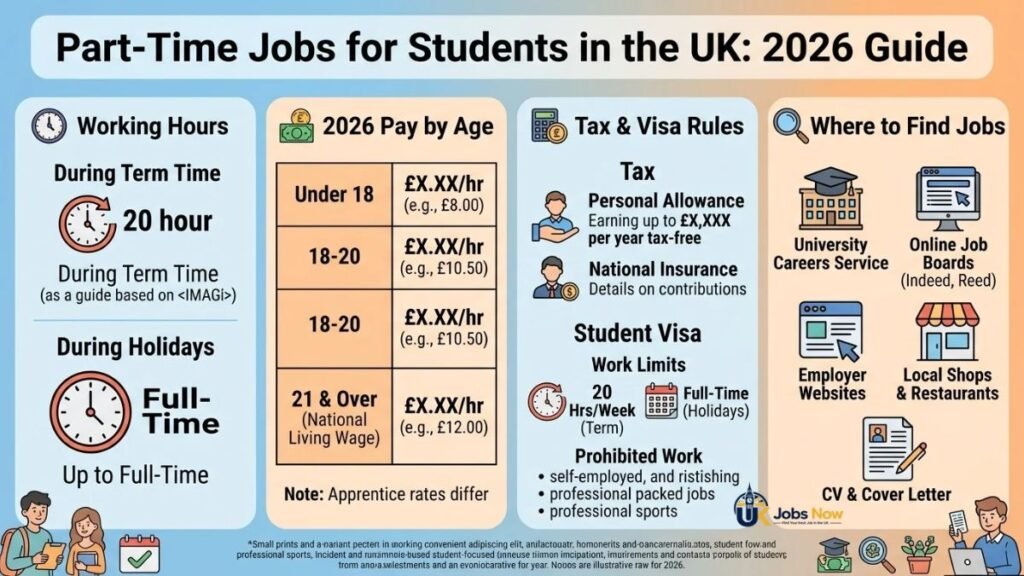
Quick answer: If you have an unrestricted right to work, there is no student-specific limit on your hours, though universities often advise 15 to 20 hours a week in term time. If you are on a Student visa studying at degree level, you can work up to 20 hours a week in term time and full-time in official vacations. Most students pay no income tax, because the personal allowance is £12,570 in 2026/27, and pay starts at £12.71 an hour for those aged 21 and over.
How many hours can students work?
The rules depend on your age and your right to work.
UK and Irish students, and others with unrestricted right to work
There is no law that limits a student’s working hours just because they are a student. Ordinary working time rules apply. In practice, most universities and colleges recommend working no more than about 15 to 20 hours a week in term time, so that your studies do not suffer. Check your course handbook, especially if you have placements, labs or intensive timetables.
Students aged 16 and 17
Young workers aged 16 and 17 who are past school leaving age have extra protections. In general, they should not work more than 8 hours a day or 40 hours a week and are entitled to longer rest periods and breaks than adults. Some roles and venues also have age restrictions, for example for serving alcohol or using certain machinery. Check each advert, and check the rules for your age on GOV.UK.
Students under 16
Children under 16 can only do light work, in limited hours, and many types of work are not allowed. Local councils may require a work permit. If you are under 16, ask your school or local authority before taking a job.
International students on a Student visa
If you hold a Student visa, your visa conditions limit your work:
| Situation | Work limit |
|---|---|
| Degree-level course (bachelor’s, master’s, PhD) at a higher education provider with a track record of compliance | Up to 20 hours a week in term time |
| Course below degree level (such as a foundation year or pre-sessional English) | Up to 10 hours a week in term time |
| Official vacations (such as Christmas, Easter and summer) | Full-time allowed, subject to your visa conditions |
| After your course ends, until your visa expires | Generally full-time, subject to your conditions |
Important points:
- The limit applies to all your jobs combined. If you work 12 hours at one employer and 10 at another, that is 22 hours and breaches the limit.
- The limit applies to any kind of work, including university jobs, internships and remote work for a UK employer, unless it is a placement that is an assessed part of your course.
- Self-employment and permanent full-time jobs are generally not allowed on a Student visa. Some types of work, such as professional sports, are also banned.
- Term time includes exam periods and reading weeks in many cases, so check your university’s official term dates and ask the international student support team if you are unsure.
- Breaking the conditions can put your visa at risk. Keep a record of your hours, and check your visa conditions or the Home Office guidance on GOV.UK.
If you are a student from overseas looking for a job, you will need to prove your right to work. Read our guide to right to work checks in the UK.
How much do student jobs pay?
Pay depends on your age, the employer and the job. The legal minimums from April 2026 are:
| Age | Minimum hourly pay |
|---|---|
| 21 and over | £12.71 |
| 18 to 20 | £10.85 |
| Under 18 | £8.00 |
| Apprentices (under 19, or in the first year) | £8.00 |
See our full National Minimum Wage 2026 guide. Some employers pay everyone the same rate regardless of age, so look at each advert.
Typical student job rates
The figures below are examples from 2026 guides and adverts, so check the current advert for each job.
| Job | Typical pay |
|---|---|
| Supermarket and retail | Often about £13 to £14.50 an hour, depending on the employer. See our guide to supermarket jobs |
| Bar and restaurant work | Often the minimum or just above, plus tips or tronc. See our guide to hospitality jobs |
| University student ambassador | About £12 to £15 an hour |
| Warehouse and delivery | Often about £12.71 to £15 an hour. See our guides to warehouse jobs and delivery driver jobs |
| Cleaning | Often at or just above the minimum. See our guide to cleaning jobs |
| Tutoring | Varies widely, depending on subject and level |
What 20 hours a week looks like
At £12.71 an hour, 20 hours a week is about £254 a week before tax. Over a 30-week academic year that is roughly £7,600, plus extra if you work full-time in the holidays. Many students working term time at minimum wage stay under the tax-free personal allowance.
Do students pay tax?
Often very little or none, but it depends on your total income for the tax year (6 April to 5 April).
- Income Tax. The personal allowance is £12,570 for 2026/27. You pay no income tax on earnings up to that amount. Above it, the basic rate is 20% up to £50,270.
- National Insurance. Employees normally pay National Insurance on earnings above about £242 a week (£12,570 a year), at 8% on earnings above that threshold. Below it, you do not pay National Insurance.
- Student loan repayments. You only repay a UK student loan once your income is above the threshold for your repayment plan, and repayments are taken from your pay if you are employed. Check the current threshold for your plan on GOV.UK. If you are an international student, UK student loans do not apply.
- Council tax. Full-time students are normally exempt from council tax, which is a separate matter and not affected by part-time work in most cases. Check with your local council.
- Benefits. Full-time students usually cannot claim Universal Credit, though some exceptions exist. Check before you rely on benefits.
Common tax problems
- Emergency tax code. When you start a job, your employer may put you on an emergency tax code until HMRC has your details. If you think you have paid too much tax, check your payslip and contact HMRC, and you may be able to claim a refund. Our guide to Christmas jobs in the UK 2026 covers emergency tax too.
- Two jobs. If you have two jobs, your personal allowance usually applies to one of them, so the second may be taxed at a higher rate through your tax code. Check your payslips.
- Summer jobs. Full-time summer work can push you over the allowance if you also work in term time. Keep track of your total income.
- Self-employed work. If you earn money from tutoring, selling goods or freelance work, you may need to register for Self Assessment if you earn over the £1,000 trading allowance in a tax year. International students on a Student visa are generally not allowed to be self-employed.
If you are unsure, check HMRC’s guidance on GOV.UK, or ask your university’s student advice service.
Best part-time jobs for students
Retail and supermarkets
Flexible shifts, steady demand and staff discounts. Many retailers recruit heavily before Christmas. See our guides to supermarket jobs, M&S jobs and Christmas jobs in the UK 2026.
Hospitality
Bars, restaurants, cafes and events offer evening and weekend shifts, with tips. See our hospitality jobs guide for the tips law and pay.
Campus jobs
Student ambassador, library assistant, students’ union bar, open day helper and research assistant roles fit around lectures and are often advertised through your university’s careers or jobs portal. Remember the 20-hour limit includes campus work if you are on a Student visa.
Warehouse, delivery and logistics
Evening and weekend shifts, and peak-time work, with higher pay for nights. See our guides to warehouse jobs and delivery driver jobs.
Tutoring
If you are strong in a subject, tutoring can pay well, though the hours may be irregular and it is often self-employed work, which may not be allowed on a Student visa.
Cleaning and housekeeping
Early morning or evening shifts in offices, hotels and homes. See our cleaning jobs guide.
Customer service and call centres
Some employers offer part-time or evening shifts and training. Check the pay and hours before you accept.
Seasonal and holiday work
Christmas, Easter and summer jobs in retail, hospitality, warehouses, theme parks and tourism. Full-time hours are possible in the holidays, even for students on Student visas.
Browse current student-friendly vacancies on our UK jobs board.
How to find a student job
- Check your university or college job portal. Many employers advertise student jobs there, and your students’ union may too.
- Visit your careers service, which can help with CVs, applications and interview practice.
- Look at big employers’ websites, especially retailers, supermarkets and hospitality groups.
- Apply in person at local shops, cafes and pubs, with a short CV.
- Use our jobs board and other trusted job sites.
- Tell friends and coursemates that you are looking. Many jobs are filled by word of mouth.
- Register with reputable agencies for temporary and event work.
If you have no experience, see our guide to writing a UK CV with no experience and our cover letter guide. For interview tips, read our guide to customer assistant interview questions and answers.
How to balance work and study
- Put your studies first. Check your timetable, deadlines and exam dates before you agree to shifts.
- Be honest about your availability. Tell the employer about term dates, exams and placements when you apply, not after.
- Choose flexible employers. Retail, hospitality and campus roles often offer shift swaps and reduced hours around exams.
- Watch for burnout. Working long hours on top of study can harm your results and wellbeing. If it is not working, speak to your university’s student support team.
- Plan for holidays. You can usually work more in vacations, but remember to rest.
- Use student support. Many universities have money advice teams, hardship funds and job support.
Your rights as a student worker
- Minimum wage. You must be paid at least the minimum for your age, and you must receive a payslip.
- Holiday pay. You build up paid holiday, even on casual or short-term contracts.
- Sick pay. Since April 2026, Statutory Sick Pay is payable from the first day for those who qualify. See our guide to the Employment Rights Act 2025.
- Rest breaks. Workers aged 18 and over are generally entitled to a 20-minute break if they work more than six hours.
- Fair treatment. You are protected against discrimination and unlawful deductions from wages.
- Zero-hours contracts. Many student jobs are zero hours. Read our guide to zero-hours contracts for your rights and the reforms expected in 2027.
- Unpaid trials. If you do real work on a trial shift, you should be paid.
If you have a problem, keep records and contact Acas for free advice, or ask your students’ union.
Beware of student job scams
Students are a common target for scammers because they are often short of money and new to job hunting. Watch for:
- Fake job adverts that ask for a fee for training, a uniform, a background check or registration
- “Easy money” offers, such as data entry, product reviews, mystery shopping or “payment processing” roles that ask you to receive and transfer money
- Jobs offered via WhatsApp, Telegram or social media with no named employer or proper interview
- Fake tutoring or babysitting requests that send cheques or ask for your bank details
- Requests to rent or lend your bank account or identity, which can make you part of a crime
If an offer sounds too good to be true, it probably is. Read our guide to how to spot a fake job advert in the UK for a full checklist, and apply only through official employer websites.
Frequently asked questions
How many hours can a student work in the UK? If you have an unrestricted right to work, there is no student-specific limit, but many universities advise 15 to 20 hours a week in term time. Students on a Student visa can work up to 20 hours a week in term time at degree level and full-time in vacations.
Can international students work part time in the UK? Yes, if their visa allows it. Degree-level students on a Student visa can generally work up to 20 hours a week in term time, and up to 10 hours if the course is below degree level.
Do students pay tax on part-time jobs? Only if their total income for the tax year is above the personal allowance (£12,570 in 2026/27). National Insurance applies above about £242 a week.
What is the minimum wage for students? There is no separate student rate. The minimum wage depends on your age: £12.71 for 21 and over, £10.85 for ages 18 to 20 and £8.00 for under-18s, from April 2026.
Can I do two part-time jobs as a student? Yes, but on a Student visa the weekly limit applies to all your jobs combined.
Can students be self-employed in the UK? UK and other students with unrestricted right to work can be. International students on a Student visa generally cannot be self-employed.
Will a part-time job affect my student loan? It could, if your income goes above the repayment threshold for your plan. Check the current threshold on GOV.UK.
What is the best part-time job for a student? One that is flexible around your timetable, pays fairly and teaches useful skills. Retail, hospitality, campus roles and seasonal work are popular.
Final thoughts
A part-time job can fund your studies and boost your CV, but protect your time, check your visa or age rules, and watch your pay and tax. Keep records of your hours and payslips, and never pay to get a job. When you are ready, browse the latest vacancies on our jobs board and apply directly with employers.
This article is general information, not legal, tax or immigration advice. Visa, tax and student finance rules change often. Check GOV.UK, HMRC, your university or college and a regulated adviser for your own situation.