Supermarket Jobs in the UK: Pay and How to Apply (Tesco, Sainsbury’s, Asda, Aldi)
Supermarkets are among the biggest employers in the UK, with jobs in stores, warehouses, delivery and head office. Most entry-level roles need no experience, hours can be flexible, and pay is now well above the legal minimum. This guide compares pay at Tesco, Sainsbury’s, Asda and Aldi (plus Lidl and others), explains the types of jobs, and shows you how to apply.
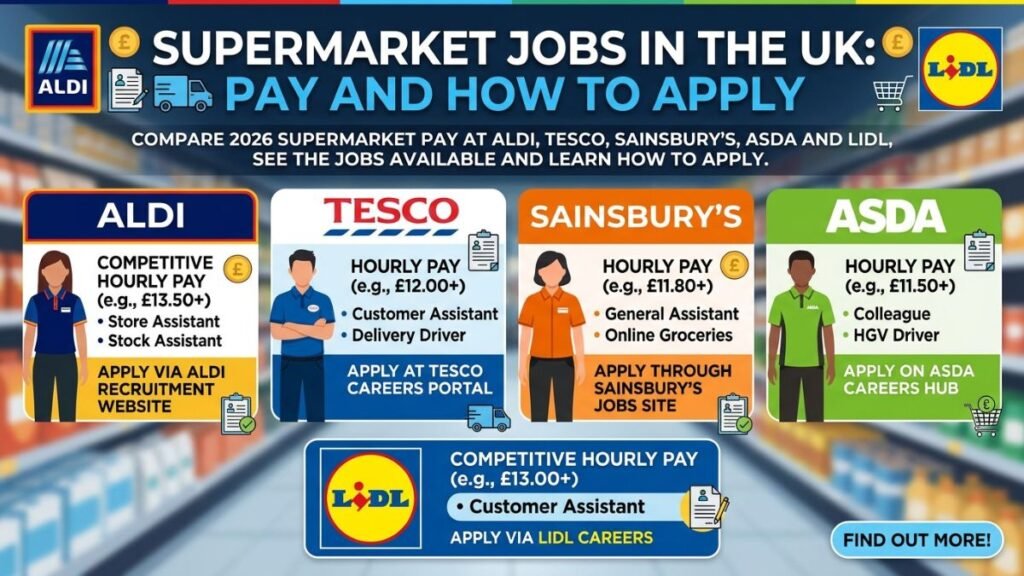
Quick answer: In 2026, entry-level supermarket pay in England, Scotland and Wales ranges from about £13.10 an hour at Asda to £13.50 at Aldi, with higher London rates of roughly £14.35 to £14.88. You apply online on each retailer’s careers site, usually followed by an online assessment and a short interview.
Supermarket pay in 2026: who pays what?
The table shows the main hourly rates for store colleagues after the spring 2026 pay rises. The legal minimum for workers aged 21 and over is £12.71 from April 2026, and every major supermarket pays above it.
| Supermarket | National rate | London / inside M25 | Effective from |
|---|---|---|---|
| Aldi | £13.50 | £14.88 | 1 April 2026 |
| Lidl | £13.45 | £14.80 | 1 March 2026 |
| M&S | £13.41 | £14.74 | 1 April 2026 |
| Tesco | £13.28 | £14.55 | 29 March 2026 |
| John Lewis / Waitrose | £13.25 | £14.80 | 1 April 2026 |
| Sainsbury’s | £13.23 | £14.54 | March 2026 |
| Asda | £13.10 | £14.35 | From July 2026 |
Notes:
- These figures come from the retailers’ own announcements as reported by retail trade and national news sources. Retailers update pay once or more a year, so check the job advert for the current rate. Aldi, for example, raised pay twice in the first half of 2026.
- Some retailers pay more with length of service. Aldi, for instance, has said rates rise with service.
- Rates for under-21s may be lower at some employers, so check the advert if you are under 21.
- Distribution centre, driver and management roles usually pay more than shop floor roles.
To see how these compare with the legal rates, read our guide to the National Minimum Wage 2026.
What that means in a week
For a 30-hour week at the 2026 national rates (before tax), you would earn roughly:
| Supermarket | Approx. weekly pay (30 hours) |
|---|---|
| Aldi (£13.50) | £405 |
| Tesco (£13.28) | £398 |
| Sainsbury’s (£13.23) | £397 |
| Asda (£13.10) | £393 |
Your take-home pay will be lower after tax, National Insurance and pension contributions.
Types of supermarket jobs
Supermarkets offer much more than the checkout.
- Customer assistant or store colleague: the main entry-level role, covering the shop floor, shelves, tills and customer help.
- Checkout and self-service host: serving customers and helping with self-checkouts.
- Online shopper or picker: collecting online grocery orders in store.
- Delivery driver: delivering orders to homes, usually needing a full driving licence.
- Warehouse and distribution operative: picking and packing in regional distribution centres, often on shifts.
- Counter and fresh food roles: bakery, deli, butchery and fish counters, sometimes with training.
- Night shift stock replenishment: filling shelves overnight, which may pay a premium.
- Team leaders and managers: supervising a department or running a store.
- Head office and specialist roles: finance, buying, technology, marketing and supply chain.
Browse current supermarket and retail vacancies on our UK jobs board.
Retailer by retailer
Tesco
Tesco is the UK’s biggest supermarket and a major employer, with Express, Metro, Superstore and Extra stores plus distribution centres. From 29 March 2026 it pays £13.28 an hour nationally and £14.55 inside the M25, after a 5.1% rise for hourly-paid staff.
Typical roles include customer assistant, checkout, online order picker and warehouse picker. Candidates report that the process usually starts with an online application, then an online assessment with scenario questions, followed by an interview or a group session in store. Some stores recruit through in-store notices as well as online.
Tesco also runs large seasonal drives, and says some temporary staff can move into permanent roles. See our guide to Christmas jobs in the UK 2026.
Sainsbury’s and Argos
Sainsbury’s raised hourly pay by 5% to £13.23 nationally and £14.54 in London from March 2026. It recruits across supermarkets, convenience stores, warehouses and delivery, and owns Argos, which hires in-store and in logistics roles.
Colleagues get a staff discount (a 10% colleague discount is reported across Sainsbury’s and Argos). Applications are made through the Sainsbury’s careers website.
Asda
Asda announced a pay deal worth more than £80 million in March 2026, taking its hourly rate to £13.10 from July, with a reported London rate of £14.35. Asda hires store colleagues, home shopping pickers and drivers, and distribution staff. It had seasonal vacancies open in autumn 2026 but no national hiring figure, so check the Asda careers site for local roles.
Aldi
Aldi positions itself as the highest-paying major supermarket for store assistants, at £13.50 nationally and £14.88 inside the M25 from 1 April 2026. It says it is the only major supermarket to give paid breaks to all staff. Aldi store assistants work across the tills, shelves and the warehouse area within a store, so roles are varied and busy. Aldi’s pay rises with service, and the company has increased pay more than once in 2026, so check the latest rate on its careers page.
Lidl, M&S, Waitrose and others
Lidl pays £13.45 nationally and £14.80 in London from 1 March 2026. M&S pays customer assistants at least £13.41, and our M&S jobs guide covers its process in detail. John Lewis and Waitrose staff were due £13.25, or £14.80 in London, from 1 April. Morrisons, Co-op and other grocers also hire, and their pay is published on their careers pages.
Requirements
For most customer assistant roles you need:
- The right to work in the UK. Employers check your documents.
- A friendly, reliable attitude, which matters more than experience.
- Flexibility with hours. Shifts may include early mornings, evenings, weekends and bank holidays.
- Basic maths and communication skills for tills and customer queries.
- A driving licence for delivery driver roles.
- Physical fitness for stocking shelves and warehouse work.
- A minimum age that varies by employer and role, and some tasks, such as handling certain products, may have extra age rules. Check each advert.
No qualifications are normally needed, and the retailer provides training.
How to apply: step by step
- Choose your retailer and store. Think about travel and shift times.
- Search on the official careers site. Apply directly on Tesco, Sainsbury’s, Asda, Aldi or other official sites, not through a link in a message.
- Prepare your details. You will need your work and education history, availability and right-to-work information. If you have never worked, read our guide to writing a UK CV with no experience.
- Complete the application form. Be accurate about your availability and check spelling.
- Take the online assessment. Many retailers use short scenario-based tests about customer service and teamwork. Read each question carefully.
- Attend the interview. It may be one-to-one with a manager, or a group session. Expect it to last 20 to 30 minutes. See our guide to customer assistant interview questions and answers.
- Complete checks. After an offer you will usually provide right-to-work documents, and sometimes references.
- Read your contract. Check hours, pay, holiday and notice. Our guide to understanding your employment contract lists what to look for.
Tips for supermarket applications
- Visit the store before you apply or interview. Notice how staff help customers and how shelves are kept.
- Be flexible. The more shifts you can offer, the more likely you are to be hired.
- Apply to several stores or retailers. Hiring is local, so different stores may have different openings.
- Mention customer service examples from any setting, including volunteering, school and family.
- Follow up politely if you hear nothing after the date you were given.
Hours and contracts
Supermarket jobs come in several patterns:
- Part-time contracts, often 10 to 30 hours a week, popular with students and parents
- Full-time contracts, typically 35 to 40 hours
- Flexible or variable hours, where your rota changes from week to week
- Temporary and seasonal contracts, common before Christmas
Check whether your hours are guaranteed. Some retailers offer contracted hours, and others use flexible arrangements. If you want security, ask what is contractually guaranteed. The Employment Rights Act 2025 plans reforms to zero-hours and low-hours contracts in 2027, as covered in our Employment Rights Act 2025 guide.
Benefits to compare
Hourly pay is only part of the picture. Compare:
- Staff discount, such as the 10% colleague discount reported at Sainsbury’s and Argos
- Paid breaks. Aldi says it gives paid breaks to all staff, so check this elsewhere
- Premiums for nights, Sundays and bank holidays
- Pension, holiday entitlement and sick pay. Since April 2026, Statutory Sick Pay is payable from the first day for those who qualify
- Service-based pay increases, which reward staying
- Training and progression, such as supervisor and manager programmes
Career progression
Supermarkets often promote from within. A typical path is customer assistant, then team leader, section manager, department manager, deputy store manager and store manager. There are also routes into specialist roles such as buying, logistics, online operations and HR, and apprenticeships and graduate schemes. Ask about training at interview.
Your rights
- You must receive at least the minimum wage for your age and a payslip.
- You build up paid holiday.
- You are entitled to rest breaks and a safe workplace.
- If you work nights, extra rules on working time and health checks may apply.
- If you have a problem with pay or hours, contact Acas for free advice, and keep your payslips and rotas.
Beware of fake supermarket job adverts
Big brands are often copied by scammers. Be wary of job offers on WhatsApp, requests for payment for uniform or training, and websites that look like a supermarket’s but have a different web address. Always apply through the retailer’s own website. Read our guide to how to spot a fake job advert in the UK.
Frequently asked questions
Which supermarket pays the most? As of spring 2026, Aldi leads for store assistants at £13.50 nationally and £14.88 inside the M25, followed by Lidl at £13.45. Rates change often, so check current adverts.
How much does Tesco pay per hour? Tesco pays £13.28 nationally and £14.55 inside the M25 from 29 March 2026.
How much does Sainsbury’s pay per hour? Sainsbury’s pays £13.23 nationally and £14.54 in London from March 2026.
How much does Asda pay per hour? Asda’s rate is £13.10 from July 2026, with a reported London rate of £14.35.
Do I need experience to work in a supermarket? No. Most customer assistant roles are open to first-time workers, and training is provided.
How old do you have to be to work in a supermarket? It varies by retailer and role. Check the advert, as some roles have higher age limits.
Can I work part time? Yes. Many supermarket roles are part time, with flexible hours.
Are supermarkets hiring now? Yes, many are recruiting for Christmas. See our guide to Christmas jobs in the UK 2026.
Final thoughts
Supermarket work offers steady pay above the legal minimum, flexible hours and clear routes to progress. Compare the pay and benefits, apply directly with the retailers you like and prepare for the assessment and interview. When you are ready, browse the latest roles on our jobs board.
This article is general information. Pay rates and recruitment processes change often, so always check the job advert and the retailer’s official careers site for the latest details. UK Jobs Now is not affiliated with any of the retailers mentioned.