NHS Jobs: How to Apply, Pay Bands and Entry-Level Roles
The NHS is one of the largest employers in the world, with jobs ranging from porters and healthcare assistants to nurses, scientists and managers. Many roles need no experience or degree, pay is set on national scales, and there are clear routes to progress. This guide explains how NHS pay bands work, what entry-level jobs pay in 2026/27, which roles to look for, and how to apply step by step.
Quick answer: NHS jobs in England are paid on the Agenda for Change scale. From 1 April 2026, Band 2 (the usual entry point for healthcare assistants and support staff) pays £25,272 a year, or about £12.92 an hour. Most jobs are advertised on the NHS Jobs website, and you apply online with a supporting statement.
How NHS pay works: Agenda for Change
Most NHS staff, apart from doctors, dentists and very senior managers, are paid under the Agenda for Change (AfC) system. Every job is evaluated against national criteria and placed in a pay band from 2 to 9. Each band has one to three pay points, and you move up them as you gain service, usually each year, subject to satisfactory performance.
The same band means the same basic pay wherever you work in the same country of the UK, so a Band 5 nurse and a Band 5 physiotherapist start on the same salary. Staff in London and the surrounding areas receive extra payments to reflect higher living costs.
2026/27 pay award: Staff on Agenda for Change contracts in England received a 3.3% increase from 1 April 2026. The government announced it in February 2026.
Scotland, Wales and Northern Ireland have their own arrangements. Scotland negotiates separately and uses a different scale and a 36-hour standard week, so figures there are higher in some bands. Check the official sources for your country (see the end of this article).
NHS pay bands 2026/27 (England)
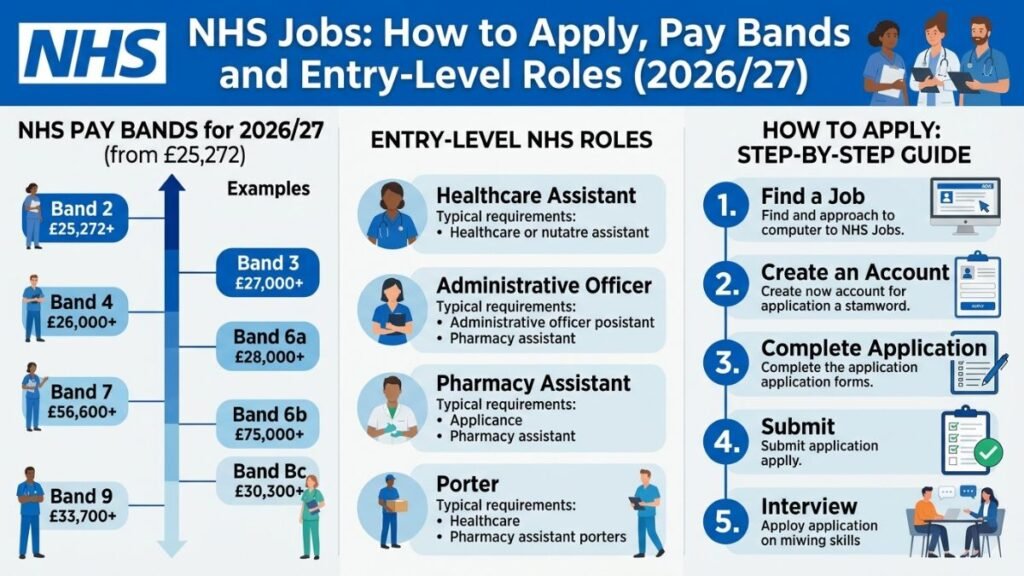
| Band | Salary (full-time) | Approx. hourly rate | Typical roles |
|---|---|---|---|
| Band 2 | £25,272 | £12.92 | Healthcare support worker, porter, domestic and housekeeping staff, ward clerk, catering assistant |
| Band 3 | £25,760 to £27,476 | £13.17 to £14.05 | Senior healthcare assistant, phlebotomist, pharmacy assistant, emergency care assistant, medical secretary |
| Band 4 | £28,392 to £31,157 | About £14.50 to £15.90 | Assistant practitioner, senior admin, technician roles |
| Band 5 | £32,073 to £39,043 | £16.40 to £19.97 | Newly qualified nurse, midwife, paramedic, physiotherapist, radiographer |
| Band 6 | £39,959 to £48,117 | — | Senior or specialist nurse and therapist |
Hourly rates are based on a standard 37.5-hour week. The figures above are for England and are published by NHS Employers. Higher bands (7 to 9) cover advanced practitioners, managers and senior leaders.
Scotland, Wales and Northern Ireland
- Scotland sets its own Agenda for Change pay. For 2026/27, Scottish Government figures show higher rates in some bands than in England, for example around £14.22 to £15.44 an hour at Band 2, and around £18.40 an hour at the entry point of Band 5.
- Wales and Northern Ireland currently publish pay scales that largely match England at Band 3, though details can differ. Check the Welsh NHS and HSC Northern Ireland sources.
London and the High Cost Area Supplement
Staff working in Inner London, Outer London and the fringe areas receive a High Cost Area Supplement on top of basic pay, which can add several thousand pounds a year at lower bands. Check the job advert for the exact figure.
Extra pay: nights, weekends and overtime
Staff who work nights, weekends and public holidays receive enhanced payments on top of basic pay, and the percentage depends on your band. Overtime is also paid at enhanced rates in many cases. These extras can make a noticeable difference to your monthly income, so check the terms in the job advert and your contract.
NHS pay compares well with the legal minimum. The National Living Wage is £12.71 an hour for workers aged 21 and over from April 2026, and Band 2 sits just above it. See our National Minimum Wage 2026 guide.
Entry-level NHS jobs (no degree needed)
You do not need clinical qualifications for many NHS roles. Common entry points include:
- Healthcare support worker or healthcare assistant (HCA), usually Band 2 or 3. You help patients with personal care, meals and mobility, and support nurses. Employers usually train you on the job, often including the Care Certificate.
- Porter, moving patients, equipment and supplies around the hospital.
- Domestic or housekeeping assistant, keeping wards and departments clean. See also our guide to cleaning jobs in the UK.
- Catering assistant, preparing and serving food to patients and staff.
- Ward clerk and receptionist, handling admin, records and visitors.
- Phlebotomist, taking blood samples, often Band 3 with training.
- Pharmacy assistant and theatre support worker, supporting specialist teams.
- Maternity support worker, helping midwives and families.
- Emergency care assistant, supporting ambulance crews.
- Mental health support worker, helping people in mental health settings.
Browse current health and care vacancies on our UK jobs board, and check the NHS Jobs website for the full list.
Apprenticeships and ways to progress
The NHS offers apprenticeships at several levels, from healthcare support to nursing associate and degree-level apprenticeships that lead to registered nursing or other professions while you earn. Many support workers move up through pay points and bands as they gain training. A typical path is healthcare support worker, then senior healthcare assistant, then assistant practitioner or nursing associate, and then registered nurse. Ask about training, development and funded study at interview.
Requirements for NHS jobs
Requirements depend on the role, but for entry-level jobs employers typically look for:
- The right to work in the UK.
- Good communication and compassion. NHS recruitment pays close attention to values such as respect, kindness and teamwork.
- Reliability and flexibility, including shifts, nights and weekends in many roles.
- Basic English and numeracy for reading care plans and recording information accurately.
- Vaccinations and health checks, which are arranged through occupational health after a conditional offer.
- A criminal record check. Roles with patient contact normally require an enhanced DBS check (or the Scottish and Northern Irish equivalents).
- References and employment history, which employers verify before you start.
For most healthcare support jobs you do not need formal qualifications, though English and maths GCSEs or equivalents help for some Band 3 and 4 jobs. Care experience, including unpaid care for a family member and volunteering, can count.
How to apply for an NHS job: step by step
- Find vacancies. In England and Wales, most NHS jobs are advertised on the NHS Jobs website. Scotland and Northern Ireland use their own recruitment sites, and many trusts also advertise on their own pages. Always check the official site.
- Set up an account. Create a profile, which can store your details and let you apply to multiple jobs.
- Read the job description and person specification. The person specification lists the essential and desirable criteria. You are shortlisted by how well you match them.
- Complete the application. Fill in your employment history carefully and explain any gaps. Employers will check your history.
- Write a strong supporting statement. This is the most important part of an NHS application (see tips below).
- Wait to hear. Shortlisting can take a couple of weeks. Check your email, including spam.
- Attend the interview. NHS interviews are often values-based and may include a panel.
- Receive a conditional offer. The offer depends on pre-employment checks.
- Complete pre-employment checks. These include right to work, references, DBS, occupational health and identity checks.
- Start work and training. New staff normally complete an induction and mandatory training, such as manual handling, infection control and safeguarding.
If you need help preparing your CV or supporting statement, see our guide to writing a UK CV with no experience.
How to write a supporting statement
The supporting statement is your chance to show how you meet the person specification.
- Go through the person specification point by point and give an example for each criterion.
- Use real examples from work, volunteering, caring for relatives or education.
- Show NHS values. Examples of compassion, respect, dignity and teamwork carry weight.
- Explain why you want to work in the NHS and in that particular role or trust.
- Be specific. Say what you did and what happened, using the STAR method (Situation, Task, Action, Result).
- Check spelling and grammar, and keep to any word limit.
- Write your own. Employers can spot copied or AI-written generic statements. Make it personal.
Interview tips for NHS jobs
NHS interviews usually ask about values and real situations. Prepare examples for questions such as:
- Why do you want to work in the NHS, and in this role?
- Tell me about a time you showed compassion for someone.
- How would you treat a patient with dignity and respect?
- Tell me about a time you worked in a team under pressure.
- What would you do if you saw something that worried you about a patient’s safety?
- How do you keep information confidential?
- How do you cope with stress or emotionally difficult situations?
Learn about the trust and the NHS values, be honest and be specific. Our guide to customer assistant interview questions and answers explains the STAR method in more detail.
Working patterns and contracts
NHS jobs come in several forms:
- Permanent full-time or part-time posts, with pay on a band and pay point
- Fixed-term contracts, often to cover leave or projects
- Bank work, where you register to take shifts on a flexible basis with a trust or an NHS staff bank, often a good way to start
- Agency work, through recruitment agencies that supply staff to the NHS
Check the hours, band and contract type before you accept. Our guide to understanding your employment contract lists what to look for, and our guide to notice periods in the UK explains what you need to know when you leave.
Benefits of working in the NHS
Benefits commonly include:
- Pension. NHS staff can join the NHS Pension Scheme, which is one of the main attractions of NHS employment.
- Annual leave. Entitlement starts at a set number of days plus bank holidays and increases with service.
- Sick pay. The NHS has its own occupational sick pay scheme, which is often more generous than statutory sick pay.
- Family leave. Enhanced maternity and other family-friendly policies.
- Training and development, including funded courses and apprenticeships.
- Discounts and wellbeing support, such as staff discount schemes and occupational health.
Benefits vary by country and employer, so always check the job advert and your contract.
Can international applicants get NHS jobs?
Some NHS roles, such as registered nurses, doctors and some allied health professionals, can be sponsored through the Health and Care Worker visa. However, entry-level healthcare assistant and support worker roles generally do not qualify for visa sponsorship, and overseas recruitment for adult social care roles closed to new applicants in July 2025. Read our guide to jobs with visa sponsorship in the UK for more detail, and check GOV.UK for the current rules. Be very wary of anyone who offers NHS jobs with sponsorship in return for a fee.
Beware of NHS job scams
Scammers often imitate the NHS. Watch for:
- Anyone asking you to pay a fee for a job, an interview, a uniform, a DBS check or a visa
- Job offers on WhatsApp or social media that skip the normal application process
- Offers of NHS jobs from abroad with a guaranteed visa
- Websites that look like the NHS but have a different web address
Apply only through official NHS and trust websites, and use the contact details on those sites to check any offer. Read our guide to how to spot a fake job advert in the UK.
Frequently asked questions
How much does an NHS healthcare assistant earn? In England in 2026/27, Band 2 pays £25,272 a year (about £12.92 an hour) and Band 3 pays £25,760 to £27,476, before enhancements for nights and weekends and any London supplement.
Do I need qualifications to work in the NHS? Not for many entry-level roles. Employers usually provide training. Some roles ask for GCSEs or equivalent.
What is the lowest NHS pay band? Band 2 is now the lowest band for new starters in England. Band 1 has closed to new entrants.
How do I apply for an NHS job? Create an account on the NHS Jobs website (in England and Wales) or the relevant recruitment site for your country, then complete the application and supporting statement.
How long does NHS recruitment take? Often several weeks, because of shortlisting, interviews and pre-employment checks. Start the checks quickly when you receive an offer.
What is the NHS pay rise for 2026/27? Staff on Agenda for Change contracts in England received a 3.3% uplift from 1 April 2026.
Can I work in the NHS part time? Yes. Many roles are part time, and some are flexible. Salaries are shown as full-time equivalents and paid pro rata.
Do NHS staff get paid more at night? Yes. Staff who work nights, weekends and public holidays receive enhanced rates, which vary by band.
Final thoughts
NHS jobs offer transparent pay, good pensions, training and clear career progression, and many do not need any experience. Read the person specification carefully, write a personal supporting statement and be ready for values-based interview questions. Check the latest figures on the official NHS Employers and GOV.UK pages before you apply, then browse the latest vacancies on our jobs board.
This article is general information. Pay scales, benefits and recruitment processes differ between England, Scotland, Wales and Northern Ireland and change each year. Always check the job advert, NHS Employers and the relevant national NHS pay pages. UK Jobs Now is not affiliated with the NHS.