HGV Driver Jobs in the UK: Licence, CPC and Pay
Heavy goods vehicle (HGV) driving is one of the best-paid jobs you can train for without a degree. Pay has stayed strong since the driver shortage of recent years, jobs are advertised in every region, and you can qualify in a matter of weeks. But the route has steps, costs and rules that catch people out. This guide explains the licence categories, the Driver CPC, what it costs, what HGV drivers earn in 2026, and how to find a job.
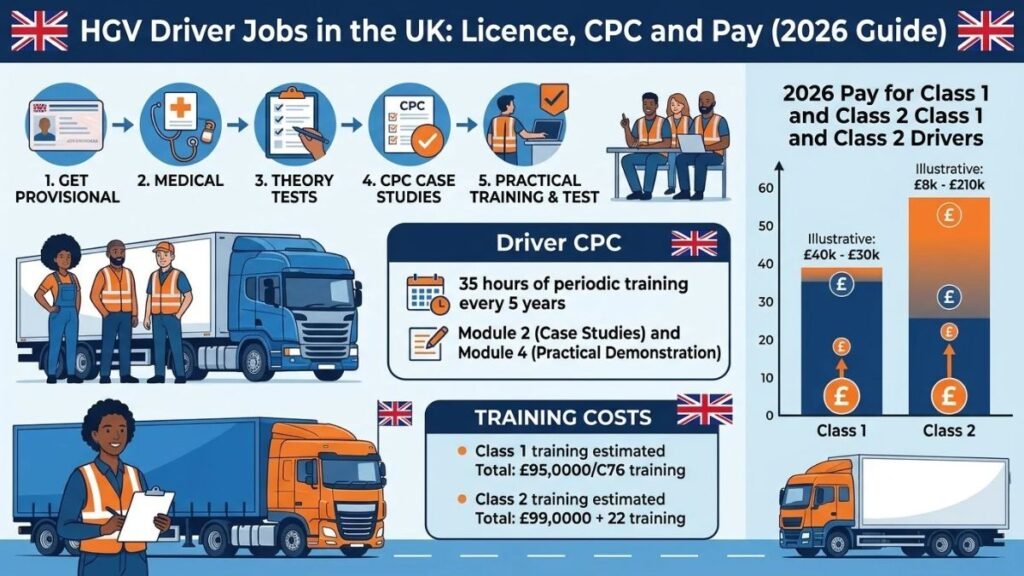
Quick answer: To drive an HGV in the UK you need a full car licence, a D4 medical, a provisional HGV entitlement, theory and practical tests, and the Driver CPC. Training usually costs about £1,500 to £3,000 for a rigid lorry licence (Category C) and up to £5,000 in total for an articulated licence (Category C+E). Most employed drivers earn roughly £28,000 to £50,000 a year depending on licence class and type of work.
What is an HGV, and what are Class 1 and Class 2?
An HGV is a heavy goods vehicle, generally a lorry over 3.5 tonnes. Drivers often use the old “Class” names, but the licence categories are:
| Common name | Licence category | What you can drive |
|---|---|---|
| Class 2 | Category C | Rigid lorries over 3.5 tonnes, such as large delivery, skip, tipper and refuse lorries |
| Class 1 | Category C+E | Articulated lorries and rigid lorries with a heavy trailer |
| 7.5 tonne | Category C1 | Smaller lorries between 3.5 and 7.5 tonnes |
Most people start with Category C (Class 2) and then add C+E (Class 1), though you should check with a training provider and the DVSA about the quickest legal route for your situation.
Requirements to become an HGV driver
To apply for a provisional HGV entitlement you need to:
- Be at least 18 years old. Some employers and insurers set higher minimum ages, so you may find that your first job opportunities are better after 21.
- Hold a full Category B (car) licence. Many training providers do not require you to have held it for a minimum period, but insurers and employers often prefer drivers with some experience.
- Pass a D4 medical. This is a medical examination by an approved doctor covering eyesight, general health and fitness to drive. It usually costs about £50 to £120.
- Have the right to work in the UK. See our guide to right to work checks in the UK.
- Have a good driving record. Serious motoring convictions can affect your licence and employment.
You must also be fit to drive over time. Drivers renew their medical at certain ages and when health conditions change.
The Driver CPC explained
The Driver Certificate of Professional Competence (CPC) is a legal qualification for professional lorry and bus drivers. You need it to drive an HGV for a living in most cases.
- Initial Driver CPC: you complete theory and practical modules, normally as part of your training course. Initial CPC training and testing is often included in licence training packages, though some providers charge extra.
- Periodic training: once qualified, you must complete 35 hours of approved training every five years to keep your Driver Qualification Card (DQC). Typical costs are around £45 to £75 per day, or roughly £300 to £500 over five years, and many employers pay for it.
Driving professionally without a valid CPC when you need one can lead to fines and problems for you and your employer.
How to get an HGV licence: step by step
- Check you meet the basic requirements. Age, car licence and right to work.
- Book a D4 medical. You can use your GP or a private provider that specialises in driver medicals. Prices vary, so compare.
- Apply for a provisional HGV entitlement. Complete the DVLA D2 application with your D4 form. There is normally no fee for adding the provisional entitlement to your licence.
- Choose a training provider. Pick an approved, well-reviewed provider with its own vehicles and good test pass rates. Ask what is included, such as test fees, CPC modules and the number of driving hours.
- Pass the theory tests. These include multiple-choice questions and hazard perception, and a theory test fee applies.
- Train and pass the practical driving test. Training usually takes five to seven days of practical lessons, but plan for weeks, because waiting times for tests can vary.
- Complete the initial Driver CPC modules. This covers the case study and practical demonstration tests.
- Get your Driver Qualification Card. The DVLA issues it after you complete the CPC.
- Get a digital tachograph driver card if your work needs one, normally arranged with your employer.
- Apply for jobs, or start work with the employer who sponsored your training.
The whole process often takes around six to eight weeks if you book promptly, according to training provider guides, but it varies with test availability.
How much does it cost?
Costs vary a lot between providers and regions. The figures below are typical ranges quoted by training providers and industry guides in 2026.
| Item | Typical cost |
|---|---|
| D4 medical | £50 to £120 |
| Provisional HGV entitlement (D2 application) | Usually free |
| Theory test | About £37 or more per attempt |
| Category C training and tests | £1,500 to £3,000 |
| Adding Category C+E | About £1,200 to £3,000 |
| Driver CPC periodic training (35 hours) | About £300 to £500 every five years |
| ADR (dangerous goods) add-on | Around £800 to £1,200 |
| Total from a car licence to Class 1 | Roughly £3,000 to £5,500 |
Some of these figures come from provider marketing, so use them as a guide, compare quotes and check what is included.
Ways to cut the cost
- Employer-funded training. Some haulage companies pay for your training in return for a commitment to work for them. Read the agreement carefully. Some include repayment clauses if you leave early.
- Government-funded training. Some areas offer funded HGV or skills bootcamp places for eligible adults. Check with your local council, Jobcentre Plus or the National Careers Service.
- Training with a job offer. Some employers offer a “driver academy” where you are paid or guaranteed a job after you qualify.
- Upgrade later. You can start on a Class 2 licence and add Class 1 once you are working.
How much do HGV drivers earn in 2026?
Pay depends on licence class, the type of work, whether you are agency or permanent, and where you live. Industry guides in 2026 give these typical ranges:
| Role | Typical annual pay | Typical hourly (agency) |
|---|---|---|
| Class 2 (Category C), permanent | £28,000 to £36,000 | £16 to £20 |
| Class 1 (Category C+E), permanent | £32,000 to £55,000 | £18 to £24 |
| Specialist (ADR tanker, multi-drop, night work) | At the top of the range or above | Higher, plus premiums |
The National Careers Service gives a typical range of roughly £27,000 for new starters to around £47,000 for experienced drivers. Different sources quote different numbers, partly because they mix basic pay, overtime and agency rates, so always check the advert for the base pay and how many hours are guaranteed.
Things that affect your pay:
- Licence class. Class 1 usually pays more than Class 2, and upgrading is one of the best returns on investment for drivers.
- Experience. Newly qualified drivers often start at the lower end, and experienced drivers command more.
- Shift pattern. Night work, weekends and bank holidays attract premiums.
- Type of work. Multi-drop, tipper, tanker, car transporter, container and “tramping” (staying away overnight) roles can pay differently.
- Overnight allowances. Guides mention allowances of around £25 to £35 per night away, but this depends on the employer.
- Region. London and the South East often pay more, but live costs are higher.
- Agency or permanent. Agency work can pay higher hourly rates but offers fewer guaranteed hours and benefits. Permanent jobs usually come with training, holiday, sick pay and a pension.
For comparison, the legal minimum wage for workers aged 21 and over is £12.71 an hour from April 2026, so HGV driving pays well above it. See our National Minimum Wage 2026 guide.
Types of HGV driver jobs
- General haulage and day work: home most nights, delivering to set customers.
- Multi-drop delivery: many drop-offs in a day, for example supermarket and retail deliveries.
- Tipper and construction: moving aggregates, soil and building materials.
- Skip, refuse and waste: local rounds, often early starts.
- Tanker and ADR: carrying liquids or hazardous goods, which needs an ADR certificate and pays more.
- Container and port work: moving containers to and from ports and depots.
- Night work and trunking: moving goods between depots overnight.
- Tramping: several nights away from home, with allowances.
- Agency and temporary driving: flexible shifts, often used in peak periods such as Christmas.
Working hours and tachograph rules
HGV drivers are regulated by drivers’ hours rules to prevent fatigue. In general terms, drivers must take breaks after set periods of driving, daily rest periods and weekly rest, and their driving is recorded by a digital tachograph. Your employer will explain the rules and the DVSA publishes the detail, so learn them properly. Breaking drivers’ hours rules can lead to fines and affect your licence.
Where to find HGV driver jobs
- Logistics and haulage companies, from small local hauliers to national operators
- Supermarket and retail distribution, such as depots serving big retailers
- Specialist agencies, which place agency drivers and may help new drivers
- Construction, waste and manufacturing companies with their own fleets
- Job boards, including our UK jobs board, which lists driver and logistics vacancies
If you already work in a warehouse, you may be able to move into driving with your employer’s support. See our guide to warehouse jobs in the UK.
How to apply and what employers look for
Employers usually want:
- A full UK driving licence with an HGV entitlement and valid Driver CPC
- A clean or reasonably clean licence, with limited points
- Reliability and good timekeeping
- Good communication and customer service
- Ability to follow safety and drivers’ hours rules
- Right to work in the UK
Prepare a CV that shows your licence categories, endorsements, vehicle types and any experience, even in a van, warehouse or delivery role. If you are new, read our guide to writing a UK CV with no experience, then add your licence details. In interviews, be ready for questions on safety, time management, handling difficult customers and what you would do after a breakdown or accident. Our customer assistant interview guide explains the STAR method you can use for examples.
Before you accept a job, check the pay, hours, overtime rules, how overnight allowances work, who pays for CPC and tachograph cards, and the notice period. Our guide to understanding your employment contract lists what to look for, and our guide to notice periods in the UK covers what happens if you leave.
Can you get an HGV job from overseas?
It is difficult. HGV driving is not generally a route for visa sponsorship for new overseas applicants under current rules, and offers of guaranteed HGV jobs with visas are a common scam target. Check any offer carefully, make sure the employer is on the licensed sponsor register, and never pay for a job or a visa. Read our guides to jobs with visa sponsorship in the UK and how to spot a fake job advert in the UK.
Pros and cons of HGV driving
Advantages
- Strong pay compared with most jobs that do not need a degree
- Plenty of vacancies in most regions
- Qualify in weeks rather than years
- Chance to move up to Class 1, specialist work or transport management
- Independent work with a lot of time on your own
Disadvantages
- Upfront training cost, unless an employer pays
- Long, irregular hours and early starts
- Time away from home for some jobs
- Sitting for long periods, which can affect health
- Responsibility for a large vehicle and strict rules
Frequently asked questions
How much does an HGV driver earn in the UK? In 2026, employed Class 2 drivers typically earn about £28,000 to £36,000, and Class 1 drivers about £32,000 to £55,000, depending on experience and type of work.
How long does it take to get an HGV licence? Often six to eight weeks if you book promptly, though waiting times for tests can add delays.
How much does an HGV licence cost? About £1,500 to £3,000 for Category C, and roughly £3,000 to £5,500 in total to reach Category C+E, including medical, tests and CPC. Quotes vary, so compare providers.
What is the minimum age to drive an HGV? You must be at least 18 to hold the provisional entitlement and to take the tests. Some employers and insurers want older drivers.
Do I need the Driver CPC? Yes, for most professional HGV driving. You need the initial qualification and then 35 hours of periodic training every five years.
What is the difference between Class 1 and Class 2? Class 2 (Category C) covers rigid lorries. Class 1 (Category C+E) covers articulated lorries and heavy trailers, and usually pays more.
Can my employer pay for my training? Some employers do, often with a commitment to stay or a repayment clause, so read the agreement carefully.
Are there HGV jobs for beginners? Yes. Many employers hire newly qualified drivers, and some offer training academies. Expect to start with local or day work and build experience.
Final thoughts
HGV driving can offer good pay and steady work, but the upfront cost and demanding hours are real. Compare training providers, check any employer-funded agreement, and choose the licence class that fits your goals. When you have your licence, browse the latest driver and logistics vacancies on our jobs board.
This article is general information. Licensing rules, fees and pay vary and change. Check the DVLA and DVSA pages on GOV.UK for current requirements, and check the details of any job advert or training offer before you commit.