How to Handle a Group Interview
A group interview changes the maths of an interview in a way that catches a lot of candidates off guard: instead of one conversation with an interviewer’s full attention, you’re one of several candidates competing for limited airtime, being watched not just for what you say but for how you behave around other people under pressure. It’s a genuinely different skill to a one-to-one interview, and the instinct that serves you well there — speaking confidently and at length — can actively work against you here.
What a group interview actually is
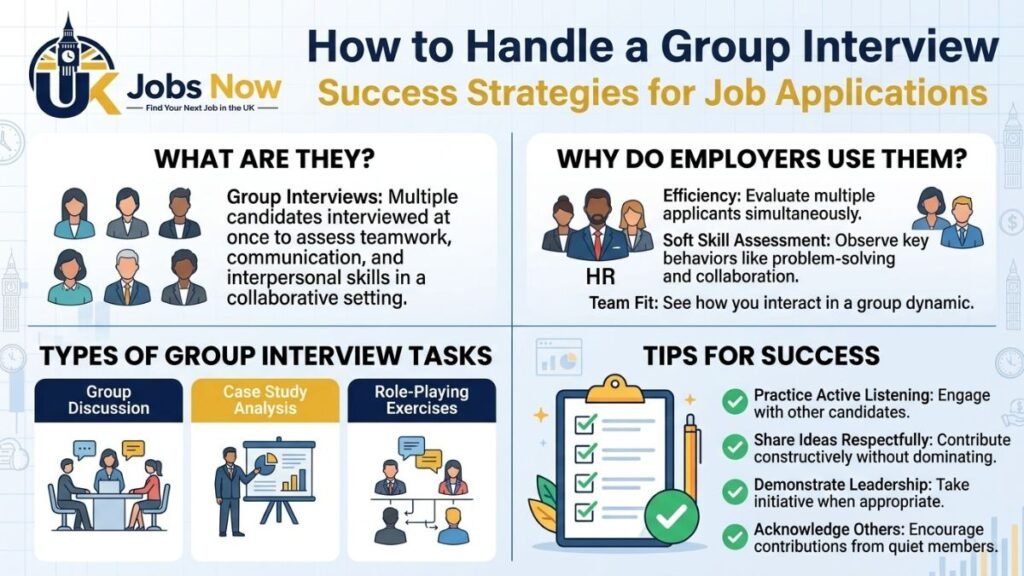
“Group interview” covers a couple of related but distinct formats, and it’s worth knowing which one you’re walking into. Some are genuinely a shared question-and-answer session, where multiple candidates are asked the same questions in turn and everyone hears everyone else’s answers. Others are closer to a group exercise — a task or discussion the whole group works through together while one or more assessors observe, with the interview element being secondary to the observed group dynamic. If you’re not sure which format to expect, it’s entirely reasonable to ask the recruiter beforehand, since the two require slightly different preparation.
Why employers use this format
Beyond simple time efficiency (screening several candidates at once), a group interview specifically reveals how you behave in a competitive, socially complex situation — something a one-to-one interview genuinely can’t show. Employers hiring for roles involving teamwork, client interaction, or collaborative problem-solving are often specifically interested in this dynamic: do you listen to others, do you build on what someone else has said, do you find space to contribute without dominating, and do you handle the natural awkwardness of a room full of people who are simultaneously your peers and your competition for the role.
The core mistake to avoid: treating it as a competition to talk the most
This is the single most common misjudgement in group interviews, and it usually backfires. Assessors watching a group interview are typically looking for collaborative, socially intelligent behaviour, not raw talkativeness — a candidate who dominates the conversation, interrupts others, or visibly competes for airtime often reads as a weaker team fit than one who contributes thoughtfully at the right moments and helps quieter candidates get a word in. If you find yourself in a group with one or two people trying to dominate, that’s actually an opportunity: politely creating space for others (“That’s an interesting point — [name], what’s your take on this?”) is exactly the kind of behaviour that tends to stand out positively, and it’s a low-risk move precisely because it’s not competing with anyone directly.
Practical strategies for standing out constructively
Aim for quality contributions, not maximum airtime
You don’t need to answer every single question first, or at the greatest length, to be remembered well. A smaller number of clear, specific, well-considered contributions generally lands better than trying to speak on every point — quality and relevance matter more than sheer volume of talking.
Actively listen and reference other candidates genuinely
Briefly acknowledging or building on something a previous candidate said (“Building on what [name] mentioned about…”) demonstrates that you’re actually listening and engaging with the group, not just waiting for your own turn to speak. This is a small habit that reads as noticeably more collaborative than simply launching into your own point as if the previous answer hadn’t happened.
Prepare examples that are concise enough for a shared format
In a one-to-one interview, you generally have more room to give a fully detailed STAR-structured answer. In a group format with limited time per person, it’s worth having a tighter, more concise version of your key examples ready, since a long answer in a group setting can eat into other candidates’ time and read as inconsiderate of the shared format, however strong the content.
Watch your body language even when you’re not speaking
Assessors in a group setting often observe the whole group continuously, not just whoever is currently talking. Visible disengagement — checking your phone, looking bored while someone else answers, obvious impatience — is noticed, even during moments that don’t feel like “your turn.”
Handling a genuinely difficult group dynamic
Occasionally a group interview includes a candidate who is genuinely disruptive, overly aggressive in competing for attention, or dismissive of others’ contributions. It’s worth resisting the urge to match that energy or call it out directly and confrontationally — a calm, professional response (continuing to contribute thoughtfully, briefly and politely redirecting attention to a quieter candidate) tends to reflect much better on you than getting visibly frustrated, even when the frustration is understandable.
A worked example of the difference in approach
| Situation | Weaker approach | Stronger approach |
|---|---|---|
| A question is asked to the whole group | Jumping in first and speaking at length to “claim” the question | Waiting a beat, then giving a focused, specific answer once you have something genuinely worth adding |
| Another candidate gives a similar answer to what you were planning to say | Repeating essentially the same point in different words | Briefly acknowledging the overlap and adding a genuinely different angle or example |
| A quieter candidate hasn’t spoken much | Ignoring this and continuing to focus on your own contributions | Creating a natural opening for them where appropriate, without being obvious or performative about it |
| You disagree with a point another candidate made | Directly contradicting them to look sharper by comparison | Respectfully offering an alternative perspective without framing it as “them being wrong” |
Preparing content the same way you would for any interview
The format changes how you deliver your answers, but not the underlying preparation — you still need genuine, specific examples ready, a clear understanding of the role and employer, and thoughtful questions to ask if given the opportunity. Our guide to common UK interview questions and the STAR method covers that core preparation in depth; this format simply requires condensing and pacing those same prepared answers differently for a shared setting.
What to do if you’re one of many candidates and feel you didn’t get much airtime
If the format genuinely limited your opportunity to contribute through no fault of your own — a dominant fellow candidate, an unbalanced facilitator, simple bad luck with question order — it’s reasonable to look for a natural closing moment (often when asked if you have any final points or questions) to briefly add something you didn’t get the chance to say earlier. This should be done naturally rather than as an obvious, forced attempt to cram in extra content, but a well-placed final contribution can meaningfully offset an earlier quieter stretch.
Group exercises specifically, as part of assessment centres
Group interviews sometimes appear as one component within a longer assessment centre day, alongside case studies, presentations, and individual interviews. If you’re facing a full assessment centre rather than a standalone group interview, our complete guide to UK assessment centres covers the wider format and how the different exercise types typically fit together across the day.
Frequently Asked Questions
Should I try to speak first in every round of a group interview?
No — speaking first isn’t inherently an advantage, and consistently rushing to answer first can read as competing for attention rather than genuinely engaging with the discussion. A smaller number of thoughtful, well-timed contributions generally lands better than maximum airtime.
What if another candidate gives almost the same answer I was planning?
Briefly acknowledge the overlap and add a genuinely different angle, detail, or example rather than repeating essentially the same point — this shows both that you were listening and that you have more than one way to demonstrate the same underlying strength.
Is it okay to disagree with another candidate during a group interview?
Yes, provided it’s done respectfully and framed as offering an alternative perspective rather than directly contradicting or undermining them — assessors are often watching how you handle disagreement constructively, which is itself a useful thing to demonstrate.
How is a group interview different from an assessment centre group exercise?
A group interview is typically a shared question-and-answer session; a group exercise (often part of a wider assessment centre) is usually a task or discussion the whole group works through together while being observed, with less direct focus on individual interview questions.
What should I do if I genuinely didn’t get much chance to speak?
Look for a natural closing opportunity, often when the group is asked for final thoughts or questions, to briefly add something relevant you didn’t get to say earlier — done naturally rather than as an obviously forced addition.