Bullying and Harassment at Work in the UK: Your Rights and What to Do
Being bullied or harassed at work can make every day feel unbearable. It can affect your health, your confidence and your income, and many people stay silent because they fear making things worse or are unsure what the law says. The law in the UK protects you from harassment linked to protected characteristics and gives you ways to challenge bullying, and from 30 October 2026 employers face tougher duties to prevent sexual harassment and to protect staff from harassment by customers and other third parties. This guide explains the difference between bullying and harassment, your rights, what your employer must do, and a step-by-step plan for what to do if it happens to you.
Quick answer: Harassment is unlawful under the Equality Act 2010 when unwanted conduct related to a protected characteristic (such as sex, race, disability or age) violates your dignity or creates an intimidating, hostile or offensive environment. Bullying is not defined in law, but it can still breach your employer’s duties and lead to grievance, constructive dismissal or other claims. From 30 October 2026, employers must take all reasonable steps to prevent sexual harassment and will be liable for harassment of staff by third parties such as customers unless they took all reasonable steps to prevent it.
If you are in immediate danger, call 999. If you are struggling emotionally, contact your GP, NHS 111, or Samaritans on 116 123 at any time. You are not alone, and it is not your fault.
What is the difference between bullying and harassment?
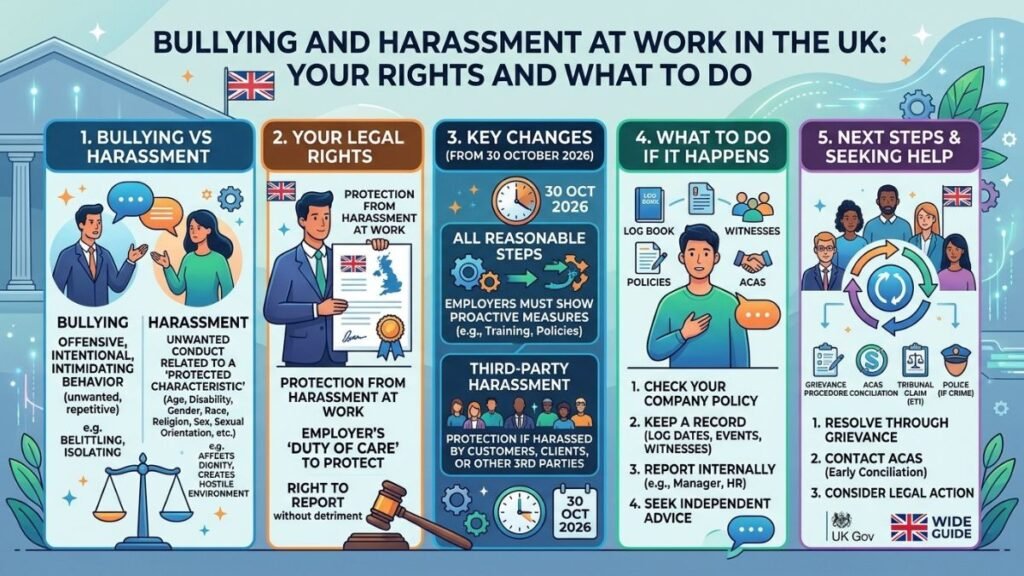
The terms are often used together, but they are not the same in law.
| Bullying | Harassment | |
|---|---|---|
| Legal definition | None in UK law. Acas describes it as offensive, intimidating, malicious or insulting behaviour, an abuse or misuse of power that undermines, humiliates or harms the person | Defined in the Equality Act 2010: unwanted conduct related to a protected characteristic, or of a sexual nature, that has the purpose or effect of violating your dignity or creating an intimidating, hostile, degrading, humiliating or offensive environment |
| Linked to a protected characteristic? | Not necessarily | Yes, or sexual in nature |
| Can you bring an Equality Act claim? | Not for bullying alone | Yes |
| Other routes | Grievance, health and safety duties, constructive dismissal, personal injury, the Protection from Harassment Act 1997 | Tribunal claim, grievance, and sometimes the criminal law |
Protected characteristics
The Equality Act protects you from harassment related to:
- Age
- Disability
- Gender reassignment
- Race (including colour, nationality, ethnic or national origin)
- Religion or belief
- Sex
- Sexual orientation
Sexual harassment is covered separately, whatever your sex. Pregnancy and maternity, and marriage and civil partnership, are protected from discrimination, though the harassment provisions work differently for them. Harassment related to one of these can also be victimisation if you are treated badly for complaining, or discrimination.
What does it look like?
Examples of bullying
- Constant criticism, shouting or humiliation in front of others
- Setting impossible targets or deadlines, or removing responsibilities without reason
- Being excluded, ignored or isolated
- Spreading rumours or gossip
- Unfair treatment, such as being denied training, leave or promotion
- Overbearing supervision or micromanagement used to undermine you
- Threats, intimidation or abusive messages
- Cyberbullying through email, messaging apps or social media
Examples of harassment
- Sexual harassment: unwanted comments, jokes, touching, requests for sexual favours, sharing sexual images or messages
- Racial harassment: racist language or “banter”, stereotypes, graffiti, exclusion based on ethnicity or nationality
- Disability harassment: mocking a condition, mimicking, refusing adjustments in a way that is demeaning
- Age harassment: comments about being too old or too young, repeated references to retirement
- Harassment related to religion, sexual orientation or gender identity: derogatory comments, outing someone, deliberate misgendering
- Harassment by customers, clients or contractors, such as abusive language, sexual comments or racist remarks
The test looks at the effect on you, your perception and whether it is reasonable for the conduct to have that effect. “It was just banter” is not a defence if it meets the legal test.
Other related behaviour
- Victimisation. Being treated badly because you complained or supported someone else’s complaint.
- Stalking and repeated conduct. Under the Protection from Harassment Act 1997, a course of conduct that causes alarm or distress can be a criminal offence and grounds for a civil claim, including online harassment.
- Violence and threats. Physical assault and credible threats are crimes and should be reported to the police.
- Whistleblowing retaliation. Being bullied for raising concerns. See below.
Who is protected?
- Employees and workers, including part-time, casual, zero-hours and agency workers, in most cases. See our guide to zero-hours contracts.
- Job applicants, against discrimination and harassment in recruitment.
- Apprentices and trainees. See our guide to apprenticeships in the UK.
- Young workers. See our guide to jobs for 16 and 17 year olds.
- Some contractors and self-employed people in some situations, and people on work placements.
The Equality Act protections apply from day one, whatever your length of service. Ordinary unfair dismissal needs qualifying service, but discrimination and harassment do not.
What the law requires of your employer
A general duty of care
Employers have a legal duty to keep staff safe, which includes protecting them from foreseeable psychological harm, as well as physical harm, and to deal properly with complaints. They also have an implied duty of trust and confidence, so a failure to deal with serious bullying can breach your contract.
The preventative duty on sexual harassment
- Since 26 October 2024, employers have had a legal duty to take reasonable steps to prevent sexual harassment of their employees in the course of their employment, including harassment by third parties.
- From 30 October 2026, the standard rises to all reasonable steps, which is a higher bar. The government can also set out in regulations what “reasonable steps” can include.
- Enforcement. The Equality and Human Rights Commission can take action, and tribunals can increase compensation by up to 25% where an employer fails to meet the duty in a successful harassment claim.
Third-party harassment
Harassment by customers, clients, patients, suppliers and other outsiders is a big issue in retail, hospitality, health, care and call centres.
- From 30 October 2026, employers will be liable if an employee is harassed by a third party in the course of their employment (for any of the harassment-related protected characteristics, and sexual harassment), unless the employer took all reasonable steps to prevent it.
- The change applies to harassment occurring on or after 30 October 2026.
- This reintroduces a form of protection that was removed in 2013, and makes it easier to hold an employer to account.
There is one pending point to watch. A law firm update from 23 October 2026 suggests that a separate part of the reforms is now expected in January 2027, so check GOV.UK for the position on each provision.
Employers should therefore have anti-harassment policies, risk assessments, training, clear reporting routes, protocols for dealing with abusive customers and support for staff who are targeted. See our guides to hospitality jobs, care worker jobs, supermarket jobs and call centre jobs, which are all sectors where customer abuse is a risk.
Whistleblowing and confidentiality
- Whistleblowing. If you raise concerns about harassment, you may be protected as a whistleblower. Recent changes mean that reports of sexual harassment are treated as protected disclosures, according to law firm summaries (from April 2026). You should not be dismissed or penalised for making a protected disclosure.
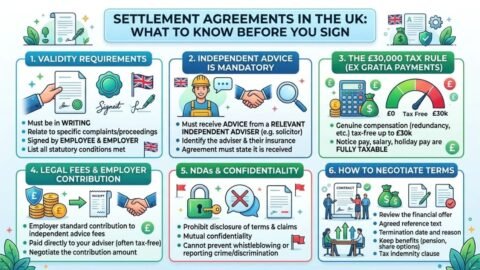
- Confidentiality agreements. The Employment Rights Act 2025 will make agreements void to the extent they stop a worker speaking about harassment or discrimination, with the main provisions expected in 2027. See our guide to settlement agreements in the UK.
What to do if you are being bullied or harassed: step by step
Step 1: Keep yourself safe and look after your wellbeing
- If you are in immediate danger, call 999.
- If it is affecting your health, see your GP. A fit note can allow time off, and you may be entitled to Statutory Sick Pay from day one. See our guide to Statutory Sick Pay 2026.
- Tell someone you trust, such as a friend, family member, colleague or union rep.
- If you are struggling emotionally, contact Samaritans on 116 123, or your employer’s employee assistance programme, if there is one.
Step 2: Keep a record
This is one of the most important things you can do. Write down:
- What happened, with dates, times and places
- Who was involved and who witnessed it
- What was said or done, using the exact words if you can
- How it affected you, including sleep, health and work
- What you did in response, including anyone you told
Keep copies of emails, messages, rotas, performance reviews and anything else relevant, and store them safely outside work systems, taking care not to breach confidentiality or data rules. Take advice before secretly recording conversations, because the rules about using covert recordings are complicated.
Step 3: Consider an informal approach
If you feel safe and the behaviour is not severe, you might:
- Tell the person that their behaviour is unwelcome and ask them to stop, clearly and calmly
- Speak to your manager or HR informally
- Ask for mediation, where an impartial person helps both sides talk
You do not have to try an informal approach first, especially for serious harassment, threats or if the person is your manager. Go straight to a formal complaint if you prefer.
Step 4: Make a formal complaint (a grievance)
Write to your employer under its grievance or anti-harassment policy, setting out what has happened, who was involved, the dates, how it has affected you and what outcome you want. Keep a copy. You have the right to be accompanied by a colleague or union representative at a grievance meeting. Your employer should investigate promptly and impartially, give you a written outcome and offer an appeal. See our guide to disciplinary and grievance procedures in the UK.
If the person you complain about is your manager or HR, ask who else you can go to, such as a more senior manager or a board member.
Step 5: Get advice and support
- Acas gives free, impartial advice on 0300 123 1100.
- A trade union can advise and support you if you are a member.
- Citizens Advice offers free help.
- The Equality Advisory and Support Service advises on discrimination and harassment.
- Protect advises on whistleblowing.
- Specialist support services exist for sexual violence, racial harassment, disability and LGBTQ+ issues, and your GP or local council can point you to them.
Step 6: Know your options if the complaint is not resolved
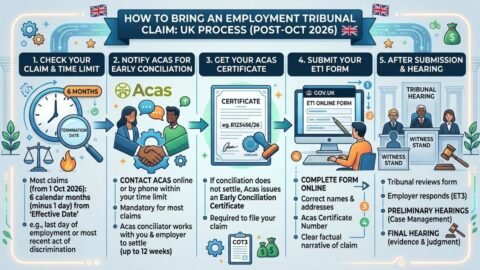
- An employment tribunal claim. You may be able to bring a claim for harassment, discrimination, victimisation, constructive dismissal or unfair dismissal. The time limit for most claims is six months less one day for events on or after 1 October 2026, and you must contact Acas for early conciliation first. Do not let an internal process delay your deadline. See our guide to how to bring an employment tribunal claim.
- A settlement. Some cases end with an agreed outcome. See our guide to settlement agreements in the UK.
- The police. If the behaviour involves assault, sexual offences, threats, stalking or hate crime, you can report it to the police (999 in an emergency, 101 otherwise).
- A civil claim. In some cases you can bring a claim under the Protection from Harassment Act 1997 or for personal injury, but take legal advice.
- Regulators. In some sectors a professional or regulatory body can investigate.
Step 7: Think carefully before you resign
Resigning can feel like the only way out, but it can affect your pay, benefits and legal rights. If you feel you have to leave, take advice first. In serious cases you might be able to claim constructive dismissal, which means you resigned because of a serious breach of your contract, but these cases are hard to prove and you need to act promptly. See our guide to unfair dismissal in the UK. Whatever you decide, the Equality Act protections apply regardless of your length of service.
What should your employer do when you complain?
A good employer will:
- Take every complaint seriously and deal with it promptly
- Investigate impartially, with a trained investigator who is not involved
- Protect you from further harm, for example by changing reporting lines or working arrangements, without penalising you
- Keep information confidential as far as possible
- Tell you the outcome, and any action taken, so far as it is allowed
- Take appropriate disciplinary action where complaints are upheld
- Offer support, such as counselling and mediation
- Prevent retaliation. Victimising someone for complaining is unlawful
If your employer fails to act, document it, and consider the options above.
Special situations
Bullying and harassment by a manager
This is common and particularly stressful. Use the grievance process, ask who else can investigate, and take advice from Acas or your union. Managers have a particular duty not to abuse their authority.
Harassment by customers, patients or the public
Tell your manager each time, make sure it is recorded and ask what protections are in place. From 30 October 2026 your employer must take all reasonable steps to prevent harassment by third parties. Employers should have clear procedures, such as removing abusive customers, support for staff and safe working practices.
Sexual harassment
Sexual harassment is never acceptable, and you can report it to your employer, the police and specialist services. Your employer has a preventative duty. You can raise a grievance, bring a tribunal claim and report to the police if it is a crime.
Disabled workers
Harassment related to disability, or failure to make reasonable adjustments in a demeaning way, is unlawful. See our guide to disability and work in the UK.
Pregnancy and family leave
Treating you badly because of pregnancy, maternity or family leave is discrimination. See our guides to maternity, paternity and shared parental leave and pay and flexible working in the UK.
Older workers
Age harassment, such as repeated comments about retirement or being past it, is unlawful. See our guide to jobs for over 50s and returners in the UK.
Young people, apprentices and students
You have the same rights, and employers have extra responsibilities for under-18s. Tell a trusted adult, your training provider, your school or college or your union. See our guides to jobs for 16 and 17 year olds and part-time jobs for students in the UK.
Online and remote harassment
Harassment through email, messaging apps, video calls and social media is treated the same as in person. Keep screenshots and report it, including to the platform. See our guide to work from home jobs in the UK for remote work issues.
Casual, agency and zero-hours workers
You are protected from harassment and discrimination, and your agency and the end client may both have duties. Report it to both. Fear of losing shifts is real, and victimisation is unlawful, so keep records and take advice.
How bullying and harassment can affect your pay and benefits
- Sick leave. If you are off work because of stress or anxiety linked to bullying, you may qualify for Statutory Sick Pay. See our guide to Statutory Sick Pay 2026.
- Lost earnings. If you leave or lose your job, you may be able to claim compensation for lost pay in a successful claim, and you must try to find new work. See our UK jobs board.
- Benefits. If your income falls, you may be able to claim support. See our guide to Universal Credit and work.
- Your contract and notice. Check your rights. See our guides to understanding your employment contract and notice periods in the UK.
Moving on: finding a better workplace
If you decide to leave, you can look for employers with a good culture. Check how they handle diversity, flexibility and complaints, and ask about it at interview. See our guides to common interview questions and answers in the UK, writing a UK CV with no experience (the layout tips work for any CV) and writing a cover letter in the UK. Be honest but brief if asked why you left, and focus on what you are looking for next. Employers cannot lawfully treat you worse for having raised a complaint, and many value workers who stand up for good standards.
Scams and traps to avoid
People who have been through a difficult time can be targeted. Watch for:
- “Claim your compensation” firms that cold-call or advertise, promise guaranteed payouts or ask for upfront fees. Check any firm on the Solicitors Regulation Authority register.
- Fake job offers to people who have left a job suddenly. See our guide to how to spot a fake job advert in the UK.
- Anyone asking for a fee to submit a tribunal claim, which is free.
- Pressure to sign an agreement without advice. See our guide to settlement agreements in the UK.
Frequently asked questions
Is workplace bullying illegal in the UK? There is no specific law against bullying, but it can breach your employer’s duty of care and contract, and can amount to harassment, discrimination or a criminal offence in some cases.
What counts as harassment at work? Unwanted conduct related to a protected characteristic, or of a sexual nature, that violates your dignity or creates an intimidating, hostile, degrading, humiliating or offensive environment.
What is changing on 30 October 2026? Employers must take all reasonable steps, rather than reasonable steps, to prevent sexual harassment, and become liable for harassment of employees by third parties unless they took all reasonable steps to prevent it.
Can I bring a tribunal claim for bullying? Not for bullying alone, unless it relates to a protected characteristic or amounts to constructive dismissal or another claim. Take advice from Acas.
How long do I have to make a claim? For most claims, six months less one day for events on or after 1 October 2026, after contacting Acas for early conciliation.
Do I need to have worked somewhere for a certain time to claim harassment? No. Harassment and discrimination protections apply from day one.
Should I resign if I am being bullied? Take advice first. Resigning can affect your rights and your pay.
Can my employer dismiss me for complaining? It is unlawful to treat you badly because you made a complaint of harassment or discrimination. That would be victimisation.
Where can I get help? Acas on 0300 123 1100, your trade union, Citizens Advice, the Equality Advisory and Support Service, Protect and your GP. If you are in danger, call 999.
Final thoughts
No one should have to put up with bullying or harassment at work. Keep a record, use your grievance procedure, get advice early and look after your wellbeing. The law is moving in the right direction, with stronger duties on employers from 30 October 2026. When you are ready for your next role, browse the latest vacancies on our jobs board.
This article is general information, not legal advice. Employment law is complex, and the harassment rules are changing. Contact Acas, Citizens Advice, a trade union or a qualified employment solicitor, and check GOV.UK for the latest guidance. If you are in danger, call 999.