How to Write a Cover Letter in the UK (With Examples)
A good cover letter can be the difference between your CV being read and being skipped. It is your chance to explain, in your own words, why you want this job and why you would be good at it. Many people find cover letters harder than CVs, especially if they have little experience. This guide shows you how a UK cover letter works, how to lay it out, what to say, and gives you four examples you can adapt.
Quick answer: A UK cover letter is a one-page letter (about 250 to 400 words) sent with your CV. Open with the job you are applying for, show how your skills match the advert, explain why you want to work for that employer, and finish with a polite call to action. Use “Yours sincerely” if you know the person’s name and “Yours faithfully” if you do not.
Do you really need a cover letter?
Not every job asks for one. Many large retailers and employers use online application forms with a section for a supporting statement instead. But a cover letter is worth writing when:
- The advert asks for one, or says “apply with CV and covering letter”
- You are applying by email, directly to a small employer or through an agency
- You have limited experience, a career gap or are changing career, and want to explain it
- The job is competitive, and you want to stand out
If the advert says no cover letter is needed, you can leave it out, or add a very short covering email. When in doubt, send one. A short, tailored letter rarely hurts.
What a UK cover letter should achieve
A cover letter has four jobs:
- Show the job you want and where you saw it
- Link your skills and experience to the job, using the advert as your guide
- Show you know the employer and care about this particular job
- Make the reader want to read your CV and invite you to interview
It should add to your CV, not repeat it. Pick two or three key points and give them a little more detail.
How long should it be?
- One page of A4 at most
- About 250 to 400 words, in three to five short paragraphs
- Short and clear. Recruiters often read dozens of applications, so every sentence should earn its place
For an email application, the letter can be the body of the email, and it can be even shorter (150 to 250 words).
The layout of a UK cover letter
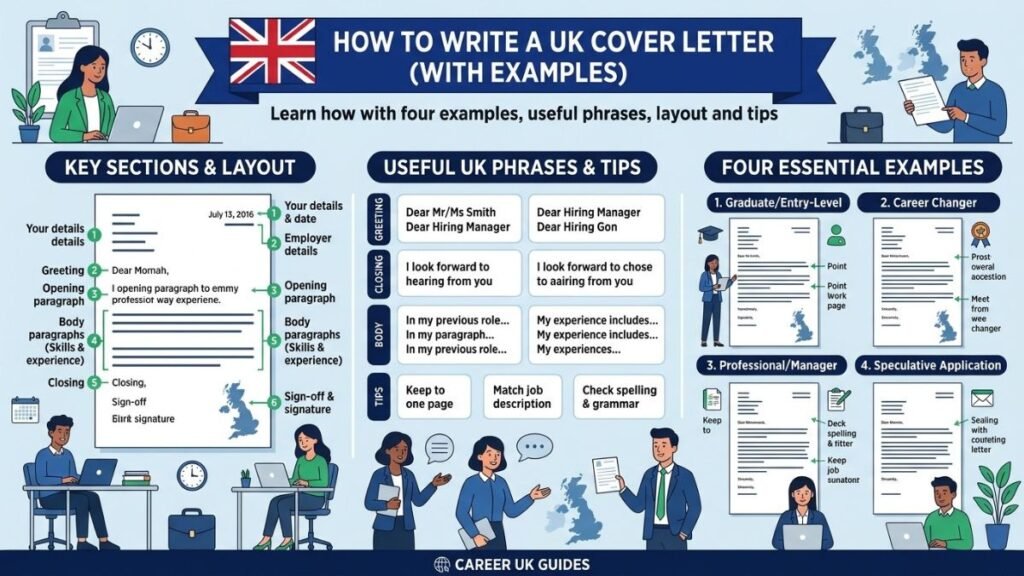
Use a clean, simple layout and the same font as your CV (such as Arial or Calibri, size 10 to 12).
1. Your details
Put your name, town or city and postcode area, phone number and email address at the top. You do not need your full address. If you are sending the letter as an email, your contact details go at the bottom, under your name.
2. The date and the employer’s details
Add the date. If you know the employer’s name and address, you can include them, though many modern letters leave this out.
3. The greeting
- Use a name if you can. “Dear Ms Patel” or “Dear Mr Jones”. Check the advert, the company’s website or LinkedIn, or phone to ask who is recruiting. If you are unsure of the title, you can write the full name, such as “Dear Alex Morgan”.
- If you cannot find a name, use “Dear Hiring Manager” or “Dear Recruitment Team”. “Dear Sir or Madam” is traditional but old-fashioned.
4. A subject line
A short line such as “Application for Customer Assistant, ref 12345” helps the reader see at once what the letter is about, especially in an email.
5. The body: four short paragraphs
Paragraph 1: The opening. Say which job you are applying for, where you saw it, and give a one-sentence summary of why you are suitable.
Paragraph 2: Your skills and experience. Pick two or three requirements from the advert and show, with a brief example, that you meet them.
Paragraph 3: Why this employer. Explain what attracts you to the company and the role, with something specific (for example, a service, a value, a product or their reputation). This is where you show you have done your research.
Paragraph 4: The close. Say you have attached your CV, mention your availability for interview, thank the reader and say you look forward to hearing from them.
6. The sign-off
- “Yours sincerely” if you began with a name (“Dear Ms Patel”)
- “Yours faithfully” if you began with “Dear Sir or Madam” or “Dear Hiring Manager”
- Many people now use “Kind regards” or “Best wishes”, which are widely accepted, especially in emails
Then type your full name.
Step-by-step: how to write yours
- Read the advert carefully. Highlight the key skills, duties and personal qualities. Use some of the same words.
- Research the employer. Look at their website, values, products and recent news. If you can, visit the shop or site.
- Choose two or three strongest examples. Match them to the requirements. Use real examples from work, volunteering, study or life.
- Draft the opening first. Name the job, then say why you are a good fit.
- Show results. Numbers and outcomes help, such as “served around 50 customers a shift” or “raised £250 for charity”.
- Show enthusiasm. Say why you want this job and this employer, not any job.
- Edit hard. Cut waffle, check spelling, and read it aloud.
- Save as a PDF (unless the employer asks for Word) and name it clearly, for example “Sam-Taylor-Cover-Letter.pdf”.
If you do not yet have a CV, see our guide to writing a UK CV with no experience first.
Example 1: First job, no experience (retail)
Sam Taylor Leeds, LS6 | 07xxx xxxxxx | sam.taylor@email.com
25 October 2026
Dear Hiring Manager,
Application for Customer Assistant (Christmas), Leeds city centre store
I am writing to apply for the Customer Assistant position advertised on your careers website. I am a friendly and reliable college student with strong communication skills, and I would welcome the chance to help your customers during your busiest season.
Although this would be my first paid job, I have built relevant skills through volunteering. For the past eight months I have worked Saturday mornings at a local charity shop, where I greet customers, operate the till and keep the shop floor tidy. I am confident with cash and card payments, and I enjoy helping people find what they need. As vice-captain of my football team, I have also learned to work well with others and stay positive under pressure.
I am applying to your store because I have shopped there for years and have always been impressed by how helpful and welcoming the staff are. I would love to be part of that team and to learn from experienced colleagues.
I am available evenings, weekends and during the Christmas holidays, including the busy days in the week before Christmas. I have attached my CV, and I would be delighted to discuss my application at an interview.
Thank you for considering my application.
Yours faithfully,
Sam Taylor
Why it works: It is honest about having no paid experience, uses volunteering and sport as evidence, shows availability and keeps to one page.
Example 2: Some experience, applying for a step up (team leader)
Priya Shah Birmingham, B15 | 07xxx xxxxxx | priya.shah@email.com
25 October 2026
Dear Mr Evans,
Application for Team Leader, Food Department (ref TL-2210)
I would like to apply for the Team Leader role in your Food Department. I have spent three years as a customer assistant in a busy supermarket and have recently been asked to cover supervisory shifts, so I am ready to take the next step into leadership.
In my current role I serve up to 100 customers a day, help to train new starters and keep the chilled and fresh sections stocked and in date. Over the last six months I have covered for my team leader on 20 shifts, allocating tasks, handling queries and handing over to the evening team. Our section was rated best in the store in the last standards audit, which I attribute to good teamwork and attention to detail.
I am drawn to your company because of its commitment to developing colleagues, and I would be keen to take part in the management training programme mentioned in the advert. I enjoy motivating people and would bring energy, reliability and a customer-first approach to the team.
My CV is attached. I am free to attend an interview at any time and would be happy to talk through my experience in more detail.
Yours sincerely,
Priya Shah
Why it works: It uses specific numbers and examples, connects to the advert (the training programme), and shows a clear step up from the current role.
Example 3: Changing career (into warehouse or logistics)
Tom Brooks Doncaster, DN4 | 07xxx xxxxxx | tom.brooks@email.com
25 October 2026
Dear Ms Clarke,
Application for Warehouse Operative (night shift)
I am writing to apply for the Warehouse Operative post at your Doncaster distribution centre. After six years in hospitality, I am looking for a role where I can use my stamina, teamwork and attention to detail in a warehouse environment, and I am keen to learn the skills your role requires.
Working in busy restaurants has taught me to stay organised during long, fast-paced shifts. I regularly worked evenings and weekends, was never late to a shift in the last two years, and trained new staff on stock handling and food safety. I am used to manual handling, lifting and working to deadlines, and I take care to keep work areas safe and tidy. I have also completed a manual handling course and am happy to train for a forklift ticket.
I am particularly interested in your company because of its focus on safety and its progression routes for operatives. I hope to build a long-term career in logistics.
I am available to work nights and can start at short notice. I have attached my CV, and I would welcome the chance to discuss the role.
Yours sincerely,
Tom Brooks
Why it works: It explains the change, translates old skills (stamina, reliability, manual handling) into new ones and shows willingness to train. See our guide to warehouse jobs in the UK for what employers look for.
Example 4: Short email cover letter
Subject: Application for Cleaner (part time), reference CL-045, Jane Okafor
Dear Hiring Team,
I would like to apply for the part-time Cleaner vacancy advertised on your website. I am a reliable, hard-working person with two years’ experience cleaning offices and private homes, and I take pride in leaving spaces spotless.
In my current role I clean six properties a week, follow health and safety instructions and use cleaning chemicals safely. My employer has always said I am punctual and trustworthy, and I am happy to provide references. I can work early mornings or evenings, and I have my own transport.
I have attached my CV and would be glad to meet you to talk about the role. Thank you for your time.
Kind regards, Jane Okafor 07xxx xxxxxx | jane.okafor@email.com | Manchester, M14
Why it works: It is short, direct and focuses on what matters for the job: reliability, safe working, availability. See our guide to cleaning jobs in the UK for more.
Useful phrases for each part
Opening
- “I am writing to apply for the position of [job title], advertised on [website].”
- “I was excited to see your vacancy for [job title], and I believe my experience in [area] makes me a strong candidate.”
Skills and experience
- “In my current role, I [did something] which resulted in [outcome].”
- “I have developed strong [skill] through [activity].”
Why this employer
- “I am particularly attracted to [company] because of [specific reason].”
- “I admire your commitment to [value, service or product].”
Closing
- “I have attached my CV and would welcome the opportunity to discuss my application.”
- “Thank you for considering my application. I look forward to hearing from you.”
Cover letter mistakes to avoid
- Copying a template word for word. Employers can tell, so use examples as a guide only.
- Repeating your CV. Add detail and personality instead.
- Being generic. If your letter could apply to any job, it is not working. Mention the job and the employer by name.
- Writing too much. Keep to one page.
- Spelling and grammar errors, including the wrong company or job title. Check names twice.
- Being negative, such as criticising a previous employer.
- Making things up. Be honest about your experience.
- Focusing on what you want (“I want to gain experience”) instead of what you can offer.
- Forgetting to attach your CV or sending a letter that is not saved properly.
A note on AI tools
Many applicants use AI tools to draft letters. They can help with structure, but generic AI text is easy to spot and often reads as bland. If you use one, give it your real examples, edit the result heavily so it sounds like you, and check every fact. Employers want to hear your voice.
Special situations
Career gaps. You do not need to apologise. A brief, positive sentence is enough, such as “After a break to care for a family member, I am keen to return to work.”
Disability or health conditions. You do not have to mention these. You can raise adjustments later, in a way that suits you.
Criminal record. Not normally mentioned in a cover letter. Some employers ask at a later stage.
Right to work. If it is relevant and true, you can add a line such as “I have the right to work in the UK.” See our guide to right to work checks in the UK.
Speculative applications. If you are writing to a company that has not advertised a job, say what you are looking for, why you are interested in the company and how you could help. Ask who to contact if you do not have a name.
After you send your letter
- Keep a copy of each letter and note the job reference.
- Prepare for interview. Read our guide to customer assistant interview questions and answers, and our guides to M&S jobs and supermarket jobs if you are applying to retailers.
- Follow up politely if you have not heard back after the date given, or after about a week or two.
- Keep applying. Browse the latest vacancies on our UK jobs board.
- Stay safe. Apply through official employer websites, and never pay to apply. Read our guide to how to spot a fake job advert in the UK.
Frequently asked questions
How long should a cover letter be in the UK? One page, usually 250 to 400 words.
Should I write “Yours sincerely” or “Yours faithfully”? Use “Yours sincerely” if you begin with a name, and “Yours faithfully” if you begin with “Dear Sir or Madam” or a general greeting. “Kind regards” is also widely accepted.
Do I need a cover letter if I am applying through an online form? Often there is a supporting statement box instead. Use the same ideas, and follow any word limit.
What if I have no experience? Use volunteering, school, college, sport, family responsibilities and personal qualities as evidence, and be honest about it.
Should I put my address and the date on the letter? Include the date and your contact details. A town or city and postcode area is enough instead of a full address.
Can I use the same letter for every job? No. Tailor each letter to the job and the employer, even if you reuse some sentences.
Should I send it as a PDF or in the email body? If you are emailing an employer directly, you can use the email body as the letter or attach a PDF. If the employer gives instructions, follow them.
Final thoughts
A cover letter does not have to be perfect, but it should be specific, positive and easy to read. Match your skills to the job, show you know the employer and keep it to one page. Then browse the latest vacancies on our jobs board and send your first tailored application today.
This article is general guidance. Employers have different preferences, so always follow the instructions in the job advert.