Breaking Into Sales: What Employers Actually Look For
Sales has an image problem that doesn’t match the reality of how the best salespeople actually operate — pushy, aggressive, willing to say anything to close a deal. Genuinely successful, sustainable sales careers are built on something closer to the opposite: understanding a customer’s actual needs well enough to know honestly whether your product solves them, and building enough trust that a customer wants to work with you again. This is a practical look at what employers actually look for in entry-level sales candidates, and how to build a credible case without prior sales experience.
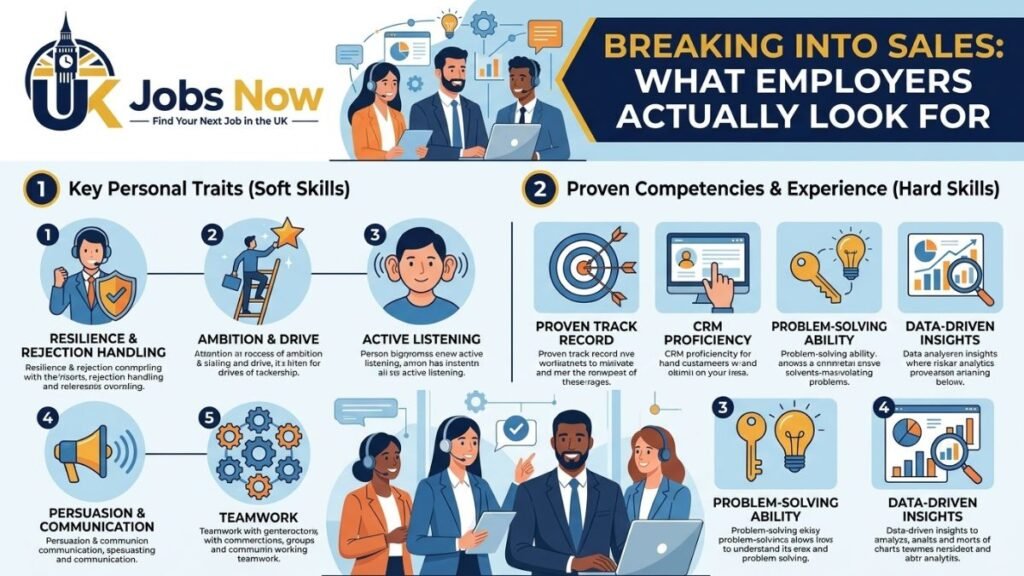
What genuinely predicts success in sales, according to what employers screen for
Sales hiring, done well, isn’t primarily testing for extroversion or natural charm — it’s testing for a more specific set of skills that don’t require prior sales job titles to demonstrate.
Resilience and a healthy relationship with rejection
Sales involves a genuinely high rate of “no” as a normal, expected part of the work, and the ability to stay motivated and professional through repeated rejection, without it affecting your energy or approach with the next prospect, is one of the most consistently valued traits in sales hiring. This is worth demonstrating through a genuine example from any context — not necessarily sales-specific — where you persisted productively through repeated setbacks.
Genuine curiosity and listening ability
Contrary to the pushy stereotype, strong salespeople typically ask more questions than they make statements, particularly early in a sales conversation — understanding what a prospect actually needs before presenting a solution. Demonstrating genuine, structured curiosity (in an interview, asking thoughtful questions about the role and company, rather than only talking about yourself) is itself a small, live demonstration of this skill.
Comfort with structured process and targets
Most sales roles operate within a structured process — a defined sales pipeline, specific activity or outcome targets, regular performance tracking. Comfort operating within this kind of structured, measurable environment, rather than needing purely unstructured or open-ended work, is a genuine and relevant thing to demonstrate, particularly if you have any experience meeting targets or working within a measured, structured process in any previous role.
Clear, persuasive communication without being pushy
The ability to explain a benefit clearly and make a genuine case for it, while reading and respecting a prospect’s actual level of interest rather than pushing regardless, is a skill distinct from simple confidence or charisma — it’s closer to structured, empathetic communication, and it’s demonstrable through examples from customer service, negotiation, or any context where you’ve had to make a case for something to someone else.
Entry routes into sales without prior sales experience
| Background | How it connects to sales |
|---|---|
| Customer service | Direct experience handling customer needs, objections, and communication — a very common and credible lateral move |
| Retail or hospitality | Direct customer interaction and, often, informal upselling or product recommendation experience |
| Any role involving targets or KPIs | Demonstrates comfort with structured, measured performance expectations |
| Graduate schemes with sales-specific tracks | A structured, formally supported entry route with no prior sales experience required |
Different types of sales role, and why the distinction matters
“Sales” covers genuinely different day-to-day work depending on the specific type of role, and it’s worth understanding this before assuming all sales jobs are similar: business-to-business (B2B) sales, often involving longer sales cycles and more relationship-focused, consultative selling; business-to-consumer (B2C) sales, often faster-paced and more transactional; inside sales (conducted remotely, by phone or video, rather than in person); and field sales (involving in-person client visits). Each rewards a somewhat different working style, and it’s worth being honest with yourself about which format genuinely suits you rather than assuming they’re interchangeable.
How sales compensation typically works
Sales roles commonly combine a base salary with commission or bonus tied to performance, meaning realistic total earning potential can differ substantially from the base salary figure alone. It’s worth understanding a specific role’s compensation structure in detail before accepting — the split between guaranteed base and performance-based earnings, how commission is calculated and paid, and what a realistic, typical total earning figure looks like for someone performing reasonably well in the role, not just the theoretical maximum used in recruitment marketing.
Preparing for a sales interview specifically
Sales interviews sometimes include a specific practical element — a role-play exercise, or being asked to “sell” a specific object or the interviewer’s own product back to them. This is a genuine, common format worth preparing for directly: practising a structured approach (asking genuine questions to understand needs before presenting a solution, rather than launching straight into a pitch) tends to perform better than a purely confident, unstructured pitch. Our broader guide to common UK interview questions and the STAR method remains relevant for the standard competency-based portion of a sales interview alongside any role-play element.
Building a CV for an entry-level sales application
If you’re moving into sales from customer service, retail, or another adjacent field, it’s worth explicitly reframing relevant experience using sales-relevant language — instances of persuading, negotiating, understanding customer needs, or working toward a measurable target, even if your previous job title wasn’t formally “sales.” Our guide to writing a UK CV covers this kind of results-focused reframing in more general depth.
Getting started
Entry-level and graduate sales roles are widely advertised, and many employers specifically design structured onboarding and training programmes for candidates without prior sales experience, recognising that the core skills above can be taught and developed on the job. You can browse current active UK job listings filtered by the sales category to see current openings.
Understanding sales team structures
Larger sales organisations often split roles across the sales process — sales development representatives (SDRs) focused specifically on prospecting and qualifying initial leads, account executives who take qualified leads through to a closed deal, and account managers who maintain and grow relationships with existing customers after the initial sale. This structure means an entry-level sales career often starts in a more specialised, narrower part of the process (commonly SDR roles) before progressing toward a full-cycle sales role — understanding this structure helps set realistic expectations about what a first sales role will actually involve day to day, rather than assuming it means managing a full deal from prospecting through to close immediately.
Sales career progression beyond an individual contributor role
Progression within sales commonly follows one of two broad paths: continuing as an individual contributor at increasing seniority and deal complexity (often the higher-earning path for genuinely strong performers, given commission structures), or moving into sales management, leading and coaching a team of salespeople rather than carrying an individual target yourself. Neither path is inherently superior — it’s worth being honest with yourself about whether you’re more motivated by direct, individual sales performance or by developing and leading others, since strong individual sales performance doesn’t automatically translate into strong sales management ability.
Industry-specific sales roles worth knowing about
Sales within specific, more technical or specialised industries — software (often called SaaS sales), pharmaceuticals, or business services, for instance — typically require a genuine, deeper understanding of the specific product or industry alongside core sales skills, and can offer meaningfully higher earning potential than general consumer sales once you’ve developed that specific expertise. If you have relevant background knowledge or genuine interest in a specific industry, moving into sales within that specific sector, rather than general sales broadly, can be a genuinely strong strategic choice worth considering explicitly.
Frequently Asked Questions
Do I need to be naturally extroverted to succeed in sales?
Not necessarily — genuine curiosity, structured listening, and resilience through rejection matter more consistently than raw extroversion, and plenty of successful salespeople describe themselves as more reserved or introverted than the stereotype suggests.
What’s the easiest way to move into sales without prior sales experience?
A lateral move from customer service, retail, or hospitality is a common and credible path, since these roles already involve direct customer interaction and, often, informal persuasion or recommendation experience that transfers well.
How does sales pay typically work?
Most sales roles combine a base salary with commission or bonus tied to performance — it’s worth understanding the specific structure and a realistic, typical total earning figure for a role, not just the theoretical maximum, before accepting an offer.
What should I expect in a sales job interview?
Alongside standard competency-based questions, many sales interviews include a practical role-play or “sell me this” exercise — practising a structured, question-led approach tends to perform better than an unstructured, purely confident pitch.
Is B2B or B2C sales better for someone starting out?
Neither is inherently better — they involve genuinely different working styles (B2B often more relationship-focused with longer sales cycles, B2C often faster-paced and more transactional), and the right starting point depends on which format genuinely suits your own working style.