How to Start a Career in Marketing With No Experience
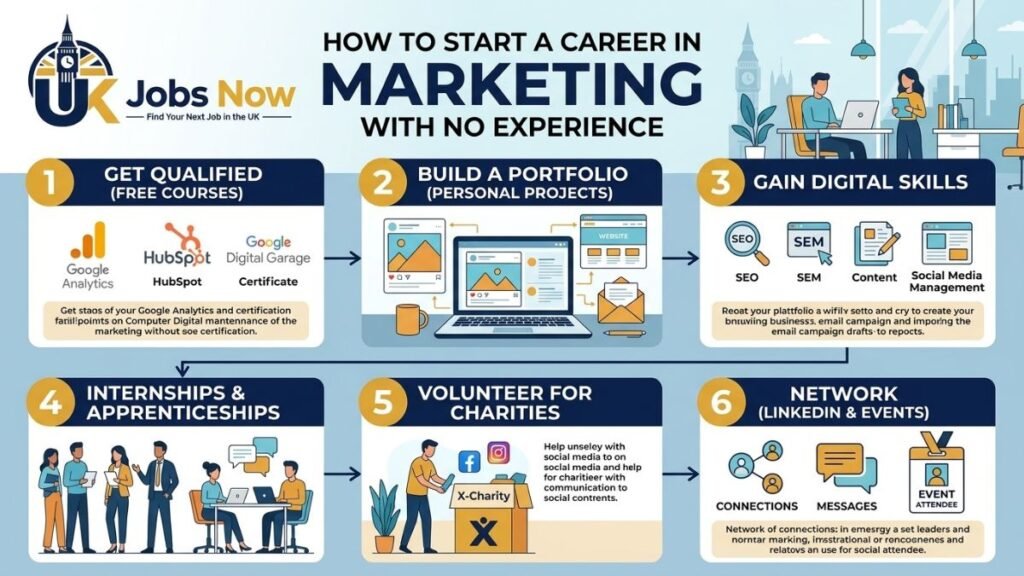
Marketing attracts a lot of interest precisely because it looks creative and varied from the outside, which also means entry-level roles are genuinely competitive. The good news is that marketing is a broad enough field, with distinct enough specialisms, that there’s more than one credible way in — and demonstrable, self-directed work often counts for as much as a marketing degree, provided you build it deliberately rather than hoping general enthusiasm will be enough.
Understanding how broad “marketing” actually is
Before targeting entry-level roles, it’s worth understanding that marketing splits into genuinely distinct specialisms with different day-to-day work and different entry paths: content and copywriting, social media management, paid advertising and performance marketing, SEO and organic search, email marketing, brand and creative, events and partnerships, and marketing analytics and data. Trying to present yourself as generally interested in “marketing” without a clearer sense of which specific area appeals to you tends to read as less credible than showing focused, demonstrable interest in one or two specific areas.
Entry routes that don’t require a marketing degree
Building a genuine portfolio through real, self-directed work
This is arguably the single most effective non-degree route into marketing, and it’s genuinely achievable without paid experience: running a real social media account (your own, a local business’s, a hobby project) and tracking its genuine growth, writing and publishing content on a specific topic, or running a small, real paid advertising campaign with your own modest budget to learn the mechanics directly. Employers hiring for entry-level marketing roles are often more interested in evidence you’ve actually done something real, even at small scale, than in a marketing qualification with no practical output behind it.
Apprenticeships
Marketing apprenticeships combine paid, structured work experience with formal study toward a recognised qualification, and are increasingly offered across companies of varying sizes, not just large corporate marketing departments — a genuinely strong route for learning while earning rather than studying full-time with no income.
Internships, including short or informal ones
A structured internship, even a short one, provides genuine, verifiable professional marketing experience that materially strengthens a subsequent application for a permanent entry-level role, and many marketing internships convert into permanent roles directly if you perform well.
Lateral moves from an adjacent role
Roles involving writing, customer communication, events coordination, or data analysis in a non-marketing context often carry genuinely transferable skills, and a lateral move into a marketing-adjacent or entry-level marketing role from one of these positions is a common, credible path, particularly within a company where you can move internally rather than needing to convince an entirely new employer from scratch.
What a strong entry-level marketing portfolio looks like
| Marketing specialism | Portfolio evidence worth building |
|---|---|
| Content/copywriting | A small, genuine collection of published writing samples, ideally on a real platform, not just unpublished drafts |
| Social media | A real account you’ve genuinely grown or managed, with honest data on engagement or follower growth over time |
| Paid advertising/performance | A small, real campaign you’ve run yourself, even with a modest personal budget, with genuine results to discuss |
| SEO | A genuine understanding demonstrated through your own website or blog, showing real search visibility improvements over time |
| Analytics | Comfort with a common analytics tool, demonstrated through a genuine project analysing real data, even your own |
Addressing limited formal experience in an application
If you’re applying with a self-built portfolio rather than formal marketing job titles, it’s worth structuring your CV and cover letter to foreground this work explicitly and specifically, rather than burying it under an unrelated employment history or presenting it apologetically. Framing a genuine self-directed project with the same specific, results-focused language you’d use for a formal role — what you did, what happened as a result — carries real weight, even at a small scale. Our guide to writing a CV with limited experience covers this kind of reframing in more general depth.
Marketing analytics and data as a growing entry point
As marketing has become increasingly data-driven, analytical ability has become a genuinely valuable differentiator for entry-level candidates, particularly those coming from a more numerate or technical background rather than a purely creative one. If you have relevant data or analytical experience from any context, it’s worth positioning this explicitly as a marketing-relevant strength — comfort interpreting data and drawing practical conclusions from it is increasingly as valued in marketing hiring as creative or writing skill, and it’s a differentiator fewer entry-level candidates bring convincingly.
Realistic expectations about entry-level marketing roles
It’s worth being honest that entry-level marketing roles are genuinely competitive, given the sector’s broad appeal, and starting salaries at true entry level can be modest relative to the eventual earning potential further into a marketing career. Building a specific, demonstrable portfolio and being genuinely focused about which specialism you’re targeting — rather than applying broadly to “marketing” roles with a generic application — meaningfully improves your competitiveness relative to other entry-level candidates who haven’t done this preparatory work.
Networking within the marketing community
Marketing has an active, accessible professional community, both online and through industry events, and genuine engagement with this community — commenting thoughtfully on industry discussion, following and learning from practitioners in your specific area of interest — can meaningfully support a job search beyond formal applications alone. Our guide to using LinkedIn effectively is particularly relevant for marketing specifically, since the sector has an unusually active professional presence on the platform.
Getting started
Once you’ve identified a specific specialism and started building even a small, genuine portfolio, it’s worth applying to entry-level roles actively rather than waiting to feel fully prepared. You can browse current active UK job listings filtered by the marketing category to see current entry-level and junior openings.
In-house marketing versus agency work
It’s worth understanding a genuine, meaningful distinction early in your search: in-house marketing roles sit within a single company, working exclusively on that company’s own brand and products, while agency roles work across multiple clients simultaneously, often with greater variety but also faster pace and more frequent context-switching between different brands and briefs. Neither is inherently better as a starting point — agency work often provides broader, faster exposure to different marketing challenges and specialisms early in a career, while in-house roles allow for deeper, more sustained ownership of a single brand’s strategy over time. It’s worth trying to understand which environment genuinely suits you, since the two involve a meaningfully different day-to-day working rhythm.
Interview preparation specific to marketing roles
Marketing interviews, particularly for roles emphasising creative or strategic thinking, sometimes include a practical task — reviewing a real or hypothetical campaign and offering your own critique or ideas, for instance. Preparing a few genuine, considered opinions about campaigns or marketing approaches you’ve noticed and found effective (or ineffective) in your own life, and being ready to explain your reasoning clearly, tends to perform better than generic praise or criticism without specific reasoning behind it.
How marketing salaries typically progress
Entry-level marketing pay is often relatively modest compared to some other professional fields, but progression through the specialism-based career ladder — from executive through to manager, senior manager, and eventually director-level roles — tends to bring meaningful pay growth over time, particularly for candidates who develop genuine, provable expertise in a specific, in-demand specialism like performance marketing or data-driven strategy. It’s worth researching typical progression timelines and pay bands specific to your chosen specialism, since these vary meaningfully between different areas of marketing.
Frequently Asked Questions
Do I need a marketing degree to get an entry-level marketing job?
No — a genuine, self-built portfolio demonstrating real marketing activity (even at small, self-directed scale) is often just as valuable to employers as a marketing degree, particularly combined with a clear focus on one or two specific marketing specialisms.
What’s the fastest way to build marketing experience without a job?
Running a real social media account, writing and publishing genuine content, or running a small real advertising campaign with a modest personal budget all provide genuine, discussable experience faster than waiting for a formal role to teach you these skills.
Should I apply broadly to any marketing role, or focus on one specialism?
Focusing on one or two specific specialisms (content, social media, paid advertising, SEO, analytics) and building demonstrable evidence in that area tends to be more effective than a broad, unfocused application to any marketing role advertised.
Is marketing analytics a good entry point if I’m not naturally creative?
Yes — marketing has become increasingly data-driven, and genuine analytical ability is a valued and differentiating strength for entry-level candidates, particularly those with a more numerate background rather than a purely creative one.
Can I move into marketing from a completely unrelated role?
Yes — a lateral move from a role involving writing, customer communication, events, or data analysis is a common and credible path, particularly if you can move internally within your current company or build a genuine portfolio alongside your current role before applying externally.