HR Careers: How to Get Your First Role in Human Resources
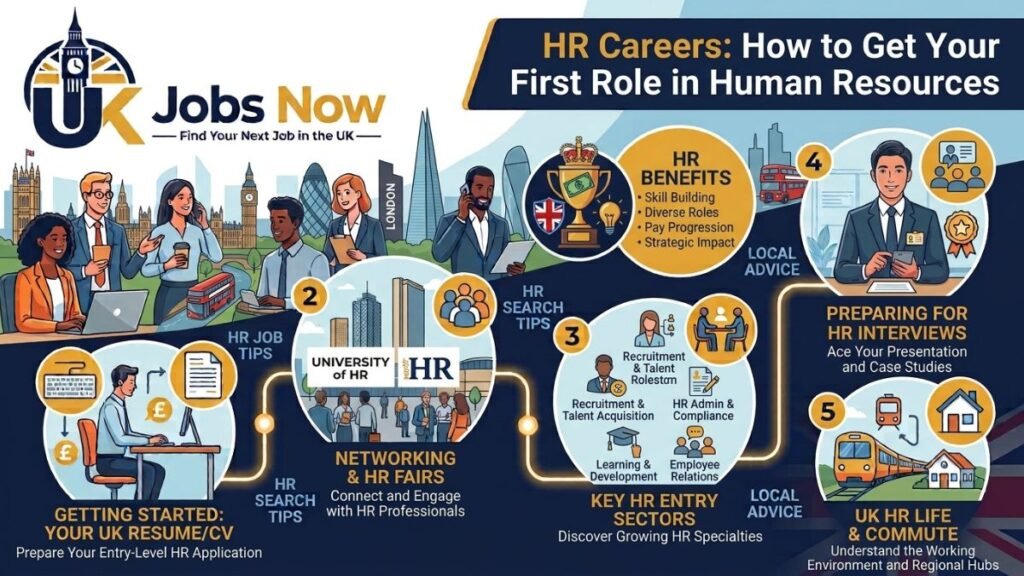
HR is one of those functions almost every organisation has, which makes it a genuinely broad field of opportunity — but the path in isn’t always obvious, particularly since HR sits at an unusual intersection of people skills, process and compliance knowledge, and increasingly, data. This is a practical guide to the actual entry routes into UK HR, the qualifications worth knowing about, and how to build a credible first application into the field.
Understanding the different areas within HR
Before targeting entry-level roles, it’s worth knowing that HR splits into distinct specialisms with genuinely different day-to-day work: generalist HR (a broad mix of recruitment, employee relations, policy, and administrative support, common in smaller organisations), recruitment and talent acquisition, employee relations and case management (handling more complex workplace issues, grievances, and disciplinary processes), learning and development, reward and compensation, and HR business partnering (a more strategic, consultative role embedded within a specific part of the business). Entry-level roles are most commonly generalist or recruitment-focused, with more specialised paths typically building from there.
Entry routes into HR
HR administrator or coordinator roles
This is the most common entry point — supporting the wider HR team with administrative tasks (managing employee records, coordinating recruitment logistics, supporting onboarding), which provides genuine exposure to the full range of HR work and a natural stepping stone toward a more specialised or advisory role.
Apprenticeships
HR apprenticeships combine paid work with structured study toward a recognised HR qualification (often linked to CIPD, the Chartered Institute of Personnel and Development, the main UK professional body for HR), providing a genuinely strong structured entry route for those without a related degree.
Graduate schemes with an HR track
Some larger organisations run HR-specific graduate schemes, or general graduate schemes with an HR rotation, offering structured entry with formal development support, typically for candidates with a relevant or sometimes any degree.
Lateral moves from an adjacent role
Moving into HR from an adjacent function — particularly recruitment (either internal or via a recruitment agency), general administration, or a people-management-heavy role in another field — is a genuinely common and credible path, since you’re bringing directly relevant, transferable experience even without a formal HR job title yet.
Understanding CIPD qualifications
CIPD membership and qualifications are the recognised professional standard in UK HR, structured across different levels (Foundation, Associate, and Chartered), with the appropriate starting level depending on your existing experience and career stage. Starting or completing a CIPD Foundation-level qualification, even before securing your first HR role, is a genuine, credible way to demonstrate serious commitment to the field, similar in principle to starting AAT study before a first finance role, as covered in our guide to breaking into finance.
What HR employers look for in entry-level candidates
| What’s commonly expected | How to demonstrate it |
|---|---|
| Discretion and judgement handling sensitive, confidential information | A specific example from any role where you’ve handled sensitive information appropriately |
| Strong interpersonal and communication skills | Concrete examples of supporting, advising, or communicating with people in a previous role |
| Attention to detail and process accuracy | Examples involving accurate record-keeping, compliance, or process management |
| Genuine interest in employment law and workplace policy | Beginning CIPD study, or demonstrable independent reading and interest in current UK employment law developments |
Recruitment as a specific entry pathway
Recruitment — whether an internal talent acquisition role or working at a recruitment agency — is one of the more accessible specific entry points into the broader HR field, and it’s worth understanding this as a genuine, deliberate strategy rather than a separate career track entirely: many people move from recruitment into broader generalist or HR business partnering roles once they’ve built foundational HR knowledge and internal relationships, particularly within an internal (in-house) recruitment function rather than an external agency, where you’re already embedded within an HR department’s wider structure.
Building your CV for an HR application
Beyond the general structure covered in our guide to writing a UK CV, an HR-specific application benefits from explicitly highlighting any experience involving confidentiality, process compliance, or supporting people through a structured process — even from outside a formal HR context. If you’re pursuing or have started a CIPD qualification, this is genuinely worth including prominently, since it directly signals serious commitment to the specific profession in a way general enthusiasm alone doesn’t.
Understanding employment law’s role in HR work, without needing to be a lawyer
HR roles require a working understanding of UK employment law and workplace regulation — notice periods, redundancy processes, discrimination law, and similar — without requiring formal legal qualification. This working knowledge is typically built through CIPD study and on-the-job experience rather than expected fully formed at entry level, though demonstrating genuine awareness and interest in this area during an application or interview is a meaningful positive signal.
Getting started
A sensible starting approach: research CIPD qualification levels appropriate to your situation, consider beginning study even before securing your first HR-specific role, and target genuinely accessible entry points — HR administrator/coordinator roles or internal recruitment positions — rather than only the most competitive HR business partner or advisory roles that typically expect several years of prior experience. You can browse current active UK job listings filtered by the HR category to see current entry-level and junior openings.
How HR is changing with growing use of people data and HR technology
HR has become an increasingly data-informed function at many organisations — workforce analytics, engagement measurement, and HR systems administration are growing areas within the field, rewarding candidates who bring genuine comfort with data and systems alongside the traditional people-focused skills of the profession. If you have a background involving data analysis or systems administration from any field, it’s worth positioning this explicitly as a relevant HR strength, since it’s an increasingly valued and differentiating combination rather than a purely traditional generalist skill set.
What a first HR interview typically covers
Entry-level HR interviews commonly combine standard competency-based questions (our guide to common UK interview questions and the STAR method is directly relevant preparation) with scenario-based questions specific to HR judgement — how you’d handle a hypothetical sensitive situation, maintain confidentiality, or balance competing priorities between supporting an employee and following organisational policy. Preparing a genuine, thoughtful answer to this kind of scenario question, demonstrating sound judgement rather than a rigid or purely rule-based response, tends to perform well even without extensive prior HR experience.
HR generalist versus specialist career paths long-term
It’s worth understanding, even early in an HR career, that the field eventually offers a genuine choice between remaining a broad generalist — valuable particularly in smaller organisations that need one person covering the full range of HR work — or specialising deeply in one specific area (reward, employee relations, learning and development, or business partnering) as you gain seniority, which is more common at larger organisations with bigger, more structured HR functions. Neither path is inherently better, and many people move between generalist and specialist roles across a career, but it’s worth being aware of this eventual choice as you build early experience, since the type of organisation you start in can meaningfully shape which path opens up first.
Frequently Asked Questions
Do I need a specific degree to work in HR?
No — while some graduate schemes prefer a relevant or sometimes any degree, HR apprenticeships, CIPD professional qualifications, and lateral moves from adjacent roles like recruitment or general administration are all genuine, degree-independent routes into the field.
What is CIPD and do I need it to work in HR?
CIPD (the Chartered Institute of Personnel and Development) is the main UK professional body for HR, offering recognised qualifications at different levels. It’s not always a strict requirement for entry-level roles, but it’s the recognised professional standard and genuinely strengthens both entry-level applications and longer-term career progression.
Is recruitment a good way into a broader HR career?
Yes — particularly internal, in-house recruitment roles, since they provide direct HR-adjacent experience and put you within an HR department’s wider structure, from which many people move into broader generalist or HR business partnering roles over time.
What’s the most accessible entry-level HR role?
HR administrator or coordinator roles are the most common and accessible entry point, providing broad exposure to the full range of HR work and a natural stepping stone toward more specialised roles.
Do I need to understand employment law in detail to start in HR?
Not at entry level — a working understanding is typically built through CIPD study and on-the-job experience over time, though demonstrating genuine awareness and interest in workplace regulation during an application is a positive signal even without full expertise.