Apprenticeships in the UK: A Complete Guide
Apprenticeships occupy an odd position in how UK career advice usually gets framed — often discussed as something for school leavers specifically, or treated as a lesser alternative to university, when in practice they’re a genuinely mainstream, well-funded route into a huge range of careers, open to people at almost any life stage, and increasingly used by career changers rather than just eighteen-year-olds. This is a complete, practical guide to how UK apprenticeships actually work in 2026, who they’re genuinely suited to, and how to find and apply for one.
What an apprenticeship actually is
A UK apprenticeship combines genuine, paid employment with structured training toward a recognised qualification, typically split between time spent working directly for your employer and time spent studying, either at a college, training provider, or increasingly through a university for higher and degree apprenticeships. Unlike a work experience placement or internship, an apprentice is a genuine employee with an employment contract, statutory employment rights, and a wage, not simply a trainee shadowing others without formal status.
The different apprenticeship levels
UK apprenticeships are structured across several levels, broadly comparable to more traditional academic qualifications: intermediate apprenticeships (roughly equivalent to GCSE level), advanced apprenticeships (roughly A-level equivalent), higher apprenticeships (leading to a qualification up to foundation degree level), and degree apprenticeships, which combine full employment with part-time study toward a complete university degree, typically taking four to six years depending on the specific programme and discipline. The right entry level depends on your existing qualifications and experience — someone with no prior relevant qualifications generally starts at intermediate or advanced level, while someone with existing relevant experience or qualifications might enter directly at a higher level.
Who apprenticeships are genuinely suited to
It’s worth being direct about the range of people this route genuinely suits, since the “for school leavers” framing undersells it considerably. School leavers deciding between university and direct employment are the most commonly discussed group, but apprenticeships are equally viable for career changers of any age — there’s no upper age limit on UK apprenticeship eligibility — including people well established in one field who want to formally retrain into another, as covered more generally in our guide to changing careers in the UK. They’re also genuinely well suited to people who know they want a specific, practical career path and would rather earn while training than take on the debt and opportunity cost of full-time study with no income.
How apprenticeship pay actually works
Apprentices are entitled to at least the National Minimum Wage apprentice rate, which applies to apprentices aged under 19, or those aged 19 or over who are in the first year of their apprenticeship — after the first year, apprentices aged 19 or over are entitled to the appropriate National Minimum Wage rate for their age. Many employers pay above the statutory minimum, particularly for apprenticeships in fields with strong demand for skilled entrants, so it’s worth checking the specific pay offered by an individual employer rather than assuming the statutory minimum applies universally. Current rates change periodically, so it’s worth checking GOV.UK directly for the exact current figures rather than relying on a fixed number that may have since been updated.
Sectors and fields offering strong apprenticeship routes
| Sector | Typical apprenticeship focus |
|---|---|
| Construction and skilled trades | Electrical, plumbing, carpentry, bricklaying, and related trades |
| Engineering | Mechanical, electrical, civil, and increasingly degree apprenticeships combining full employment with university study |
| IT and technology | Software development, IT support, cybersecurity, data |
| Finance and accountancy | Accountancy apprenticeships linked to AAT and other professional qualifications |
| Human resources | HR apprenticeships linked to CIPD qualifications |
How to actually find and apply for an apprenticeship
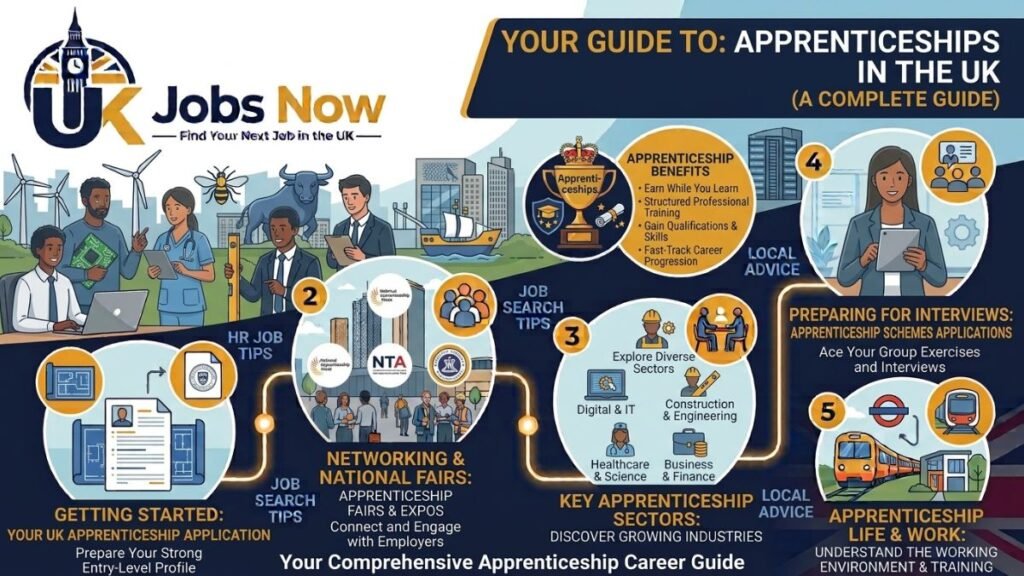
The primary route for finding UK apprenticeship vacancies is the national apprenticeship service, alongside direct advertising by individual employers and training providers, and increasingly, general job boards listing apprenticeship vacancies alongside standard roles. Applications typically follow a broadly similar process to a standard job application — a CV or application form, sometimes followed by an interview or assessment stage — though it’s worth checking each specific programme’s process directly, since larger, more competitive apprenticeship schemes (particularly degree apprenticeships at well-known employers) can involve a more extensive, multi-stage process similar to a competitive graduate scheme.
Apprenticeships versus university: a genuine comparison
Rather than treating this as a simple better-or-worse question, it’s worth comparing the two routes against your specific circumstances and goals. An apprenticeship offers immediate income, no student debt, and direct, practical workplace experience from day one, but can mean a narrower initial specialisation than a broader academic degree might offer. University offers broader academic development and, for some fields, remains the more established or even required route (certain professions still expect a specific degree), but comes with genuine financial cost and, for most students, several years without significant income. Degree apprenticeships specifically offer something close to both — a full degree alongside paid employment — though places on these programmes tend to be genuinely competitive given the clear appeal of this combination.
What happens after you complete an apprenticeship
Most apprenticeships lead directly to continued employment with the same employer, since many are specifically designed as a structured route into a permanent role within the company that trained you, though this isn’t universally guaranteed and it’s worth clarifying a specific programme’s typical outcomes during the application process. Even where a permanent offer isn’t automatic, a completed apprenticeship provides a genuine, recognised qualification and real workplace experience that meaningfully strengthens subsequent applications elsewhere in the field.
Common misconceptions worth clearing up
A few persistent misconceptions are worth addressing directly, since they put off genuinely well-suited candidates. Apprenticeships are not “lesser” qualifications in any formal sense — many now lead to qualifications equivalent to or including a full degree, and employers across increasingly prestigious fields, including law, engineering, and finance, run genuine, competitive apprenticeship schemes rather than treating them as a fallback route. Nor are apprenticeships limited to manual or trade-based work — the range now spans everything from digital marketing and data analysis to nursing associate and solicitor apprenticeships, reflecting a genuinely broad expansion of the model well beyond its traditional trade-focused reputation over the past decade.
Preparing a strong apprenticeship application
Because apprenticeship applicants are often earlier in their career with limited formal work history, the same principles covered in our guide to writing a CV with limited experience apply directly — focus on genuinely relevant experience, however informal, and be specific about why you’re drawn to the particular trade or field rather than submitting a generic application. Many apprenticeship application processes also include a values or motivation-based interview question, similar in spirit to the competency-based format covered in our guide to common UK interview questions, so it’s worth preparing a genuine, specific answer for why this particular route and employer appeal to you, rather than a generic statement about wanting to learn on the job.
Getting started
If you’re considering an apprenticeship, it’s worth researching specific sectors and employers that genuinely interest you directly, alongside general apprenticeship listings, since programme quality and structure can vary meaningfully between providers. You can also browse current active UK job listings filtered by the apprenticeship job type to see current openings across sectors.
Frequently Asked Questions
Is there an age limit for starting an apprenticeship in the UK?
No — there’s no upper age limit on UK apprenticeship eligibility, and apprenticeships are genuinely open to career changers at any life stage, not just school leavers.
Do apprentices get proper employment rights?
Yes — an apprentice is a genuine employee with an employment contract and the same statutory employment rights as any other employee, not simply an unpaid trainee or work experience participant.
Can an apprenticeship lead to a full university degree?
Yes — degree apprenticeships combine full-time paid employment with part-time study toward a complete university degree, typically over four to six years, though places on these specific programmes are often genuinely competitive.
How much do apprentices get paid?
At minimum, the National Minimum Wage apprentice rate, which applies to under-19s and first-year apprentices aged 19 or over — many employers pay above this statutory minimum, so it’s worth checking specific offers directly and confirming current rates on GOV.UK.
Is an apprenticeship a worse option than going to university?
Neither is inherently better — the right choice depends on your specific field, financial circumstances, and learning preferences. An apprenticeship offers immediate income and practical experience with no student debt, while university offers broader academic development and remains the established route for certain professions.