How to Negotiate Your Salary After a Job Offer
A job offer arrives, and the number is decent but not quite what you’d hoped for — and the instinct for a lot of people is to simply accept it, out of relief that the process is finally over, or genuine uncertainty about whether pushing back is appropriate, or acceptable, or likely to backfire. UK salary negotiation is more normal and more expected by employers than it feels from the candidate’s side of the table. This is a practical guide to how to actually do it, with realistic expectations about what tends to work.
Is it actually normal to negotiate a job offer in the UK?
Yes — most employers build some flexibility into an initial offer, expecting a reasonable counter in at least some cases, and a polite, well-reasoned negotiation is a completely normal part of UK hiring practice rather than an unusual or aggressive move. That said, the degree of flexibility genuinely varies — a large organisation with fixed, banded pay scales may have very little room to move, while a smaller company or a more senior role often has considerably more flexibility built in.
When to negotiate, and when it’s genuinely not worth it
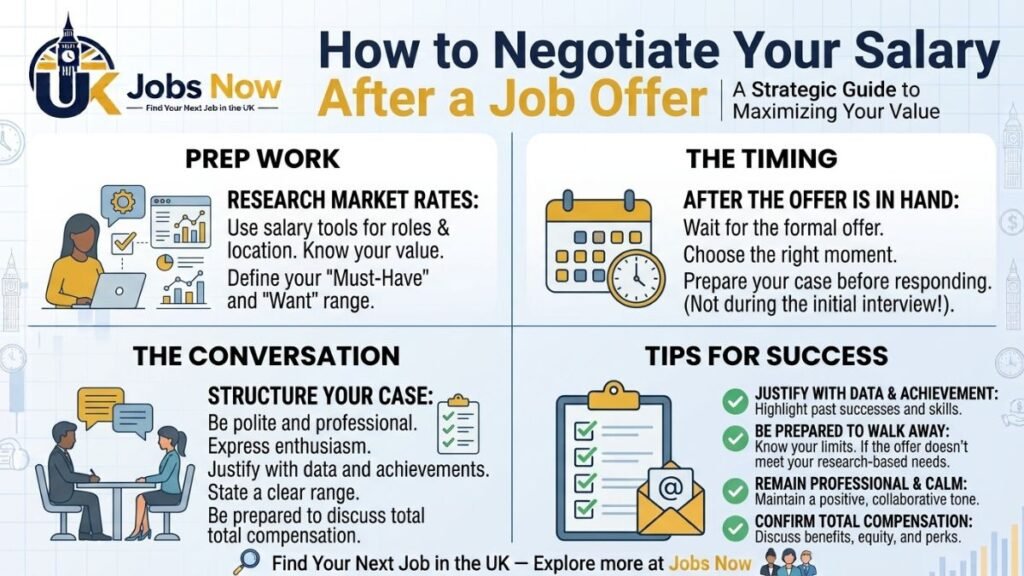
Negotiation is most appropriate once you have a firm, formal offer — not during the interview process itself, and generally not before you’ve actually decided you’d accept the role at a reasonable adjusted number. It’s also worth being realistic about situations where negotiation is less likely to succeed: very structured public sector or large-organisation roles with fixed pay bands often have genuinely little room to move, and pushing hard in these cases can occasionally read as not understanding how the organisation’s pay structure works, rather than as confident negotiation.
Doing your research before you say anything
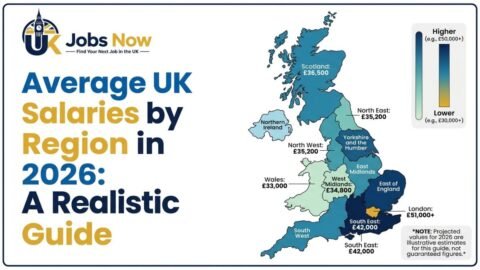
A negotiation grounded in genuine market data is considerably stronger than one based purely on what you’d like to earn. Before entering a negotiation, it’s worth researching what’s realistic for the specific role, region, and your level of experience — our guide to UK regional salaries covers how pay varies by region and why national averages alone are usually the wrong benchmark. Current job listings for similar roles in your specific area are also a genuinely useful, real-time reference point — you can browse active UK job listings filtered by category, location, and salary to build a realistic sense of the current range.
How to actually make the ask
Be specific, not vague
“Is there any flexibility on the salary?” is a weaker opening than a specific, reasoned request: “Based on my research into similar roles in this region, and my experience with [specific relevant skill or achievement], I was hoping we could discuss a salary closer to £X.” A specific number, grounded in genuine reasoning, is easier for an employer to actually respond to than an open-ended question.
Lead with genuine enthusiasm for the role
Frame the conversation as wanting to find a number that works for both sides on a role you’re genuinely keen to take, rather than as an ultimatum. “I’m genuinely excited about this role and keen to make it work — I did want to raise whether there’s flexibility on the salary” reads very differently to a colder, purely transactional opening, and tends to keep the conversation collaborative rather than adversarial.
Justify your ask with something specific
A stronger negotiation connects your request to something concrete — genuine market research, a specific skill or qualification that’s directly relevant and perhaps not fully reflected in the initial offer, or a competing offer if you genuinely have one. A request with no underlying reasoning at all is harder for an employer to act on, even when they’d otherwise be willing to.
Beyond base salary: what else is often negotiable
If the base salary itself has limited flexibility — common with fixed pay bands — it’s worth knowing that other elements of an offer are sometimes more flexible even when the number itself isn’t: a signing bonus, an earlier salary review date (three or six months rather than a standard twelve-month review), additional annual leave, flexible or remote working arrangements, professional development budget, or a higher starting point within an existing pay band if one exists. A slightly disappointing base salary combined with genuinely useful flexibility elsewhere can still add up to a good overall offer.
A simple comparison of negotiation approaches
| Weaker approach | Stronger approach |
|---|---|
| “Can you offer more money?” | “Based on similar roles in this region and my experience with [specific skill], I was hoping for closer to £X — is there flexibility there?” |
| Negotiating before receiving a formal offer | Waiting until you have a clear, firm offer in hand before raising it |
| An ultimatum tone (“I won’t accept less than…”) | A collaborative tone (“I’m keen to make this work — can we find a number that suits us both?”) |
| Focusing purely on base salary when it’s clearly fixed | Exploring other elements (start date flexibility, review timing, leave, benefits) if salary itself has no room |
What if the employer says no?
A firm “no” on salary doesn’t necessarily mean the negotiation has failed entirely, or that you should walk away from an otherwise good offer. It’s reasonable to ask directly whether any of the other elements mentioned above have flexibility instead, and to take a moment to genuinely weigh whether the original offer — the one you were happy enough with to consider before you asked — is still a good outcome on its own merits. Occasionally what feels like a “loss” in the moment is simply confirmation that the initial offer was already close to what the role could reasonably support, which isn’t the same as the negotiation having gone badly.
Common concerns about negotiating, addressed directly
“Will asking make them withdraw the offer?”
This is a genuine but generally overstated fear — a polite, reasonable, well-justified negotiation essentially never results in an offer being withdrawn from a legitimate UK employer. Employers who make formal offers have already decided they want you; a professional negotiation conversation doesn’t typically change that.
“What if I ask for too much and look unreasonable?”
This is where research genuinely matters — a request grounded in realistic market data for your specific role, region, and experience level is very unlikely to come across as unreasonable, even if the employer ultimately can’t meet it. An unresearched, arbitrarily high number is more likely to land poorly, which is exactly why the research step matters as much as the ask itself.
“Should I negotiate if I’m just relieved to have an offer at all?”
It’s a genuinely personal decision, and there’s no obligation to negotiate if you’re satisfied with the initial offer — but it’s worth separating relief at reaching the end of a job search from an honest assessment of whether the number is actually fair for the role, since these are two different things that can easily get conflated in the moment.
Putting it all together
Salary negotiation in the UK is a normal, expected part of accepting a job offer, not an aggressive or unusual move — approached with genuine research, a specific and reasonable ask, and a collaborative tone, it carries far less risk than most candidates assume. If you’re earlier in the process and haven’t yet received an offer, our guide to second interviews covers the stage where salary discussions often first come up more concretely.
Frequently Asked Questions
Is it rude to negotiate a UK job offer?
No — a polite, well-reasoned negotiation is a completely normal and expected part of UK hiring, and most employers build some flexibility into an initial offer anticipating it.
When is the right time to bring up salary negotiation?
Once you have a firm, formal offer in hand — not during earlier interview stages, and generally after you’ve decided you’d genuinely accept the role at a reasonable adjusted number.
What if the employer says there’s no flexibility on salary at all?
Ask whether other elements of the offer have flexibility instead — start date, review timing, additional leave, or benefits — and weigh the original offer on its own merits rather than assuming the negotiation has failed entirely.
Can negotiating cause an employer to withdraw a job offer?
This is very unlikely with a polite, reasonable, well-justified request from a legitimate UK employer — an employer who’s made a formal offer has already decided they want to hire you.
How do I know what’s a reasonable number to ask for?
Research current listings for similar roles in your specific region and experience level, and use broader regional salary data as additional context — a request grounded in genuine research is both more effective and less risky than an arbitrary number.