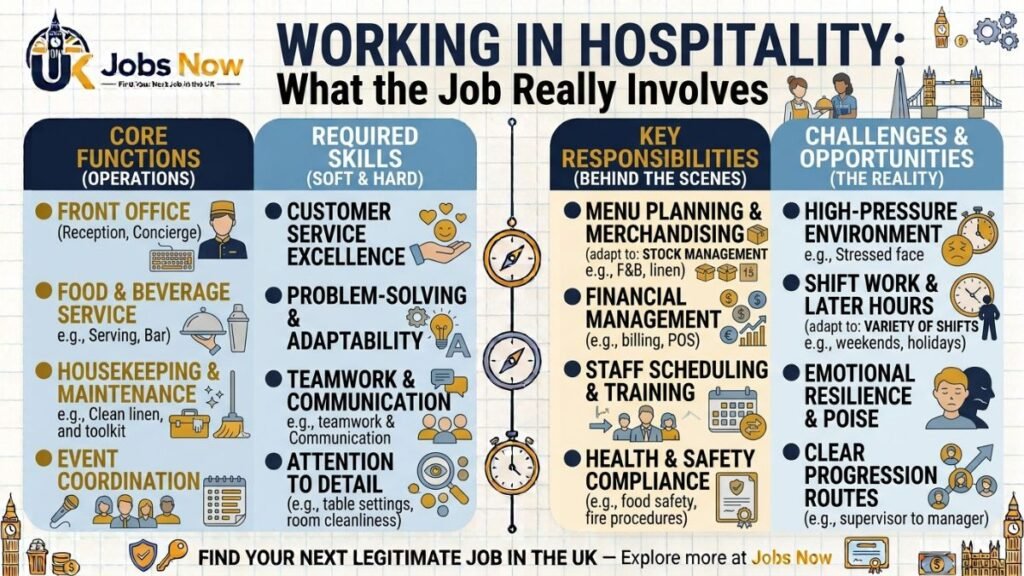
Working in Hospitality: What the Job Really Involves
Hospitality gets talked about in fairly extreme terms — either as an easy, low-commitment job to fall into, or as a genuinely brutal industry defined entirely by long hours and difficult customers. The honest picture sits between those two extremes: hospitality is genuinely demanding work with real, well-documented challenges, but it also offers faster progression, more varied roles, and more transferable skills than either caricature suggests. This is a practical, honest look at what the work actually involves and what a genuine career path within the sector looks like.
The range of roles within hospitality
“Hospitality” covers a genuinely broad set of quite different roles, and it’s worth understanding the range before assuming any single job represents the whole sector: front-of-house roles (serving, bar work, front desk and reception), kitchen and culinary roles (from commis chef through to head chef and executive chef), housekeeping and facilities, events and conference management, and management roles at every level from shift supervisor through to general manager and above, at properties ranging from a small independent café to a large international hotel group.
What the work genuinely involves — an honest picture
Hours and shift patterns
Hospitality operates when other industries don’t — evenings, weekends, and holidays are often the busiest periods, not quiet ones, and shift work is standard across most roles in the sector. This is a genuine, significant lifestyle consideration, not a minor detail — it’s worth being honest with yourself about whether irregular, evening, and weekend-heavy scheduling fits your circumstances, particularly around family commitments or other obligations, before committing to the sector.
Physical and emotional demands
Many hospitality roles are physically demanding — extended periods on your feet, fast-paced service periods, and in kitchen roles, genuinely challenging working conditions during service. Customer-facing roles also carry real emotional demands, managing difficult interactions with patience and professionalism, often during periods of high pressure. This is worth acknowledging honestly rather than glossing over, since going in with realistic expectations makes the genuine challenges more manageable than being caught off guard by them.
The genuine upsides that get less attention
Alongside the real demands, hospitality offers things that are genuinely valuable and don’t always get equal airtime: relatively fast progression compared to many other sectors (a genuinely capable, committed person can move from an entry-level role into supervisory or management responsibility considerably faster than in many other industries), highly transferable skills (customer service, working under pressure, team coordination), and for many people, a genuinely social, varied working environment that suits people who’d find a static desk role considerably less engaging.
Entry points and what they typically require
| Role type | Typical entry requirements |
|---|---|
| Front-of-house (serving, bar) | Usually minimal formal requirements; strong customer service ability and reliability matter most |
| Kitchen (commis chef entry level) | Culinary qualification helpful but not always required; apprenticeships are a common structured entry route |
| Front desk/reception (hotels) | Customer service experience valued; some larger hotel groups run structured entry programmes |
| Housekeeping | Generally minimal formal requirements; reliability and attention to detail matter most |
| Events and conference roles | Organisational and coordination experience valued, sometimes from outside hospitality specifically |
Progression within hospitality
A genuinely common and well-established path involves moving from a front-line role into a supervisory position (shift leader, team leader) within a relatively short time for a capable, reliable performer, then into assistant management and full management roles from there. Larger hospitality groups, particularly major hotel chains and restaurant groups, often run structured management development programmes specifically designed to progress internal talent, recognising that experienced, capable staff who understand front-line operations make genuinely strong managers.
Culinary career progression specifically
The kitchen career path follows a fairly well-defined structure — commis chef, chef de partie (responsible for a specific section), sous chef, and head chef, with executive chef roles overseeing multiple kitchens or a larger operation at the top of the structure. Formal culinary qualifications help, particularly for faster entry at a higher starting level, but a genuinely committed, skilled individual can and does progress through this structure via demonstrated ability and experience, particularly at smaller, less formally structured establishments.
Hospitality apprenticeships
Structured apprenticeships exist across culinary, front-of-house, and hospitality management pathways, combining paid work with formal training toward a recognised qualification. This route suits people who want structured progression and a formal qualification while earning, rather than starting entirely informally and building experience without a parallel qualification.
Realistic expectations about pay and progression speed
Entry-level hospitality pay varies significantly by role, region, and specific employer, and it’s worth researching current listings for realistic figures in your specific area rather than relying on general assumptions. What’s genuinely notable about the sector is progression speed relative to pay growth — moving into supervisory and management roles tends to happen faster in hospitality than in many other sectors for a capable, committed performer, which can offset a more modest entry-level starting point over a reasonably short timeframe.
Is hospitality the right fit for you?
It’s worth honestly weighing the genuine trade-offs rather than assuming the sector is uniformly good or bad. If irregular hours, physical demands, and sustained customer-facing interaction under pressure sound manageable or even appealing, and you value fast progression and varied, socially engaged work, hospitality can be a genuinely strong fit. If a stable, predictable schedule and minimal direct customer interaction matter more to you, it’s worth being honest about that before committing, rather than discovering the mismatch after starting.
Finding hospitality roles
Hospitality hiring often moves quickly, particularly for front-line roles, and many venues hire on a rolling basis rather than through lengthy formal processes. You can browse current active UK job listings filtered by the hospitality category to see current openings across front-of-house, kitchen, and management roles.
Working across different types of hospitality venue
It’s worth knowing that the day-to-day experience of hospitality work varies considerably depending on the type and scale of venue — a small independent café or restaurant offers a genuinely different working environment to a large branded hotel chain or a high-volume city-centre bar, in terms of pace, team size, structure, and progression opportunity. Larger, branded operations often have more formal training and progression programmes in place, while smaller independent venues can sometimes offer faster, more informal progression for someone who builds a strong relationship with an owner-operator directly. Trying a couple of different venue types early in your hospitality career, rather than assuming your first workplace represents the whole industry, can help you identify which environment genuinely suits you.
Building specific skills that stand out within hospitality
Beyond general reliability and customer service ability, developing specific, recognised expertise — a genuine, demonstrable knowledge of wine or cocktails for bar roles, specific culinary techniques for kitchen roles, or event coordination experience — differentiates you within a sector where basic entry requirements are otherwise fairly similar across candidates. Pursuing relevant short courses or certifications in your specific area of interest, even informally, is a genuine way to accelerate progression beyond what general experience alone provides.
What hiring managers in hospitality actually prioritise
Reliability tends to matter disproportionately in hospitality hiring compared to some other sectors, precisely because the operational impact of a no-show or unreliable team member during a busy service period is immediate and severe in a way it might not be in a role with more individual flexibility. Demonstrating a genuine, consistent track record of reliability — turning up on time, honouring shift commitments, communicating proactively if a genuine issue arises — is often weighted just as heavily by hospitality employers as specific technical skill, particularly at entry level, and it’s worth foregrounding this explicitly in any application or interview.
Frequently Asked Questions
Is hospitality a good career, or just a stopgap job?
Both are genuinely true depending on your approach — it’s an accessible entry point for many people, but it also offers a genuine, well-established career progression path into supervisory and management roles for those who want to pursue it seriously.
Do I need formal qualifications to work in a kitchen?
Not necessarily for entry-level roles — a formal culinary qualification helps and can support faster entry at a higher level, but progression through demonstrated ability and experience, particularly at smaller establishments, is a genuine and common path too.
How fast can I realistically progress into hospitality management?
Faster than in many other sectors for a capable, reliable performer — moving from a front-line role into supervisory responsibility within a relatively short time is common, particularly at larger hospitality groups with structured internal development programmes.
What’s the most physically demanding part of hospitality work?
Extended periods on your feet and fast-paced service periods are common across most front-of-house and kitchen roles — it’s worth being realistic about this physical demand before committing to the sector, particularly if you have any relevant health considerations.
Are hospitality apprenticeships worth considering over just starting work directly?
They’re a genuinely good option if you want structured progression and a formal recognised qualification while earning — they combine paid work with training, which some people find more valuable long-term than starting entirely informally without a parallel qualification.