Admin and Office Support Roles: An Underrated Career Path
Administrative and office support roles rarely get discussed as a deliberate career choice — they’re often framed as a stopgap on the way to something else, or a role you fall into rather than pursue. That framing undersells what’s actually a genuinely stable, skills-rich field with real progression, and one that sits at the operational centre of almost every organisation, which makes the experience gained there more broadly useful than its reputation suggests.
Why admin experience is more valuable than its reputation suggests
A genuinely competent administrator develops a specific, valuable combination of skills that many other entry points into the working world don’t provide together: organisational systems and process management, comfort with a wide range of software and tools, discretion handling sensitive information, and — often underappreciated — a working understanding of how an entire organisation actually functions day to day, since admin roles frequently touch multiple departments and see how different parts of a business connect. This breadth of exposure is genuinely useful groundwork for a wide range of future career directions, not just further admin roles.
The range of roles within admin and office support
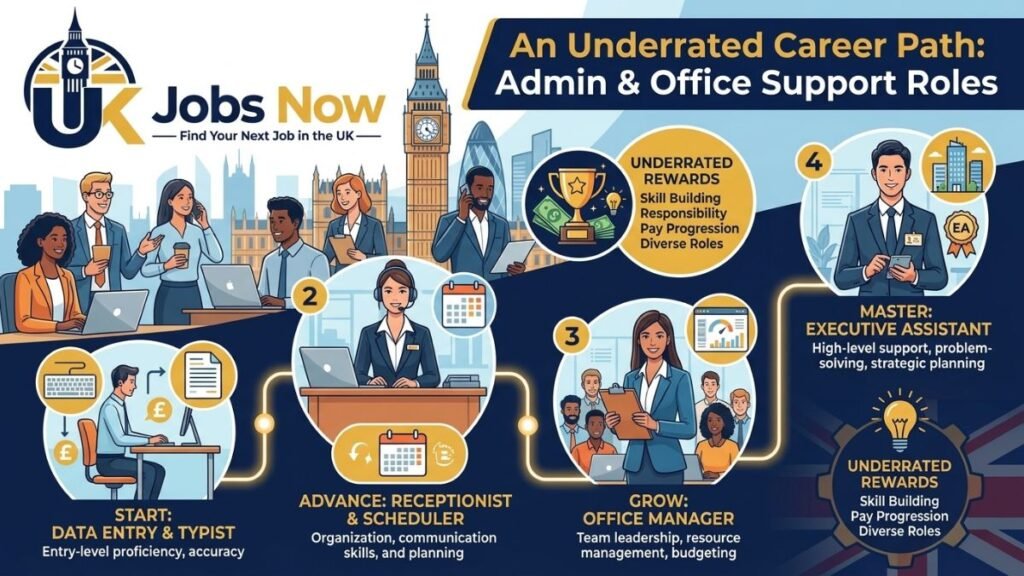
- General administrator/office assistant — broad support covering scheduling, correspondence, filing, and general office operations.
- Executive assistant/PA — dedicated support for a senior individual or small leadership team, involving greater responsibility, discretion, and often direct involvement in strategic scheduling and decision support.
- Office manager — responsibility for the smooth operational running of an office or workplace, often including facilities, supplier relationships, and light HR administrative functions.
- Department-specific coordinators — administrative roles embedded within a specific function (HR coordinator, finance administrator, marketing coordinator), combining general admin skills with some department-specific knowledge.
- Data and records administrators — roles focused specifically on maintaining accurate records and data systems, increasingly overlapping with basic data analysis skills as organisations rely more heavily on structured data.
Skills that genuinely differentiate a strong admin candidate
| Skill | Why it matters |
|---|---|
| Genuine proficiency in relevant software (Microsoft Office/Google Workspace, and increasingly specific tools like project management or CRM software) | Directly affects how quickly you can be productive in a new role, and how much support you’ll need getting up to speed |
| Written communication clarity | Admin roles involve substantial written correspondence — clear, professional writing is a genuinely differentiating skill |
| Discretion and judgement handling sensitive information | Particularly important for PA/EA roles and any role with access to confidential organisational information |
| Proactive problem anticipation | The strongest administrators anticipate issues before they become urgent, rather than only reacting to requests as they arrive |
Progression from admin into other functions
Because administrative roles frequently sit close to a specific department or function, they’re a genuinely common and well-trodden route into a more specialised role within that same area — an HR administrator moving into a full HR advisor role, a finance administrator progressing toward a finance analyst position, a marketing coordinator moving into a marketing specialist role. This lateral, department-specific progression is often faster and more accessible than trying to break into a specialised field entirely from outside, since you’re already embedded within the relevant team and building direct, contextual knowledge of that function’s work.
Progression into office and operations management
For those more interested in the operational and management side rather than moving into a specific department’s specialism, progression from general administrator through to office manager, and from there into broader operations management roles, is a well-established path — drawing on the organisational, process, and stakeholder management skills built through admin work, applied at increasing scope and responsibility.
Executive assistant and PA roles as a distinct, higher-responsibility path
Moving from general administration into an executive assistant or PA role represents a meaningful step up in responsibility and, often, compensation, typically requiring a demonstrated track record of reliability, discretion, and strong organisational judgement, since these roles involve close, trusted support for senior individuals. This path is worth considering explicitly if you’re drawn specifically to a more strategic, high-trust support role rather than broader office management.
Building your CV for an admin role
Beyond the standard structure covered in our guide to writing a UK CV, an admin-specific CV benefits particularly from quantified, specific examples of organisational impact — the scale of scheduling or coordination you’ve managed, specific systems or processes you’ve maintained or improved, and any measurable efficiency gained through work you’ve led. “Responsible for office administration” is weak; “managed scheduling and correspondence for a team of 15, maintaining a filing and records system that passed an external audit with no issues” is considerably stronger and more specific.
Is a specific qualification needed for admin roles?
Generally, no formal qualification is strictly required for most administrative roles, though relevant business administration qualifications, and demonstrable proficiency in commonly used software, are genuinely useful and can strengthen an application, particularly at entry level with limited direct work experience. Practical, demonstrable competence and reliability tend to matter more than formal credentials for most roles in this field.
Getting started
Admin and office support roles are advertised broadly across almost every sector and organisation size, from small businesses needing general support to large organisations with more specialised administrative functions. You can browse current active UK job listings filtered by the admin category to see current openings across general administration, PA/EA, and specialist coordinator roles.
Temporary and contract admin work as a genuine strategy
Temporary and contract administrative roles are genuinely common and worth considering deliberately, not just as a fallback — they can provide a fast route into paid work, genuine exposure to different organisations and industries that helps clarify what kind of environment you want to work in long-term, and in many cases, a real path to a permanent offer if a temporary role goes well and a permanent position opens up. If you’re early in your admin career or exploring which sector genuinely suits you, deliberately taking on a couple of different temporary roles across different industries can be a genuinely useful way to gather this information faster than committing to one permanent role immediately.
Working with a recruitment agency for admin roles specifically
Recruitment agencies handle a significant proportion of administrative hiring, particularly for temporary and contract roles, more so than in some other fields — it’s worth registering with one or two reputable agencies specifically specialising in office and administrative support if this is your target field, since they often have earlier and broader visibility of relevant openings than general job board searching alone provides. Our guide to recruitment agencies versus direct applications covers how to evaluate and work with an agency effectively.
Industry-specific admin knowledge as a career accelerator
While core administrative skills transfer broadly across sectors, developing genuine, deeper knowledge of a specific industry’s particular administrative requirements — legal administration, medical practice administration, or property management administration, for instance — can meaningfully accelerate both pay and progression compared to purely general administrative work, since this specialised knowledge is harder for an employer to quickly source than general organisational competence alone. If you find yourself drawn to a specific sector through early admin experience, it’s worth deliberately building on that specific knowledge rather than treating all admin experience as interchangeable.
Frequently Asked Questions
Is administrative work a good long-term career, or just a temporary role?
It can genuinely be either — admin roles offer real progression into specialised department roles, office and operations management, or higher-responsibility PA/EA positions, making it a genuinely viable long-term career path for those who build on it deliberately.
Do I need a specific qualification to become an administrator?
Generally no formal qualification is strictly required, though relevant business administration training and demonstrable software proficiency can strengthen an entry-level application, particularly with limited direct prior experience.
How do I progress from general admin into a more specialised role?
Moving from a department-specific administrative role (HR, finance, marketing) into a more specialised position within that same function is a common, accessible path, since you’re already building relevant contextual knowledge and internal relationships within that team.
What’s the difference between an office administrator and an executive assistant?
An office administrator typically provides broader operational support across a team or office; an executive assistant or PA provides dedicated, higher-trust support to a senior individual or small leadership team, usually involving greater discretion and strategic scheduling responsibility.
What software skills matter most for admin roles?
Genuine proficiency in standard office software (Microsoft Office or Google Workspace) is a baseline expectation, and increasingly, familiarity with specific tools relevant to a particular role or department — project management software, CRM systems, or basic data tools — is a genuine differentiator.