How to Get Into IT and Tech Without a Computer Science Degree
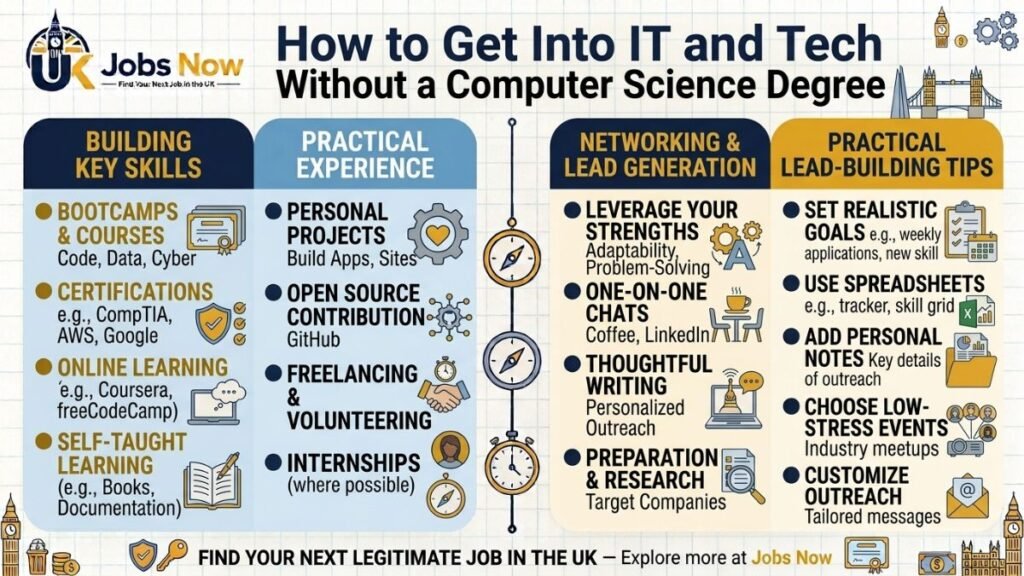
Plenty of genuinely successful people working in UK tech didn’t study computer science, and a fair few didn’t go to university at all. The industry has enough distinct entry routes — apprenticeships, bootcamps, self-teaching combined with a portfolio, lateral moves from adjacent roles — that “no CS degree” is a real but very solvable obstacle, not a wall. This is a practical look at the actual routes in, what employers realistically expect at entry level, and how to build a credible case without a traditional technical education.
Why a computer science degree isn’t the only credible path
It’s worth understanding why this is genuinely true, not just encouraging. Much of day-to-day work in many tech roles — particularly in web development, IT support, quality assurance, and increasingly in data-adjacent roles — draws on practical, demonstrable skills more than deep theoretical computer science knowledge. Employers hiring for these roles are often looking for evidence you can actually do the work: code that runs, a system you’ve configured and can explain, a problem you’ve solved and can walk through — which is exactly the kind of evidence a self-taught or bootcamp-trained candidate can build just as credibly as someone with a degree, provided they invest the effort into building it.
The main entry routes, and what each involves
Apprenticeships
UK tech apprenticeships combine paid, on-the-job training with structured study, typically leading to a recognised qualification, and are open to both school leavers and career changers of any age (there’s no upper age limit on apprenticeship eligibility in the UK). This route is particularly strong for genuinely learning while earning, rather than studying full-time with no income, and apprenticeship providers range from small tech companies to major employers running structured graduate-equivalent apprenticeship schemes.
Coding bootcamps and intensive courses
Shorter, more intensive than a degree (typically a few months rather than three or four years), bootcamps focus specifically on practical, employable skills in a particular area — often web development, data analysis, or a specific technology stack. Quality and outcomes vary meaningfully between providers, so it’s worth researching a specific bootcamp’s actual employment outcomes and alumni experiences carefully before committing, rather than assuming all providers deliver comparable results.
Self-directed learning combined with a genuine portfolio
Free and low-cost learning resources for most areas of tech are genuinely abundant, and a self-taught path is a real, credible route into the industry — but it depends heavily on building tangible, demonstrable evidence of your skills, since without a formal qualification to point to, a portfolio of genuine projects becomes your primary evidence for employers.
Lateral moves from an adjacent role
Moving into a technical role from an adjacent position — IT support into software development, business analysis into a more technical product role, QA testing into development — is a genuinely common path, since you’re already bringing real workplace context and often some technical exposure, reducing the gap an employer needs to bridge compared to hiring someone with zero relevant background.
What a strong portfolio actually looks like
For most entry-level technical roles, a small number of genuinely complete, well-explained projects outperforms a large number of unfinished or trivial ones. A portfolio worth showing typically includes: two or three projects that solve an actual, specific problem (not just a tutorial followed exactly, but something with your own genuine additions or decisions), clear, well-written explanations of what each project does and the choices you made building it, and code that’s organised and readable, since this itself signals professional habits beyond just the ability to make something work.
What entry-level UK tech employers realistically expect
| What employers commonly look for | How to demonstrate it without a CS degree |
|---|---|
| Practical, demonstrable coding or technical ability | A genuine, well-explained portfolio of projects |
| Problem-solving approach, not just memorised syntax | Ability to talk through your reasoning for a project’s design choices in an interview |
| Willingness and ability to keep learning independently | Evidence of self-directed learning — courses completed, technologies picked up on your own initiative |
| Basic collaboration and communication skills | Group project experience, open-source contributions, or simply clear written communication in your application and portfolio |
Choosing a specific area to focus on
“Tech” covers a genuinely wide range of quite different roles — web development, IT support, data analysis, quality assurance, product management, cybersecurity, and more — each with somewhat different entry expectations and learning paths. Rather than trying to become broadly competent across all of tech at once, it’s usually more effective to pick one specific area to focus your learning and portfolio-building on initially, since depth in one area tends to be more convincing to an employer than shallow breadth across several.
Addressing the “no degree” question directly in an application or interview
If asked directly about the absence of a formal technical qualification, a confident, straightforward answer works better than an apologetic or defensive one: briefly acknowledge your path, and pivot quickly to concrete evidence — your portfolio, your self-directed learning, and your genuine enthusiasm for continuing to develop your skills. Employers hiring for genuinely practical, skills-based roles are often more interested in what you can actually do than in how you got there, provided you can demonstrate real, credible ability.
Building your CV for a career change into tech
If you’re moving into tech from a different field entirely, your CV needs particular attention to framing — leading with relevant technical projects and self-directed learning rather than burying them under an unrelated employment history. Our broader guide to changing careers in the UK covers this kind of transition in more depth, including how to reframe transferable skills from your previous field, and our guide to writing a CV with limited experience is also relevant if your technical work history is still thin.
Realistic expectations about timeline and starting salary
Breaking into tech without a traditional background typically takes genuine, sustained effort over months rather than weeks — building a credible portfolio and applying skills isn’t an overnight process — and entry-level roles in this position may start at a more modest salary than more experienced positions, which is worth factoring into your planning rather than expecting to command an experienced-level salary immediately upon entry. This is a normal, expected part of establishing yourself in a new field, not a sign the path isn’t working.
Getting started
Once you’ve built even an initial, genuine portfolio, it’s worth actively applying rather than waiting until you feel “fully ready” — many entry-level and junior roles are specifically designed for candidates still building their skills. You can browse current active UK job listings filtered by category to find IT and technology roles specifically, including graduate and entry-level positions.
Preparing for a technical interview without a traditional background
Technical interviews for entry-level tech roles typically combine some assessment of practical ability — a coding exercise, a walkthrough of a project from your portfolio, or a problem-solving discussion — alongside more standard competency questions about teamwork and communication. Being ready to talk through your reasoning on a portfolio project in real detail is often more valuable preparation than trying to memorise theoretical computer science concepts you’re unlikely to be tested on directly for a practical, applied role. Our guide to common UK interview questions and the STAR method is worth combining with more technical-specific preparation for the competency side of the conversation.
Staying current once you’ve entered the field
Technology changes quickly, and this is true regardless of your entry route — a computer science graduate and a self-taught developer both need to keep learning throughout their career, not just to get their first role. Building a genuine habit of ongoing learning from the start — following relevant communities, working through new technologies as they become professionally relevant, contributing to open-source projects where possible — tends to matter more for long-term career success in tech than the specific entry route you took in the first place.
Frequently Asked Questions
Can I really get a tech job in the UK without a computer science degree?
Yes — apprenticeships, bootcamps, self-directed learning with a genuine portfolio, and lateral moves from adjacent roles are all real, commonly used entry routes, particularly for practical roles like web development, IT support, and quality assurance.
How important is a portfolio compared to formal qualifications?
For most entry-level technical roles without a degree, a genuine, well-explained portfolio of real projects is often the most important evidence you can provide — it directly demonstrates practical ability in a way a qualification alone doesn’t.
Should I do a bootcamp or teach myself?
Both are viable paths — a bootcamp offers structure and often some direct employer connections but costs money and time; self-teaching is more flexible and often cheaper but requires more self-discipline to build an equally credible portfolio. The right choice depends on your learning style, budget, and how much structure you personally benefit from.
What tech role is easiest to break into without a degree?
This varies by individual background and effort, but IT support, junior web development, and quality assurance testing are commonly cited as relatively accessible entry points, often with lower formal barriers than more specialised or advanced technical roles.
How long does it typically take to become job-ready without a formal tech background?
It varies significantly by individual effort and the specific area chosen, but genuine, sustained learning and portfolio-building over several months is a realistic expectation rather than a matter of weeks — treating it as a gradual, serious process tends to produce better outcomes than trying to rush it.