Psychometric Tests for Job Applications: A Beginner’s Guide
An email arrives asking you to complete a 20-minute online assessment before the next stage of your application, and suddenly a role you felt confident about comes with a genuine unknown: a test you haven’t taken before, with a time limit, and no clear sense of what “passing” even looks like. Psychometric tests are common enough across UK hiring — particularly for graduate schemes, larger employers, and roles involving significant analytical or interpersonal demands — that it’s worth understanding what they actually measure and how to prepare properly, rather than going in cold.
What psychometric tests actually are
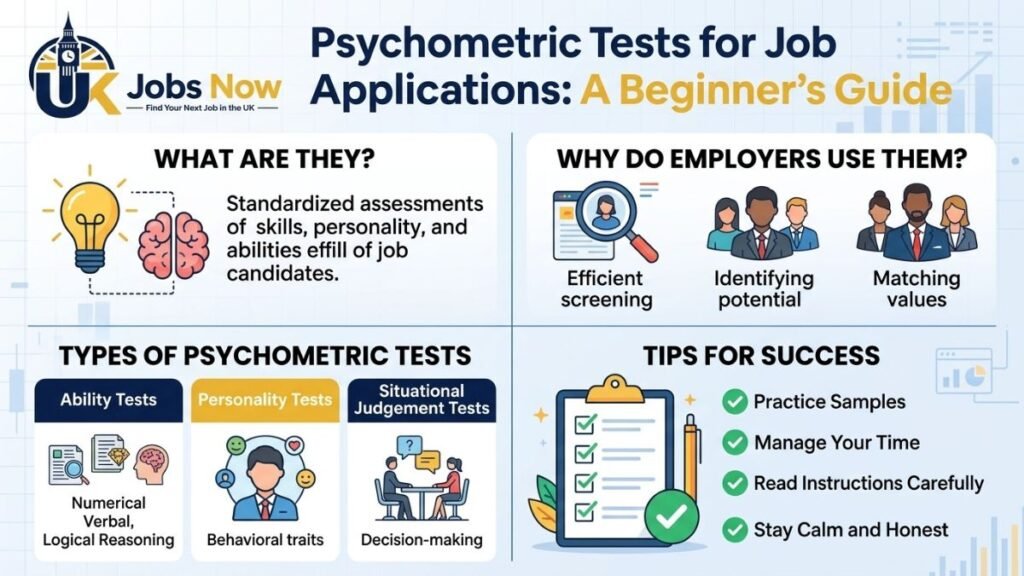
“Psychometric test” is an umbrella term covering several distinct types of assessment, each measuring something different. Employers use them because a CV and interview, however well conducted, can only reveal so much about how someone actually thinks and behaves under structured, comparable conditions — a psychometric test gives every candidate the same standardised task, which makes comparing candidates more consistent than relying purely on subjective interview impressions.
The main types you’ll encounter
Numerical reasoning tests
These assess your ability to interpret and work with numerical data — typically presented as tables, charts, or graphs, with multiple-choice questions asking you to calculate percentages, ratios, trends, or basic financial figures from the data shown. They’re not usually testing advanced mathematics; they’re testing whether you can accurately and quickly extract the right information from data under time pressure, which is a genuinely different skill to solving an equation on paper.
Verbal reasoning tests
These present a passage of text followed by statements you must judge as true, false, or “cannot say” based strictly on the information given — not on general knowledge or reasonable inference. This distinction trips a lot of candidates up: the test is deliberately checking whether you can separate what a passage actually states from what merely seems plausible or likely to be true.
Situational judgement tests (SJTs)
You’re presented with realistic workplace scenarios and asked to rank or choose the most (and sometimes least) appropriate response from a set of options. These are less about a single “correct” answer and more about how well your judgement aligns with the specific behaviours and values the employer has identified as important for the role — which can vary meaningfully between employers and industries.
Personality or behavioural questionnaires
These ask you to respond to a series of statements about your typical preferences and working style, generally with no strict time limit and no objectively “correct” answers. They’re used to build a general profile of your working style rather than to test a skill directly.
Logical or abstract reasoning tests
These present sequences of shapes or patterns and ask you to identify the next item in a sequence or the rule connecting them. They’re designed to be culturally and educationally neutral, testing general pattern-recognition ability rather than knowledge gained through formal education.
Why these tests are used, and what employers are actually looking for
Different tests map to different aspects of a role. Numerical reasoning is common for finance, analytical, and data-heavy roles. Verbal reasoning appears widely across professional and graduate-level roles generally. Situational judgement tests are particularly common in customer-facing, healthcare, and public sector hiring, where day-to-day judgement calls matter significantly. Employers are generally looking for a reasonable, consistent performance relative to other candidates for that specific role — not a “perfect score,” which for a genuinely well-calibrated test is often intentionally difficult to achieve within the time given.
How to actually prepare
Practise the specific format, not just general knowledge
The content of numerical and verbal reasoning tests isn’t advanced — what actually determines performance for most candidates is familiarity with the specific format and time pressure. Practising sample questions in the exact style you’ll face (many test providers, and independent practice sites, offer free or low-cost sample tests) genuinely improves performance, mostly by reducing the time lost to simply understanding what’s being asked the first time you encounter that question style.
Time management matters more than perfect accuracy
Most psychometric tests are deliberately timed tightly enough that few candidates finish every question comfortably. Getting stuck on one difficult question at the expense of several easier ones later in the test is a common, avoidable way to underperform relative to your actual ability. If a question is taking too long, it’s often better to make your best judgement and move on, rather than losing disproportionate time on a single point.
Read instructions carefully, especially for verbal reasoning
The “true, false, or cannot say” distinction in verbal reasoning tests specifically catches out candidates who answer based on what seems reasonable rather than what the passage strictly states. Practising this specific judgement — sticking rigidly to only the information given — is one of the most useful, learnable skills for this test type.
For situational judgement tests, think about the employer’s actual values
Rather than guessing at a universally “correct” answer, consider what the specific employer has likely told you about their values, either directly in the job listing or through general knowledge of the sector — a customer-facing SJT for a retail employer is likely looking for prioritising customer resolution and calm de-escalation; a compliance-heavy sector might prioritise following process correctly over individual initiative. There’s genuine variation here, so tailoring your judgement to what you know about the specific employer, where possible, is more useful than a single generic strategy.
A quick comparison table
| Test type | What it measures | Best preparation |
|---|---|---|
| Numerical reasoning | Interpreting data under time pressure | Practice tests in the same format; basic percentage/ratio calculation speed |
| Verbal reasoning | Distinguishing stated fact from plausible inference | Practice tests focusing specifically on the true/false/cannot say distinction |
| Situational judgement | Alignment with role-specific values and judgement | Research the employer’s stated values and typical priorities for the role |
| Personality questionnaire | General working style and preferences | Honest, consistent responses rather than guessing an “ideal” profile |
| Logical/abstract reasoning | General pattern recognition | Practice tests to build familiarity with common pattern types |
Should you try to guess what the employer “wants” on a personality test?
It’s generally not effective, and can backfire. Well-designed personality questionnaires often include consistency checks — similar questions asked in different ways to catch inconsistent or seemingly strategic answering — and even where they don’t, answering dishonestly to fit an assumed ideal profile risks landing you in a role that’s a genuinely poor fit for how you actually work, which tends to surface as a problem later regardless of how well it served the initial application. Honest, consistent answers are both the more reliable and the more sustainable approach.
What if you have a condition that affects test performance
If you have dyslexia, ADHD, or another condition that could reasonably affect your performance on a strictly timed test, UK employers are generally required to consider reasonable adjustments — extra time, an alternative format, or other accommodations — under the Equality Act 2010. It’s worth raising this directly with the employer or recruiter ahead of the test, rather than after a weaker result, since adjustments are typically arranged in advance of the assessment rather than retrospectively.
How much weight these tests actually carry
Psychometric test results are rarely the sole deciding factor in a UK hiring process — they’re usually one input alongside your CV, application, and interview performance, used either as an initial filter for high-volume roles or as supporting evidence alongside the rest of your application. A single test result, particularly a marginal one, is unlikely to override an otherwise strong application, though a very weak result relative to other candidates can be a genuine factor at the initial screening stage for high-volume graduate and entry-level hiring specifically.
Preparing for the rest of the process
Psychometric tests are often just one stage within a longer process that also includes interviews and, for many larger employers, assessment centres combining multiple exercise types in a single day. Our guide to UK assessment centres covers that broader format in depth, and our guide to common UK interview questions is worth working through alongside test preparation, since both are frequently part of the same overall hiring process.
Frequently Asked Questions
Can I fail a psychometric test?
There’s rarely a strict pass/fail threshold in the way a school exam works — most employers assess your result relative to other candidates or against a general benchmark for the role, rather than an absolute cutoff, though very high-volume screening processes sometimes do use a minimum score to manage large applicant numbers.
How much time should I spend practising before a test?
A few practice sessions in the exact test format you’ll face, spread across several days rather than crammed into one sitting, tends to meaningfully improve familiarity with the format and timing without requiring an unreasonable time commitment.
Are personality questionnaires something I can “prepare” for?
Not in the same way as ability tests — since there’s no objectively correct answer, the most reliable approach is answering honestly and consistently rather than trying to guess an ideal profile, which well-designed questionnaires are often built to detect.
What happens if I run out of time on a numerical or verbal reasoning test?
Most candidates don’t finish every question within the time limit — this is expected by design in many tests, and your score is calculated based on the questions you did answer, so managing your time to answer as many as possible accurately, rather than perfecting a smaller number, is usually the better strategy.
Can I request extra time or an alternative format if I have a learning difference?
Yes — UK employers are generally required to consider reasonable adjustments under the Equality Act 2010. It’s worth raising this directly with the employer or recruiter in advance of the test.