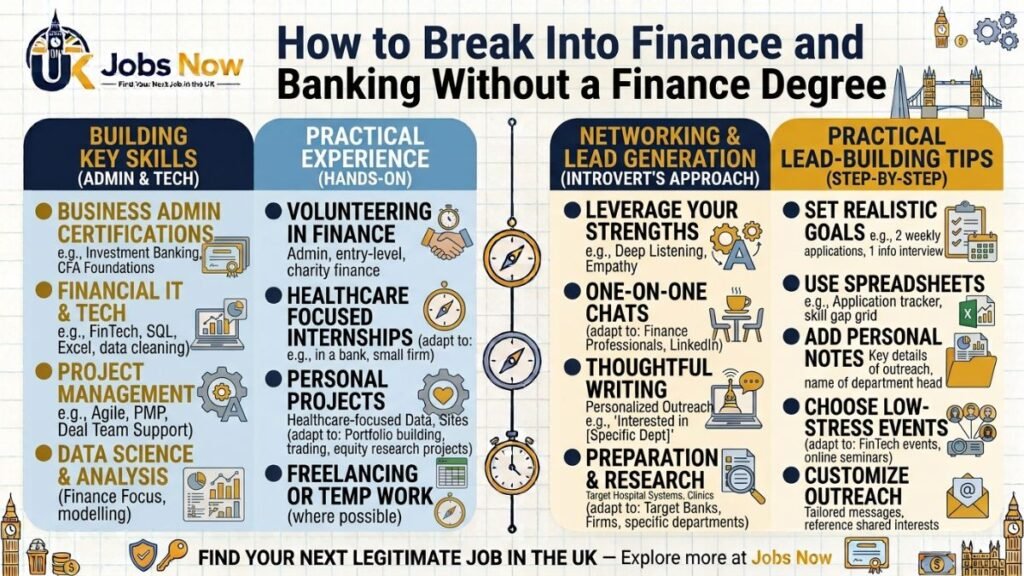
How to Break Into Finance and Banking Without a Finance Degree
Finance has a reputation as a closed shop requiring a specific degree and a specific route in — and for a narrow set of highly competitive graduate roles at major investment banks, that reputation isn’t entirely wrong. But UK finance is a much broader sector than that narrow slice suggests, and most of it is genuinely accessible to candidates without a finance degree, provided you understand the actual entry points and build the right evidence of capability.
Understanding how broad “finance” actually is
It’s worth separating the narrow, highly visible slice of finance — investment banking, trading, top-tier graduate schemes at global institutions — from the much larger, more accessible body of finance roles that exist across every company and sector: financial analysis, accounts and bookkeeping, credit control, payroll, financial planning, internal audit, and finance business partnering within companies of every size, not just banks. The competitive, degree-gated routes get most of the attention, but they represent a genuinely small fraction of actual finance employment in the UK.
Entry routes that don’t require a finance degree
Professional qualifications studied alongside work
UK accountancy and finance professional bodies — AAT, ACCA, CIMA, and others — offer structured qualification routes that many people complete while working, often with employer sponsorship, rather than through a full-time university degree. Starting in an entry-level finance-adjacent role (accounts assistant, finance administrator) while studying toward a professional qualification is one of the most common and well-established non-degree routes into a genuine finance career.
Apprenticeships
Finance and accountancy apprenticeships combine paid work with structured study toward a recognised qualification, open to school leavers and career changers alike, and increasingly offered by both accountancy firms and finance departments within larger employers across all sectors.
Lateral moves from an adjacent function
Moving into finance from an adjacent role — administration into accounts, data analysis into financial analysis, operations into finance business partnering — is a genuinely common path, since relevant transferable skills (attention to detail, working with numbers and systems, process management) reduce the gap an employer needs to bridge, even without a formal finance qualification yet in hand.
Entry-level roles with on-the-job training
Roles like accounts payable/receivable, payroll administration, and credit control are often genuinely accessible at entry level with limited or no prior finance-specific experience, and can serve as a practical stepping stone into more senior finance roles once you’ve built direct, demonstrable experience.
What finance employers actually look for beyond a degree
| What’s commonly expected | How to demonstrate it without a finance degree |
|---|---|
| Comfort and accuracy working with numbers | Relevant experience from any role involving data, budgets, or numerical accuracy — even outside finance specifically |
| Attention to detail | Concrete examples from your existing experience where accuracy or careful checking genuinely mattered |
| Familiarity with spreadsheets and financial systems | Demonstrable Excel proficiency, and willingness to learn specific systems on the job |
| Understanding of, or willingness to pursue, a professional qualification | Enrolling in or completing initial stages of AAT or an equivalent qualification, even before a formal finance role |
Starting a professional qualification before you have a finance role
It’s genuinely possible, and reasonably common, to begin studying toward a foundational qualification like AAT before securing your first finance role — this demonstrates concrete, provable commitment to the field in a way that simply stating interest doesn’t, and it can meaningfully strengthen an application for an entry-level finance role even without prior direct experience. It’s a worthwhile investment of time specifically because it converts “I’m interested in finance” from a vague statement into something an employer can verify and take seriously.
How your current experience might already be more relevant than it seems
A lot of roles carry genuinely relevant, transferable experience for a finance move that isn’t always obvious at first glance — managing a budget in a non-finance role, handling invoicing or basic bookkeeping as part of a broader operations job, analysing data or building reports in any function, or simply demonstrating strong numerical accuracy in a customer-facing or administrative role. When applying for an entry-level finance position, it’s worth deliberately identifying and highlighting this kind of experience specifically, rather than assuming your CV needs to start from a blank slate just because your job titles haven’t been explicitly “finance.”
Realistic entry-level roles to target first
For someone genuinely new to the field, roles like accounts assistant, purchase/sales ledger clerk, payroll assistant, or finance administrator are commonly accessible entry points that don’t typically require a finance degree or completed professional qualification, provided you can demonstrate the foundational skills above and genuine motivation to build a career in the field. These roles also commonly come with employer support to begin or continue a professional qualification once you’re in post, which is worth specifically asking about during the interview process if it’s not already mentioned in the listing.
Framing a career change into finance
If you’re moving into finance from an unrelated field, your application should lead with the transferable skills and any qualification progress covered above, rather than apologising for the absence of a traditional finance background. Our broader guide to changing careers in the UK covers how to structure this kind of transition more generally, and it’s worth pairing that with a CV that explicitly foregrounds numerical, analytical, and process-driven experience from your current field.
Getting started
A sensible starting sequence: research which professional qualification path (AAT is the most common entry-level route) fits your situation, consider beginning initial study even before securing a finance role, and start targeting genuinely accessible entry-level finance roles rather than only the most competitive, degree-gated graduate schemes. You can browse current active UK job listings filtered by the finance category to see what entry-level and junior roles are currently available.
Choosing between AAT, ACCA, and CIMA
These three qualifications are often mentioned together, but they serve somewhat different purposes and it’s worth understanding the distinction before committing significant time to one specific route. AAT is generally the most accessible entry-level qualification, well suited to starting from little or no prior finance background, and can lead directly into employment or serve as a foundation before progressing to a more advanced qualification. ACCA is a chartered accountancy qualification, more commonly pursued by those aiming for a professional accountancy career, often (though not exclusively) within an accountancy practice. CIMA is more specifically oriented toward management accounting within a business context, rather than practice-based accountancy. Researching which of these best fits your specific career direction, rather than assuming they’re interchangeable, is worth doing early rather than partway through a qualification you later realise doesn’t align with your actual goals.
Building genuine financial literacy even before formal study
Alongside pursuing a formal qualification, building a genuine, practical understanding of core financial concepts — how a profit and loss statement and balance sheet work, basic budgeting principles, how cash flow differs from profit — through free or low-cost resources can meaningfully strengthen an entry-level application even before you’ve completed formal study. This kind of self-directed groundwork demonstrates genuine initiative and gives you a real head start once you do begin formal qualification study or start in an entry-level role.
Frequently Asked Questions
Do I need a finance or accounting degree to work in UK finance?
No, not for most finance roles — professional qualifications (AAT, ACCA, CIMA), apprenticeships, and lateral moves from adjacent roles are all common, genuinely accessible routes that don’t require a finance-specific degree.
What’s the easiest way to start a career in finance without prior experience?
Entry-level roles like accounts assistant, purchase/sales ledger clerk, or finance administrator are commonly accessible starting points, often alongside employer support to begin a professional qualification once you’re in post.
Should I start a professional qualification before I have a finance job?
It’s genuinely worthwhile if you can manage it — beginning study toward AAT or a similar qualification demonstrates concrete, provable commitment to the field and can meaningfully strengthen an entry-level application even without direct prior experience.
Is investment banking the only well-paid path in UK finance?
No — investment banking and trading represent a narrow, highly competitive slice of the finance sector. Broader finance roles across companies of every size and sector, including financial analysis, finance business partnering, and management accounting, offer genuine, well-paid career progression without needing to enter through that specific, highly competitive route.
Can experience from a completely unrelated field help me get into finance?
Yes, often more than people expect — experience involving budgets, data accuracy, invoicing, or numerical analysis in any role is genuinely relevant and worth highlighting explicitly on your CV when applying for entry-level finance roles.