Universal Credit and Work: How Earnings Affect Your Payments
Many people on Universal Credit worry that taking a job, or working more hours, will leave them no better off. In fact, Universal Credit is designed so that working usually pays: your payment falls gradually as your earnings rise, rather than stopping suddenly. This guide explains how Universal Credit (UC) works alongside a job in 2026/27, what the work allowance and taper rate mean, how to work out what you might receive, how self-employment and irregular pay are treated, what childcare help is available and what to tell the Department for Work and Pensions (DWP).
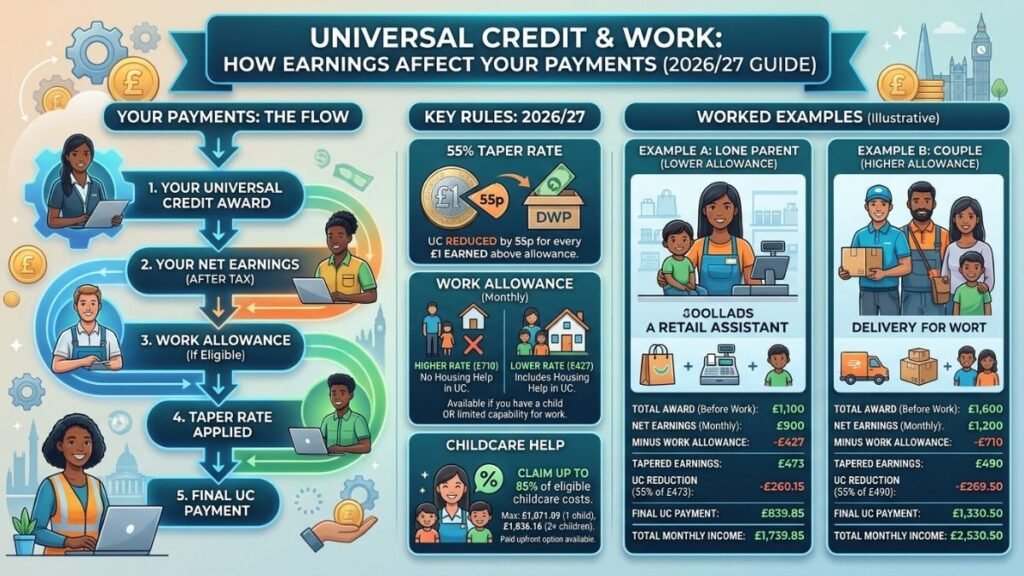
Quick answer: Once your earnings pass any work allowance, Universal Credit is reduced by 55p for every £1 of take-home pay you earn. You therefore keep at least 45p of each extra pound. Households with children or a limited capability for work get a work allowance of £427 a month (if they get help with housing costs) or £710 a month (if not) before the reduction starts. Other claimants lose 55p of UC from the first pound they earn.
This article covers Universal Credit in Great Britain. Northern Ireland has its own version with similar rules, so check nidirect. UK Jobs Now is not affiliated with the DWP. Always claim and report changes through your official GOV.UK account.
How Universal Credit works
Universal Credit is a monthly payment for people on a low income, whether in work or out of work. It combines several older benefits into one payment. Your award is made up of:
- A standard allowance for you (and your partner, if you have one)
- Extra elements for children, housing costs, childcare costs, disability or health conditions and caring responsibilities
- Minus any deductions for your earnings, other income and savings
The amount is worked out in monthly assessment periods and is normally paid a month in arrears. The first payment usually takes about five weeks after you claim, though you can ask for an advance, which you repay later.
2026/27 rates
The main figures from 6 April 2026 are:
| Item | Monthly amount |
|---|---|
| Standard allowance, single, under 25 | £338.58 |
| Standard allowance, single, 25 or over | £424.90 |
| Standard allowance, couple, both under 25 | £528.34 |
| Standard allowance, couple, one or both 25 or over | £666.97 |
| Child element (each child) | £303.94 |
| Child element, first child born before 6 April 2017 | £351.88 |
| Carer element | £209.34 |
| Health element (limited capability for work and work-related activity), new claimants from 6 April 2026 | £217.26 |
| Health element, protected rate for existing claimants | £429.80 |
| Childcare costs, up to 85% of costs, capped at | £1,071.09 (one child) or £1,836.16 (two or more) |
| Work allowance, with a housing element | £427 |
| Work allowance, no housing element | £710 |
| Taper rate | 55% |
Two important changes began in April 2026. The two-child limit was abolished, so a child element is now paid for every child, and the health element was split into two rates, depending on when you were found to have a limited capability for work-related activity. Standard allowances also rose by more than inflation. Housing elements depend on your rent and local rules, so they are not listed here. These figures come from several benefit guides that agree with each other, so check GOV.UK for your own circumstances.
How earnings reduce your Universal Credit
The 55% taper
Universal Credit counts your earnings after tax, National Insurance and pension contributions, which is your take-home pay. For every £1 you earn above your work allowance, your UC award falls by 55p. So you keep 45p of each extra pound, on top of the pay itself.
Formula: UC award = standard allowance + elements − (55% × take-home earnings above your work allowance).
The work allowance: who gets one?
A work allowance is the amount you can earn before the taper begins. Only some claimants get one:
- You get a work allowance if you have a child or qualifying young person in your household, or you (or your partner) have a limited capability for work (LCW) or limited capability for work and work-related activity (LCWRA).
- The amount depends on housing: £427 a month if your UC includes a housing element, and £710 a month if it does not.
- If you have no children and no health element, there is no work allowance. The taper starts from your first pound of take-home pay.
Worked example 1: single parent with one child
Assume a single parent aged 25 or over with one child (child element £303.94) and rent of £700 a month covered by the housing element, so the work allowance is £427. The maximum UC is:
£424.90 + £303.94 + £700 = £1,428.84 a month before earnings.
Here is what happens as take-home earnings rise:
| Take-home pay per month | Amount over work allowance | UC reduced by 55% | UC you receive | Total income (pay plus UC) |
|---|---|---|---|---|
| £0 | £0 | £0 | £1,428.84 | £1,428.84 |
| £500 | £73 | £40.15 | £1,388.69 | £1,888.69 |
| £881 (16 hours at £12.71) | £454 | £249.70 | £1,179.14 | £2,060.14 |
| £1,000 | £573 | £315.15 | £1,113.69 | £2,113.69 |
| £1,500 | £1,073 | £590.15 | £838.69 | £2,338.69 |
| £2,000 | £1,573 | £865.15 | £563.69 | £2,563.69 |
| £2,500 | £2,073 | £1,140.15 | £288.69 | £2,788.69 |
Every extra £100 of take-home pay raises total household income by about £45. UC would stop altogether at around £3,025 of take-home pay a month in this example. These figures ignore council tax support, deductions and the benefit cap.
Worked example 2: single person, no children, no health element
Assume a single person aged 25 or over, with rent of £600 a month covered by the housing element, and no work allowance. Maximum UC is:
£424.90 + £600 = £1,024.90 a month.
| Take-home pay per month | UC reduced by 55% | UC you receive | Total income (pay plus UC) |
|---|---|---|---|
| £0 | £0 | £1,024.90 | £1,024.90 |
| £500 | £275 | £749.90 | £1,249.90 |
| £1,000 | £550 | £474.90 | £1,474.90 |
| £1,500 | £825 | £199.90 | £1,699.90 |
UC would stop at around £1,863 of take-home pay a month. Because there is no work allowance, the reduction begins from the first pound.
These examples are my own simple calculations using the 2026/27 rates quoted above. Your actual award depends on your housing costs, household, savings, other income and any deductions, so use the GOV.UK calculators, Citizens Advice or the benefit calculators provided by charities to check your own figures.
Turning pay into take-home pay
UC works from take-home earnings, so check what you actually receive after tax and National Insurance. See our guides to take-home pay in the UK 2026/27 and payslips, tax codes and National Insurance. Many people on lower earnings pay little or no tax, so their take-home pay is close to their gross pay. For comparison, the minimum wage for workers aged 21 and over is £12.71 an hour from April 2026. See our National Minimum Wage 2026 guide.
What counts as earnings and income?
- Employment earnings, including wages, overtime, bonuses and commission, counted after tax, National Insurance and your own pension contributions.
- Statutory payments, such as Statutory Sick Pay, maternity pay and redundancy pay in some cases. See our guides to Statutory Sick Pay 2026 and maternity, paternity and shared parental leave and pay.
- Self-employed profits, not takings, after allowable expenses, tax and National Insurance (see below).
- Other income, such as some pensions, maintenance and rent from lodgers, may reduce your award.
- Savings and capital. If you have more than £6,000 in savings or capital, your UC is reduced by a set amount for each £250 above that level, and you cannot get UC if you have more than £16,000. Check GOV.UK for current rules.
The DWP gets information about your pay directly from your employer through HMRC’s real-time system, so changes show up automatically. You should still report changes that the system might not pick up.
Irregular pay and the “four or five paydays” problem
If your pay varies from week to week, or you are paid four-weekly or on a date that sometimes falls twice in one assessment period, your UC can swing sharply from month to month. For example, if you are paid on the last working day of the month and that day falls on a weekend, you might be paid early, so two pay packets land in one assessment period and none in the next. The DWP can sometimes adjust this if you ask, so contact your work coach and keep your payslips. Our guides to zero-hours contracts and holiday entitlement and holiday pay explain how irregular pay and holiday pay work.
Self-employment and Universal Credit
Self-employed people can get Universal Credit, but the rules are different.
- Your profit is counted, based on monthly records of your income and allowable expenses.
- The Minimum Income Floor. After a start-up period, which is usually 12 months, the DWP assumes you earn at least a minimum amount, based on working a set number of hours at the National Minimum Wage for your age, even if you earn less. If your actual profits are lower, your UC is calculated as if you had earned the floor, so a bad month can leave your UC lower than you expect. Check GOV.UK for the current rules.
- Report your income and expenses every month, and keep clear records.
- Gainful self-employment. The DWP will check that your business is real, organised and expected to become sustainable.
See our guide to how to become self-employed in the UK, and our guides to delivery driver jobs and taxi and private hire driver jobs, which often involve self-employment.
Childcare costs and Universal Credit
If you are working and paying for registered childcare, you can claim back up to 85% of your childcare costs through Universal Credit, up to the cap, which is about £1,071 a month for one child and £1,836 for two or more in 2026/27.
- You pay the provider first, then report the costs and claim back.
- You need to be in paid work, or about to start work within a month.
- Funded hours. In England, working parents of children aged nine months to school age can get up to 30 hours a week of funded childcare for 38 weeks a year. You can use funded hours alongside UC childcare, but you cannot use UC childcare and Tax-Free Childcare together, so work out which is better for you. See our guide to jobs that fit around school hours and childcare in the UK.
Report your childcare costs on time each month, because late reports can cost you money.
Health conditions and disability
If you have a health condition or disability, you may be able to claim the health element, and you may get a work allowance. From April 2026, new claimants found to have a limited capability for work-related activity get a lower rate of the health element (£217.26) than existing claimants on the protected rate (£429.80), and rules have been under review, so check GOV.UK for the latest. Disabled people can also get support to start or keep work, including Access to Work and reasonable adjustments. See our guide to disability and work in the UK.
Looking for work on Universal Credit
Your claimant commitment sets out what you must do. Depending on your circumstances, you may need to look for work, attend appointments with your work coach and take reasonable steps to find or increase work. Requirements vary, for example for people with young children or health conditions, and for people who are already earning above a certain level, where you may only need to speak to a work coach occasionally. If you do not meet your commitments without good reason, your payments can be sanctioned, so talk to your work coach if you are struggling.
To make the most of your time:
- Tell your work coach about your plans, including training, apprenticeships and part-time work.
- Ask about support, such as help with interview costs, travel, clothing and training courses. Work coaches can sometimes offer a Flexible Support Fund payment, subject to availability.
- Search widely. See our UK jobs board, and our guides to supermarket jobs, care worker jobs, warehouse jobs and admin and office jobs.
- Think about progression. Some employers offer training and promotion, and apprenticeships can lead to higher pay. See our guide to apprenticeships in the UK.
- Older workers and returners. See our guide to jobs for over 50s and returners in the UK.
What to tell the DWP when you start work
You must report changes in your circumstances. When you take a job, you should:
- Tell the DWP through your online account journal as soon as you accept the job, including the start date, pay and hours.
- Report your childcare costs if you will be claiming them.
- Keep your payslips and contract. See our guide to understanding your employment contract.
- Check your first payslips are correct, and that your employer reports them properly.
- Tell the DWP about other changes, such as a change in your hours, rent, household, savings or health.
Not reporting changes can lead to overpayments that you have to repay, and in serious cases penalties or prosecution. If you are unsure, ask your work coach or Citizens Advice.
What happens if you earn too much for Universal Credit?
If your earnings rise high enough, your UC award can fall to £0. That is not the end of your claim. In general, if your award stops because of your earnings, your claim remains open for a period, usually six months, so if your income falls again you can often restart payments without making a new claim. After that you must claim again. Check the rules on GOV.UK.
Reaching £0 may also affect other help linked to UC, such as free school meals, council tax support and NHS help with health costs. In England, free school meals have been extended to children in all Universal Credit households from September 2026, according to the government’s announcement, so check the rules with your local council and GOV.UK.
Is it worth working more?
For most claimants, yes. Because UC falls by 55p for each extra pound you earn above your work allowance, you always end up with more money overall when you earn more, even if it feels less because of the reduction in UC. But consider the full picture:
- The 55% taper plus tax and National Insurance and student loan repayments can leave you keeping a smaller share of each extra pound if your earnings are high. See our guide to take-home pay in the UK 2026/27.
- Childcare and travel costs can reduce the benefit of working extra hours.
- Other support that is linked to UC may change as your income changes.
- Long-term benefits include a better work record, pension contributions and the chance of promotion.
A benefits adviser can help you check what working extra hours would mean for your household.
Scams and warnings
Benefits attract scammers. Be careful of:
- Fake websites that look like GOV.UK and ask for a fee to help you claim. Claiming Universal Credit is free, and the official site is GOV.UK.
- Calls, texts and emails claiming to be from the DWP, offering a bonus, a refund or a payment if you give your bank details. The DWP does not ask for your bank PIN or full password. Report suspicious messages to the DWP, forward texts to 7726 and emails to report@phishing.gov.uk.
- Fake job offers that ask you to pay a fee or to lend your bank account, which could affect your benefits and make you part of a crime. See our guides to how to spot a fake job advert in the UK and work from home jobs in the UK.
- Cash-in-hand work that you do not report. This can be treated as benefit fraud and can leave you without payslips or protections.
- Anyone asking you to share your account or to claim on behalf of others.
If you think you have been scammed, contact your bank and report it to Report Fraud.
Where to get help
- Your Universal Credit account journal and your work coach for questions about your claim.
- Citizens Advice for free, independent advice on benefits, work and debt.
- Turn2us and other charities for benefit calculators and grants.
- Your local council for council tax support and local help.
- Acas if you have problems with your employer over pay or hours.
- Disability charities for help if you have a health condition.
Frequently asked questions
How much does Universal Credit go down when I work? Once you earn more than any work allowance, UC is reduced by 55p for every £1 of take-home pay. You keep 45p of each extra pound.
What is the Universal Credit work allowance in 2026/27? £427 a month if your UC includes a housing element, and £710 a month if it does not. Only claimants with children or a limited capability for work get one.
What is the standard allowance in 2026/27? £424.90 a month for a single person aged 25 or over, £338.58 if under 25, and £666.97 for a couple where one or both are 25 or over.
Has the two-child limit been abolished? Yes, from 6 April 2026. Families now get a child element for every child.
Do I have to tell the DWP if I get a job? Yes. Report it through your online account journal as soon as you accept, along with your pay, hours and any childcare costs.
Does Universal Credit count gross or net pay? Net. It counts your take-home pay after tax, National Insurance and your own pension contributions.
Can I claim Universal Credit if I am self-employed? Yes, but your profit is counted and a Minimum Income Floor may apply after the start-up period.
Can I get help with childcare on Universal Credit? Yes. You can claim back up to 85% of registered childcare costs, up to a cap, if you are working.
What happens if my earnings are too high? Your UC falls to £0, but your claim usually stays open for around six months, so you can restart if your income drops. After that, you need to claim again.
Is it worth working if I am on Universal Credit? Usually yes, because you keep 45p of every extra pound after the work allowance, but check the effect of childcare, travel and other benefits.
Final thoughts
Universal Credit is designed to support you when you work, so taking a job, or more hours, should leave you better off. Report changes promptly, keep your payslips and use the free advice services if you are unsure. When you are ready, browse the latest vacancies on our jobs board and apply directly with employers.
This article is general information, not benefits or legal advice. Universal Credit rules and rates change, and the worked examples are simplified. Check GOV.UK, Citizens Advice or Turn2us for the latest figures, and use an official calculator or adviser for your own situation.