Unfair Dismissal in the UK: Your Rights, Claims and the Six-Month Change
Being dismissed is stressful, and it is even harder when it feels unfair. UK law protects many employees from unfair dismissal, but the protection depends on how long you have worked for your employer, why you were dismissed and how your employer handled it. The rules are changing on 1 January 2027, when the service you need to bring an ordinary claim falls from two years to six months and the cap on most compensation is removed. This guide explains what unfair dismissal means, who can claim, what counts as a fair reason, what you can be awarded, how the time limits work and what to do if you have been dismissed.
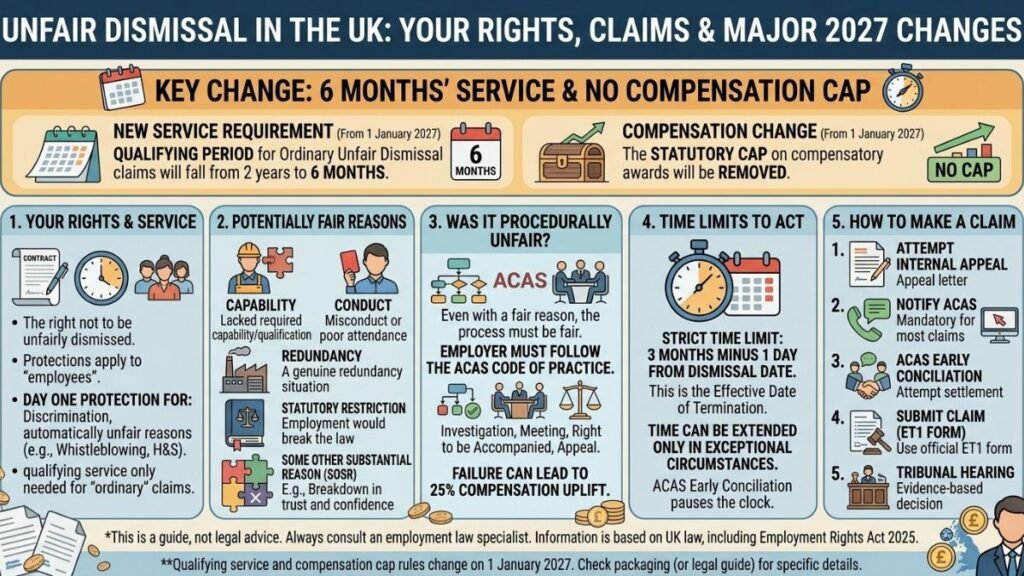
Quick answer: Today you normally need two years’ service to claim ordinary unfair dismissal. For dismissals ending on or after 1 January 2027, you will need only six months, and the cap on the compensatory award will be removed. Some dismissals are unfair from day one, such as for whistleblowing, pregnancy or discrimination. Most tribunal claims must be brought within six months for events on or after 1 October 2026, after contacting Acas.
What is unfair dismissal?
You are dismissed if your employer ends your contract (with or without notice), does not renew a fixed-term contract or forces you to resign through its conduct (called constructive dismissal). A dismissal is unfair if the employer did not have a fair reason, or if it had a fair reason but did not act reasonably or follow a fair process.
Unfair dismissal is a statutory right. It is different from:
- Wrongful dismissal, which is a breach of contract claim, for example if you were not given the notice you were owed. See our guide to notice periods in the UK.
- Discrimination, which is unlawful whatever your length of service. See below.
- Redundancy, which is a fair reason for dismissal if it is genuine and handled properly. See our guide to redundancy rights in the UK.
Who can claim unfair dismissal?
To bring an ordinary unfair dismissal claim you must normally be:
- An employee (not a self-employed contractor, and generally not a casual worker or agency worker who is not an employee). If you are unsure of your status, ask Acas. Our guide to zero-hours contracts explains the difference between employees and workers.
- Working in Great Britain. Northern Ireland has its own rules, so check the Labour Relations Agency.
- Someone with the qualifying period of continuous service on the date your employment ends.
The qualifying period: what is changing
| Date your employment ends | Service you need for an ordinary unfair dismissal claim |
|---|---|
| Before 1 January 2027 | Two years |
| On or after 1 January 2027 | Six months |
The change is set out in the Employment Rights Act 2025, and the government has confirmed the start date as 1 January 2027. The key point is that the date your employment ends decides which rule applies, not when you started. Service before 2027 still counts. For example:
- If you started a job on or before 1 July 2026 and are dismissed on or after 1 January 2027, you will already have six months’ service, so you can claim straight away.
- If you started on 1 September 2026 and are dismissed on 1 February 2027, you will have five months’ service and will not yet qualify for an ordinary claim. You will reach six months on 1 March 2027.
- If you are dismissed before 1 January 2027 with less than two years’ service, the old two-year rule applies.
The six months means continuous employment. Some breaks and changes of employer count and some do not, so get advice if your service history is complicated.
Other changes from 1 January 2027
- Compensation cap removed. See below.
- Written reasons for dismissal. The service needed to ask for a written statement of reasons falls to six months.
- Spent convictions. Dismissal because of a spent conviction will be unfair without any qualifying period. See our guide to how to get a job with a criminal record in the UK.
The Act also plans to restrict “fire and rehire”, where employers dismiss staff to impose worse terms. Check GOV.UK for the timing. Our guide to the Employment Rights Act 2025 covers the wider reforms.
Dismissals that are unfair from day one
You do not need any qualifying service if your dismissal is automatically unfair or discriminatory. Examples include dismissal because you:
- Are pregnant, on maternity or other family leave, or asked for family leave. See our guide to maternity, paternity and shared parental leave and pay.
- Made a protected disclosure (whistleblowing) about wrongdoing, danger or illegality
- Raised a health and safety concern
- Asserted a statutory right, such as the minimum wage, holiday pay or sick pay, or tried to enforce it
- Joined or took part in a trade union, or refused to
- Refused to work more than the maximum working hours or took the rest breaks you are entitled to
- Are a part-time or fixed-term worker and were treated worse because of that status
- Made a flexible working request in line with the law. See our guide to flexible working in the UK.
Discrimination because of age, disability, sex, race, religion or belief, sexual orientation, gender reassignment, pregnancy and maternity, or marriage and civil partnership is unlawful under the Equality Act 2010. You can claim for discriminatory dismissal from day one, and compensation is not capped in the same way. Discrimination claims are separate from unfair dismissal claims, and you can bring both.
Fair reasons for dismissal
Even with qualifying service, an employer can dismiss you fairly if it has one of five potentially fair reasons, and acts reasonably.
| Reason | Examples |
|---|---|
| Conduct | Misconduct such as theft, violence, serious breaches of rules or repeated lateness |
| Capability or qualifications | Poor performance despite support, long-term ill health, or losing a required qualification or licence |
| Redundancy | Your job is genuinely no longer needed. See our redundancy guide |
| Statutory illegality | Continuing to employ you would break the law, for example if you lose the right to work |
| Some other substantial reason | A catch-all, including a business reorganisation or a breakdown in working relationships |
Having a fair reason is not enough. The tribunal then asks whether the employer acted reasonably in the circumstances, including whether dismissal was within a range of reasonable responses.
A fair procedure
A fair dismissal normally follows a proper process. The Acas Code of Practice on disciplinary and grievance procedures sets out the basics:
- A proper investigation to establish the facts
- Telling you in writing what the issue is, with the evidence
- A meeting where you can respond, with reasonable notice
- The right to be accompanied by a trade union representative or a colleague
- A decision communicated in writing, with reasons
- A right of appeal to someone not previously involved
For capability, a fair employer normally gives warnings, support and time to improve. For redundancy, it consults and selects fairly. If an employer ignores the Acas Code without good reason, a tribunal can increase your compensation by up to 25%. Read our guide to disciplinary and grievance procedures in the UK for more.
Constructive dismissal
You can resign and claim that you were constructively dismissed if your employer committed a serious breach of your contract, such as not paying you, changing your duties or pay without agreement, or bullying you, and you resigned in response. These cases are hard to prove, and you generally must resign promptly and not affirm the contract by staying too long. Take advice from Acas, a union or a solicitor before resigning.
Dismissal during probation
Until the six-month rule starts, an employer can usually dismiss someone with under two years’ service without facing an ordinary unfair dismissal claim, though notice, contractual rights and discrimination and automatic unfair dismissal protections still apply. From 1 January 2027, a dismissal after six months of service will need a fair reason and a fair process, so probation periods become more important to employers. See our guide to probation periods and your rights as a new employee.
For how new starters are affected by the other 2026 changes, such as day-one sick pay, see our guide to Statutory Sick Pay 2026.
What can you get if you win?
A tribunal can order:
- Reinstatement, getting your old job back, or re-engagement, a comparable job. These are rarely ordered.
- Compensation, which is the usual outcome.
Compensation has two main parts.
The basic award
Calculated like statutory redundancy pay, using your age, length of service and a capped week’s pay. From 6 April 2026 a week’s pay is capped at £751, so the maximum basic award is £22,530. The basic award is not changing in January 2027.
The compensatory award
This covers your financial loss because of the dismissal, such as lost earnings and benefits, the cost of looking for work and loss of pension and statutory rights. The tribunal can reduce it if you did not try to find work (mitigation), or if you contributed to your dismissal.
- For dismissals ending before 1 January 2027, the compensatory award is capped at the lower of £123,543 or 52 weeks’ gross pay (2026/27 figures).
- For dismissals ending on or after 1 January 2027, the cap is removed, so an award can reflect your full proven loss.
A tribunal may also adjust awards for a failure to follow the Acas Code (up to 25% either way) and for other reasons. Awards for discrimination are assessed separately.
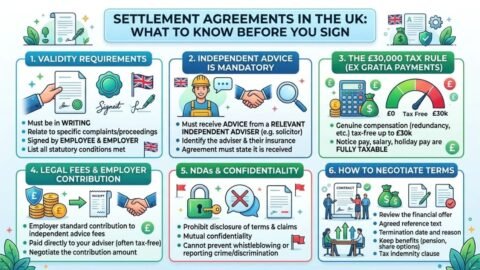
Many cases settle before a hearing, often through a settlement agreement. Do not sign one without independent advice. By law, you must receive advice for the agreement to be valid, and employers often contribute to the cost.
Time limits: act quickly
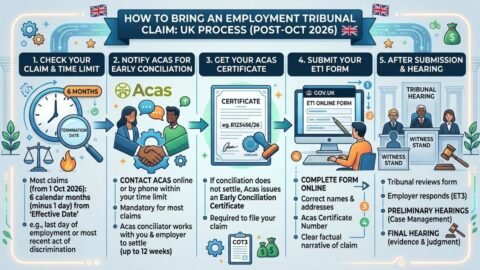
- Six months (less one day) from the effective date of termination for most tribunal claims, where the time limit starts on or after 1 October 2026. For earlier dismissals, the limit was three months less one day.
- Acas early conciliation comes first. You must contact Acas before you can bring a claim. The process pauses the clock, and gives you extra time in some cases, but do not leave it late.
- Breach of contract claims in Scotland follow a separate date of 9 November 2026 for the longer limit.
Tribunals are strict about time limits, and only rarely extend them. If in doubt, contact Acas immediately and keep a record of the dates.
What to do if you have been dismissed: step by step
- Check the date and your service. Work out your effective date of termination, and how long you had worked for your employer. Remember that from 1 January 2027 six months’ service is enough.
- Get the reason in writing. Employees with the qualifying service can ask for a written statement of reasons, and your employer must provide it within 14 days.
- Keep evidence. Save your contract, emails, messages, performance reviews, warning letters, notes of meetings and payslips.
- Use any appeal. If your employer offers an appeal, use it. Appealing does not stop you making a claim, but it can show you tried to resolve things, and may lead to your reinstatement.
- Raise a grievance if your issue is about how you were treated.
- Contact Acas for free, confidential advice and to start early conciliation. Its helpline can explain your options.
- Get advice. Consider a trade union, Citizens Advice, a law centre or an employment solicitor. Some home insurance, bank accounts and unions include legal expenses cover.
- Protect your income. Claim any unpaid wages, notice pay and holiday pay owed to you. You may also qualify for Universal Credit. See our guide to holiday entitlement and holiday pay.
- Look for work. You have a duty to try to reduce your loss, and keeping records of your applications helps. Browse vacancies on our jobs board and update your CV. See our guide to common interview questions and answers in the UK for how to talk about a dismissal.
- Decide whether to bring a claim, and, if so, submit it within the time limit after conciliation.
Making a tribunal claim: the basics
- Early conciliation certificate. After you contact Acas, you receive a certificate which you need to submit your claim.
- The claim form. You submit it online to the employment tribunal, setting out what happened and what you want.
- Your employer’s response, followed by case management, document exchange and a hearing.
- Costs. There are no tribunal fees to bring a claim, but you may have legal costs if you hire a lawyer. In most cases each side pays its own costs.
- Timescales. Cases can take months, so many people settle.
Tribunals and procedures are different in Scotland and Northern Ireland, so check the local guidance.
Special situations
- Dismissed after complaining about pay or sick pay. This may be automatically unfair if it relates to a statutory right. Contact Acas.
- Off sick or disabled. Dismissing you because of ill health can be fair if the employer follows a proper process and considers adjustments, but dismissal because of your disability or for absence linked to it can be discrimination. See our guide to Statutory Sick Pay 2026.
- Zero-hours and agency workers. Ordinary unfair dismissal applies only to employees, but other rights may apply to workers.
- Dismissed for refusing a change to your terms. The new rules on “fire and rehire” are due to tighten protection. Check GOV.UK for the latest.
- Dismissed for a spent conviction. From 2027 this will be unfair without a qualifying period.
- Dismissed while right to work is in question. If you genuinely lose the right to work, dismissal can be lawful. See our guide to right to work checks in the UK.
What this means if you are starting a job now
The changes mean that the first six months of a job matter more for employers, and that new starters will gain protection sooner than before. Keep your offer letter and contract, make a note of your start date and check your probation terms. Our guide to understanding your employment contract explains what to look for, and our guide to payslips, tax codes and National Insurance helps you check your records.
Frequently asked questions
How long do I need to work to claim unfair dismissal? Currently two years. For dismissals ending on or after 1 January 2027, six months. Some claims, such as for whistleblowing or discrimination, need no qualifying service.
When does the six-month rule start? 1 January 2027. Whether it applies depends on the date your employment ends, and service before then counts.
If I started a job in September 2026, can I claim after 1 January 2027? Not yet. You need six months’ service when your employment ends, so you would qualify from 1 March 2027.
Is the unfair dismissal compensation cap being removed? Yes. For dismissals ending on or after 1 January 2027, the cap on the compensatory award is removed. Until then it is the lower of £123,543 or 52 weeks’ gross pay. The basic award remains capped at £22,530.
What is the time limit for an unfair dismissal claim? Six months less one day for dismissals on or after 1 October 2026, after contacting Acas for early conciliation. It was three months for earlier events.
What are the fair reasons for dismissal? Conduct, capability or qualifications, redundancy, statutory illegality and some other substantial reason, provided the employer acts reasonably.
Can I be dismissed during probation? Yes, but notice, discrimination and automatic unfair dismissal protections still apply. After the six-month rule starts, a dismissal after six months of service will need a fair reason and process.
What if I resigned because of how I was treated? You may be able to claim constructive dismissal, but it is hard to prove. Get advice before you resign.
Do I need a solicitor to bring a claim? No, but advice is valuable. Acas, unions and Citizens Advice can help, and there are no tribunal fees.
Do the new rules apply in Northern Ireland? No. Northern Ireland has its own employment law, so check the Labour Relations Agency.
Final thoughts
Unfair dismissal law is shifting in favour of people in newer jobs, but time limits are strict and the details matter. Keep records, get the reason in writing, contact Acas early and take advice before you decide what to do. When you are ready to look for your next role, browse the latest vacancies on our jobs board.
This article is general information, not legal advice. Employment law is complex, and the 2027 changes apply by reference to dates. For advice on your situation, contact Acas, Citizens Advice, a trade union or a qualified employment solicitor, and check GOV.UK for the latest rules.