How to Get a Job With a Criminal Record in the UK
Having a criminal record does not mean you cannot get a job. Millions of people in the UK have a conviction or caution, and many employers are willing to hire them. But the rules on when you must tell an employer, what shows up on background checks and which jobs are closed to you can be confusing, and mistakes can cost you an offer. This guide explains how criminal records work in the UK, when you have to disclose, what the different DBS checks show, how to talk about your past at interview, and where to find help and fair-chance employers.
Quick answer: You only have to tell most employers about unspent convictions, and only if they ask. Once a conviction is spent, you generally do not need to mention it, unless the job is one of the roles that is exempt from the rules, such as working with children or vulnerable adults. Always answer honestly when you are asked a lawful question, because lying can lose you the job.
The rules below mainly apply in England and Wales. Scotland and Northern Ireland have their own rules, so check Disclosure Scotland and AccessNI if you live there.
Spent and unspent convictions
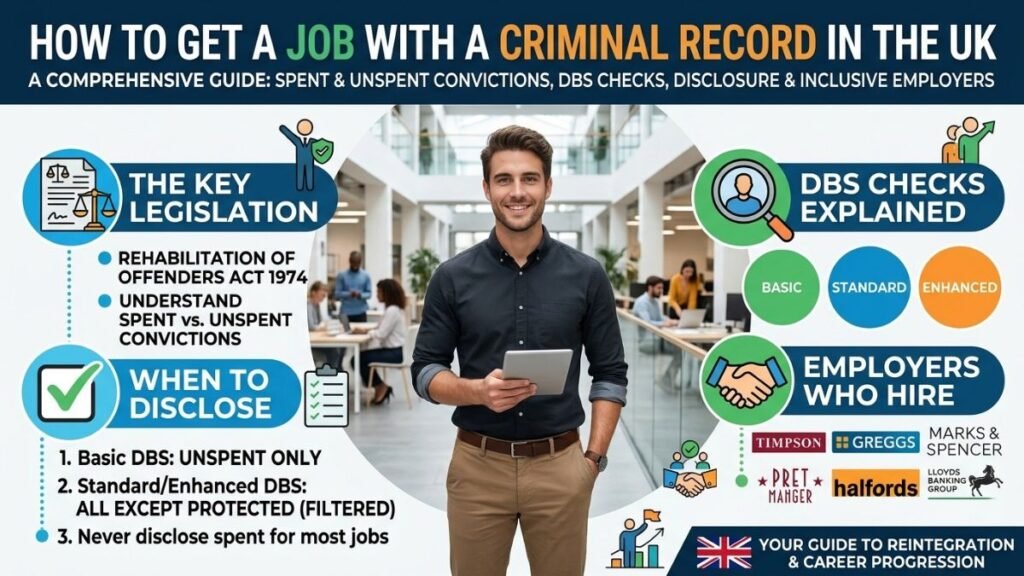
The Rehabilitation of Offenders Act 1974 lets many convictions become “spent” after a set period, meaning you are treated as rehabilitated. How long this takes depends on the sentence, not the offence, and on whether you were an adult or a child when convicted.
- Unspent: the rehabilitation period has not yet finished. You usually must declare it if an employer asks.
- Spent: the period has ended. You do not have to declare it to most employers, and they generally cannot lawfully refuse to employ you because of it.
Rehabilitation periods for adults in England and Wales
Rules changed on 28 October 2023, shortening many periods. For adults (18 or over at conviction), the periods for custodial sentences are now roughly:
| Custodial sentence | Spent after |
|---|---|
| Up to 1 year (including suspended sentences of that length) | About 1 year after the sentence ends |
| More than 1 year and up to 4 years | 4 years after the sentence ends |
| More than 4 years | 7 years after the sentence ends |
| More than 4 years for serious violent, sexual or terrorism offences, and life or indeterminate sentences | Never spent |
The period starts when the sentence is completed, which includes any time on licence. Other sentences, such as fines and community orders, generally have shorter periods, often around a year, and periods for people convicted under 18 are shorter. A new conviction can affect how your old ones are treated. These are summaries, so use the official calculators and guidance to check your own case. Charities such as Unlock explain how to work out when a conviction becomes spent.
For the first time, sentences of more than four years can become spent. Before the 2023 changes, they were never spent.
What employers can ask and what you must say
- Application forms and interviews. Employers may ask whether you have unspent convictions. You must answer truthfully. If your conviction is spent, you can usually say you have no criminal record, unless the job is exempt.
- Exempt roles. For certain jobs and professions, you may be asked about spent convictions too (apart from those that are “protected” by the filtering rules below). This includes working with children or vulnerable adults, many roles in healthcare, teaching and social work, law, accountancy and financial services, security and some other regulated work.
- Don’t lie. If you give false information and it is discovered, you could be refused a job or dismissed. If you are unsure whether to declare something, get advice before you apply.
- Employers cannot withdraw an offer simply because of a spent conviction, if the job is not an exempt one. Some employers may ask about your record as a condition of the offer.
- Employers also run background checks in some sectors, and they can only ask for the level of check that is allowed for the job.
If an application form asks “Do you have a criminal record?” without saying unspent, it is worth checking with Unlock or Acas what you should answer.
DBS checks explained
In England and Wales, the Disclosure and Barring Service (DBS) provides criminal record checks. In Scotland the equivalent is Disclosure Scotland, and in Northern Ireland, AccessNI. There are three levels:
| Check | What it shows | Who can ask for it |
|---|---|---|
| Basic | Unspent convictions and conditional cautions only | Anyone. Employers can ask you to provide one for most jobs |
| Standard | Spent and unspent convictions and cautions, subject to filtering | Only for jobs listed in the law, such as some roles in security, law and finance |
| Enhanced | Everything on a standard check, plus relevant police information, and (with a barred list check) whether you are barred from working with children or adults | Only for jobs such as teaching, care and health roles that work with children or vulnerable adults |
Employers cannot ask for a standard or enhanced check unless the job qualifies by law. For many ordinary jobs, only a basic check can be requested.
Filtering rules
For standard and enhanced checks, some old and minor convictions are filtered out, which means they are not shown. As a general rule, a conviction is filtered if:
- It is more than 11 years old (or 5.5 years if you were under 18 at the time), and
- It did not result in a custodial sentence, and
- It is not on the list of specified offences that are always disclosed, such as certain serious violent and sexual offences
Any custodial sentence is never filtered, and the same applies to the listed offences. The filtering rules were amended on 28 October 2023, so some people now see more unspent convictions on standard and enhanced checks than before. The date on your certificate tells you which rules were applied.
Know your own record
Before applying, find out exactly what is on your record so you can answer questions accurately. You can apply for a basic check yourself through GOV.UK, which costs around £18 in England and Wales (check the current fee). You can also ask the police for information they hold about you. Charities like Unlock can help you understand what will show up.
Jobs that may be harder to get
Some careers have stricter rules about criminal records, though it depends on the offence, how long ago it was and your circumstances.
- Working with children and vulnerable adults: teaching, care, nursing and health roles require enhanced checks and may involve barred lists. See our guides to care worker jobs, teaching assistant jobs and NHS jobs.
- Security: SIA licences have published criminal record criteria. See our guide to how to get an SIA licence. Airport and airside roles require vetting and a criminal record check. See our guide to how to get an airport job in the UK.
- Finance, law and regulated professions: these often require standard or enhanced checks and have their own fitness and propriety tests.
- Driving jobs: motoring convictions and points can affect licences and insurance. See our guides to HGV driver jobs and delivery driver jobs.
- Government and some public sector roles, which can involve security clearance.
It is still worth checking the specific rules, because in many cases people with convictions are accepted after a risk assessment.
Jobs and sectors that are often more open
Many employers focus on skills and reliability, particularly where staff are hard to recruit. Sectors where people with criminal records often find work include:
- Construction and trades. See our guide to CSCS cards and construction jobs.
- Warehouse, logistics and manufacturing. See our guide to warehouse jobs.
- Hospitality and catering. See our hospitality jobs guide.
- Cleaning and facilities services. See our cleaning jobs guide.
- Retail and customer service, where some employers use a basic check only.
- Self-employment and starting a business, which has its own rules, such as tax and insurance. Some people retrain as tradespeople or freelancers.
Some employers have publicly signed up to fair-chance or “Ban the Box” recruitment, which means they do not ask about criminal records at the first stage of an application. Companies such as Timpson and Greggs are often cited as examples of employers that actively recruit people with convictions, though policies change, so check each employer’s own information.
You can browse current vacancies on our UK jobs board.
How to apply: step by step
- Find out what is on your record, and whether each conviction is spent or unspent.
- Check the job. Read the advert and the employer’s recruitment information, and see whether the job needs a basic, standard or enhanced check or is exempt.
- Choose employers who are open to fair chances. Look for those that mention recruiting people with convictions, or use a basic check only.
- Prepare your CV. Focus on your skills, qualifications, training and strengths. See our guides to writing a UK CV with no experience and writing a cover letter in the UK.
- Be ready to explain gaps. If you were in prison, you do not have to give details on your CV. You can say “career break” or describe the courses, qualifications or work you did in custody.
- Decide when and how to disclose, following the legal rules and the employer’s process. See below.
- Prepare for interview, including how you will talk about your past. See our guide to common interview questions and answers in the UK.
- Complete the checks honestly and on time.
- Check any offer in writing. Our guide to understanding your employment contract explains what to look for.
Telling an employer about your record
The best approach depends on whether the conviction is spent, what the form asks and how the employer handles disclosure.
- Follow the process. If the application form asks, answer honestly. If it does not ask, you do not need to volunteer a spent conviction for a non-exempt job.
- Choose your moment. If you have an unspent conviction, many people find it works best to disclose at a point that gives them the chance to explain, such as in a separate section or at interview, but always follow the employer’s own rules.
- Be brief and factual. State what the conviction was, when it happened and that it is behind you. Do not over-explain.
- Take responsibility. Avoid blaming others, and avoid minimising what happened.
- Show what has changed. Talk about what you have done since: work, training, volunteering, stable housing, support and the skills you gained.
- Link it to the job. Explain why you are a safe, reliable choice, and offer references from probation officers, tutors, employers or support workers if relevant.
- End on the positive. Return to your skills and why you want the job.
Example wording for an unspent conviction:
“I want to be upfront that I have a conviction from three years ago. I took full responsibility and completed my sentence. Since then I’ve completed a forklift training course, worked steadily and received positive feedback from my last employer. I’m keen to show you I’m reliable, and I’m happy to answer any questions.”
Practise saying this out loud until it feels natural.
Support and help
Several organisations offer free, practical help:
- Unlock. A charity that supports people with criminal records, with clear guidance on disclosure, DBS checks and the rehabilitation rules.
- Nacro. A charity that supports people leaving prison, with advice, training and housing support.
- Jobcentre Plus. Work coaches, including prison leaver support in many areas, can help with job searches, CVs and training.
- The National Careers Service. Free careers advice, CV help and skills assessments.
- Probation services. Your probation officer may help with references, training and work referrals.
- Local charities and employment programmes, many of which work with employers who are open to hiring people with convictions.
- Acas. Free advice if you think you have been treated unfairly at work because of a spent conviction.
- Citizens Advice. Help with benefits, debt and housing.
If you are in custody or being released, ask your prison employment lead or resettlement team about training and job opportunities before release.
Your rights
- Spent convictions. In most cases, you do not have to disclose them, and employers cannot lawfully refuse to employ you because of them, unless the job is exempt.
- Protection from unfair treatment. If an employer withdraws an offer or dismisses you because of a spent conviction, in a non-exempt job, seek advice from Acas or Unlock.
- Minimum wage and standard rights. You have the same rights to the minimum wage, holiday pay and sick pay as other workers. See our National Minimum Wage 2026 guide and our guide to Statutory Sick Pay 2026.
- Right to work. Your criminal record does not affect your right to work, and you will still need to prove it. See our guide to right to work checks in the UK.
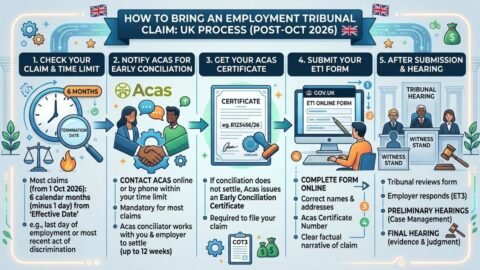
- Time limits. The time limit for most employment tribunal claims is six months for events on or after 1 October 2026, and you must go through Acas early conciliation first.
Scams and exploitation to watch for
People with criminal records can be targeted by scammers and exploitative employers who assume they have few options. Be careful of:
- Anyone who asks for money to find you a job or to “clear” or “hide” your record. No one can erase a criminal record for a fee.
- Cash-in-hand work with no contract or payslip, which leaves you without holiday pay, sick pay or protection.
- Offers that seem too good to be true, such as high pay for little work.
- Anyone asking you to move money, receive parcels or lend your bank account, which can lead to new offences.
- Fake adverts that collect your documents and bank details.
Read our guide to how to spot a fake job advert in the UK for a full checklist.
Frequently asked questions
Do I have to tell an employer about my criminal record? Only about unspent convictions, and only if they ask, for most jobs. For exempt roles, such as working with children or vulnerable adults, you may need to declare spent convictions too, apart from those that are filtered.
When does a conviction become spent? It depends on the sentence and your age at conviction. For adults in England and Wales, a custodial sentence of up to one year is spent about one year after the sentence ends, one to four years after four years, and over four years after seven years, unless it is a serious violent, sexual or terrorism offence, which is never spent.
What is the difference between a basic, standard and enhanced DBS check? A basic check shows unspent convictions. A standard check also shows spent convictions and cautions, subject to filtering. An enhanced check adds relevant police information and, for some jobs, a barred list check.
Can I get a job with a criminal record? Yes. Many employers hire people with convictions, especially in sectors with staff shortages. Some regulated jobs have stricter rules, and each case depends on the offence and the role.
Can an employer withdraw a job offer because of a conviction? If the conviction is spent and the job is not exempt, they generally cannot lawfully do so. For unspent convictions, employers can consider relevance and risk.
Should I put my criminal record on my CV? No. You do not need to put it on your CV. Disclose it when it is asked about, following the employer’s process.
How can I find out what is on my record? Apply for a basic disclosure certificate yourself through GOV.UK, and ask Unlock for guidance on how to read it.
Where can I get help? Unlock, Nacro, Jobcentre Plus, the National Careers Service, your probation officer and Acas can all help.
Final thoughts
A criminal record makes some jobs harder to get, but it does not shut every door. Know your record, understand which convictions are spent, be honest, prepare to talk about your past in a short and positive way and aim for employers who give people a fair chance. When you are ready, browse the latest vacancies on our jobs board and apply directly with employers.
This article is general information, not legal advice. Rules on spent convictions, DBS checks and disclosure are detailed and differ across England and Wales, Scotland and Northern Ireland. Check GOV.UK, Unlock and Nacro for the latest guidance, and seek advice about your own situation.