Graduate Jobs and Schemes in the UK: Pay, Deadlines and How to Apply
If you are finishing university, or have graduated recently, the graduate job market in 2026 is competitive. Large employers open applications for 2027 graduate schemes this autumn, and many close in the following weeks. This guide explains what graduate schemes and graduate jobs are, what they pay, when to apply, how the selection process works, how to stand out and what your options are if you do not get a place on a scheme.
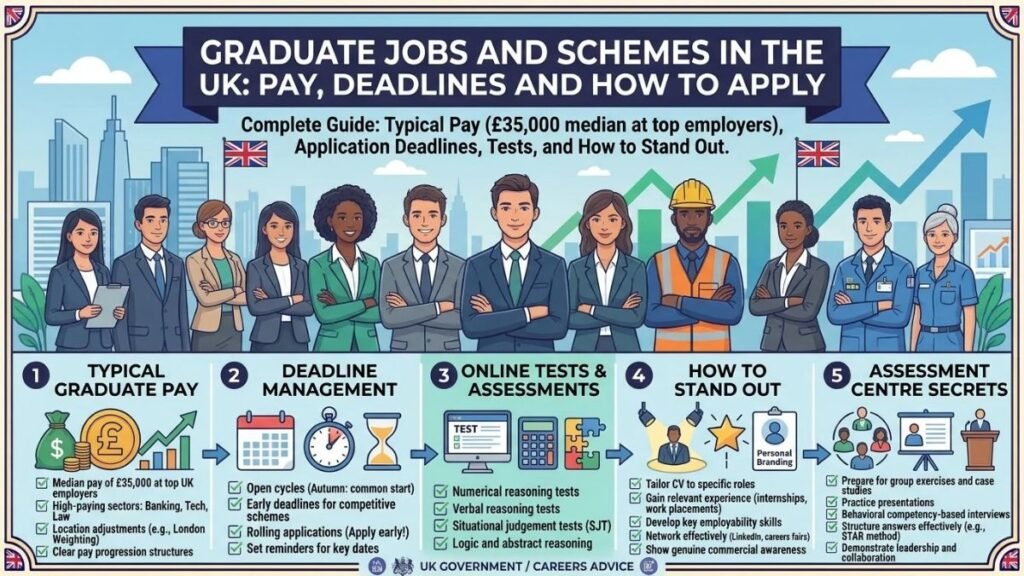
Quick answer: Many large employers open applications for autumn 2027 graduate schemes from September to October 2026 and accept them until the end of the year or early January, sometimes closing earlier once places fill. The median starting salary at the UK’s top 100 graduate employers is about £35,000, though across the wider market graduates start nearer £30,000 to £33,000. Competition is intense, with an average of around 140 applications per vacancy.
Graduate scheme or graduate job?
The two terms are used loosely, but there is a difference.
| Graduate scheme | Graduate job | |
|---|---|---|
| What it is | A structured training programme, usually 1 to 3 years, with a cohort of graduates, rotations or set development | A normal role that happens to need a degree, with training on the job |
| Who offers it | Large employers, such as banks, law firms, consultancies, the civil service, retailers and engineering firms | Employers of all sizes, including small and medium-sized businesses |
| How you apply | Online applications in a fixed annual cycle, with tests and assessment centres | Job adverts all year round, with a normal CV and interview process |
| Pay | Often higher, with a clear progression structure | Varies widely |
| Competition | Very high, with large numbers of applicants | Varies |
Both can lead to excellent careers. Many people take a graduate job at a smaller employer and progress quickly.
The graduate market in 2026
The numbers help you set realistic expectations.
| Measure | Latest figure |
|---|---|
| Graduate vacancies at the UK’s top 100 employers | At their lowest level since 2012, down about a quarter over three years (High Fliers, The Graduate Market in 2026) |
| Expected change in recruitment at top employers in 2026 | About 0.5% fewer graduates than in 2025, a much smaller fall than in recent years |
| Applications per graduate vacancy | An average of about 140 in 2025, a record, though the typical (median) vacancy drew about 97 (Institute of Student Employers) |
| Median starting salary at top 100 employers | About £35,000 (High Fliers) |
| Average starting salary across the Institute of Student Employers sample | About £32,000 to £33,000 |
| Median salary of graduates in full-time work 15 months after leaving | About £28,500 (HESA Graduate Outcomes 2022/23) |
| Highest-paying schemes | Investment banks, law firms and consultancies, with starting salaries of £50,000 or more |
These figures come from different surveys with different samples, so they do not match. Top employers’ schemes pay more than the typical graduate job, and many graduates start on less than £35,000. Competition varies by sector and employer, and employers are also increasing other entry routes, such as apprenticeships.
How much do graduates earn?
Pay depends on the sector, employer, location and your degree.
| Sector | Typical starting salary |
|---|---|
| Investment banking, top law firms and consulting | £50,000 and above |
| Technology and engineering | Often £30,000 to £40,000, varying by role |
| Accountancy and finance | Around £28,000 to £35,000 at large firms |
| Retail and consumer goods | Around £30,000 to £36,000, with some schemes higher |
| Public sector and civil service | Around £30,000, with some schemes slightly higher |
| Healthcare, education and charities | Often lower, with set pay scales |
These ranges come from industry guides and surveys that differ, and London usually pays more. Check each employer’s advert. For comparison, the legal minimum is £12.71 an hour for workers aged 21 and over (about £24,800 a year for 37.5 hours a week), £10.85 for ages 18 to 20 and £8.00 for apprentices. See our National Minimum Wage 2026 guide.
Take-home pay and student loans
Your take-home pay will be lower than your salary after Income Tax, National Insurance, pension and student loan repayments. For 2026/27 the annual repayment thresholds are about £26,900 (Plan 1), £29,385 (Plan 2), £33,795 (Plan 4) and £25,000 (Plan 5), with repayments of 9% of earnings above the threshold. See our guide to payslips, tax codes and National Insurance for how these are calculated.
When to apply: the graduate recruitment calendar
The main graduate scheme cycle follows an annual pattern.
| When | What happens |
|---|---|
| Late summer to autumn (August to October) | Many large employers open applications for schemes starting the following summer or autumn |
| October to December | Application deadlines for many popular schemes, though some close earlier, and some employers review applications on a rolling basis and fill places as they go |
| Autumn to early winter | Online tests, video interviews and first-round selection |
| January to March | Assessment centres and final interviews, with some employers making offers |
| Spring and summer | Later schemes, smaller employers and graduate jobs advertised year-round |
Check each employer’s own website for exact dates. If a scheme takes applications on a rolling basis, apply early, because places can fill before the stated deadline. If you have missed the main cycle, do not worry. Many graduate jobs are advertised throughout the year, and some schemes recruit later.
Types of graduate employers and schemes
- Finance and professional services: banks, accountancy firms, law firms, consultancies and insurers
- Technology and engineering: software, data, cyber security, engineering, utilities, manufacturing and construction
- Public sector: the Civil Service Fast Stream, the NHS graduate management scheme, local government and the police and teaching routes
- Retail and consumer goods: supermarkets, brands, logistics and retailers with buying, supply chain and management schemes
- Education and public service programmes: teacher training and leadership programmes for schools and social work
- Charities and the voluntary sector
- Small and medium-sized businesses, which recruit graduates directly with less structure but often more responsibility early on
See our guides to NHS jobs and how to become a nurse in the UK for healthcare routes, and browse current vacancies on our UK jobs board.
How the selection process works
Graduate scheme applications usually follow several stages. Each can knock candidates out, so prepare for all of them.
1. The online application
You submit a CV, answer questions about your motivation and experience and sometimes write short competency answers of a few hundred words. Some employers use CV scanning and screening questions. See our guides to writing a UK CV with no experience and writing a cover letter in the UK.
2. Online tests (psychometric tests)
Common types include:
- Numerical reasoning: interpreting tables, charts and figures
- Verbal reasoning: understanding passages and judging statements
- Situational judgement tests: choosing responses to realistic workplace scenarios
- Logical or abstract reasoning, for some roles
- Game-based assessments, used by some employers
Practise free sample tests before the real thing, find a quiet place and read the instructions carefully.
3. Video interview
Many employers use a one-way video interview where you record answers to questions with a time limit, sometimes with an AI-assisted review. Prepare using the STAR method and test your camera and microphone. See our guide to common interview questions and answers in the UK.
4. Assessment centre
An assessment centre can be in person or online and usually includes several of:
- Group exercises, where you work with other candidates
- Presentations or case studies
- In-tray or written exercises
- Interviews, often competency-based
- Informal networking with current graduates and managers
Employers assess how you work with others and what you contribute, not only your answers.
5. The offer
Successful candidates receive an offer, which may be conditional on your degree result, references and checks. Check the details, including salary, start date, location and contract. See our guide to understanding your employment contract.
How to stand out
- Start early and plan. Many applications take several hours each, and the best ones take longer. Block out time before each deadline.
- Be selective and tailor each application. Quality beats volume. Research each employer, its values and the role. Some guidance suggests applying to a sensible spread of schemes, such as 10 to 25, depending on your field.
- Show evidence, not claims. Use real examples of teamwork, leadership, problem solving and results from your degree, jobs, societies and volunteering.
- Get work experience. Internships, placements, summer jobs, volunteering and part-time work all count. See our guide to part-time jobs for students in the UK.
- Use your university careers service. It offers CV checks, practice tests, mock interviews and employer events, often for free and after you graduate.
- Practise tests and interviews. Use free practice tests, mock interviews and the STAR method.
- Network. Attend careers fairs and employer events, speak to current graduates and use LinkedIn.
- Proofread carefully. Spelling and grammar errors can end an application.
- Use AI tools carefully. They can help you structure answers or practise, but employers want your own voice and honest examples. Check each employer’s rules on AI in applications, and never submit text you cannot explain.
- Be resilient. Most candidates are rejected many times. Ask for feedback and keep improving.
If you do not get a place on a scheme
Graduate schemes are only one route. Many graduates build excellent careers through other paths.
- Graduate jobs outside schemes. Many small and medium-sized employers hire graduates directly, often all year round.
- Degree apprenticeships and graduate apprenticeships. You earn while you learn, and employers are increasing apprenticeship hiring. See our guide to apprenticeships in the UK.
- Internships and temporary work that can lead to permanent roles. Temping in admin or customer service can build experience. See our guides to admin and office jobs and call centre jobs.
- Public sector and charity roles, including councils, the NHS and national organisations.
- Further study or professional qualifications, such as a masters, teaching qualification, accountancy training or conversion course, if it fits your goals.
- Part-time work, volunteering and building skills while you search.
- Self-employment and freelance work, using your skills. See our guide to how to become self-employed in the UK.
- Working abroad or on a gap year, if that fits your plans.
It is normal to take several months to find a graduate role. In the meantime, a part-time job provides income and experience.
Special situations
International graduates
If you studied in the UK on a Student visa, you may be able to apply for the Graduate visa, which lets you work after your degree. The length of permission has been two years for most graduates (longer for some doctorates), and the government has said it will fall to 18 months for new applicants from 1 January 2027, so check the latest on GOV.UK. After the Graduate visa, you would normally need an employer to sponsor you, usually through the Skilled Worker route, which has a salary threshold, with lower rates for some new entrants. See our guides to jobs with visa sponsorship in the UK and right to work checks in the UK. Ask employers early whether they sponsor.
Graduates with disabilities or health conditions
You have the right to reasonable adjustments in applications, tests and interviews, and Access to Work can fund support. Some employers offer a guaranteed interview through Disability Confident. See our guide to disability and work in the UK.
Mature graduates and career changers
If you graduated later in life, your work experience is an asset. See our guide to jobs for over 50s and returners in the UK.
Graduates with a criminal record
Some schemes and professions have extra checks. See our guide to how to get a job with a criminal record in the UK.
Your rights and money as a new graduate employee
- Pay. You are entitled to at least the minimum wage for your age. Check your payslip.
- Probation. Many graduate contracts have a probation period. See our guide to probation periods and your rights as a new employee.
- Sick pay and holiday. Since April 2026, Statutory Sick Pay is payable from the first day for eligible employees. See our guides to Statutory Sick Pay 2026 and holiday entitlement and holiday pay.
- Flexible working. You can request it from day one. See our guide to flexible working in the UK.
- Negotiating your offer and future pay. It is reasonable to ask politely about salary and benefits. See our guide to how to ask for a pay rise or negotiate salary in the UK.
- Notice. Check your notice period. See our guide to notice periods in the UK.
Scams targeting graduates
Graduates and students are often targeted by scammers. Watch for:
- Fake graduate adverts that look like real schemes but ask you to pay for training, assessments, uniforms or “registration”
- Offers via WhatsApp, Telegram or social media with no interview or named recruiter
- Remote jobs that promise high pay for simple tasks, or ask you to move money or receive parcels
- Fake recruiters or agencies that copy the names of well-known employers
- Requests for your passport, bank details or National Insurance number before you have an offer
Real graduate employers never charge to apply. Check the employer’s own careers page and apply directly. See our guides to how to spot a fake job advert in the UK and work from home jobs in the UK.
A simple action plan
- Decide what you want. Choose two or three sectors and roles that interest you.
- List deadlines. Create a calendar of application dates, and apply early where schemes recruit on a rolling basis.
- Update your CV and LinkedIn and write a strong generic cover letter you can adapt.
- Practise tests and interviews using free resources and your careers service.
- Apply to a mix of schemes and graduate jobs. Include some less well-known employers.
- Gain experience alongside your search, through part-time work or volunteering.
- Ask for feedback after rejections and use it.
- Keep your options open, including apprenticeships, public sector roles and further study.
- Check offers carefully before you accept.
- Look after yourself. The process can be stressful, and your university or student support service can help.
Frequently asked questions
When do graduate scheme applications open? Many employers open applications for the following year’s schemes from September to October, and accept them until the end of the year or early January, though some close earlier.
How much do graduates earn in the UK? The median starting salary at the UK’s top 100 graduate employers is about £35,000. Other surveys put average graduate starting salaries around £30,000 to £33,000, and graduates overall have a median of about £28,500 around 15 months after leaving university.
How competitive are graduate schemes? Very. An Institute of Student Employers survey found an average of about 140 applications per vacancy in 2025, with a median of about 97. Competition varies by employer and sector.
Do I need a 2:1 for a graduate scheme? Many employers ask for a 2:1, but some have dropped or relaxed the requirement. Check each scheme.
What is a psychometric test? An online test of skills such as numerical and verbal reasoning, or how you respond to workplace situations. Practise sample tests first.
What if I miss the graduate scheme deadlines? Graduate jobs are advertised all year, and some schemes recruit later. Apply to roles at smaller employers, and consider apprenticeships or temporary work.
Can international graduates work in the UK after a degree? Possibly, on the Graduate visa, subject to eligibility. The government has said the length of permission will fall to 18 months from 1 January 2027, so check GOV.UK.
Are graduate apprenticeships a good alternative? They can be. You earn a wage, may get a degree without tuition fees and gain experience. See our apprenticeships guide.
Do I have to pay to apply for graduate jobs? No. Anyone asking for payment to apply is probably a scammer.
Final thoughts
The graduate market is tough but not closed. Start early, apply selectively, practise the tests and interviews and keep a flexible mind about routes. When you are ready, browse the latest vacancies on our jobs board and apply directly with employers.
This article is general information, not careers or financial advice. Pay data, deadlines and visa rules change often. Check each employer’s website, GOV.UK and your university careers service for the latest details.