Disciplinary and Grievance Procedures in the UK: Your Rights and the Acas Code
If your employer raises a concern about your conduct or performance, or you have a serious complaint about how you are being treated, there are set ways to deal with it. These are called disciplinary and grievance procedures. Knowing how they should work, and what the Acas Code of Practice says, can protect your job and help you resolve problems fairly. This guide explains both processes step by step, your right to be accompanied, what employers must do, how tribunals treat unfair procedures and what is changing as Acas updates its Code.
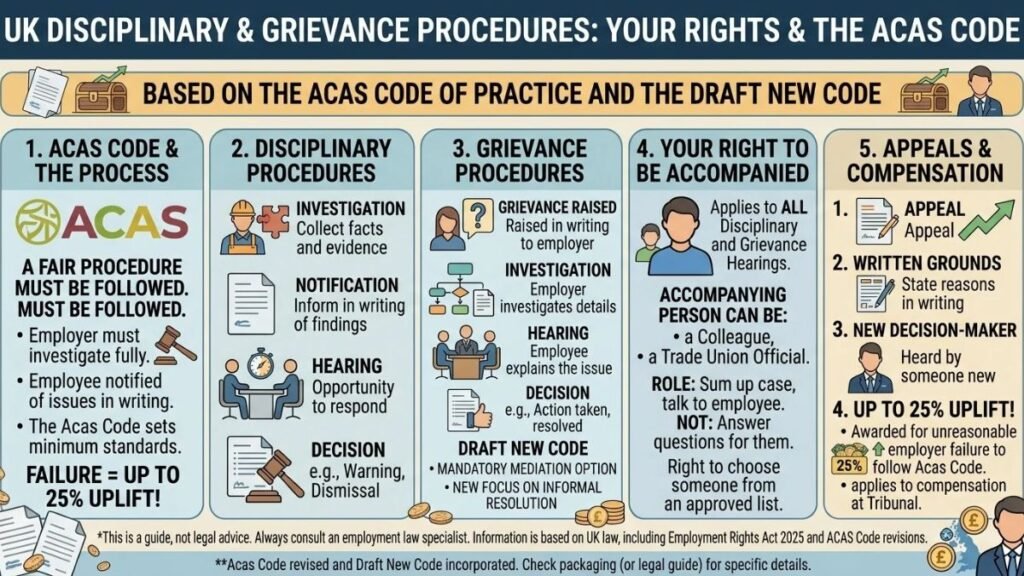
Quick answer: A fair disciplinary process involves an investigation, written notice of the allegations, a meeting where you can respond and bring a companion, a decision in writing and a right of appeal. For a grievance you raise a complaint in writing, attend a meeting and receive a written outcome with a right of appeal. A tribunal can increase or reduce compensation by up to 25% if an employer (or employee) unreasonably fails to follow the Acas Code.
What are disciplinary and grievance procedures?
- A disciplinary procedure is the process an employer uses when it has concerns about an employee’s conduct (how they behave) or capability (how well they do the job). It can lead to warnings or, in serious cases, dismissal.
- A grievance procedure is the process an employee uses to raise a complaint about their employer, manager, colleagues, pay, treatment or working conditions.
Both should be set out in your contract, staff handbook or on the company intranet. Employers must also give you a written statement of your terms that points to the procedures. Our guide to understanding your employment contract explains where to look.
The Acas Code of Practice
The Acas Code of Practice on disciplinary and grievance procedures sets out the basic standards of fairness that employers and employees should follow. Key points:
- It is not law, but employment tribunals must take it into account when deciding cases.
- If an employer unreasonably fails to follow it, a tribunal can increase an employee’s compensation by up to 25% in many types of claim. If the employee unreasonably fails to follow it, for example by not using the grievance procedure, the tribunal can reduce compensation by up to 25%.
- The uplift or reduction applies to claims by employees. Acas encourages employers to follow the Code for workers too, and the right to be accompanied applies to workers.
- The current Code was last revised in 2015.
A revised Code is on the way
Acas published a new draft Code for consultation on 30 July 2026, and the consultation closed on 23 September 2026. It is the first full rewrite in many years. The draft proposals include:
- A much stronger emphasis on informal resolution before starting a formal process
- Clearer limits on when and how suspension is used, and how it is communicated
- A new section on mediation and facilitated conversations
- Updated guidance on the right to be accompanied
- Clearer expectations on reasonable adjustments for disabled workers in these processes
- A request for views on how AI is used in disciplinary and grievance processes
- Using the word “workers” rather than “employees” as its default term
The draft is not yet in force. After consultation, the final Code must be approved and laid before Parliament, so the current Code still applies. Check Acas and GOV.UK for updates before you rely on any of the proposed changes.
Disciplinary procedures: how they should work
Informal first
For minor concerns, a good employer will first try an informal conversation to explain the problem and what needs to change. An informal chat is not formal disciplinary action. There is no legal right to be accompanied at an informal conversation, and an informal meeting should not lead to formal disciplinary action. If the problem continues or is serious, the employer may start the formal process.
The formal process: step by step
- Investigation. The employer should establish the facts, usually by gathering evidence and speaking to witnesses. The person doing it should be impartial, and the investigation should be proportionate. There is generally no statutory right to be accompanied at an investigation meeting, though your employer’s policy may allow it.
- Written notice. If the employer decides there is a case to answer, it should write to you setting out the allegations, the possible consequences (including dismissal if that is possible), the evidence it has, and the date, time and place of the hearing. You should get reasonable notice to prepare.
- The disciplinary hearing. You have the right to explain your side, ask questions, present evidence and call witnesses. You have the statutory right to be accompanied (see below).
- The decision. The employer decides whether action is justified. It should tell you in writing, with reasons, what the outcome is.
- The sanction. Depending on the seriousness, this can be no action, a verbal or written warning, a final written warning, demotion or transfer (if allowed by your contract) or dismissal.
- The right of appeal. You should be told how to appeal and who to appeal to. The appeal should be heard by someone who was not previously involved, wherever possible, and you have the right to be accompanied at it.
At each stage, your employer should act consistently with how it has treated others in similar situations, and the decision must be reasonable.
Misconduct and gross misconduct
- Misconduct covers matters such as poor timekeeping, absence without permission, breaking rules or inappropriate behaviour. It normally leads to warnings first.
- Gross misconduct covers very serious acts such as theft, violence, serious dishonesty or serious breaches of health and safety. An employer may dismiss without notice, but should still follow a fair process and investigate before deciding.
Your contract or handbook should give examples of what counts as gross misconduct.
Poor performance (capability)
If the concern is about how well you do your job, rather than misconduct, a fair employer will usually:
- Explain clearly what is expected and where you are falling short
- Give you training, support and a reasonable time to improve
- Review progress and warn you of the consequences if there is no improvement
- Consider whether health problems or a disability are affecting your performance, and whether reasonable adjustments are needed. See our guide to disability and work in the UK.
Suspension
An employer may suspend you during an investigation, but suspension should not be automatic and should be as short as possible. The draft Code proposes to limit suspension to situations where there is a risk to the investigation, the organisation, other staff or the person under investigation. Suspension is not a punishment or a finding of guilt, and you would normally continue to be paid. Ask what the reason is and how long it will last.
Warnings and how long they last
Warnings usually stay on your record for a set period, for example six or twelve months for a first warning, and longer for a final written warning. After that they are “spent” and should not be used against you, unless there is a new issue. Check your policy.
The right to be accompanied
Workers have a statutory right to be accompanied by a companion at a formal disciplinary or grievance hearing, including appeal hearings.
- Who can accompany you. A work colleague, a trade union representative, or an official employed by a trade union. Some employers also allow other people, such as a friend or family member, but they do not have to.
- When it applies. At formal hearings that could result in a formal warning or other action, and at formal grievance meetings that deal with a complaint about the employer’s duty to you. It does not usually apply to informal conversations or investigation meetings.
- What the companion can do. They can address the hearing, put your case, sum up and confer with you privately. They cannot answer questions for you.
- If your companion cannot attend. You can ask for the hearing to be postponed, and your employer should agree to a reasonable alternative time, within a limited number of working days.
- If you are refused. You can claim compensation from a tribunal, and the refusal may count against the employer.
If you are in a union, contact your representative as soon as you receive an invitation to a meeting. If you are not, ask a trusted colleague, and consider joining a union.
How to prepare for a disciplinary hearing
- Read the letter carefully. Check the allegations, the date, who will chair the hearing and what evidence has been shared.
- Ask for the evidence. You can ask for copies of witness statements, emails, reports and policies that the employer relies on.
- Check the policy. Look at your contract, handbook and disciplinary policy to see what rules apply and what sanctions are possible.
- Gather your own evidence. Emails, messages, performance records, training records, references and witness names that support your case.
- Write down your account in order, with dates, and think about what questions you may be asked.
- Arrange your companion and brief them.
- Consider mitigating factors. For example, personal circumstances, health issues, lack of training, inconsistent treatment or provocation.
- Attend calmly and listen. Take notes, ask for breaks if you need them and stay professional.
- Ask for adjustments if you need them, for example because of a health condition or disability.
- Ask for the outcome in writing, and how to appeal.
During the hearing
- Be honest and stick to the facts.
- Take responsibility for anything you accept you got wrong, and explain what you have learned.
- Challenge inaccurate evidence politely, and say what you think the right facts are.
- Ask questions about the evidence and about consistency with other cases.
- Do not sign anything you do not understand, and do not resign on the spot.
If you receive a warning or are dismissed
- Appeal. Use the right of appeal within the time limit in your policy, usually a few working days. Explain in writing why you think the decision is wrong or too harsh, and what you want, such as removal or reduction of the warning.
- Keep records. Save all letters, emails and notes.
- Know what claims might apply. If you are dismissed, you may be able to claim unfair dismissal if you have enough service (currently two years, and six months for dismissals ending on or after 1 January 2027), or earlier if the dismissal is automatically unfair or discriminatory. See our guide to unfair dismissal in the UK.
- Check notice and pay. You are entitled to notice unless you were dismissed for gross misconduct. See our guide to notice periods in the UK.
- Check your final pay, including holiday. See our guide to holiday entitlement and holiday pay.
- Think about references and your next job. Employers must give accurate references. See our guide to common interview questions and answers in the UK for how to talk about leaving a job.
Grievance procedures: how to raise a complaint
A grievance is a formal complaint, for example about bullying, discrimination, unfair treatment, pay, workload, safety or breaches of your contract.
Step 1: Try to resolve it informally
If you feel able, talk to your manager or HR. Many problems are resolved with a conversation, and the Acas Code encourages informal resolution first. Mediation, a facilitated conversation with an impartial person, can also help.
Step 2: Raise a formal grievance in writing
If informal efforts do not work, or the issue is serious, write to your employer following the grievance policy. Your letter should:
- State that you are raising a formal grievance
- Describe the problem clearly, with dates, names and examples
- Say how it has affected you
- Say what outcome you want
- Attach any evidence you have
Keep a copy. Send it to the person named in the policy, and if the complaint is about your manager, ask who else you can send it to.
Example grievance wording
“I am writing to raise a formal grievance under the company’s grievance procedure. The issue is [brief description]. The key events were [dates and facts]. This has affected me by [effect]. I would like [outcome sought]. I attach [evidence]. I would like a meeting to discuss this and I would like to be accompanied by [name].”
Step 3: The grievance meeting
Your employer should invite you to a meeting without unreasonable delay. You have the right to be accompanied at a formal grievance meeting. Explain your complaint, answer questions and give your evidence. The meeting should be chaired by someone who is not involved in the issue, wherever possible.
Step 4: Investigation and decision
The employer may need to investigate further, speak to witnesses and gather documents. It should then give you a written decision, set out what action it will take and tell you how to appeal.
Step 5: Appeal
If you are not satisfied, you can appeal in writing, normally within a few working days. The appeal should be heard by someone more senior who has not been involved, wherever possible. You have the right to be accompanied.
If your employer ignores your grievance
- Chase politely in writing, referring to your policy and the Acas Code.
- Ask HR or a more senior manager to deal with it.
- Contact Acas for free advice and early conciliation.
- Keep records of all contact.
- Remember that a tribunal can increase compensation by up to 25% if an employer unreasonably fails to follow the Acas Code on grievances.
Grievance or discrimination complaint?
If your complaint is about discrimination, harassment or victimisation, the grievance procedure is often the right first step, but you should also keep the time limits for a tribunal claim in mind, as the grievance does not stop the clock. See our guide to disability and work in the UK for how disability discrimination claims work.
Whistleblowing
If you are reporting wrongdoing, such as illegal activity, a danger to health and safety or a cover-up, you may be protected as a whistleblower, and the rules are different from a personal grievance. You should be protected from dismissal and detriment for making a protected disclosure, from day one. Get advice from Acas or Protect, an independent whistleblowing charity.
Time limits and claims
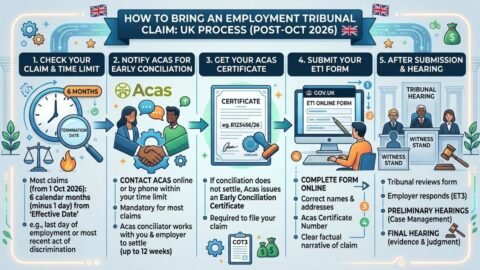
- Tribunal time limit. For most claims, you must start Acas early conciliation within six months less one day for events on or after 1 October 2026, and then bring your claim within the time limits after that. For earlier events, the limit was three months less one day.
- Using the grievance procedure does not stop the clock on a tribunal claim, so contact Acas early.
- Early conciliation is compulsory before most tribunal claims.
- Constructive dismissal. If your employer seriously breaches your contract, for example by failing to deal with a serious grievance or by bullying, you may be able to resign and claim, though these cases are hard. Take advice before you resign.
Tribunal claims are strict on time, so do not wait for an internal process to finish if the deadline is close.
What if you are a worker, agency worker or on a zero-hours contract?
The statutory right to be accompanied applies to workers, not only employees, and Acas encourages employers to apply the Code to workers. The 25% uplift or reduction applies only to claims by employees, and unfair dismissal rights apply only to employees with enough service. If you are unsure of your status, ask Acas. Our guide to zero-hours contracts explains the difference.
Disciplinary and grievance issues in common situations
- Sickness absence. Employers often use absence policies and trigger points. If your absence is linked to a disability, they should consider adjustments and avoid unfavourable treatment. See our guide to Statutory Sick Pay 2026.
- Probation. Some employers use a shorter process during probation, but they should still treat you fairly and avoid discrimination. See our guide to probation periods and your rights as a new employee.
- Redundancy. This is a separate process, with its own consultation rules. See our guide to redundancy rights in the UK.
- Flexible working. If your request is refused, a grievance may help, though there are specific rules. See our guide to flexible working in the UK.
- Harassment by customers or third parties. Employers’ responsibilities to prevent harassment are being strengthened from 30 October 2026. See our guide to the Employment Rights Act 2025.
Where to get help
- Acas gives free, impartial advice and early conciliation, including template letters and guidance.
- Your trade union, if you are a member, can advise and accompany you.
- Citizens Advice provides free help and can signpost to legal advice.
- Law centres, legal expenses insurance and solicitors. Some home insurance and bank accounts include legal cover.
- The Equality Advisory and Support Service can advise on discrimination.
- Protect advises on whistleblowing.
- Your employer’s HR team or employee assistance programme may offer support, including counselling.
Common mistakes
- Ignoring letters or invitations. Always reply, even if you cannot attend.
- Resigning in the heat of the moment, which can weaken any claim and affect your finances.
- Not asking for evidence or not keeping your own records.
- Going to a meeting without a companion when you are entitled to one.
- Missing appeal deadlines.
- Raising a grievance only after being invited to a disciplinary meeting, without evidence of earlier concerns. Raising concerns early is better.
- Leaving it too late to contact Acas for early conciliation.
- Making secret recordings without advice. There can be legal and evidential consequences, so ask Acas or a union first.
Frequently asked questions
What is the Acas Code of Practice? Statutory guidance on how to handle disciplinary and grievance issues fairly. Tribunals take it into account and can adjust compensation by up to 25% if it is unreasonably ignored.
Do I have the right to bring someone to a disciplinary hearing? Yes. Workers have a statutory right to be accompanied at formal disciplinary and grievance hearings by a colleague or trade union representative or official.
Can I be accompanied at an investigation meeting? There is no statutory right, but your employer’s policy may allow it.
Can I be suspended without pay? Suspension should normally be on full pay, unless your contract says otherwise. Check your contract and take advice.
How long do warnings stay on my record? Usually six to twelve months for a first warning and longer for a final warning, but it depends on your employer’s policy.
How do I raise a grievance? Try to resolve it informally, then write to your employer following the grievance policy, attend a meeting with a companion if you wish, and appeal if you are unhappy with the outcome.
What if my employer ignores my grievance? Chase in writing, escalate to HR or a senior manager, and contact Acas. A tribunal can increase compensation by up to 25% if the employer unreasonably fails to follow the Code.
Is the Acas Code changing? Acas consulted on a new draft Code from 30 July to 23 September 2026. It is not yet in force, so the current Code still applies.
What is the time limit for a tribunal claim? Six months less one day for most claims where the events happen on or after 1 October 2026, after contacting Acas for early conciliation.
Final thoughts
A fair process protects both sides. Keep calm, read every letter, ask for evidence, use your right to a companion and keep records. If things go wrong, get advice quickly because time limits are strict. When you are ready to look for your next role, browse the latest vacancies on our jobs board.
This article is general information, not legal advice. Employment law is complex, and the Acas Code is being revised. Check Acas and GOV.UK for the latest guidance, and seek advice about your own situation.